Maharashtra's drought was forecast before its rains even began. The India Meteorological Department's official pre-monsoon outlook, issued in May 2026, put a 60 percent probability on the southwest monsoon coming in deficient nationally, with the rainfed Monsoon Core Zone forecast below normal months before a single seasonal gauge reading was in. By the time the season closed out, the forecast looked vindicated: Maharashtra's cumulative monsoon rainfall for 1 June to 18 September 2026 came in 18.8 percent below the seasonal average, at 755.9 mm against 932.3 mm. On the strength of that shortfall, the state government issued a resolution late on Friday, 25 September, declaring drought in 265 of Maharashtra's 358 talukas across 32 districts, about 74 percent of the state. Read as one headline number, it sounds like the entire state failed its monsoon together.
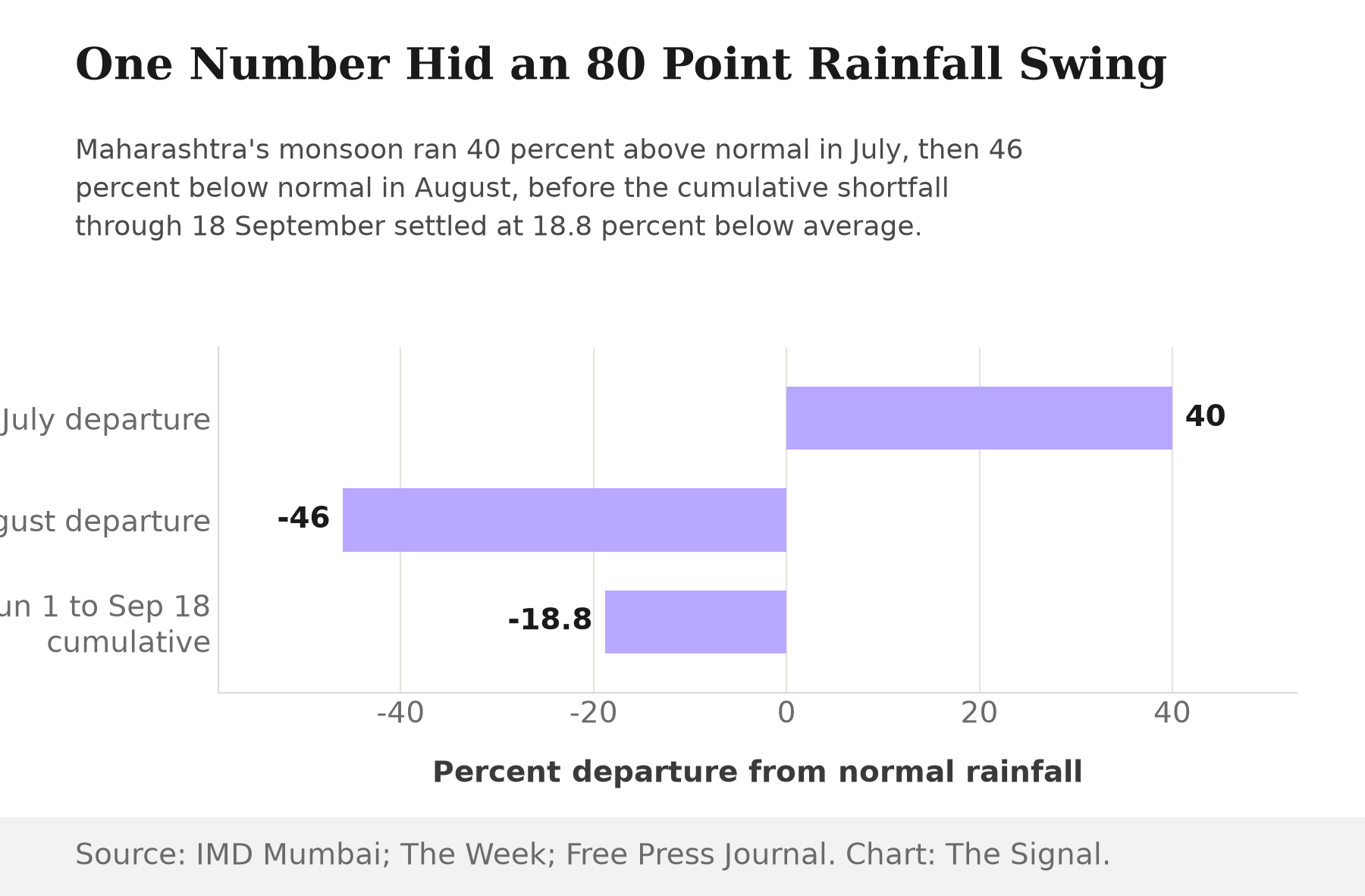
It is worth slowing down on how that 74 percent figure was actually produced, because nobody walked a field to get it. Maharashtra's drought trigger is a rainfall-deficiency calculation run against a season total, and a season total can bury a season that moved in two directions. The state's July rainfall came in 40 percent above the monthly normal, at 454.2 mm against 324.2 mm, with the Madhya Maharashtra subdivision 72 percent above normal, a wet month by any reading. A month later the season reversed: August rainfall fell 46 percent below its own monthly average, pulling the cumulative June-to-August total to 12 percent below normal, with 17 districts landing in IMD's "deficient" band of 20 to 59 percent below average. A formula built on a season average absorbs both swings into a single shortfall number. It cannot, on its own, say which talukas actually lost a standing crop and which simply had two unlucky months bracketing one wet one.
The number that should give a reader more pause than 265 is how few talukas have an actual damage count attached to them. Maharashtra's agriculture department has estimated that at least a quarter of standing crops were damaged in Marathwada, the state's driest belt and the one place officials have put an actual figure on the loss. For the rest of the declared districts, the public record so far holds a rainfall number, not a crop number.
A season that turned twice, then turned again
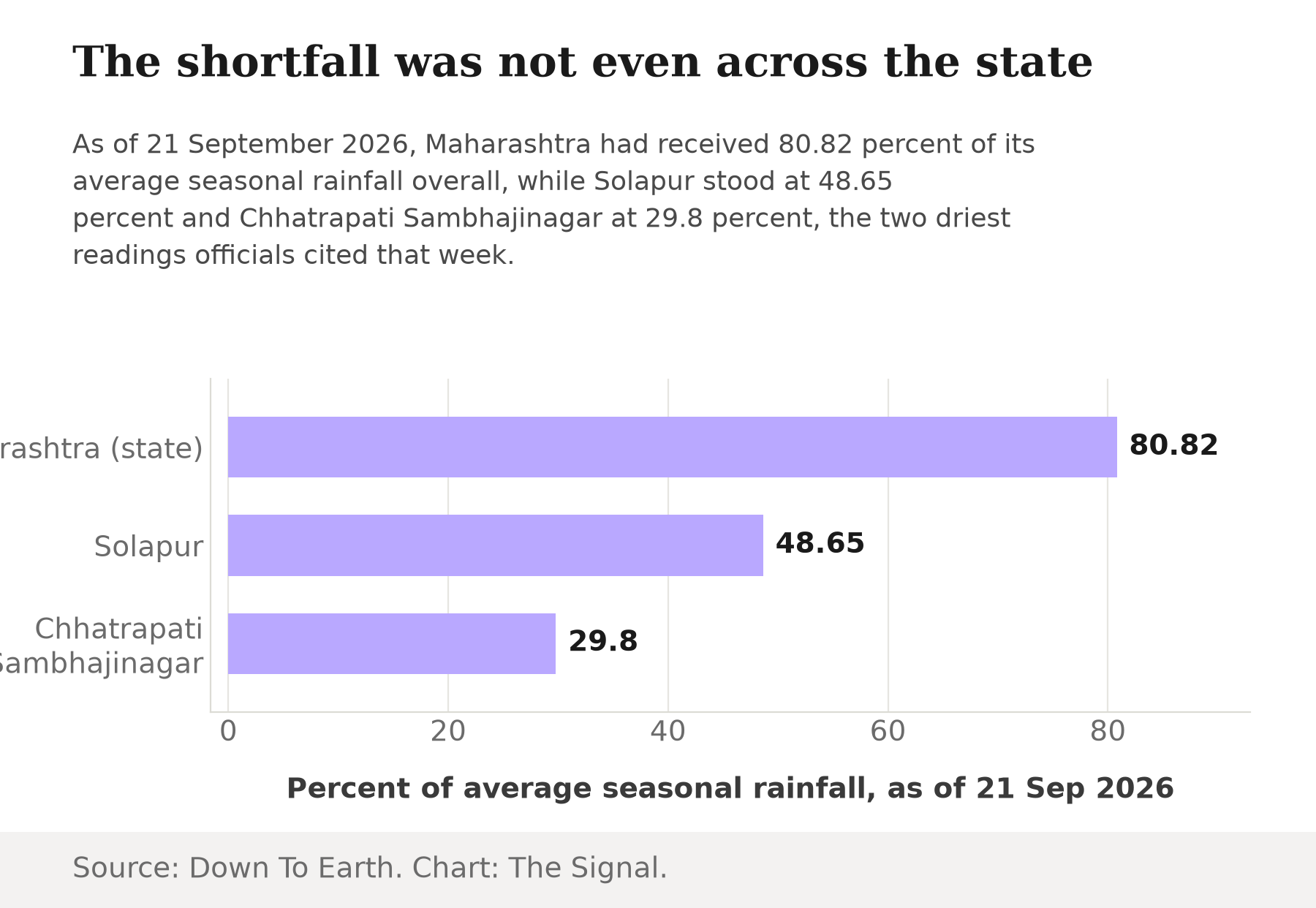
Even the rainfall readings kept moving in the final stretch before the resolution. Four days before the declaration, on 21 September, Maharashtra had received only 80.82 percent of its average seasonal rainfall, with Solapur at 48.65 percent of its average and Chhatrapati Sambhajinagar district at just 29.8 percent, the two driest readings officials cited that week. At that point, officials were expecting to classify roughly half of the state's 364 tehsils as drought-like. The eventual government resolution went well beyond that same-week expectation, reaching 74 percent of talukas rather than half.
That gap between a mid-September estimate and a late-September declaration is itself a clue to how the formula works: it kept recalculating against a moving cumulative total right up to the moment a district-by-district rainfall count, not a crop-loss count, could be finalized. By late September, 31 of Maharashtra's 36 districts were recording rainfall significantly below average, a wider set than the 32 that ultimately made the drought list, which is itself a reminder that the rainfall count and the declared count are not the same tally.
Wider than the state's last drought
This is not Maharashtra's first drought declaration this decade. In October 2018, the state declared drought in 151 talukas across 26 districts, split into 112 severe and 39 moderate. The 2026 declaration covers 265 talukas across 32 districts, nearly 75 percent more talukas and about a quarter more districts than in 2018.
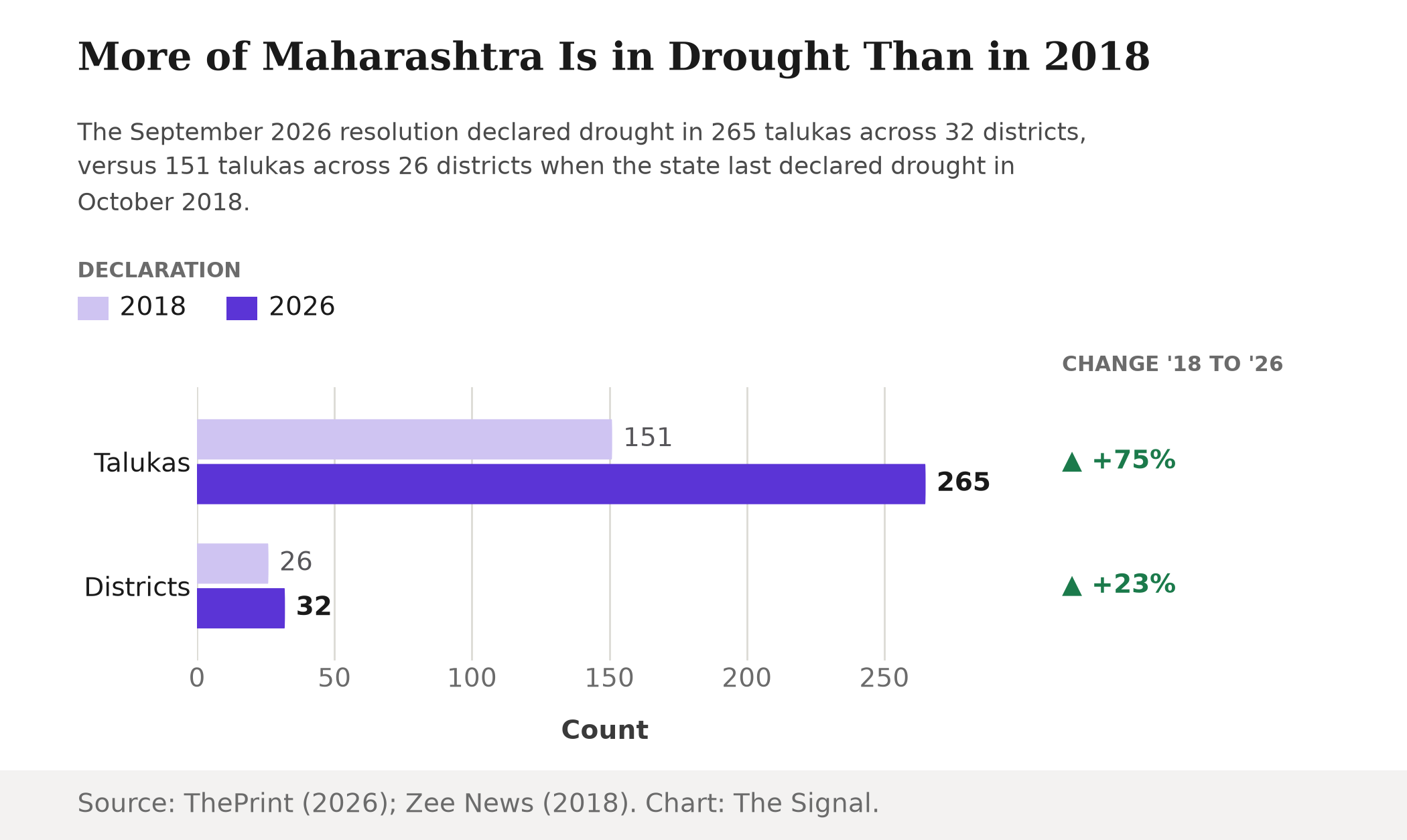
A wider declaration could mean a genuinely worse season, a lower bar for triggering the formula, or both; the two data points alone cannot separate the two. What they do establish is scale: whatever produced 2026's list produced a substantially bigger one than the last time the state ran the same exercise.
Relief moves on the resolution's clock, not the survey's
Whatever remains unmeasured on the ground, relief does not wait for it. The resolution's package pairs a full waiver of land revenue for affected farmers with a restructuring, and an immediate stay on recovery, of agricultural bank loans, plus electricity-bill concessions for agricultural pumps rated above 7.5 HP, on top of pumps up to 7.5 HP that were already exempt. It also extends to concessions on students' examination fees and an expansion of employment-guarantee works.
The relief package leans on debt and revenue relief, not on a per-farm damage payout.
| Relief measure | What it covers |
|---|---|
| Land revenue | Full waiver for farmers in declared talukas |
| Agricultural bank loans | Restructuring, plus an immediate stay on recovery |
| Electricity bills, farm pumps | Concessions for pumps above 7.5 HP (pumps up to 7.5 HP already waived) |
| Student examination fees | Concessions |
| Employment guarantee scheme | Expanded works |
Selected measures from the government's 12-point relief package. Source: Punjab Kesari; ETV Bharat.
Every one of those measures can be granted the moment a taluka's name appears on the resolution. None of them requires a field count of ruined acreage first. That is precisely why the rainfall trigger exists, and why it produces a headline number that describes exposure, not loss.
The honest objection
The strongest case for running the trigger on rainfall alone is speed. A crop-loss survey covering tens of thousands of hectares takes real time to complete properly. A rainfall shortfall against the seasonal average, by contrast, is ready the moment the season's data comes in. With 31 of the state's 36 districts already recording significantly below-average rainfall by late September, waiting for a field-by-field damage count before releasing any relief would have meant farmers absorbing a full season's shortfall before the state moved at all. On this reading, the rainfall trigger is not a shortcut around measurement. It is what makes early relief possible at all.
That case is real, but it does not explain why the declared footprint now covers 74 percent of talukas by rainfall while a matching damage estimate exists for one part of one region. Marathwada's estimate that at least a quarter of standing crops were damaged is itself proof that a real count is possible while the season is still fresh. The gap is not that ground verification takes too long: only one such verification has made it into the public record so far, while every taluka's rainfall count already has.
The Signal
Maharashtra's drought declaration is a real administrative act with real consequences: land revenue waived, loan recoveries paused, an expanded jobs program, running across roughly three in four talukas the resolution named. But the number that made the news, 265 talukas, describes rainfall against an average, not ruined crops. The one crop-loss figure on the books, a quarter of Marathwada's standing crop, came from the state's own agriculture officials, which means a comparable count for the rest of the declared districts is not just possible, it has already been done once. Watch for that number next, district by district, rather than for any revision to the taluka count the government has already announced. A rainfall trigger can tell a state where to look. Only a crop count can tell it what it lost.
Reporting basis: the drought declaration and its taluka and district counts are per ThePrint's coverage of the government resolution. The cumulative monsoon shortfall is per Free Press Journal. The Marathwada crop-loss figure is per Down To Earth, citing the state agriculture department; the same outlet separately covered the pre-declaration rainfall readings for the state, Solapur and Chhatrapati Sambhajinagar. The rainfall reversal across the season and the district deficiency count are per The Week. The relief package's land revenue, loan and electricity provisions are per Punjab Kesari; its exam-fee, employment-guarantee and districtwide rainfall-shortfall figures are per ETV Bharat. The prior drought-declaration figures are per Zee News' contemporaneous coverage. The pre-monsoon outlook and Maharashtra's monthly rainfall bulletin are from the India Meteorological Department directly. The change in talukas and districts declared between the two cycles is The Signal's calculation from those figures.