Boeing told airlines this week that a software flaw in the flight-management computers guiding some 737 MAX jets during landing approach can misjudge speed and mishandle the flight controls. CBS News reports, citing sources familiar with the matter, that an airline first flagged the issue to Boeing in November 2024. Boeing decided in February 2025 that it was not a safety issue. It reversed course this year, opening a formal safety review board whose findings reached the FAA this month. In India, the timing lands on a fleet that has grown fast. PTI reports India's Boeing 737 MAX count is now about 96 aircraft, roughly 53 with Air India Express and 43 with Akasa Air, up from the 56 the Ministry of Civil Aviation told the Lok Sabha were registered and operating as of August 2024, split 25 with Air India Express, 24 with Akasa Air (then SNV Aviation) and 7 with SpiceJet.
That is a fleet up about 71 percent in roughly two years. With more than 2,400 737 MAX jets delivered worldwide, India's near-100-strong fleet now accounts for about 4 percent of the global total. Ninety-six planes and a live software problem is an easy story to write.
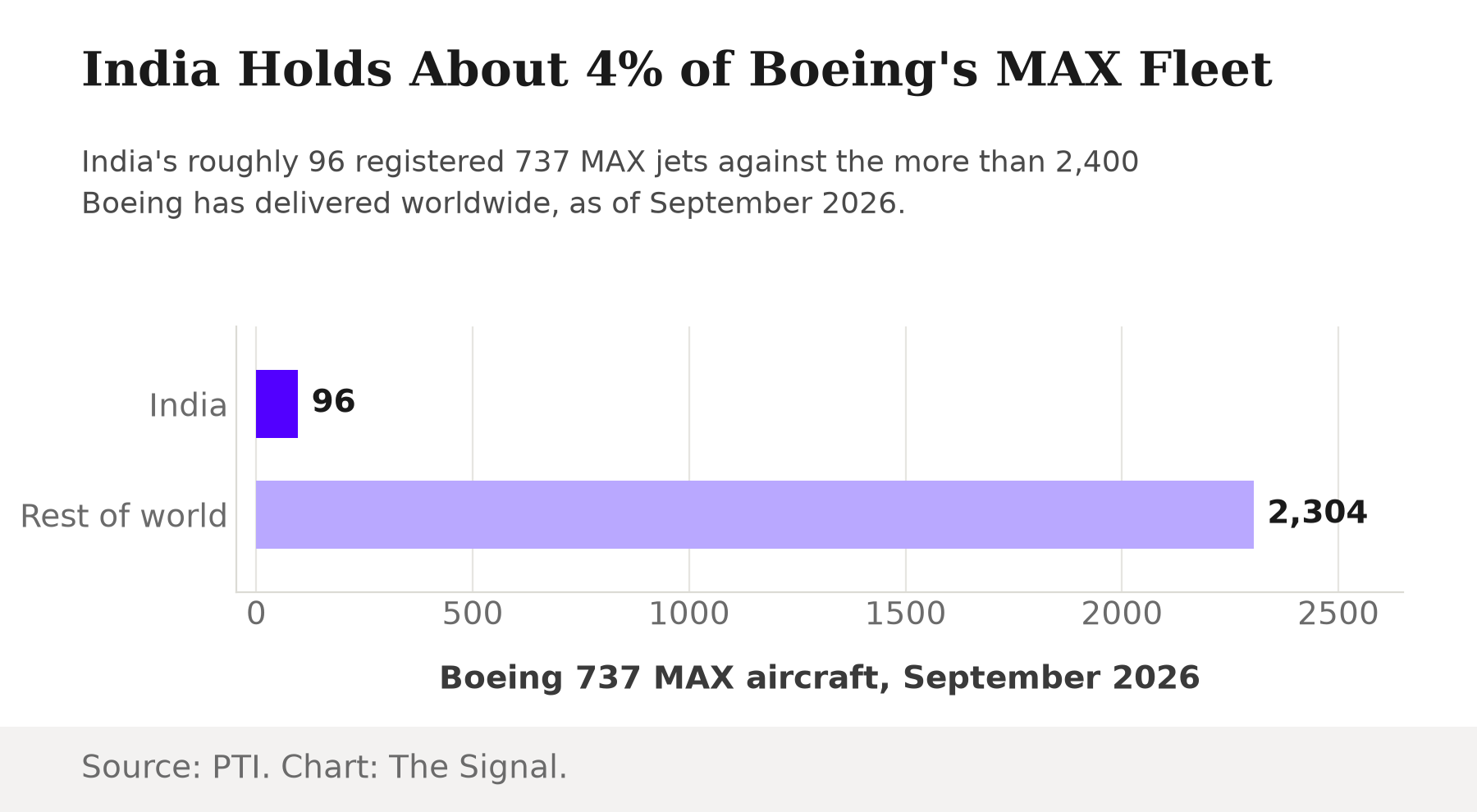
It is worth slowing down on that number before it becomes the story. The Wall Street Journal's original report, as relayed by IANS, did not identify a single Indian carrier as having aircraft equipped with the affected software, and found no public indication that flights in India have been disrupted. Ninety-six is a fact about how many MAX jets fly in Indian skies. It is not a fact about which of them, if any, carries the flawed code.
Where the flaw actually sits
The regulatory action so far centers on a specific variant. The FAA said on August 3, 2026 that it had issued an amended type certificate for the Boeing 737 MAX-7, capping what it called "almost a decade of extensive review" and clearing that variant's certification, including the software build now under scrutiny for the landing flaw. That is a newly-certified aircraft type entering service, not the installed base already flying. Nothing in the public record ties a specific Indian tail number, or a specific Indian carrier's software configuration, to that build.
That gap can now be narrowed rather than just noted. The flaw traces to versions 14 and 14.1 of the flight-management-computer software: the FAA certified the MAX-7 in August with version 14, and the MAX-10 used version 14.1 in its own certification testing, while Southwest and United say the MAX aircraft they already fly in service run neither version. Both Indian operators' delivered aircraft sit on the same side of that line as Southwest's and United's in-service fleets. Air India Express's Boeing 737 MAX deliveries, arriving at roughly two a month since September 2023, have all been the MAX-8 variant, with 50 MAX-10s still on order at Boeing and undelivered, and Akasa Air's fleet, which reached 42 aircraft on September 1, 2026, is built on the same MAX-8 family: its 42nd aircraft was itself a MAX 8-200. Neither airline has taken delivery of a MAX-7 or MAX-10. That does not prove the MAX-8's own software is clean of every issue Boeing has found, but it does mean the specific software builds now under FAA review are not the ones India's roughly 96 jets are actually running today, and the exposure that scale implies is a future one, tied to the MAX-10s both carriers have ordered but not yet received, not a live one.
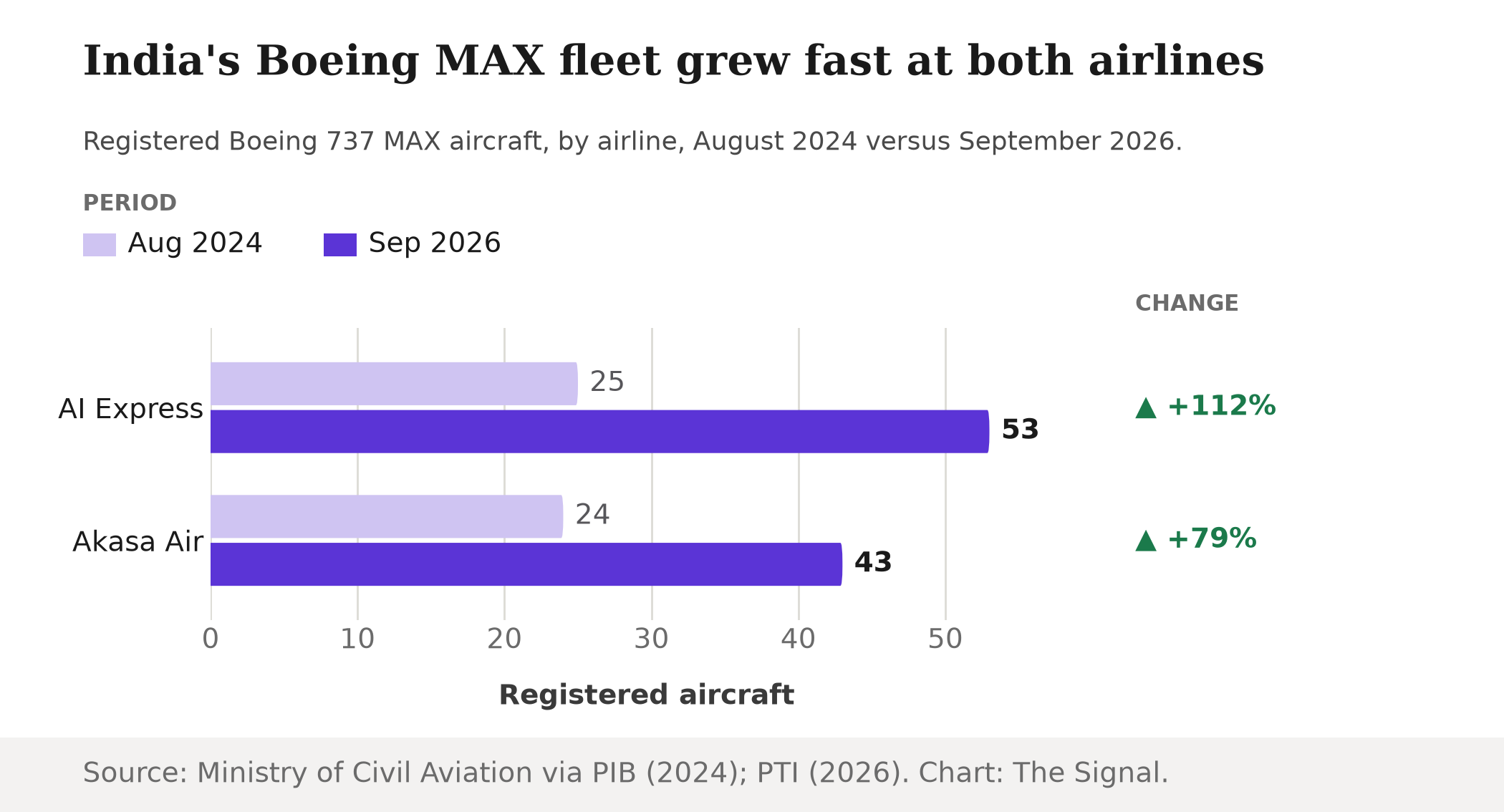
The growth itself is real and worth registering on its own terms: both Indian operators roughly doubled their MAX fleets in two years, expansion that would matter if the software problem does turn out to be widespread, and matters not at all if it does not.
A slow institutional timeline
The more concrete story is not who is exposed. It is how long Boeing sat on what it knew. CBS News's timeline, per its sources, runs from an airline's initial report in November 2024, through Boeing's own February 2025 conclusion that the issue was not safety-related, to a reversal this year that produced a formal safety review board. That board's findings went to the FAA this month, nearly two years after the first flag. Boeing's initial bulletin told airlines a permanent software fix would not be ready until 2028, with updated pilot guidance to follow in November: a stopgap procedure, not a repair, for at least two more years.
The regulator's response matches that pace. The FAA said it will convene a Corrective Action Review Board to evaluate the issue and will take immediate action if it identifies a safety concern. A review board is an evaluation step, not the emergency airworthiness directive the FAA issues once it has already decided a plane is unsafe to fly as configured. As of this week, that stronger order has not been issued.
The honest objection
The strongest case for treating this as a live India story is scale, not confirmation. A fleet that grew from 56 to about 96 aircraft in roughly two years is real exposure once the MAX-10s both Air India Express and Akasa Air have on order actually arrive, given that variant runs the same software version now under FAA review. Boeing's own board only escalated this year, and its FAA submission is barely weeks old; it would be premature to declare the matter closed on the strength of an absence of bad news so far.
That case is real, but it answers a different question than the one the fleet-count headlines imply. Scale explains why India would care if the flaw spreads. It does not supply the fact that would make it an India story today, which is confirmation that an Indian-registered aircraft runs the affected build. That confirmation is precisely what the Journal's own reporting does not provide, and no matrix of registered aircraft counts fills that gap by itself.
The Signal
The real news in this story is not a number of Indian planes; it is a timeline. Boeing learned of a landing-approach software flaw in November 2024, told itself for three months it was not a safety issue, then spent this year building the review process it should arguably have started sooner, only sending its findings to the FAA this September while leaving airlines to run on interim pilot guidance until a permanent fix lands in 2028. The variant mismatch resolves the piece's opening question for today: the software builds under FAA review run on the MAX-7 and MAX-10, and India's delivered jets are MAX-8s, the same generation Southwest and United say is unaffected. It does not resolve it for good, since both Indian carriers have MAX-10s on order. Watch two things from here, not the fleet-size headline: whether the FAA's review board upgrades its evaluation into an actual airworthiness directive, and whether that verdict lands before either carrier's first MAX-10 does. Until then, the size of India's Boeing fleet is a fact about tomorrow's exposure, not today's.
Reporting basis: India's August 2024 Boeing 737 MAX fleet count is from the Ministry of Civil Aviation's reply to the Lok Sabha, via a Press Information Bureau release. The current fleet count and Boeing's global MAX delivery total are both Press Trust of India wire reporting, carried respectively by The Federal and DT Next. The FAA's MAX-7 certification statement is from the FAA's own newsroom, and its comment on the Corrective Action Review Board is the FAA's statement as relayed by NBC News, the same regulator in both cases. The flaw's internal timeline, the safety review board and the 2028 fix target are CBS News's reporting, citing sources familiar with the matter. That the Wall Street Journal's original account named no Indian carrier is per the Journal, as relayed by IANS. The link between the affected software versions and the MAX-7/MAX-10 variants, and the US airlines' comment that their in-service fleets do not run those versions, is Air Data News's reporting. Air India Express's delivery history and outstanding MAX-10 order book are per ch-aviation; Akasa Air's fleet composition is per Asianet Newsable. India's fleet growth rate and its share of Boeing's global MAX fleet are The Signal's calculations from those figures.