India crossed a threshold it had chased for years. In 2025, the country reached 20 percent ethanol blending in petrol, five years ahead of the original target it had set for 2030, the government announced, after years of pushing sugar mills and grain distilleries to expand supply. The National Policy on Biofuels had set that 20 percent target for 2030 when it was first notified in 2018. Hitting it five years early looked, on its own terms, like a policy working exactly as designed.
India hit a 2030 ethanol target five years early.
It is worth slowing down on what pulling a 2030 target into 2025 actually required. The government did not just add distilleries. It made growing corn for ethanol lucrative enough that farmers changed what they planted, on a record area, in a single season, and the corn market could not absorb what that incentive produced.
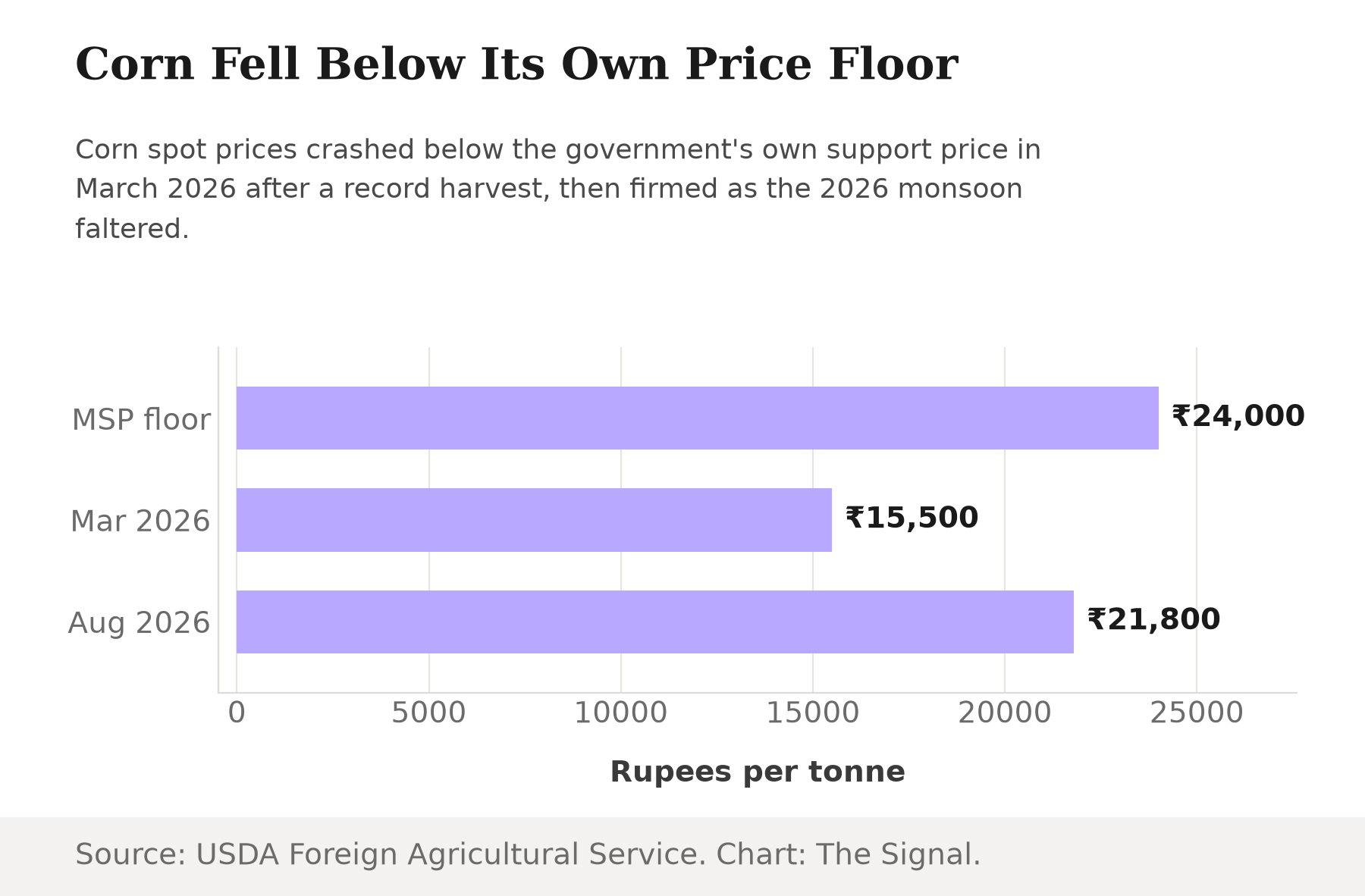
Corn production surged 12 percent to a record 48.5 million tonnes in the 2025-26 marketing year, on a record 13 million hectares, fueled directly by the ethanol blending mandate. By March 2026, that record crop had done what record crops do to prices: spot rates in major producing states fell to between Rs 15,500 and Rs 18,500 a tonne, nearly 19 percent below a year earlier and well under the government's own Rs 24,000 support price.
An incentive with no ceiling on the downside
A minimum support price exists precisely so a bumper harvest does not wipe out farm incomes. In the 2025-26 season it did anyway: growers who had expanded corn acreage to feed the ethanol program's distilleries found the open market paying nearly a third less than the floor meant to protect them. The program had done its job of pulling in supply. Nothing in its design stopped that supply from overshooting the one buyer, the blending mandate, built to absorb it.
The ethanol side has the same problem
That overshoot was not confined to the farm gate. Grain now supplies nearly half of India's ethanol, with corn accounting for 46 percent of the feedstock mix and rice from the Food Corporation of India another 15 percent, a sharp shift for an industry that used to run almost entirely on sugarcane. The capacity built to process it is running well under what it can do: India's ethanol sector was operating at only 40 to 45 percent of installed capacity as of February 2026.
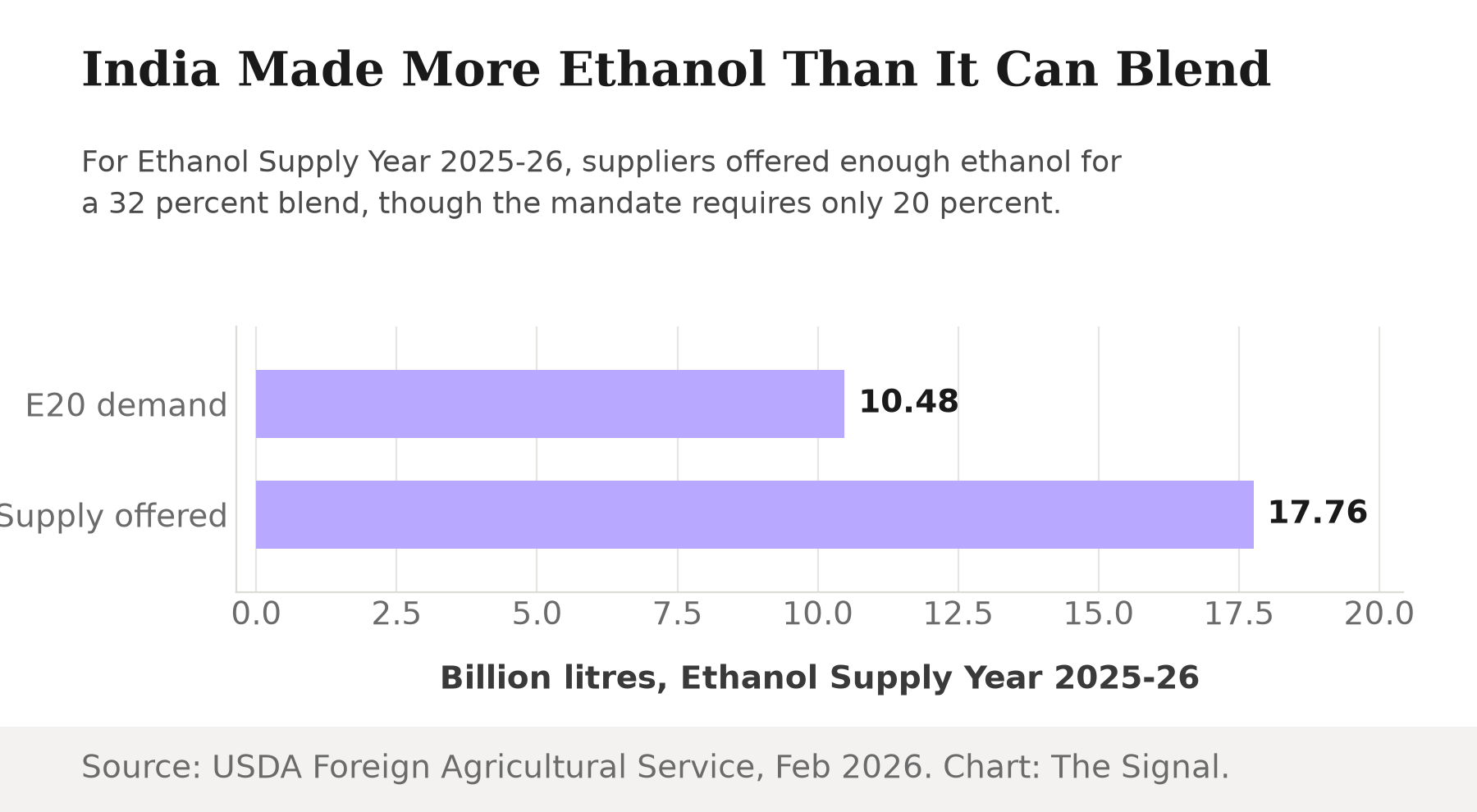
The gap shows up directly in the numbers filed for the year. For Ethanol Supply Year 2025-26, suppliers offered 17.76 billion litres of ethanol, enough for a 32 percent blend, against actual demand of just 10.48 billion litres under the 20 percent mandate: a surplus of roughly 7.3 billion litres with no legal place to go, since the blending mandate itself caps how much of it can be burned as fuel.
Now the same crop is being squeezed from the other side
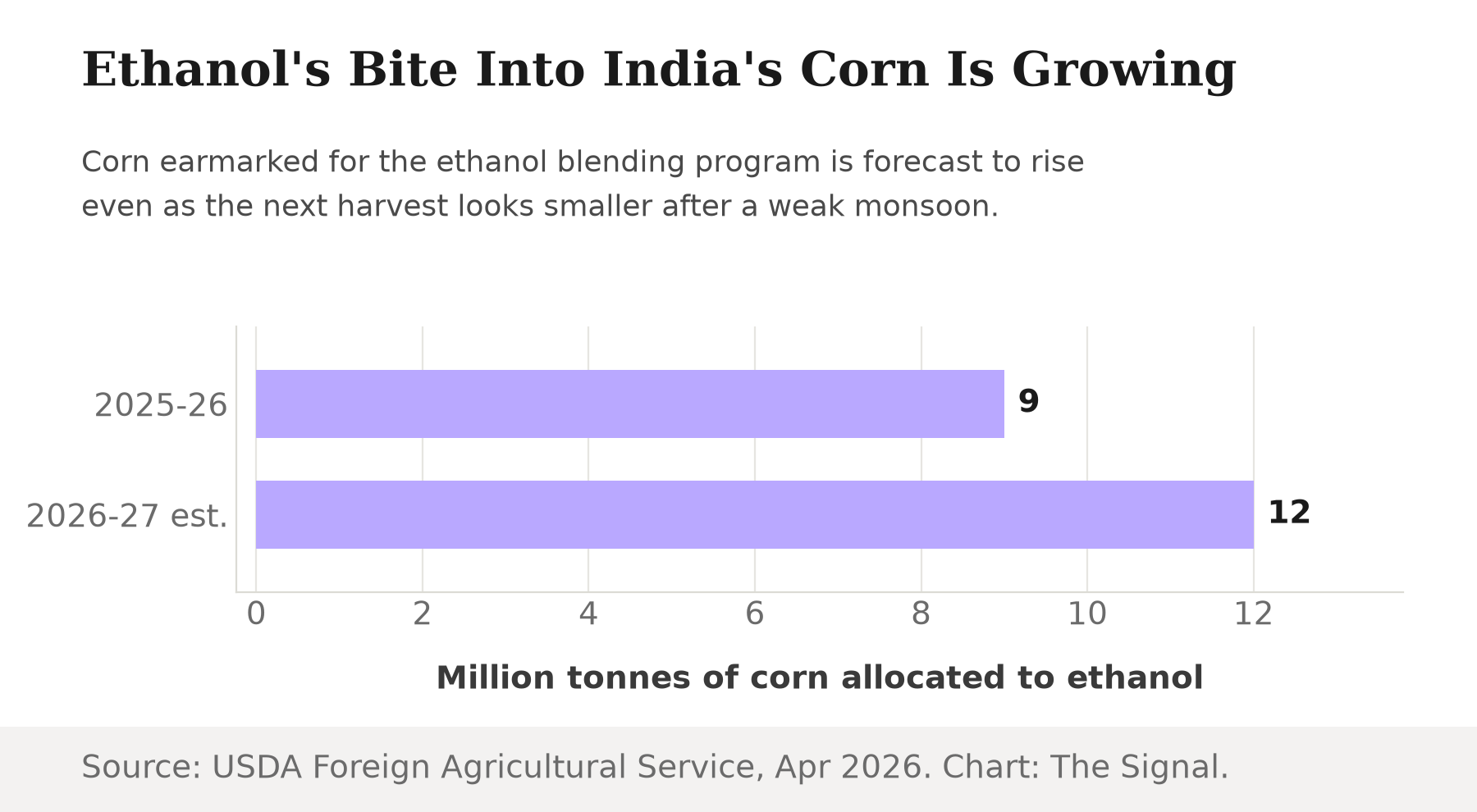
Here the timing turns against the industry's own numbers. Corn earmarked for the ethanol program is forecast to rise from 9 million tonnes in the 2025-26 marketing year to 12 million tonnes in 2026-27, a third more, even as the crop feeding it looks smaller. The 2026-27 corn production forecast has been cut to 50 million tonnes after a weak monsoon, with corn planting down 4 percent year on year as of mid-August 2026.
Prices are already answering. Corn has firmed since April 2026 on concern about the smaller coming harvest, with the national average reaching Rs 21,800 a tonne in the first half of August 2026, up sharply from March's crash even though still about 2 percent below where the price stood in August 2025. The corn that fell through its own support floor eight months ago is climbing back toward it.
That matters past the distilleries. India's animal feed industry, which the ethanol program increasingly competes with for corn, sends 75 to 78 percent of its output to the poultry sector alone. A crop that swung from glut to tightening supply inside a single marketing year is the input every egg and broiler producer in the country prices against.
The honest objection
The strongest case against pinning any of this on policy is that agriculture swings on its own. A good monsoon produces a bumper crop and a crash; a weak one produces a shortfall and a rally. India hit its blending target in 2025 for real, five years ahead of a goal first set in 2018, and that achievement stands regardless of what corn did afterward.
That case explains the direction of the swings. It does not explain their size. An ordinary buyer responds to a shortfall by rationing demand: paying up, substituting elsewhere, easing off. The ethanol program is not that kind of buyer. Its claim on corn is a policy-set allocation scheduled to grow by a third at the exact moment the harvest is shrinking, not a demand that steps back to let the market clear. The same mandate that pulled in the glut is now adding to the squeeze behind it.
The Signal
The headline number, 20 percent ethanol blending five years early, is real and worth taking at face value. But it was delivered by making one crop absorb swings that a national energy target used to spread across the whole fuel supply chain: first a glut large enough to break through the government's own price floor, now a squeeze building back toward that same floor, with the program's own claim on the crop rising exactly as the harvest turns down. Distillers sitting on unsellable ethanol and poultry producers watching feed costs firm are opposite ends of the same swing. Watch what the corn price does over the rest of this monsoon's retreat, not what the blending percentage says.
Reporting basis: India's 2025 achievement of 20 percent ethanol blending in petrol is per newsonair.gov.in's report of a statement by Union Petroleum Minister Hardeep Singh Puri, and the original 2030 target is per NITI Aayog's 2021 Roadmap for Ethanol Blending in India. Every other figure, including corn production and area, the March 2026 and August 2026 corn price ranges, the ethanol supply and blending-demand totals for Ethanol Supply Year 2025-26, the ethanol capacity utilization rate, the feedstock mix, the corn allocation to the ethanol program for 2025-26 and 2026-27, the 2026-27 production forecast, and the poultry share of commercial animal feed, comes from two US Department of Agriculture Foreign Agricultural Service reports on India: the India Biofuels Market report of February 2026 and the India Grain and Feed Annual of April 2026 together with its August 2026 update. Those reports in turn cite India's Ministry of Agriculture and Farmers Welfare, its Agricultural Marketing Information Network, and the Indian Meteorological Department for the underlying production, price and weather data. The 7.3 billion litre ethanol surplus is The Signal's calculation from the supply and demand figures in the February 2026 report.