
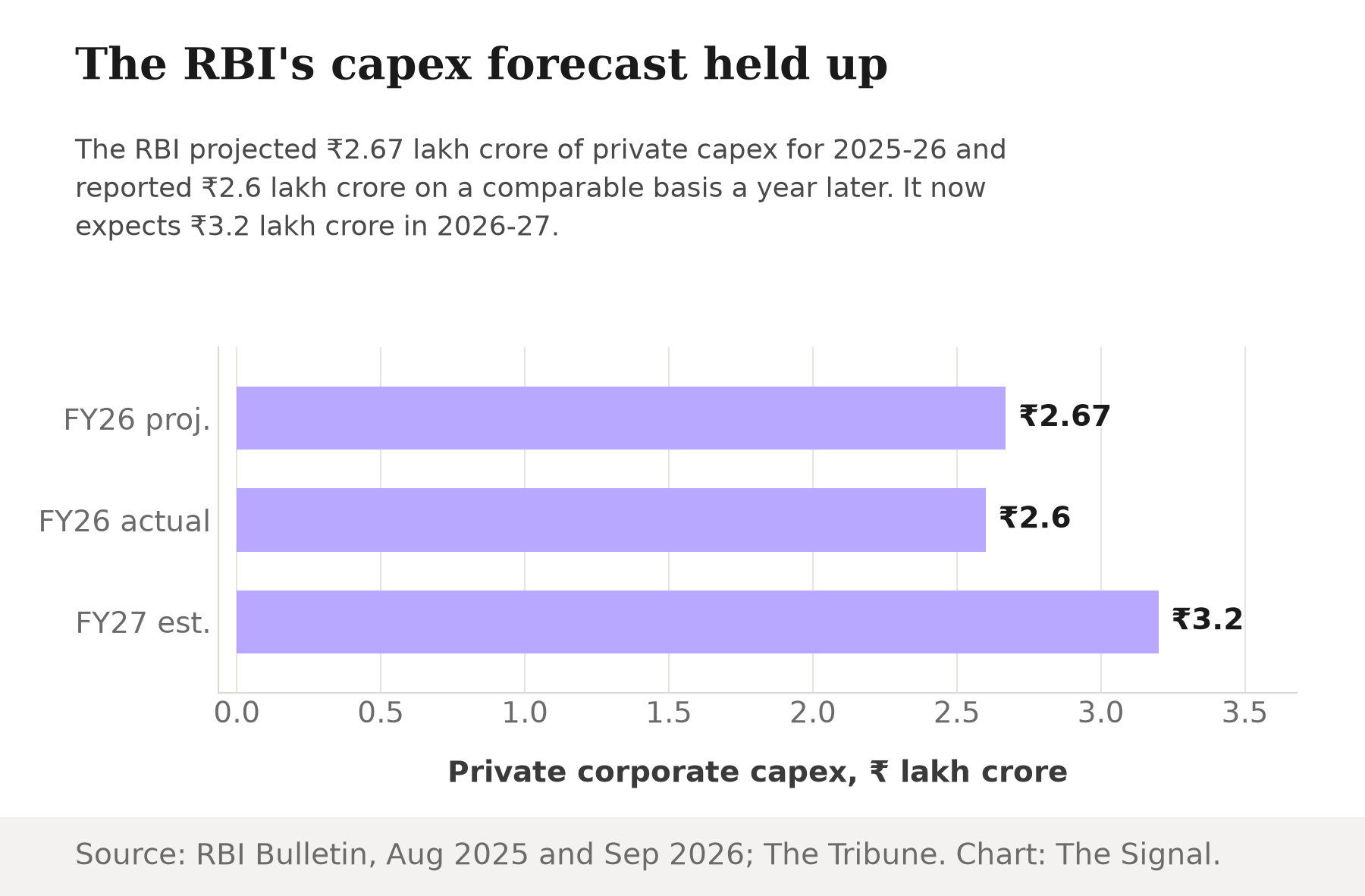
The Reserve Bank of India has a good year to point to. In its August 2025 Bulletin, the RBI projected that private capital expenditure would rise to ₹2.67 lakh crore in 2025-26. A year later, its September 2026 Bulletin says comparable capex from the same funding channels stood at ₹2.6 lakh crore in 2025-26. That is about 97 percent of the forecast. The central bank now says envisaged capex is ₹3.2 lakh crore in 2026-27, "indicating sustained momentum in private investment". Read those three numbers and the story is a private investment cycle that is delivering what was promised, with 23 percent more to come.
It is worth slowing down on that. A month earlier, the National Institute of Public Finance and Policy (NIPFP), a public-policy research institute in New Delhi, had published a very different reading of the same economy.
The number that does not fit
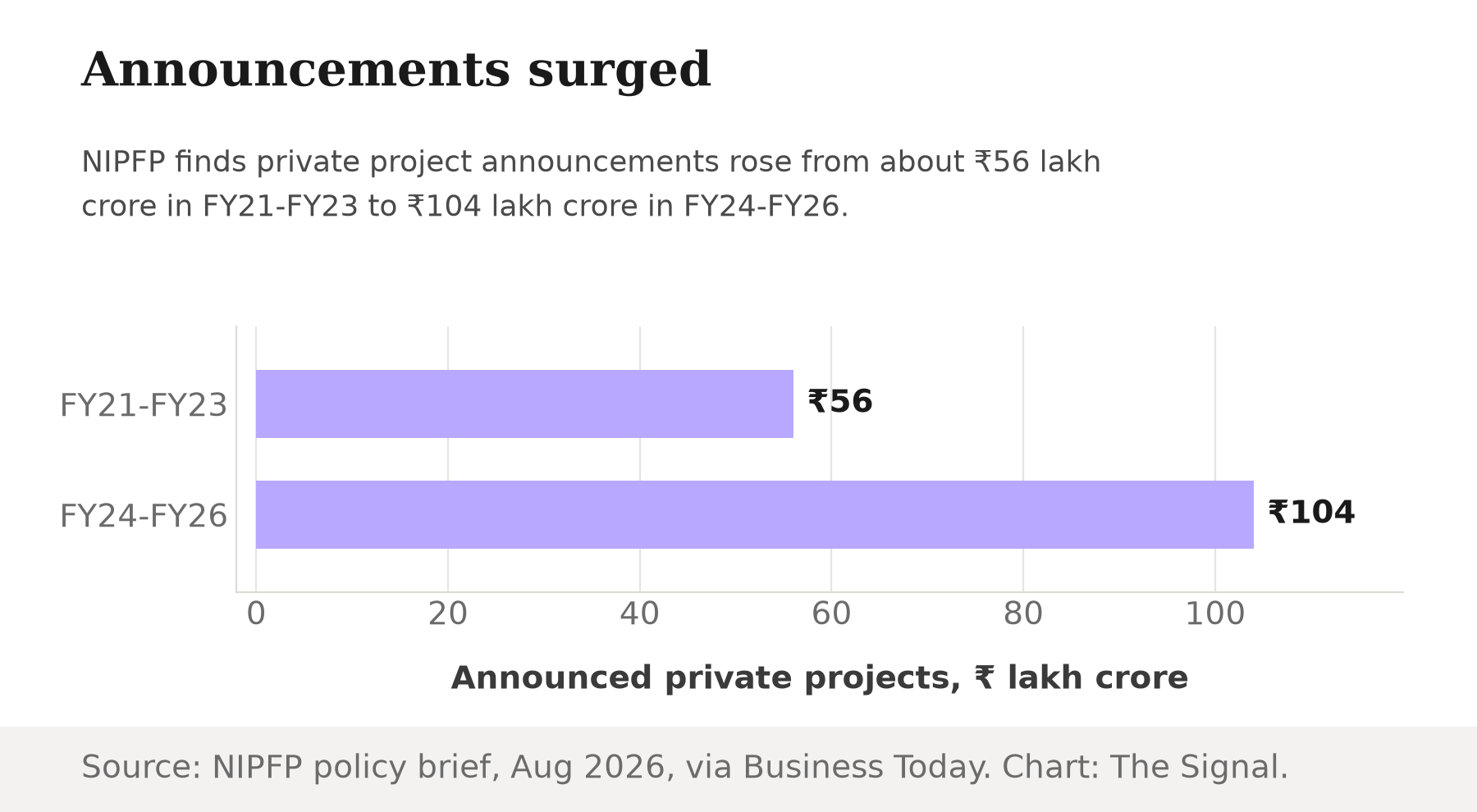
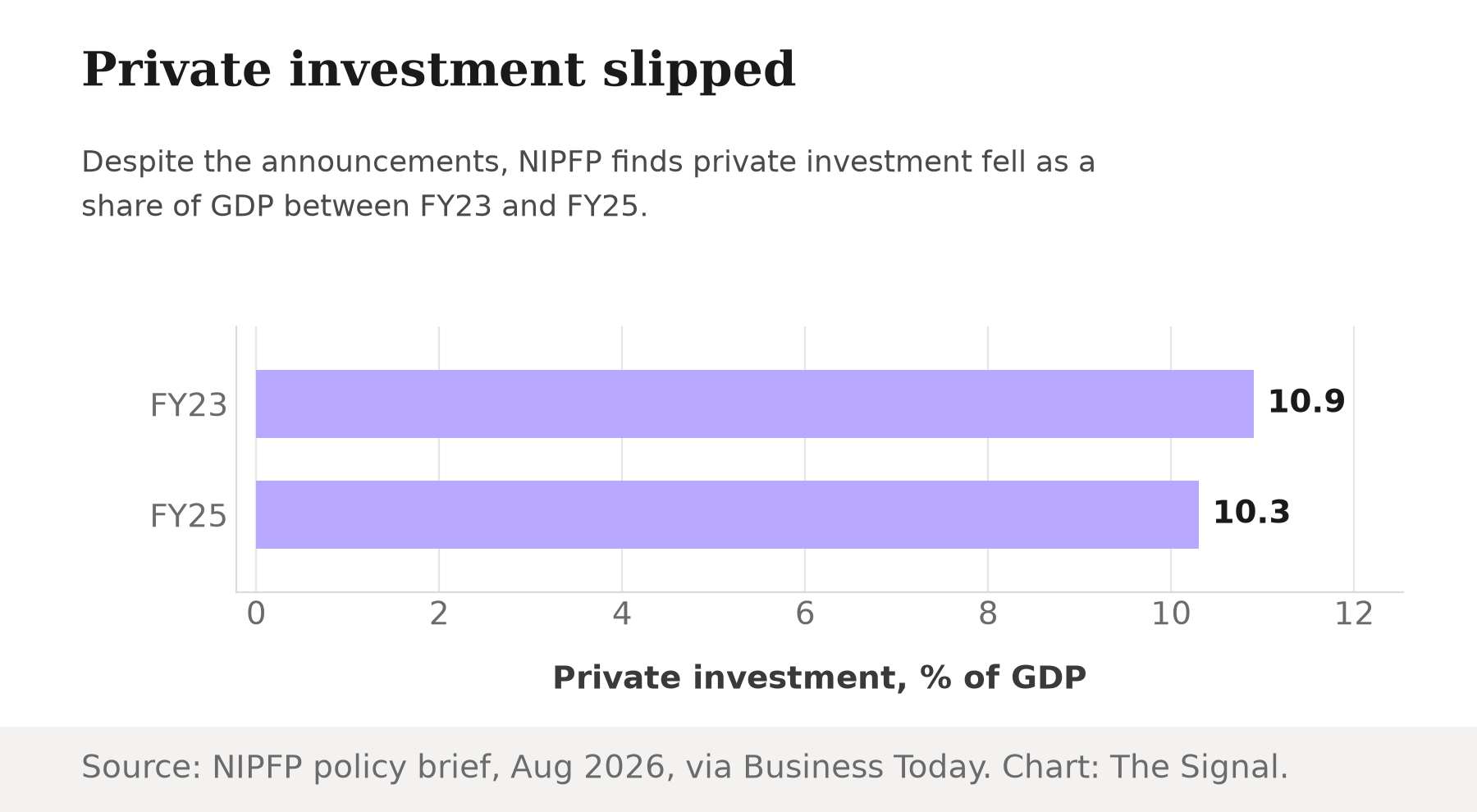
Business Today reports that NIPFP's August 2026 policy brief found private investment as a share of GDP declined to 10.3 percent in FY25 from 10.9 percent in FY23. The fiscal year runs April to March, so FY25 ended in March 2025. In the same report, NIPFP says private-sector project announcements rose to ₹104 lakh crore across FY24 to FY26, from about ₹56 lakh crore across FY21 to FY23, and that companies are increasingly accumulating cash rather than committing it to greenfield capital expenditure. Greenfield means a new facility built from scratch, as opposed to expanding or buying an existing one.
So announcements climbed by roughly 86 percent between the two three-year windows, per NIPFP's brief as Business Today reports it, and private investment as a share of the economy fell. Both charts below come from that one NIPFP brief.
Two pipelines, not one
The tension is real, but much of it comes from treating two different pipelines as one. The RBI's estimate counts projects with financing already lined up: bank and financial institution loans, external commercial borrowings and initial public offerings. A project that has a sanctioned loan or a completed share sale is a project someone has committed to paying for. Its track record on the RBI's own numbers is good, with ₹2.67 lakh crore projected and ₹2.6 lakh crore reported.
Announcements are a different animal. A press release costs a company nothing, and it can signal confidence to shareholders, lenders and governments whether or not a cheque follows. NIPFP's finding that firms are hoarding cash is the revealed-preference test: what companies say they will build and what they commit money to are diverging. The two datasets do not contradict each other. One measures what is financed. The other measures what is declared.
That distinction matters for how to read the ₹3.2 lakh crore figure. It is an estimate built from bank and institution financing, foreign borrowing and share sales, so it covers financed projects only, so it can be right and still leave private investment falling as a share of GDP, if the rest of the economy grows faster than the financed slice.
Why a shock reaches intentions first
There is a second reason for caution, and it comes from timing. NIPFP's May 2026 review reports that CMIE capex data showed private investment growing at over 20 percent in nominal terms during the first three quarters of FY26, before that revival collapsed in the fourth quarter as a consequence of the Gulf crisis. The fourth quarter of FY26 ended in March 2026.
A financed pipeline is slow to move, because loans are sanctioned months before money is spent. Spending decisions, in contrast, can be reversed within a single quarter. The RBI's own caution points the same way: the Bulletin says heightened global uncertainties are likely to temper the investment sentiment, even as the outlook remains healthy. If the forecast has a weak point, it is that it was assembled from projects planned before the Gulf shock was priced in.
The honest objection
The strongest case against this reading is that the "puzzle" is a matter of measurement. NIPFP's share-of-GDP figure runs to FY25, while the RBI's outturn is for FY26, a year later. Capex can be rising in rupee terms and still lose ground as a share of a fast-growing GDP. The CMIE data quoted above points to a strong FY26 for the first nine months, which would be consistent with a rebound that the FY25 figure has not yet captured.
That is fair, and it may prove right. But it answers a narrower question. It explains why the forecast can be accurate while the share of GDP is down. It does not explain why announcements rose so sharply while the share fell, or why NIPFP describes firms as accumulating cash. A recovery in FY26 would help the share, but it would not turn announcements into spending.
The Signal
The RBI's forecast record shows that financed capex plans can be trusted. The NIPFP evidence shows that announced ones cannot be, at least as a guide to what gets built. The number to watch is not the size of the next pipeline headline. It is the fourth-quarter FY27 capex print against the ₹3.2 lakh crore envisaged for 2026-27, and whether private investment's share of GDP turns up when NIPFP next measures it. A pipeline is a promise. Investment is what is left after the promise meets the bill.
Reporting basis: the 2026-27 capex estimate and the caution on global uncertainty are from the Reserve Bank of India's September 2026 Bulletin, via its press release. The comparable 2025-26 outturn is per The Tribune's report of that Bulletin article, and the earlier projection is from the RBI's August 2025 Bulletin page. The private investment share of GDP, the announcement totals and the cash-accumulation finding are from NIPFP's August 2026 policy brief as reported by Business Today, and rest on that single secondary account because the brief itself could not be retrieved. The CMIE capex growth and its fourth-quarter reversal are from NIPFP's May 2026 macroeconomic review. The forecast-accuracy ratio, the rise to 2026-27 and the growth in announcements are The Signal's calculations from those figures.