
On September 28, 2026, Tata Trusts, which holds a 66 percent stake in Tata Sons Private Limited, proposed folding two of its electronics and engineering units, Tata Electronics Systems Solutions (TESS) and Tata Consulting Engineers (TCE), into that same holding company. The stated purpose is direct: exit the regulatory categories, a Core Investment Company (CIC) and a Non-Banking Financial Company (NBFC), that currently apply to Tata Sons. Read as a single headline, this looks like routine corporate tidying, two related units consolidating under the parent that already controls them.
It is worth slowing down on the timing. Seventeen days before this merger was proposed, on September 11, 2026, the RBI rejected Tata Sons' direct request to be excluded from the unregistered CIC category, a rejection the regulator itself said would effectively require the company to go public. Tata Sons asked to leave the category and was told no. Tata Trusts is now trying to change what the category applies to.
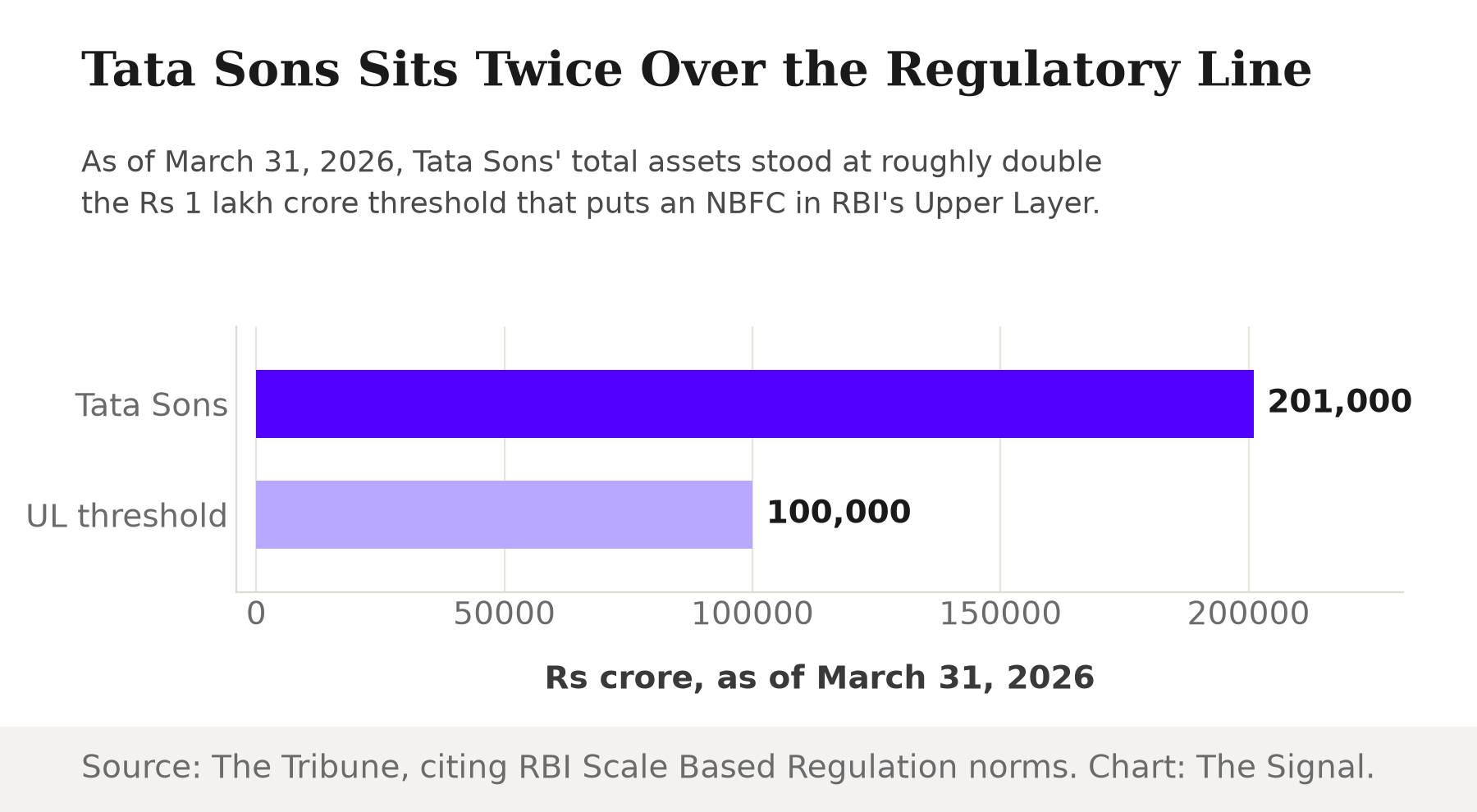
The number that explains why any of this matters is 2. Tata Sons reported total assets of about Rs 2.01 lakh crore as of March 31, 2026, roughly double the Rs 1 lakh crore asset threshold at which the RBI classifies an NBFC as Upper Layer. Cross that line and the consequence is not a fine or a warning. It is a clock.
Why a size threshold turns into a listing order
The RBI's Scale Based Regulation framework sorts NBFCs into layers by size and risk, and any NBFC placed in the Upper Layer must be listed on a stock exchange within three years of that identification. Listing is not incidental to the framework; it is the framework's chosen instrument for Upper Layer discipline, on the logic that public markets impose disclosure and scrutiny a private balance sheet does not. Tata Sons, which does not currently trade on any exchange, sits squarely inside that net by size alone.
The Upper Layer regime also carries a capital rule: an NBFC-UL must hold Common Equity Tier 1 capital of at least 9 percent of risk-weighted assets. A CIC identified as Upper Layer is carved out of that specific capital test and follows its own Adjusted Net Worth rules instead, so Tata Sons' CIC status has already bought it relief on capital. It has bought it nothing on listing. The RBI's own August 6, 2026 list of Upper Layer NBFCs for 2026-27 names Tata Sons Private Limited as a Core Investment Company on that list, noting only that its inclusion is without prejudice to its then-pending de-registration application. As of that list, the exemption was still an open request, not a settled fact.
The first attempt was a request. It failed.
This is not Tata Sons' first move against the listing mandate. In March 2024 the company filed to surrender its NBFC and CIC registration outright, after repaying more than Rs 21,000 crore of debt earlier that year, in effect asking to be treated as an ordinary unregulated holding company rather than a regulated NBFC at all. That bid sat with the RBI for over two years, still pending as of the RBI's August 2026 Upper Layer list, before the regulator's September 11, 2026 letter closed it down. The request route is now exhausted. What Tata Trusts filed on September 28 is a different kind of move: not a request for an exemption, but an attempt to change the underlying facts the exemption test runs on.
What the merger actually changes
A CIC is not a size category. It is a business-composition test: under the RBI's 2016 Core Investment Companies directions, an entity qualifies as a CIC by holding at least 90 percent of its net assets as investments in group companies, meaning equity, preference shares, bonds, debentures, or loans, rather than as operating assets of its own. Tata Sons has functioned as exactly that: a holding vehicle whose balance sheet is mostly stakes in other Tata companies, which is precisely what pulled it into the CIC bucket in the first place and, by extension, into the size test that follows from it.
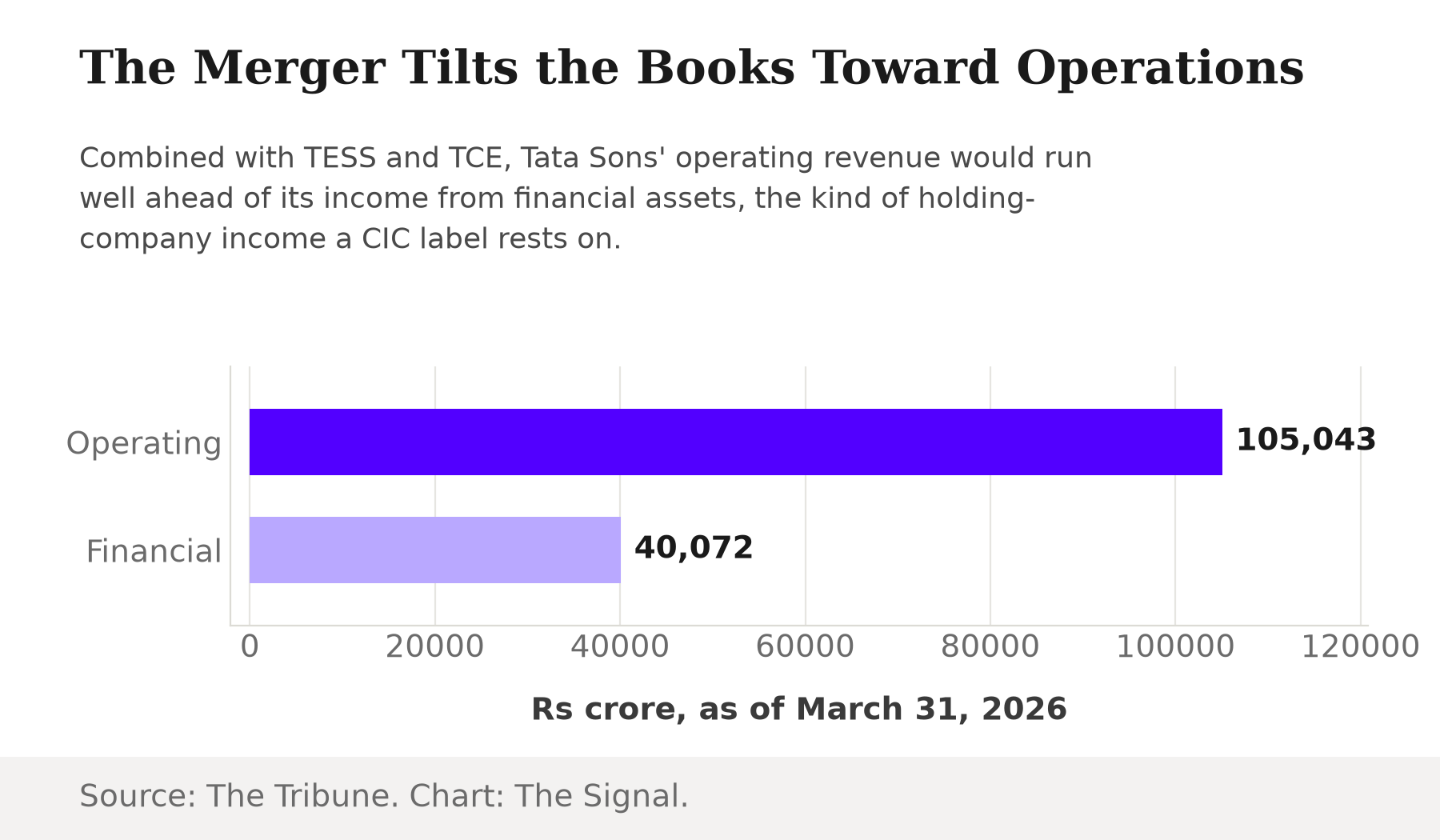
Folding TESS and TCE into Tata Sons adds two operating electronics and engineering businesses onto that balance sheet, not two more equity stakes. Following the proposed merger, the combined entity's operating revenues would have been Rs 1,05,043 crore as of March 31, 2026, against income from financial assets of Rs 40,072 crore, more than two and a half times as much. That is a revenue split, not the net-asset test the CIC directions actually apply, so it does not by itself prove Tata Sons would clear the 90 percent bar. But it is the clearest evidence yet of the logic behind the filing: shift the entity's business mix visibly toward operations, and the case that it is still "predominantly a group-investment company" gets harder to sustain.
Revenue tells a different story from the CIC test, but it points the same way.
The comparison below is what the merged entity's income statement would show, not a claim about its balance sheet.
Two regimes, one company
| Core Investment Company (CIC) | NBFC, Upper Layer, non-CIC | |
|---|---|---|
| Defining test | At least 90% of net assets as investments in group companies, per the RBI's 2016 CIC directions | No 90% group-investment test |
| Upper Layer trigger | Asset size of Rs 1 lakh crore or more on the latest audited balance sheet | Same asset-size test |
| Capital rule | Follows CIC Adjusted Net Worth rules, exempt from the standard capital ratio, per RBI's Scale Based Regulation capital norms | Must hold Common Equity Tier 1 capital of at least 9% of risk-weighted assets |
| Listing rule if Upper Layer | Mandatory listing within 3 years of identification | Same three-year listing mandate |
Source: RBI's 2016 CIC directions and Scale Based Regulation notifications. Table: The Signal.
The table makes the point the filing is chasing: the listing clock runs off the size test alone, for a CIC or any other NBFC-UL. There is no version of Tata Sons, at roughly Rs 2.01 lakh crore in assets, that avoids the three-year listing mandate by staying an NBFC. The only route out runs through the CIC and NBFC labels themselves, which is exactly the pair of classifications the September 28 filing targets.
The honest objection
The strongest case against reading this as regulatory maneuvering is that it may simply be sound corporate housekeeping. TESS and TCE are Tata-group electronics and engineering units already majority-owned through the same ownership chain; folding related businesses into a single parent is standard consolidation practice for any large conglomerate, done for operational and governance reasons that have nothing to do with the RBI. On that reading, the CIC exit is a welcome side effect of a merger Tata Trusts would have wanted anyway.
That case would be more persuasive without the calendar. A restructuring aimed at operational tidiness does not usually arrive 17 days after the specific regulatory request it addresses was denied in writing, and it does not usually come packaged, as this one was, with a same-day comparison of operating revenue against financial-asset income, the exact business-mix question a CIC test turns on. Ordinary consolidation does not need to explain itself in the language of a regulatory classification. This filing does.
The Signal
Tata Sons has now tried both routes out of a mandatory listing: asking the RBI directly, and rewriting its own business mix so the classification that triggers the mandate no longer plainly applies. The first route is closed. The second depends on whether the RBI treats a post-merger balance sheet, heavier with electronics and engineering revenue, as genuinely outside the 90 percent group-investment test, or as the same holding company wearing a different income statement. If the RBI accepts it, every large Indian conglomerate holding company sitting near the Upper Layer threshold now has a tested template for staying private. If it does not, Tata Sons has spent two structuring attempts and two years arriving back at the same three-year clock. Either way, the RBI's response to this filing, not the filing itself, is the number to watch next.
Reporting basis: the merger proposal, its pro forma revenue split, and the RBI rejection letter are as reported by The Tribune, which reviewed the RBI's correspondence and the merger filing directly. The surrender application and debt repayment that preceded it are as reported by ThePrint. Tata Sons' asset total and the Upper Layer threshold it sits against are as reported by The Tribune, citing RBI's Scale Based Regulation framework. The CIC net-asset test, the listing mandate, the capital norms for NBFC-Upper Layer entities, and Tata Sons' place on the RBI's current Upper Layer roster are from the RBI's own Master Direction, Scale Based Regulation notifications, and press release, read directly. The doubling of Tata Sons' assets over the Upper Layer threshold and the ratio of operating revenue to financial-asset income are The Signal's calculations from those figures.