On 30 September 2026 the Union Cabinet approved Green Energy Corridor Phase-III. The total outlay is Rs 1,86,405 crore: Rs 1,36,378 crore for intra-state transmission and Rs 50,000 crore for 50 GWh of battery storage. The stated aim is to enable evacuation of up to 135 gigawatts of renewable energy by FY 2032-33. The easy read is that India has finally decided to pay for the wires its clean-power boom needs, and that the boom can now run without interruption.
It is worth slowing down on that. The money is large, but it buys less grid per gigawatt than the last round, and it is aimed at a different part of the network from the one where the losses have been counted.
The bill per gigawatt has gone up
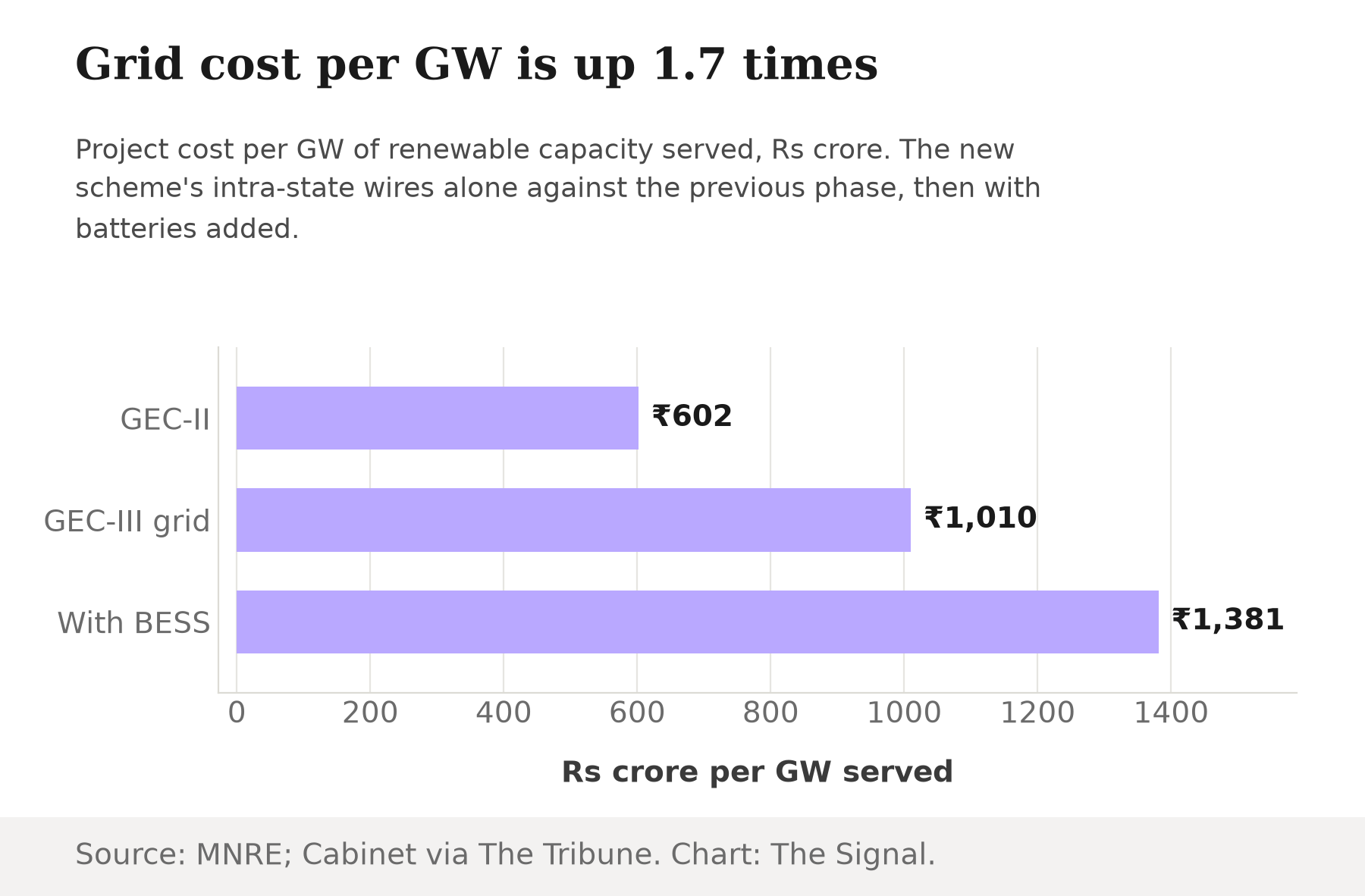
The previous phase for state grids, GEC-II, targeted about 10,750 circuit km of lines and 27,500 MVA of substations to serve about 20 GW of renewable generation, at a project cost of Rs 12,031.33 crore, according to the Ministry of New and Renewable Energy. That works out to about ₹602 crore per gigawatt served.
The new scheme's grid component is ₹1,36,378 crore for up to 135 GW, or about ₹1,010 crore per gigawatt. That is roughly 1.7 times the earlier figure. Add the batteries and the whole package comes to about ₹1,381 crore per gigawatt. These are The Signal's calculations, and the scopes are not identical: the new scheme runs to FY 2032-33 and prices a later period than GEC-II. Even so, the direction is clear. Each gigawatt now needs more grid than it did.
The Centre's share is Rs 54,082 crore, about 29 percent of the outlay. GEC-II's central assistance was 33 percent of project cost. States and their transmission utilities carry the rest, in both cases.
What the losses look like so far
The clearest measurement of what a weak grid costs comes from Ember, an energy think tank. It found that renewable curtailment in the first quarter of 2026 was around 470 GWh, of which 300 GWh came directly from transmission constraints. The Northern region accounted for 178 GWh and the Western region for 122 GWh. On 30 March 2026 alone the country lost 34 GWh of clean generation.
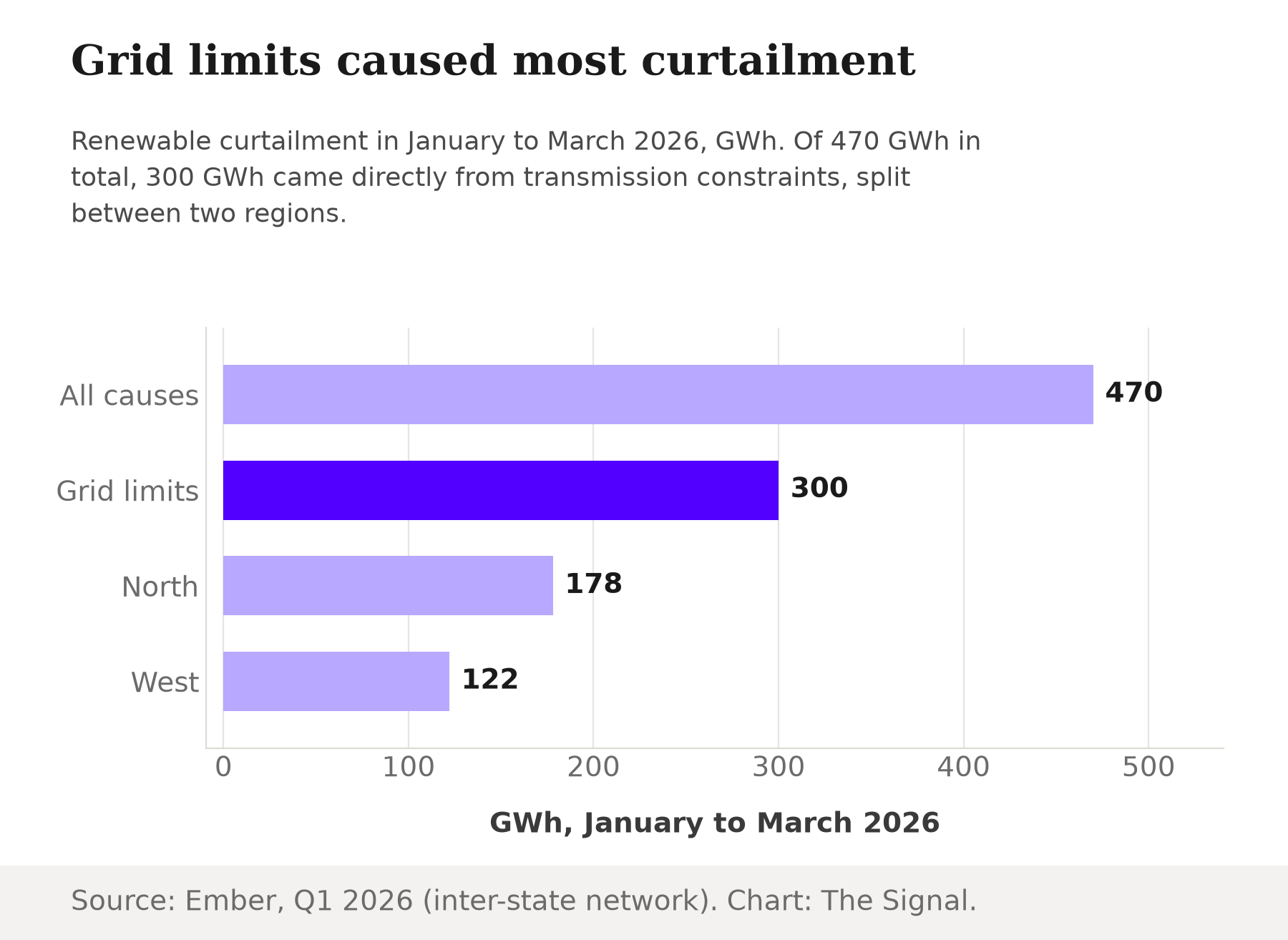
Ember's count is built on the inter-state network. Its own note is careful on this point: some curtailment also occurs at the intra-state level, and these volumes are typically not compensated. That means the 300 GWh is a floor for the grid problem and a measurement of one layer of it. Nobody has published the state-grid figure in the sources we could verify, so the scheme is aimed at a loss that has not yet been counted in public.
The wider pattern is consistent. ICRA says around one-third of India's newly commissioned renewable capacity is facing grid curtailment as of May 2026. IEEFA estimated over 50 GW of renewable capacity stranded nationwide as of June 2025, with 8 GW stuck in Rajasthan.
Money is not the only constraint
The scale of the target makes the delivery record matter. India's installed renewable capacity was 295,554.37 MW at the end of August 2026, so 135 GW is a little under half of what has been built in all the years to date. The scheme is targeted to deliver it by FY 2032-33.
The record so far is uneven. Ember reports that India has met only about 80 percent of its annual transmission targets over the past five years. ICRA found that of transmission projects commissioned under competitive bidding by March 2026, only 12 percent were completed on schedule, with a median delay of more than 10 months. Ember adds that around 20 GW out of 45 GW of projects could see connectivity delays beyond four months.
If the delay pattern holds, the constraint on GEC-III will be the same as before: land, right of way, and approvals, not the size of the cheque. A larger outlay does not change how quickly a line gets built.
The honest objection
The strongest case for the scheme is that it does not need to match the measured loss. State grids feed the inter-state pooling stations. A weak feeder network can cap what reaches them, so strengthening it should ease the constraint that Ember measured in the North and West.
The batteries also target the loss directly. Ember estimates that roughly 3 to 4 GW of two-hour storage could have absorbed most of the curtailed generation. GEC-III provides 50 GWh of battery storage, and storage is the fastest asset to build.
That case is real. But it argues for the design, not for the confidence around it. Nothing in the sources we verified shows how much of the 135 GW the scheme targets sits behind state-level bottlenecks rather than behind inter-state ones.
The Signal
The Cabinet has priced the grid at about ₹1,010 crore per gigawatt, against about ₹602 crore in the last state-grid round (Rs 1,36,378 crore for up to 135 GW, against Rs 12,031.33 crore for about 20 GW). The number to watch is not the outlay. It is how many of the 135 GW are actually connected, year by year, against a record in which only 12 percent of competitively bid transmission projects finished on schedule by March 2026.
Watch also whether anyone starts publishing curtailment at the state-grid level. Until they do, the country is funding a fix for a loss it has only half measured. The wires will take years, and the meter runs meanwhile.
Reporting basis: the scheme's outlay, split, central support, 135 GW target and FY 2032-33 timeline are per The Tribune, reporting the Union Cabinet's official statement, and rest on that single relay; we did not verify the primary press release. Curtailment, transmission-target and connectivity-delay figures are from two Ember publications, which share one origin. The 33 percent curtailment share and the transmission-delay and investment figures are ICRA's, as reported by pv magazine. The stranded-capacity estimate is IEEFA's, as reported by Down To Earth. Installed capacity and the GEC-II scope and cost are from the Ministry of New and Renewable Energy's own pages. The cost per gigawatt, the 1.7 times ratio, the central share of the outlay and the share of installed capacity are The Signal's calculations from those figures.