
The headline from the latest GST release is a good one. Gross collections for September 2026 were Rs 2,03,521 crore, up 14.7 percent on a year earlier, and April to September collections were Rs 12,46,278 crore, up 11.6 percent, according to the GST portal's monthly report. A year after the rate cut, the tax appears to have shrugged off the cost.
It is worth slowing down on that. The cut was large: in September 2025 the GST Council replaced the four-tier structure with a 5 percent merit rate, an 18 percent standard rate and a 40 percent rate for a select few goods and services, effective 22 September 2025. A cut of that size should leave a mark on collections from households and shops. The test is whether it did, and the headline cannot answer that, because it mixes tax on domestic sales with tax collected on imports.
Split the headline and the gap opens
The GST portal reports the two separately. For April to September 2026, gross domestic GST revenue was Rs 8,74,366 crore against Rs 8,24,462 crore a year earlier, up 6.1 percent, while gross import GST revenue rose 27.1 percent to Rs 3,71,912 crore. Net domestic revenue, after refunds, rose only 4.3 percent to Rs 7,70,010 crore. Imports grew more than four times as fast as the domestic base.
Tax on imports follows the value of what comes in. MoSPI's national accounts show imports at current prices grew 30.9 percent in April to June 2026, to Rs 24,98,720 crore. Import GST rose 27.1 percent over the half-year, close to the pace of the underlying trade value. It is tracking a bill, not domestic buying.
The number that carries the argument
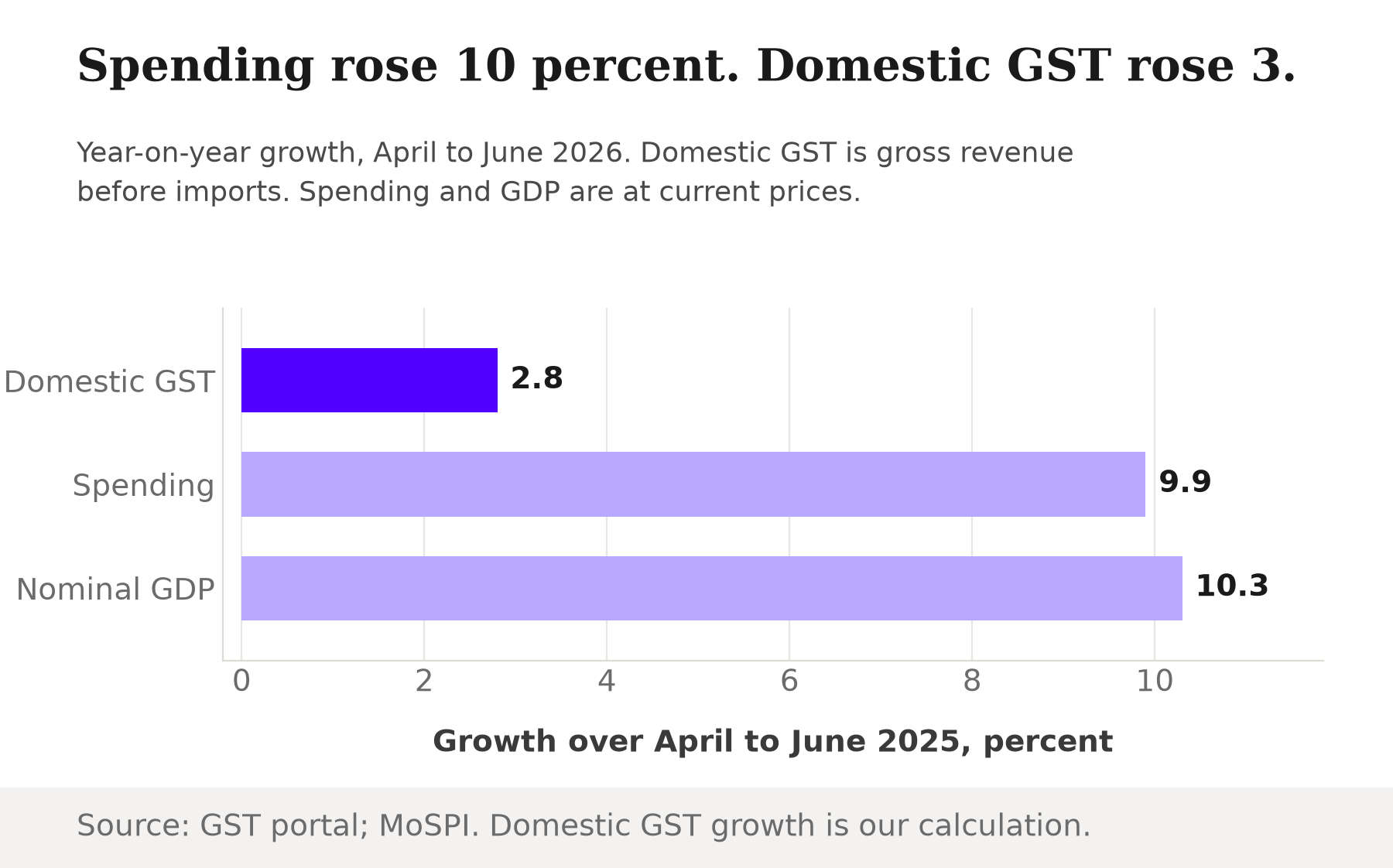
To see what the cut did to domestic collections, compare them with what households were spending. The July report gives gross domestic revenue of Rs 5,99,121 crore for April to July 2026 against Rs 5,73,558 crore a year earlier, with July alone at Rs 1,44,695 crore against Rs 1,31,439 crore. Subtract July from each total and April to June domestic collections were Rs 4,54,426 crore against Rs 4,42,119 crore. That is growth of 2.8 percent (our calculation).
Over the same three months, MoSPI estimates that private final consumption expenditure at current prices grew 9.9 percent, to Rs 49,08,179 crore from Rs 44,66,151 crore, and nominal GDP grew 10.3 percent. Spending grew about 3.5 times as fast as the domestic tax collected on it. Under the old rates, a tax with a stable base would be expected to grow roughly with the spending it taxes. In April to June, it did not.
The quarter that followed looks better
The next quarter does not repeat the picture. Using the September report's April to September totals and the April to June figures above, July to September domestic collections were about Rs 4,19,940 crore against Rs 3,82,343 crore, growth of 9.8 percent (our calculation). The quarterly pattern for domestic gross GST looks like this:
Domestic GST growth swung from far below spending to roughly level with it.
| Period | Gross domestic GST growth (year on year) |
|---|---|
| April to June 2026 | 2.8 percent |
| July to September 2026 | 9.8 percent |
| April to September 2026 | 6.1 percent |
Source: GST portal monthly reports for July and September 2026; quarterly splits are The Signal's calculations.
That is a real recovery, and it should be stated plainly. But it does not settle the question. The new rates took effect on 22 September 2025, so the July to September 2025 base was almost entirely collected under the old rates. A bounce against that base cannot be a simple matter of the base dropping out. Neither the portal nor the economists quoted below explain the swing, and nominal spending for July to September has not yet been published, so there is nothing to hold the 9.8 percent against.
A re-labelled cess blurs the headline
There is a second distortion in the headline. The cess that once sat on top of GST on tobacco and pan masala was abolished, and those goods moved into a revised structure alongside an additional excise duty. BusinessToday reports that economists Arvind Subramanian, Josh Felman and Abhishek Anand estimate that actual gross GST growth, after accounting for compensation cess and additional excise duty, was 5.8 percent in FY26 against headline growth of 7.5 percent.
For this year the gap is wider. The same economists put actual gross growth at 1.5 percent in the first quarter of FY27 against headline growth of 10.5 percent, narrowing to 9.5 percent against 15 percent in the second quarter. They also estimate that net GST revenue fell from around 6 percent of GDP in FY24 and FY25 to 5.7 percent in FY26.
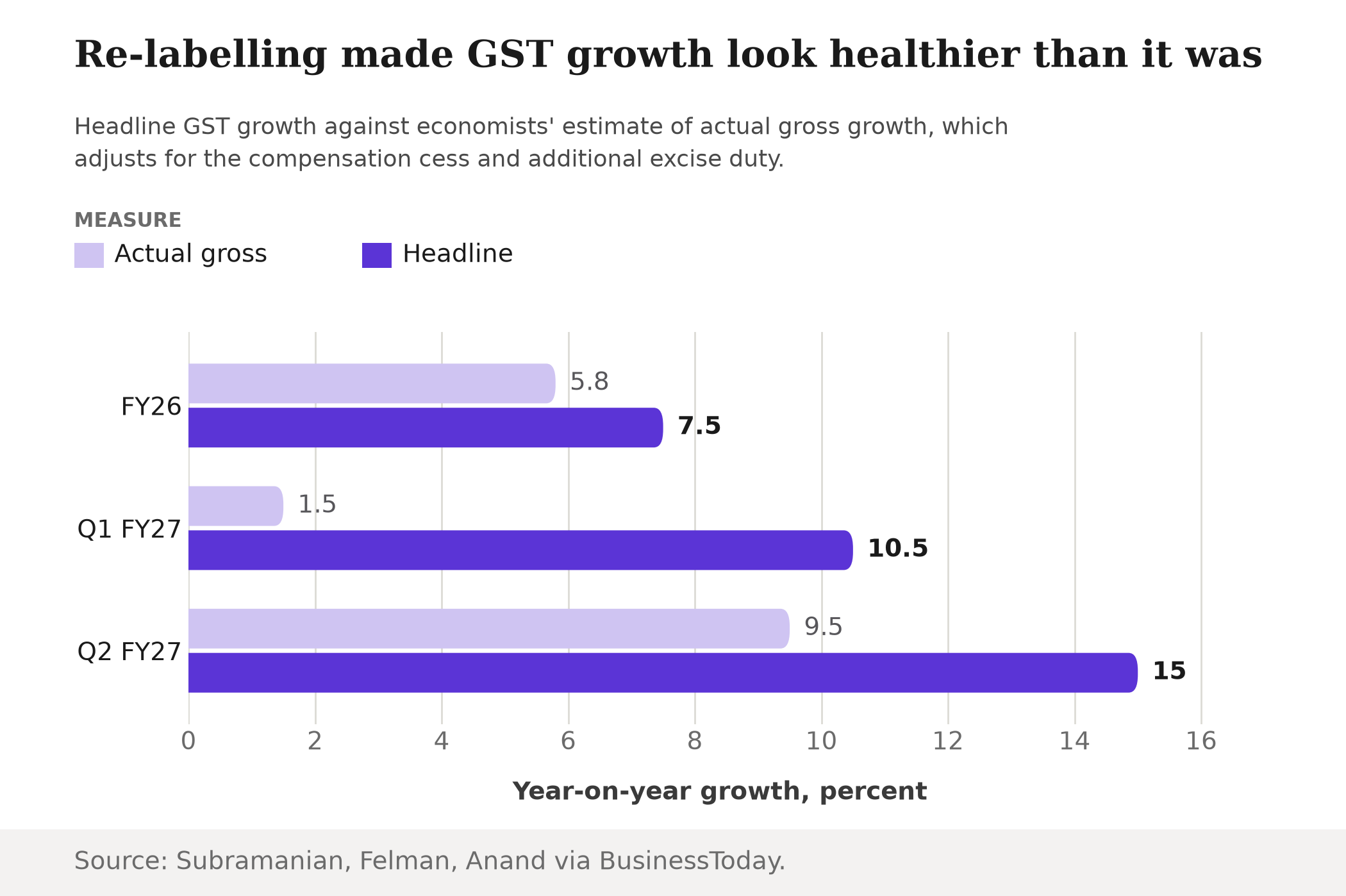
The economists' adjusted series and the portal's domestic series are different measures. They point the same way, though: the April to June weakness was real, and the July to September recovery is smaller than the headline suggests.
The honest objection
The strongest case against this reading is that consumer spending and GST are not the same base. Not every rupee households spend is taxed at GST, and the cut changed the mix of what people buy as well as the price they pay. Lower rates on everyday goods can move spending toward items that carry less tax. If so, a 7-point gap between spending growth of 9.9 percent and domestic GST growth of 2.8 percent is partly a change in what the economy is buying, not lost revenue. A one-quarter comparison is also a thin test, and the 9.8 percent in July to September suggests the Q1 gap may have been a transition effect.
That case is fair, and it is why this piece says "not yet" rather than "failed". But it cuts both ways. A rate cut that pays for itself should show up in revenue growth catching spending growth, and over the six months to September 2026 domestic collections grew 6.1 percent, below the 10.3 percent growth in nominal GDP for April to June. Revenue has not caught up on the half-year.
The Signal
The GST Council is due to meet on 7 October. BusinessToday reports, citing people familiar with the matter, that broad-based rate cuts are unlikely and that the meeting will assess the one-year-old reforms. The question that review needs to answer is not whether collections hit a record. They did, because the value of imports rose. It is whether the households and shops that were meant to gain from lower rates are paying tax at the pace they are spending.
Watch domestic gross GST growth against MoSPI's nominal spending growth once the July to September national accounts are out. If the two are level, the Q1 gap was a transition. If domestic GST falls back toward the 2.8 percent of April to June, the cut has a standing cost that imports are covering. A rate cut pays for itself when the shops show it, not the ports.
Reporting basis: monthly GST collections, domestic and import splits and refunds are from the GST portal's monthly revenue reports for July and September 2026, which are provisional. Nominal GDP, private consumption and import growth are from MoSPI's press note on Q1 2026-27 GDP estimates. The structure and effective date of the rate reform are from the GST Council's 56th-meeting press release. The adjusted gross GST growth rates and the net-GST-to-GDP share are the estimates of Arvind Subramanian, Josh Felman and Abhishek Anand, as reported by BusinessToday, and rest on that single secondary account because the original column was not readable. The Council's October meeting date and expectations are per BusinessToday, citing unnamed sources. The April to June and July to September domestic growth rates, and the spending-to-GST multiple, are The Signal's calculations from those figures.