On 7 October 2026, the Reserve Bank of India said it will implement interoperability among NBFC-Account Aggregators. In the central bank's words, this "will enable customers to access and share their financial information, across different Financial Information Providers, through any NBFC-AA of their choice." The same statement says SEBI-regulated depositories are being facilitated to include bank deposit information in their Consolidated Account Statement through these aggregators. RBI expects both measures to be operational by 31 December 2026.
The obvious read is a plumbing upgrade. Account Aggregators are the licensed intermediaries that move a person's financial data from one institution to another, and a rule that lets any of them reach any data source sounds like more pipe. That read is fair, and it is probably part of the story.
It is worth slowing down on one number, though, because it suggests the pipe was not the scarce thing.
The rail is built. The accounts are not linked.
Sahamati, the industry alliance for the ecosystem, reports that the ecosystem had 2.8 billion financial accounts enabled for sharing as of 2 September 2026, and that customers had linked 310 million of them. That is about 11 percent, or roughly one in nine.
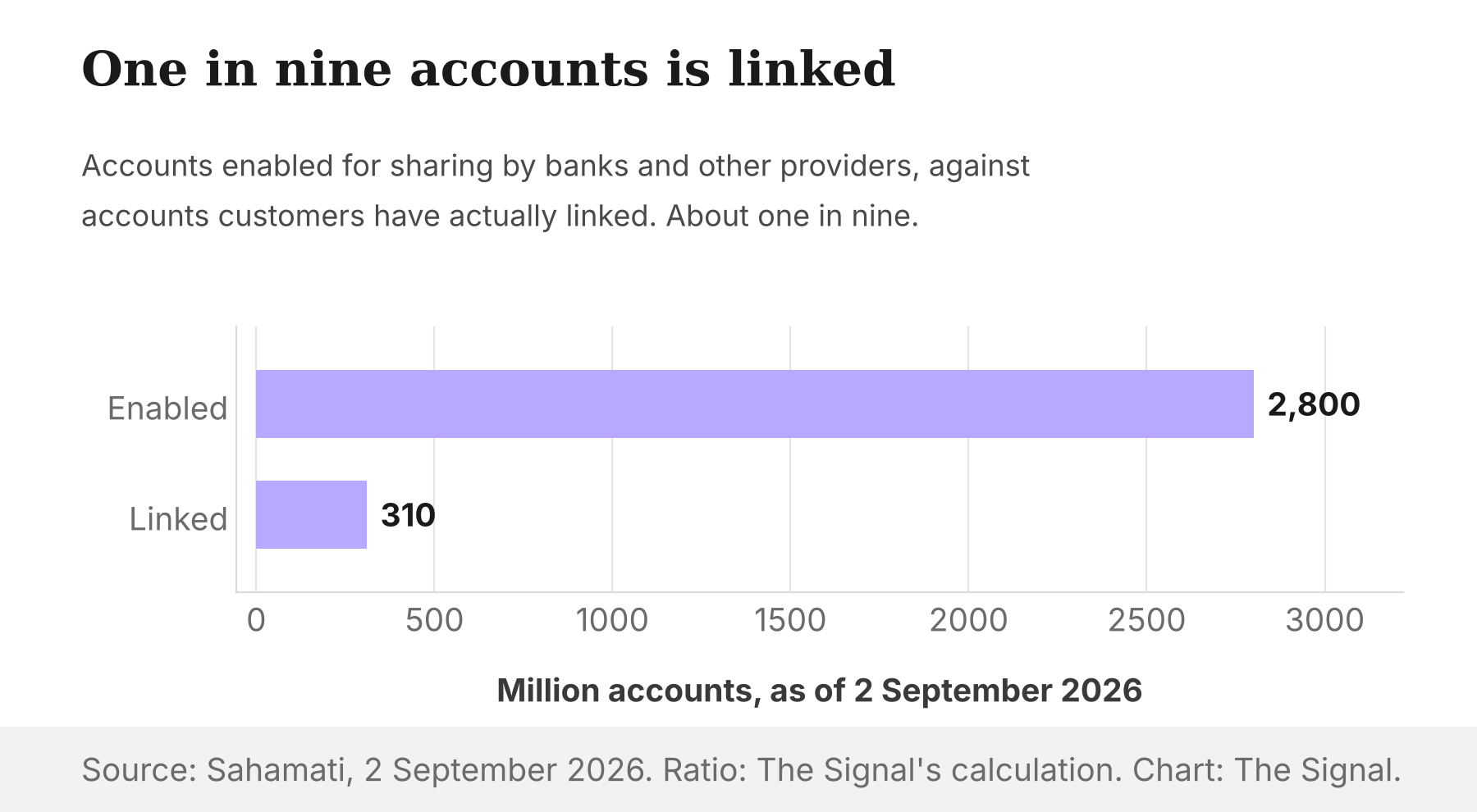
In Sahamati's terms, "enabled" means a provider has made the account available for sharing, and "linked" means a customer has linked it. The first number is a supply-side achievement. The second is the one that decides how much value flows. Sahamati also reports that the network had crossed 500 million fulfilled consents, so the rail is in real use.
The Department of Financial Services says RBI has granted a Certificate of Registration to seventeen companies as Account Aggregators. Seventeen licensed intermediaries serve the whole country, and each one has to persuade customers to link accounts.
What the new rule changes
RBI's statement is about choice. A customer will be able to pick "any NBFC-AA of their choice" and still reach different information providers through it. The rule does not say how much of this was impossible before, and this piece does not claim to know. What it does say is where the new freedom sits: with the customer, at the point of choosing an app.
That fits the original design. In 2021, then Deputy Governor Rajeshwar Rao described the AA model as data-blind: "Data cannot be stored by the aggregator or used by it for any other purpose and shall be shared only with the regulated financial entities." If the aggregator cannot keep or reuse the data, it has little to compete on except the experience of asking for consent. An aggregator that is reachable to every data source competes on that experience alone.
This is our reading, not RBI's: interoperability looks aimed at the linking gap, because it removes one reason a customer might stay away from an app.
Where the money already is
Lending is the use that shows the rail working. Sahamati reports that AA-enabled lending reached ₹3.82 lakh crore in FY26, and that it accounted for 8.4 percent of retail and MSME lending by value. Banks accounted for 47.3 percent of AA-enabled lending by value in the second half of FY26.
The share by loan count, which Sahamati puts at 11.8 percent, is higher than the share by value at 8.4 percent. Dividing 8.4 by 11.8 gives about 0.71, so the typical AA-enabled loan is roughly 70 percent the size of the typical retail or MSME loan.
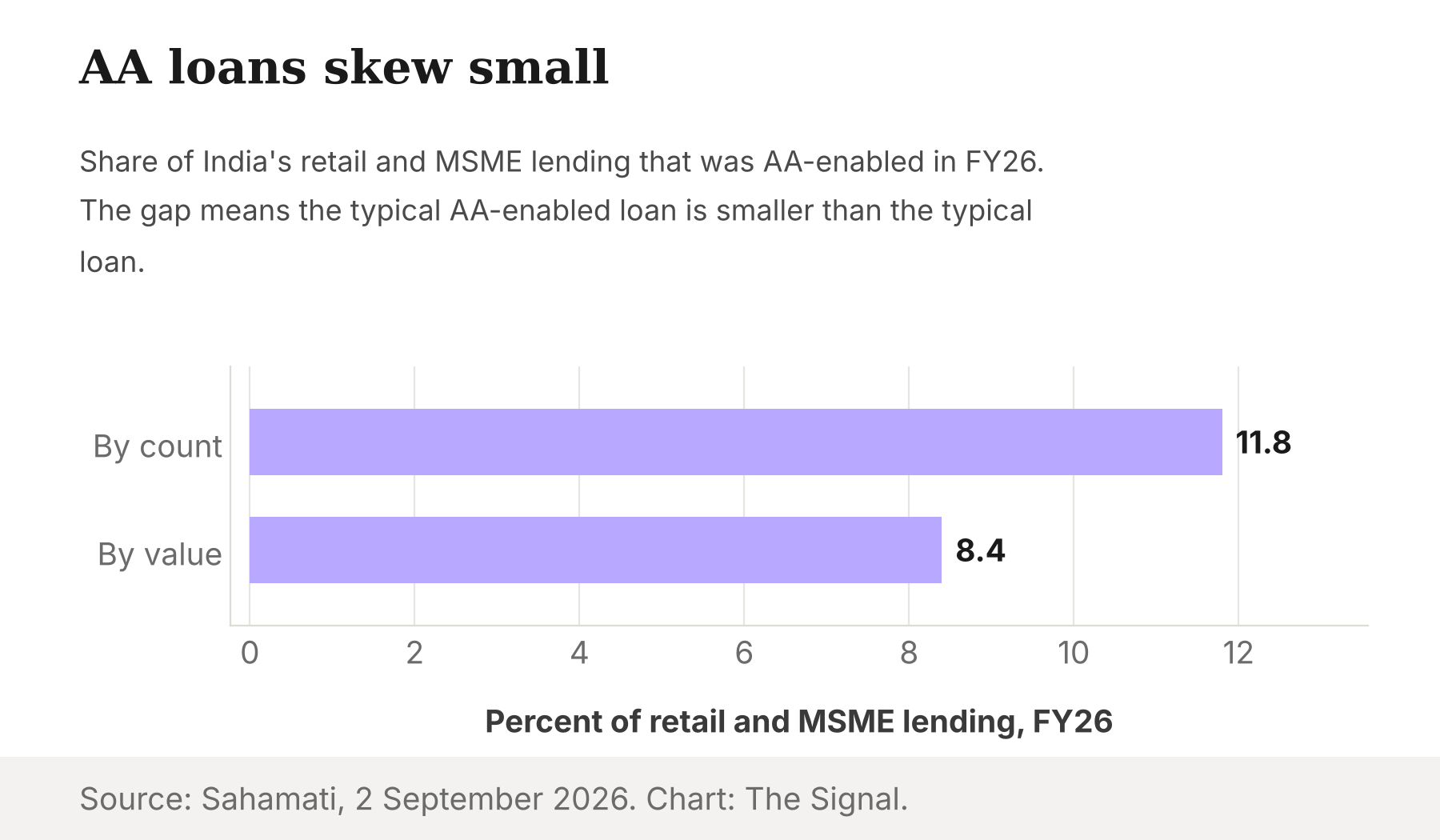
That skew matters for what comes next. The depository change in RBI's statement puts bank deposit information into the consolidated statement that demat account holders already receive. A lender sizing up a borrower with holdings and deposit balances in one view has a fuller picture than one with a salary account alone. Whether that lifts loan sizes is a question the numbers cannot answer yet.
The honest objection
The strongest case against this reading is that the 11 percent figure, from the Sahamati data, is the wrong yardstick. Not every enabled account belongs to someone who needs to share data, and a customer who borrows once a decade will never link anything. On that view, the linked accounts are simply the demand that exists, and a rule about aggregator choice changes nothing about it.
That case has force. The published figures do not tell us how many linked accounts belong to how many people, so the gap cannot be read as a count of missing customers. But if demand were the only limit, a rule about aggregator choice would be beside the point. That RBI chose to regulate it suggests it sees the front door as part of the constraint. That inference is ours, and RBI's statement does not make it.
The Signal
RBI's interoperability rule, due by 31 December 2026, moves competition to the one layer where customers can see a difference: which app asks them for permission.
Three numbers will show whether it works: the 310 million linked accounts reported for 2 September 2026, the AA-enabled share of retail and MSME lending (8.4 percent by value in FY26), and the seventeen registered aggregators. If linking rises faster than lending, the rule is working on access. If lending rises faster than linking, lenders are working it harder than customers are.
A data rail is only as wide as the people who step onto it, and so far 310 million accounts have.
Reporting basis: the interoperability rule, the demat and deposit measure and the 31 December 2026 timeline are from RBI's Statement on Developmental and Regulatory Policies of 7 October 2026, which was read directly. The 2021 description of the AA design is from a speech by then RBI Deputy Governor Rajeshwar Rao, as published by the Bank for International Settlements. The count of seventeen registered Account Aggregators is from the Department of Financial Services of the Ministry of Finance. The consent, account and lending figures, including the share of retail and MSME lending and the bank share, all come from a single source, Sahamati, an industry alliance that is an interested party in the ecosystem's growth; they are self-reported and were not independently confirmed. The one-in-nine linking ratio and the relative loan-size figure are The Signal's calculations from those figures.