On October 7, Airtel announced that its postpaid plans would cost Rs 50 more a month. The revised plans, effective October 8, start at Rs 499 for individual users, up from Rs 449, an increase of about 11 per cent, according to Asianet Newsable. The headline read is that the country's most premium-priced mobile operator is squeezing its best customers. Existing subscribers will be moved to the nearest higher plan within a month, and a company official said the free international roaming trip bundled with the new plans is worth Rs 2,000, Business Today reports. That framing makes the move sound bigger than it is.
It is worth slowing down on the money. Airtel's postpaid base reached 30 million in the April to June 2026 quarter, after a record 1 million postpaid additions, TelecomTalk reports. If every one of those 30 million moved up exactly one Rs 50 step, the extra revenue would be Rs 150 crore a month, or Rs 1,800 crore a year. That is a ceiling, not a forecast, because family plans carry several SIMs under one price and some customers will leave or downgrade.
Set that ceiling against the business. Airtel's India revenue was INR412.14 billion, or Rs 41,214 crore, in the quarter ended June 2026, up 9.7 percent year on year, according to Developing Telecoms. Annualising that single quarter gives roughly Rs 1.65 lakh crore, so the best case from the hike is about 1 percent of India revenue (our calculation). A move worth that little is not mainly about the money.
The number that carries the thesis
The better question is why Airtel chose now, and why it wrapped the rise in a gift. The timing is the clue. The hike lands after the highest quarterly postpaid additions Airtel has ever recorded, when the segment is growing fastest and its customers are least likely to be shopping around. A company that was worried about postpaid demand would not touch the price. A company that has just seen record demand is checking how much of it is price-sensitive.
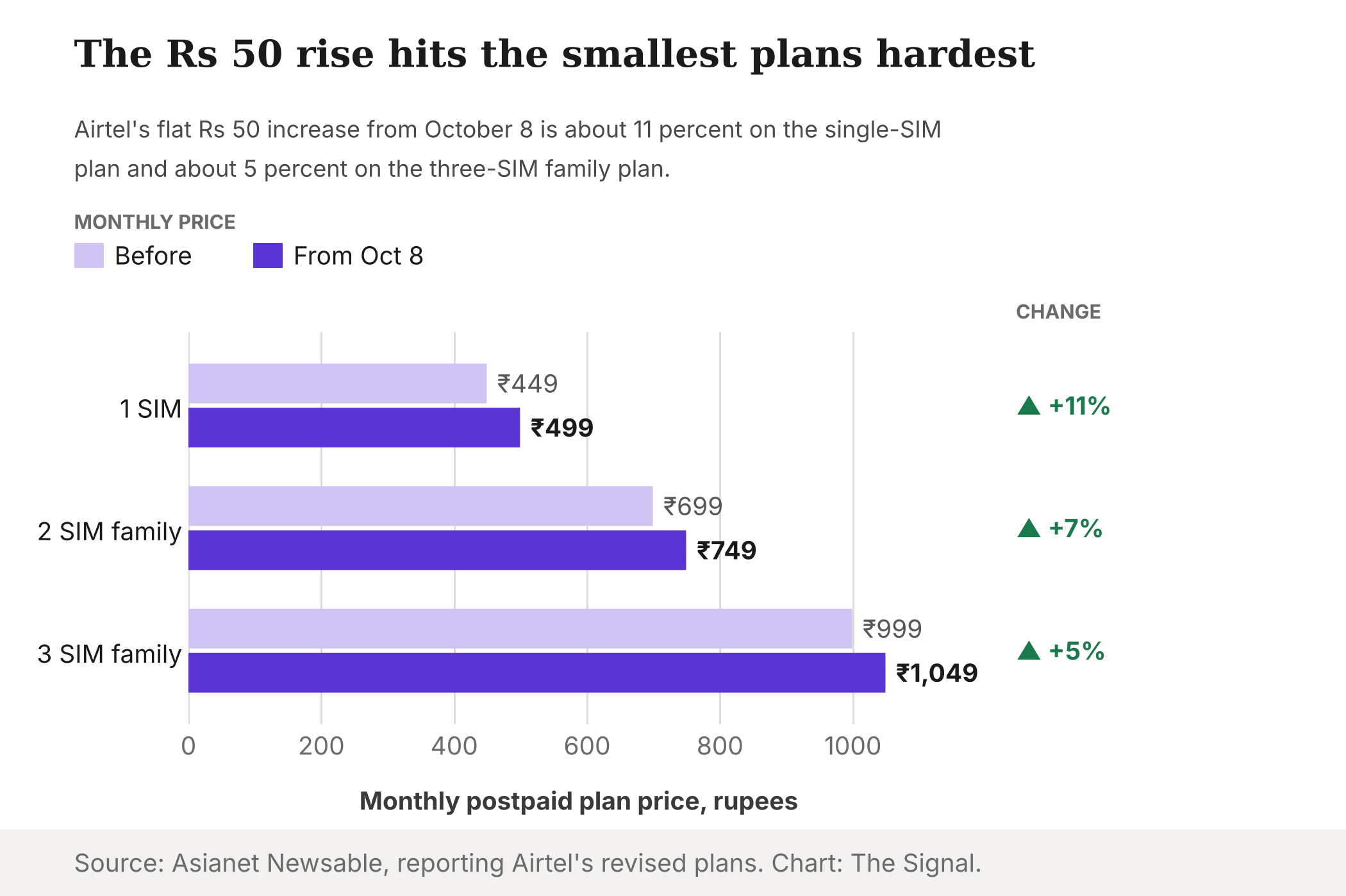
The flat Rs 50 also hides an uneven burden. On the single-SIM plan it is 11 percent. On the two-SIM family plan, Rs 699 becomes Rs 749, and on the three-SIM plan Rs 999 becomes Rs 1,049, which is 7 percent and 5 percent. The smallest buyers take the largest percentage rise.
The roaming trip is a price discriminator
Airtel did not present this as a price rise. Each SIM gets one free international roaming trip a year, with a five-day pack of 5GB of data, 60 minutes of calls and 25 outgoing SMS, a bundle the company values at Rs 2,000.
The arithmetic is simple. Rs 50 a month is Rs 600 a year. A customer who uses the trip receives Rs 2,000 of value for Rs 600, or about three and a third times what the rise costs. A customer who never travels abroad pays Rs 600 and receives nothing. The same plan therefore carries two different prices depending on who holds it, and Airtel gets to sell the rise as a perk to those who travel abroad while collecting it from everyone else. That is revealed preference at work: the company is not asking customers what they value, it is letting travel patterns sort them.
Why the premium base can bear it
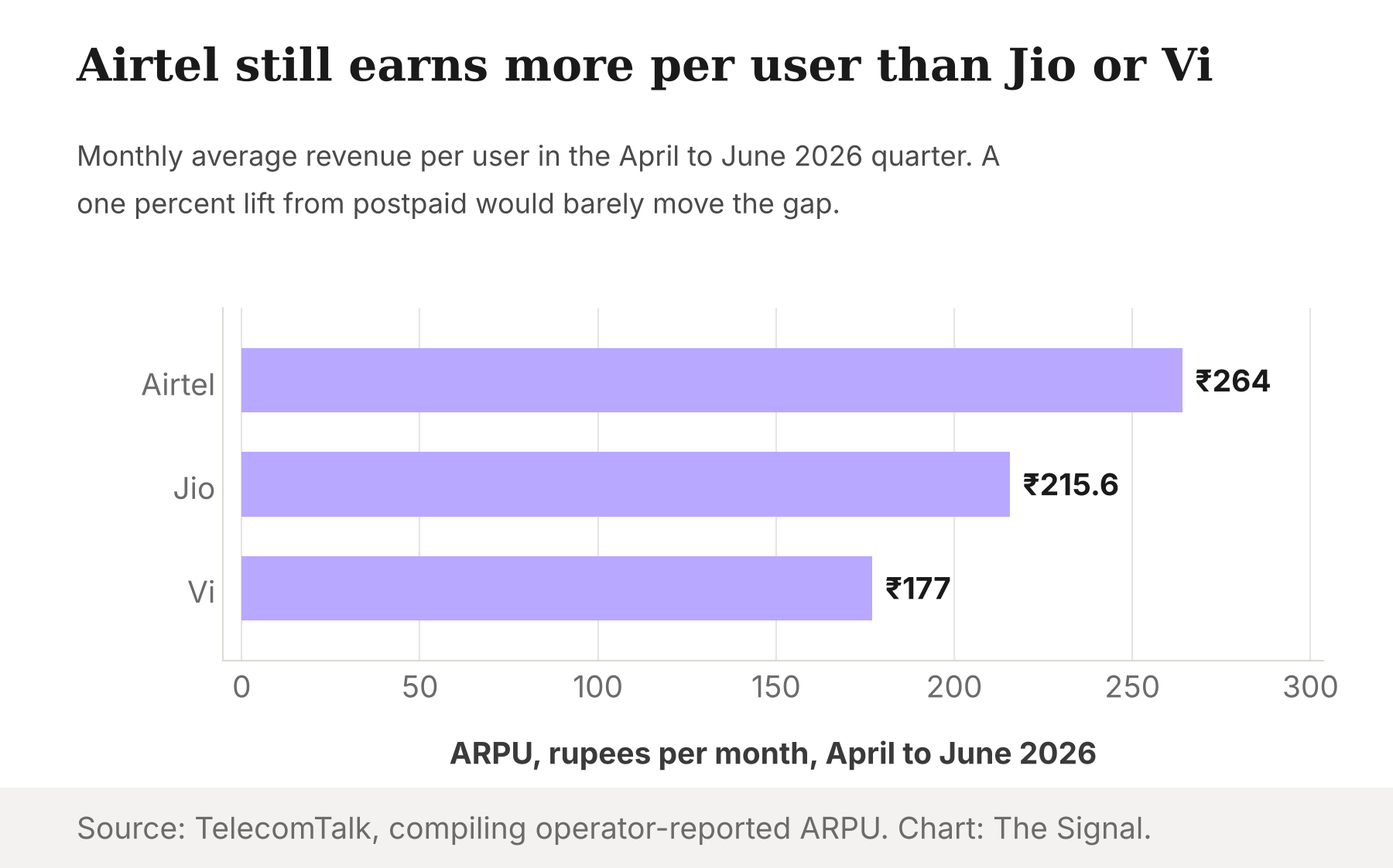
Airtel's pricing power is not new. Airtel's mobile ARPU of Rs 264 in the April to June 2026 quarter was well ahead of Jio's Rs 215.6 and Vodafone Idea's Rs 177, TelecomTalk's comparison shows. ARPU is average monthly revenue per user.
There is a puzzle in the regulator's numbers, though. TRAI's report for the quarter to March 2026 puts industry postpaid ARPU at Rs 194.31 a month against Rs 196.22 for prepaid. Across the whole industry, postpaid users do not yet pay more than prepaid ones on average. That is a blended figure across every operator and plan type, so it is not comparable with a Rs 499 plan price, but it shows that postpaid does not yet carry a premium across the market as a whole. The premium that Airtel is pricing does not show up in the regulator's blended average.
The honest objection
The strongest counter is that a rise this small cannot be a test of anything. Operators raise tariffs when costs demand it, and a Rs 50 step across plans is modest. That is fair. If the hike were only about revenue it would be a rounding error, and Airtel would not bother wrapping it in a roaming bundle.
But the objection proves the point. A step that small, announced with a bundle designed to blunt the reaction, is aimed at something other than the rupees. Airtel's postpaid base is 30 million, and TRAI's subscription report shows the company also carries 80.83 million M2M cellular connections, 61.65 percent of the industry's total as of May 2026. Headline subscriber counts and per-user averages therefore reflect a mix that includes machine connections. Postpaid, with named customers and monthly bills, is the segment where price changes can be measured cleanly.
The Signal
The Rs 50 is not the story. It is a probe, priced low and packaged kindly, on the one customer segment where Airtel just recorded its best quarter of additions. If those 30 million absorb it with little churn, the same logic can move to heavier plans and, eventually, to the prepaid tiers where most of the industry's users sit. If they leave, Airtel will have learned that cheaply.
The number to watch is not the 11 percent. It is postpaid net additions in the quarter that includes October, measured against the 1 million record. A record 1 million is the baseline Airtel just set for itself. A price rise that leaves that number intact is worth far more than the Rs 1,800 crore it adds.
Reporting basis: the plan prices and the October 8 effective date come from Asianet Newsable and the roaming bundle from Business Today, both reporting Airtel's announcement, and the Rs 2,000 value is a company official's figure as relayed by Business Today. Airtel's 30 million postpaid base, record additions and Rs 264 ARPU are as reported by TelecomTalk and Developing Telecoms from the company's Q1 FY27 results, which are two outlets carrying one origin, Airtel's disclosure. Jio and Vodafone Idea ARPU come from a TelecomTalk compilation of operator figures. Industry postpaid and prepaid ARPU and the M2M connection counts are from the Telecom Regulatory Authority of India's own releases. The Rs 1,800 crore ceiling, the 1 percent share of annualised India revenue, the Rs 600 annual cost and the plan-level percentage rises are The Signal's calculations from those figures.