India's pitch to the cloud industry is simple. Run your servers here, sell to the world from here, and the income from those global sales will not be taxed in India until 2047. The Union Budget put that in writing in February 2026. The easy read is that long tax certainty will turn India into a hub for the world's servers.
The World Bank has now asked what the country is actually buying. Its World Development Report 2026, launched in India on October 8, carries a warning that such incentive policies risk creating a race to the bottom, according to ThePrint's reading of the report. It is worth slowing down on that, because the warning is aimed at the shape of the deal, not at data centres themselves.
What India is offering
The terms matter. The exemption applies from tax year 2026-27 to tax year 2046-47, according to the Press Information Bureau's Budget explainer. It covers the foreign provider's income from global cloud services routed through data centres in India.
Two conditions limit the giveaway. First, services to Indian customers must go through an Indian reseller entity, so domestic sales stay inside the tax net. Second, where the Indian data centre is a related company of the foreign provider, a safe harbour margin of 15 percent on cost applies, so the local arm is still taxed on a fixed profit.
In plain terms, India taxes the rack space and the domestic customer. It gives up the global profit that the rack space helps earn.
The case for the holiday
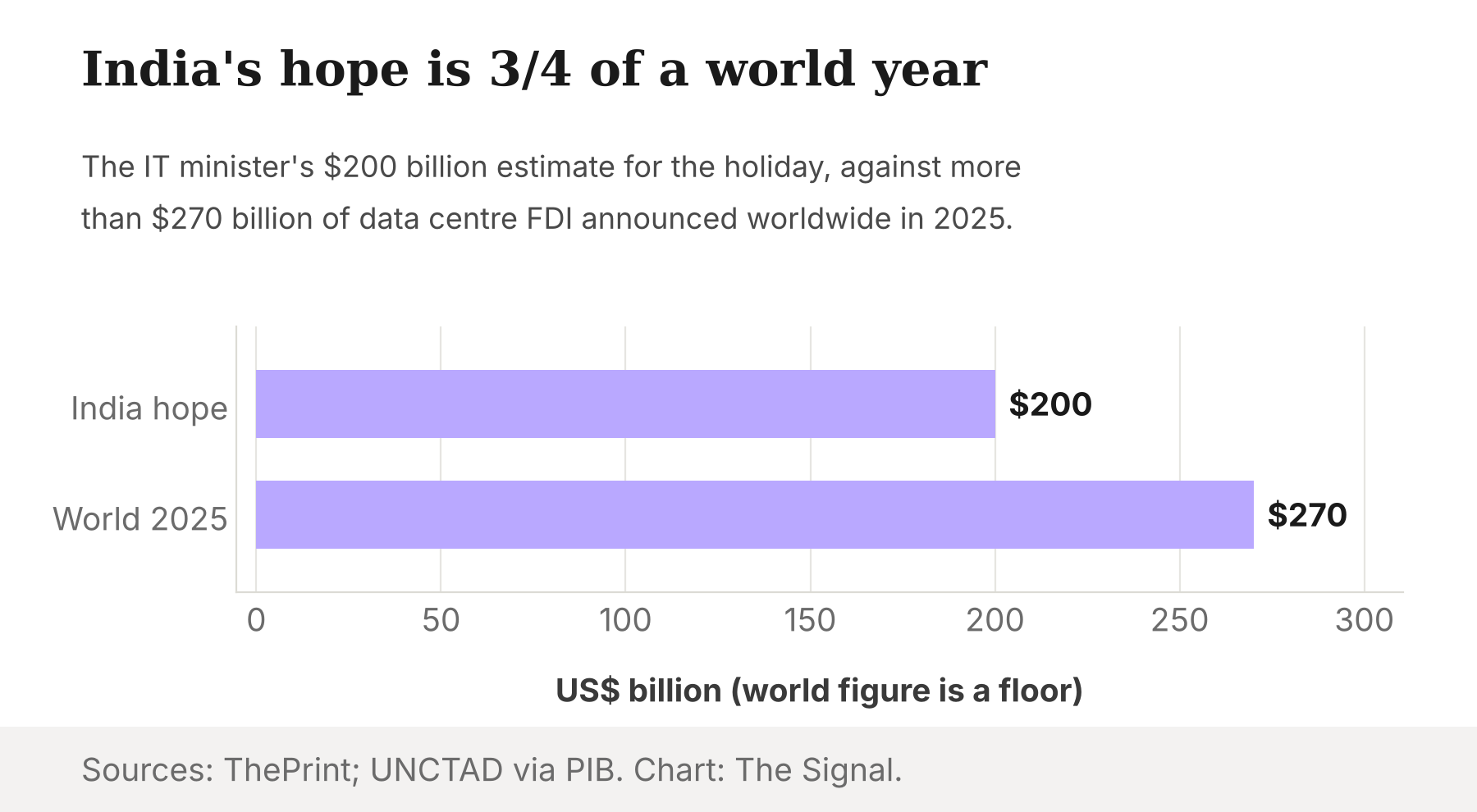
The government's logic is competitive. The same explainer, citing UNCTAD, says data centres made up more than one fifth of global greenfield project values in 2025, with announced investments above $270 billion. Other countries are chasing the same money.
The ambition is large. IT Minister Ashwini Vaishnaw has said the holiday could draw $200 billion, as ThePrint reports. Set against the UNCTAD figure, that is roughly three-quarters of everything announced worldwide in a single year.
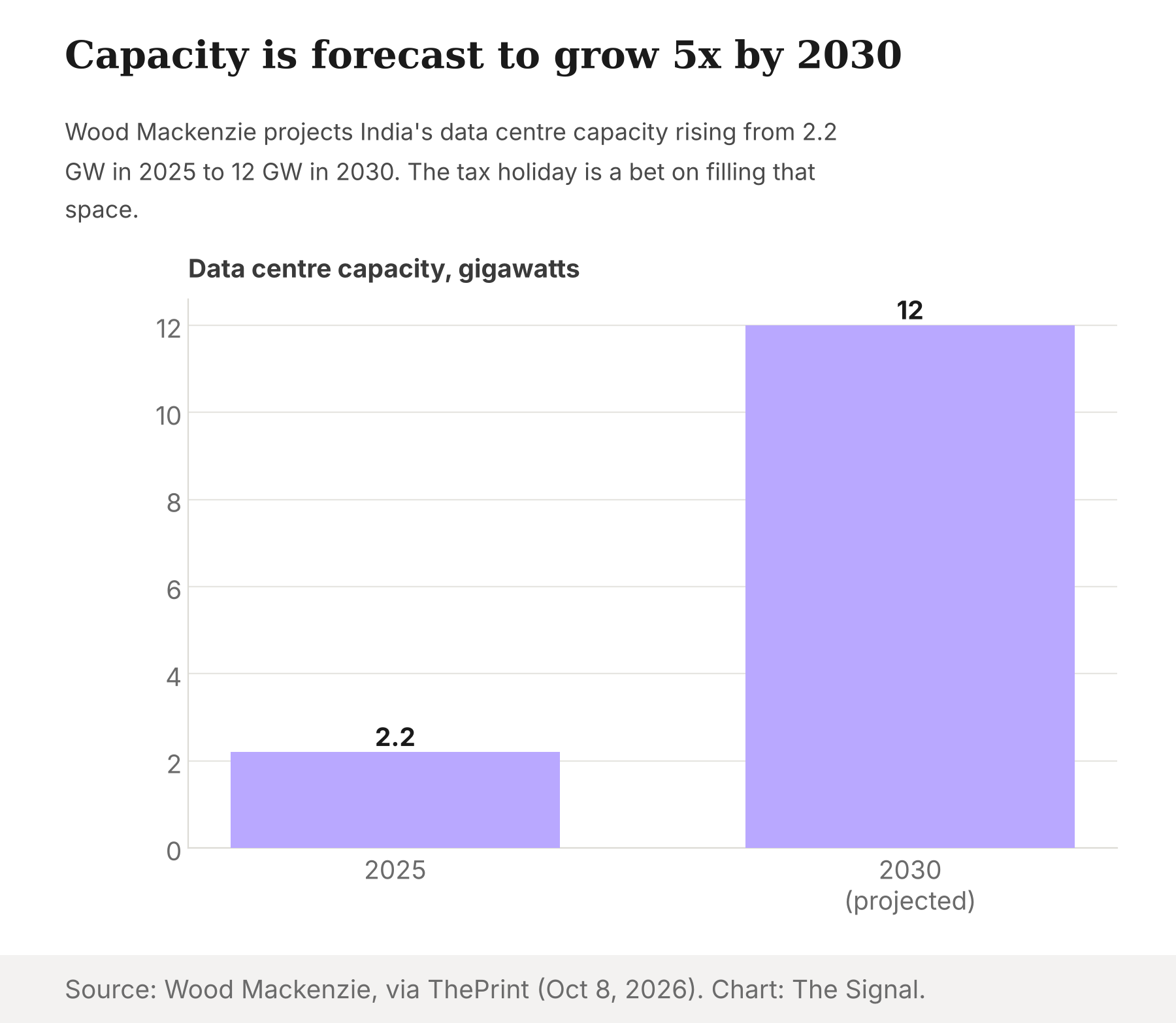
The market is also growing fast. Consultancy Wood Mackenzie projects India's data centre capacity rising from 2.2 GW in 2025 to 12 GW by 2030, according to ThePrint. That is more than a fivefold rise in five years.
What a local data centre does not buy
Here the World Bank's argument bites. The report says that simply having a local data center cannot avoid dependencies on chips from major foreign providers. The same passage adds that large investments in data centers may impose other societal costs, such as higher electricity prices.
Put those two lines next to the holiday and a pattern appears. India is giving up tax on the profit. The chips stay foreign. The power bill is local. What remains in the country is the building, the grid connection and the jobs that come with them.
India is also not alone in the chase. Developing countries now account for about 40 percent of new foreign direct investment projects in data centers worldwide, the report says. If many of them offer a holiday, the competition is over who gives most. That is the race to the bottom the report names. ThePrint also reports the report's caution that excessive deals may place a disproportionate share of the financial and technological risks on the public.
The home front has the same worry
The concern did not start with the World Bank. A parliamentary standing committee chaired by BJP MP Nishikant Dubey put the holiday on its list of significant issues in a report tabled on August 6, 2026, alongside huge power and water consumption by data centers, as ThePrint reported. The article gave no figures for that consumption, and none are available in the evidence here.
The honest objection
The strongest answer to all of this is that the holiday gives up tax India would never have collected. Without a reason to place servers in India, the global profit would be booked elsewhere. The reseller rule and the safe harbour keep the domestic base intact. On that view the cost is close to zero, and any jobs, construction and local compute are a gain.
That case is real. But it rests on a counterfactual that has to be argued, not read off a source. The evidence behind this piece contains no estimate of the revenue forgone. The World Bank's warning is not that the holiday must fail. It is that a long fixed-term giveaway is hard to renegotiate if the benefits come in smaller than promised.
The Signal
The holiday runs from tax year 2026-27 to 2046-47. The data centres it attracts will need foreign chips, local power and local water for as long as they run. The right test is therefore not how much investment is announced, but how much of it stays useful if the incentive is copied by a neighbour or the chips are rationed.
Watch two things. One is whether the government publishes an estimate of tax forgone against capacity built. The other is whether the committee's concerns on power and water turn into conditions on the next notified facility. Until then, India has priced the deal in announcements, and the risk sits with those who pay the electricity bill.
Reporting basis: the holiday's terms, the reseller condition, the safe harbour and the UNCTAD data centre figures are from the Press Information Bureau's Budget explainer; the UNCTAD numbers are relayed through that explainer and were not checked against UNCTAD directly. The statements on foreign chips, electricity prices and developing countries' share of new data centre investment projects are from the World Bank's World Development Report 2026 as published by the Bank. The race-to-the-bottom and risk-allocation wording, the IT minister's investment estimate, the Wood Mackenzie capacity projection and the parliamentary committee's findings are per ThePrint, reporting each, and each rests on that single outlet. The three-quarters comparison and the fivefold capacity rise are The Signal's calculations from those figures.