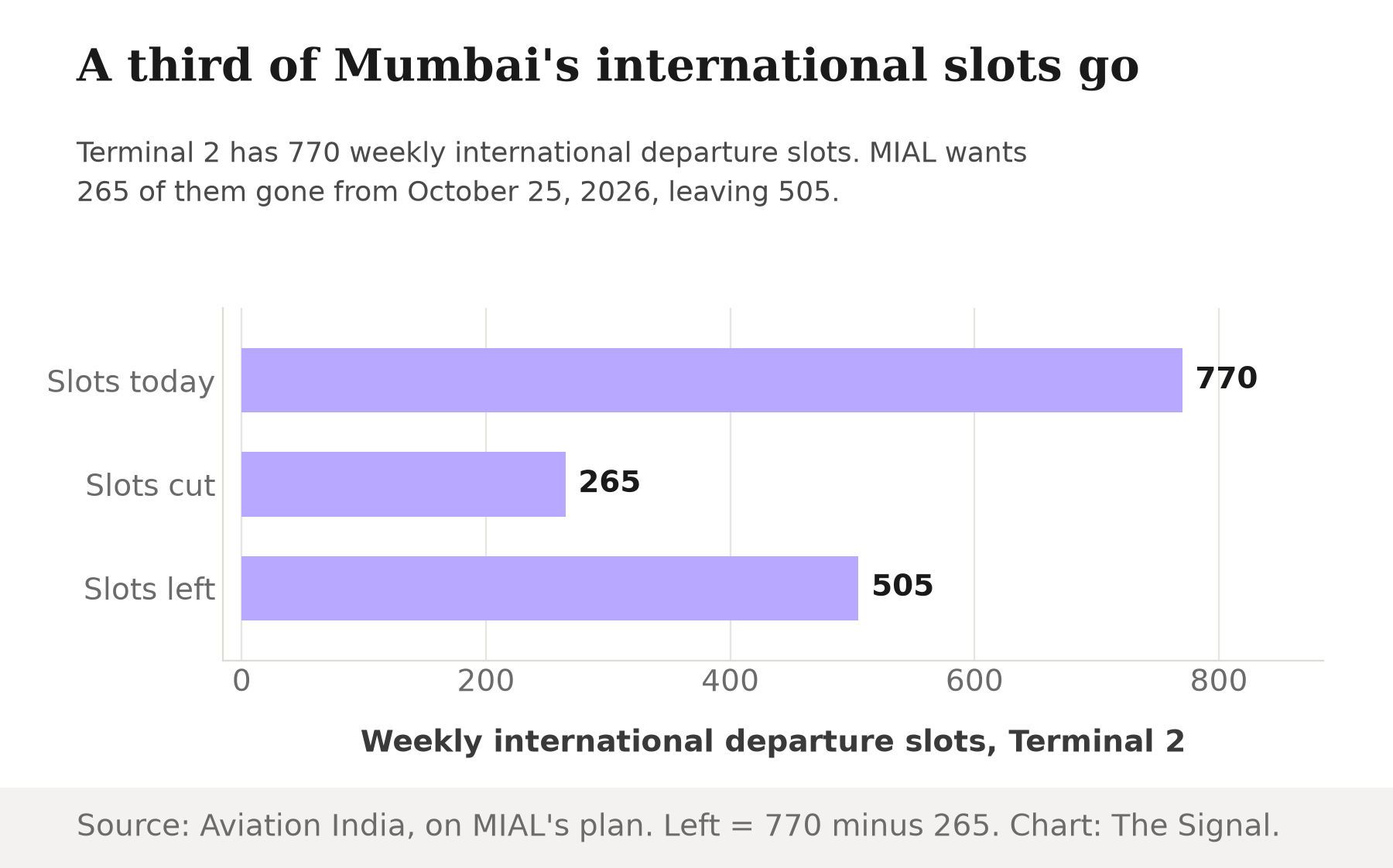
The surface read is a capacity story. Mumbai International Airport Ltd (MIAL) has proposed temporarily discontinuing 265 of the 770 weekly international departure slots at Terminal 2 from October 25, a cut that affects 46 airlines. That is 34 percent of the international schedule at the terminal, leaving 505 slots. The natural conclusion is that Mumbai has run out of room and is pushing flights to its new neighbour in Navi Mumbai.
It is worth slowing down on that. The runway is not what is being rationed here. The cut is about counters, belts and gates, and it exists because a different terminal is about to close.
The cut is a terminal swap
MIAL says the freed capacity is meant for domestic flights that will move from Terminal 1 after its closure. The plan is to accommodate around 5 million additional domestic passengers a year at Terminal 2 by reallocating check-in counters, baggage belts and boarding gates currently used for international operations. Terminal 1 redevelopment is scheduled to begin in January 2027.
So the arithmetic is a swap. International carriers are asked to give up 265 of 770 weekly departure slots so that the roughly 5 million domestic passengers a year displaced from Terminal 1 can be handled in the same building.
The runway matters, but as the reason Mumbai cannot simply add flights. Mumbai's two runways intersect and cannot be operated simultaneously, which gives single-runway operations with a declared peak-hour capacity of 46 aircraft movements an hour. That figure was already trimmed once: in February 2024 the Ministry directed the operator to reduce operations from 46 to 44 an hour at peak and from 44 to 42 at other times. With the airside fixed, terminal space is the only lever left, and that is the lever being pulled.
The delay is the real cause
Why now, and why this hard? Because the original plan slipped. MIAL says demolition of Terminal 1 was originally planned for mid-2025 but was deferred because Navi Mumbai airport was not ready to provide an alternative operating facility. Redevelopment now begins in January 2027, and airlines may relocate to Navi Mumbai or temporarily suspend services until the rebuilt Terminal 1 is commissioned in 2029-30.
Read that again from an airline's chair. The operator's own account is that the new airport was late. The consequence of that lateness is that carriers at the old airport now choose between moving and suspending service until 2029-30. The schedule risk sat with the infrastructure. The cost has landed on the tenants.
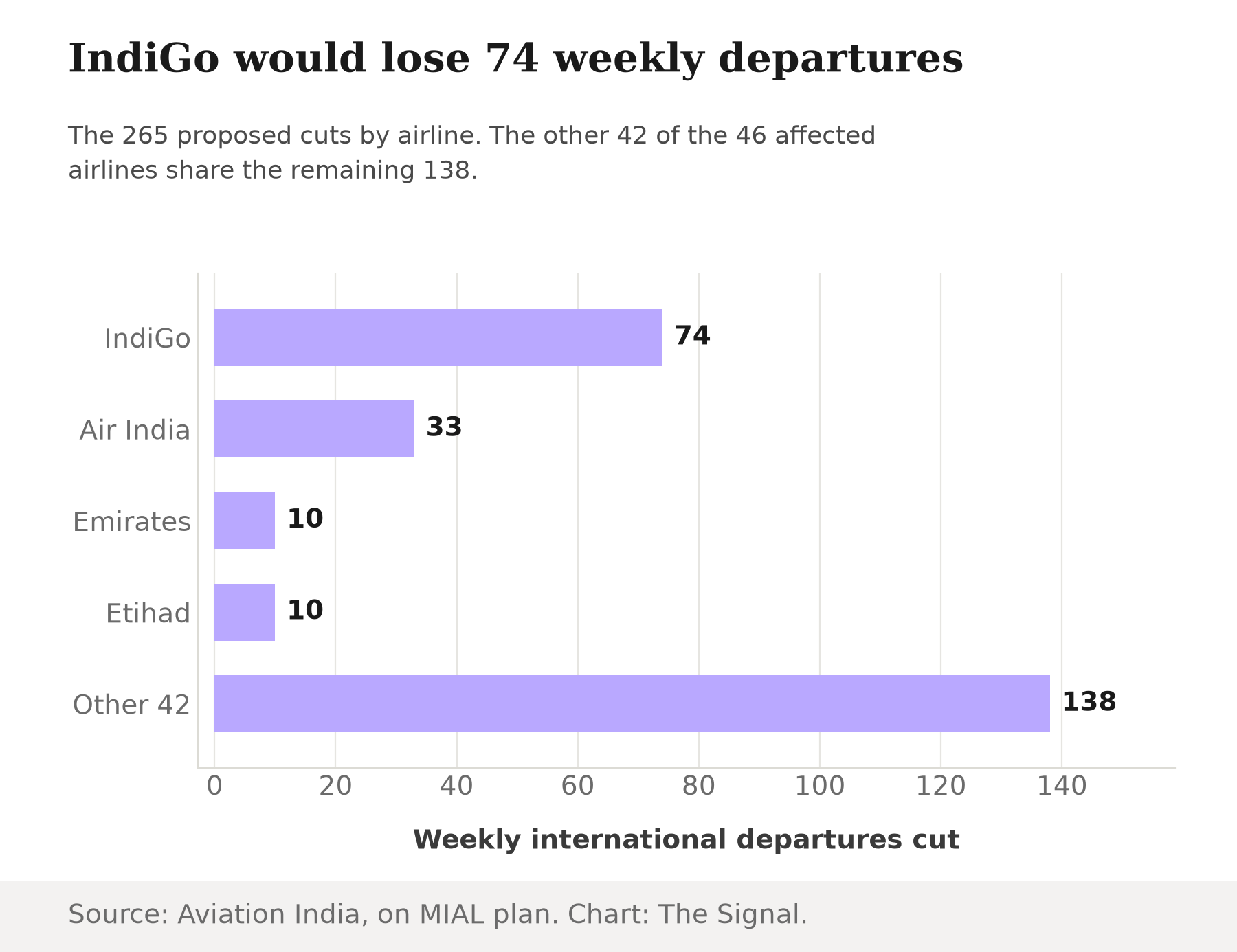
The burden is not spread evenly. The largest named reduction falls on India's biggest carrier: IndiGo faces the largest cut at 74 weekly international departures, followed by Air India at 33, while Emirates and Etihad would each lose 10. Those four carriers account for 127 of the 265. The other 42 affected airlines share the remaining 138, an average of just over three each.
What Navi Mumbai can and cannot absorb
The destination is real, but it is young. Phase 1 of Navi Mumbai International Airport was built at a cost of around Rs 19,650 crore, and the government describes it as the second international airport for the region, working in tandem with Mumbai's existing airport, eventually handling 90 million passengers and 3.25 million tonnes of cargo a year. The word to hold on to is "eventually". The 90 million figure is the build-out target, not what the airport handles today.
That gap is where the airline objection lives. IATA says airlines were not adequately consulted before the transition plan was communicated, and that it opposes forced airline relocations and wants any transfer to remain voluntary, commercially viable and operationally practical. A slot at Mumbai's existing airport is valuable because of the connections and passengers around it. A slot in a newer airport is a bet that the same passengers will follow.
The honest objection
MIAL has a strong answer. A terminal cannot be rebuilt while passengers are using it, and MIAL says it already deferred the demolition once, from mid-2025. Deferring again would push the rebuilt Terminal 1 further past the 2029-30 commissioning date. On that view, a temporary reduction in international slots is a fair price for a modern terminal, and asking carriers to use Navi Mumbai is simply what a two-airport city does.
That case is real. It does not, though, answer the question airlines are asking. The reporting does not say who compensates a carrier that suspends a Mumbai route until the new terminal is commissioned, or what happens to the slot it surrenders. IATA's position is that any reduction in capacity at Mumbai should follow transparent capacity analysis, advance communication and consultation with affected airlines. The dispute is less about whether Terminal 1 must close than about who bears the cost of the timing.
The Signal
The headline number is 265 slots, but the number that explains it is a date. Terminal 1 demolition was meant to start in mid-2025 and now starts in January 2027, because the alternative airport was not ready. Every international departure removed from Mumbai on October 25 is a payment on that delay.
Three things decide whether the arrangement works. First, how many carriers choose to move to Navi Mumbai rather than suspend routes, which will show in the slots airlines choose to give up. Second, whether regulators step in on the consultation complaint. Third, whether the rebuilt Terminal 1 arrives in 2029-30 as promised. If it slips again, the temporary cut stops being temporary.
Reporting basis: the 265-of-770 slot cut, the airline-by-airline figures, the 5 million passenger figure and the January 2027 start date are per Aviation India, reporting MIAL's proposal; the mid-2025 demolition plan, the 2029-30 commissioning date and IATA's objections are per Aviation A2Z, reporting statements by MIAL and IATA. We did not review MIAL's or IATA's own documents. Runway capacity and the 2024 reduction are from a Ministry of Civil Aviation release published by the Press Information Bureau, dated February 2024, so the current declared figure may differ. Navi Mumbai's cost and build-out targets are from the Press Information Bureau's October 2025 inauguration release. The 34 percent share, the 505 remaining slots, the 127 and 138 splits and the per-airline average are The Signal's calculations from those figures.