The headline number from the Controller General of Accounts (CGA) sounds like a warning. The Centre's fiscal deficit for April to August 2026 was Rs 7,10,249 crore, or 41.9% of the full-year Budget Estimate, against 38.1% at the same point a year earlier. Five months in, more than two-fifths of the year's borrowing need is already gone. The fiscal deficit is the gap between what the government spends and what it collects, excluding borrowing. One lakh crore is one trillion rupees.
It is worth slowing down on that. Five months is 41.7% of a twelve-month year. A deficit at 41.9% is not running hot. It is running on a straight line. The full-year Budget Estimate is Rs 16,95,768 crore, which the Union Budget puts at 4.3 percent of GDP. That leaves Rs 9,85,519 crore for the remaining seven months, about Rs 1.41 lakh crore a month. The first five months averaged about Rs 1.42 lakh crore. The target needs the same pace to hold, no faster and no slower.
That reading is fair as far as it goes, but the total hides what sits underneath it.
Taxes are behind, non-tax revenue is far ahead
A straight line implies each line of the accounts should be near 41.7% of its annual estimate. Two of them are nowhere close.
Net tax revenue through August was Rs 8,37,921 crore, 29.2% of the Budget Estimate, against 28.6% a year earlier. Taxes are about twelve points behind a straight line. Non-tax revenue was Rs 4,54,549 crore, already 68.2% of its full-year estimate of Rs 6,66,228 crore. That is about 26 points ahead of one.
Non-tax revenue is a smaller pool, so it cannot fully replace taxes. On a straight line, the Budget Estimate of Rs 6,66,228 crore implies about Rs 2.78 lakh crore by now, so the overshoot is roughly Rs 1.77 lakh crore. Net tax revenue at 41.7% of its estimate of Rs 28,66,922 crore would be about Rs 11.95 lakh crore, so the shortfall is roughly Rs 3.57 lakh crore. Our calculation, from the same CGA table, is that non-tax revenue has covered about half of the tax gap.
The other half is spending that has come in under the straight line. Total expenditure was Rs 20,77,958 crore, or 38.9% of the Budget Estimate of Rs 53,47,315 crore. That is about three points slower than a straight line.
So the deficit is on pace because non-tax revenue (68.2% of its estimate) and spending (38.9%) both sit on the favourable side of the line, while taxes (29.2%) sit on the other. It is a balance, not a trend.
The month that moved the number
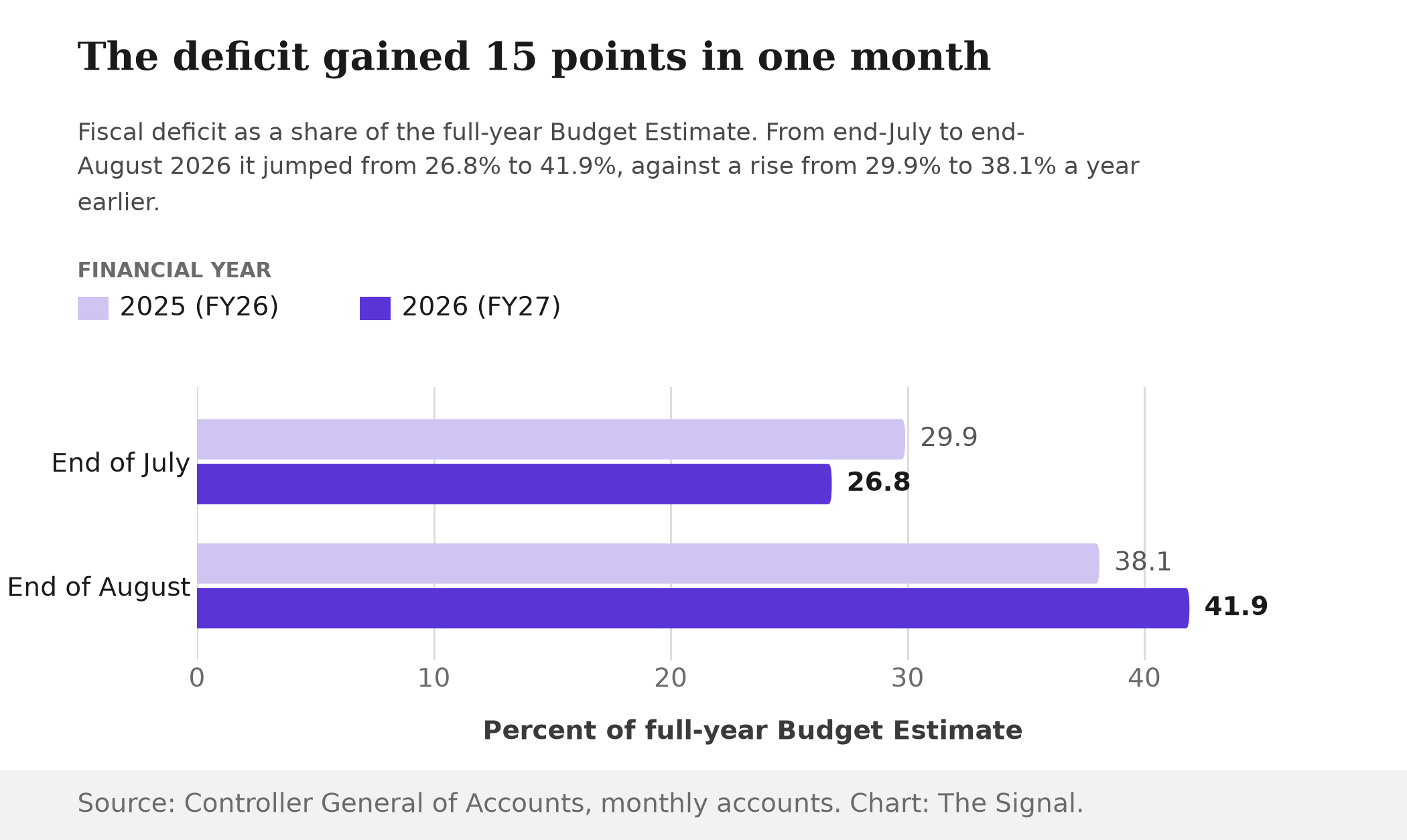
The deficit did not build evenly. At the end of July 2026 it stood at Rs 4,55,144 crore, 26.8% of the Budget Estimate, below the 29.9% of a year earlier. One month later it was 41.9%. That is a jump of about 15 points in August alone, worth about Rs 2.55 lakh crore of new deficit (7,10,249 less 4,55,144). The same month a year earlier moved the ratio by about eight points, from 29.9% to 38.1%.
The jump came from the receipts side, not from a burst of spending. Total spending rose from Rs 17,61,853 crore at end-July to Rs 20,77,958 crore, so August added about Rs 3.16 lakh crore. That is below the roughly Rs 4.40 lakh crore a month of April to July. Total receipts were Rs 13,06,709 crore at end-July and Rs 13,67,709 crore at end-August, so August added only about Rs 61,000 crore, against a monthly average of about Rs 3.27 lakh crore over April to July. Net tax revenue actually slipped, from Rs 8,44,560 crore at end-July to Rs 8,37,921 crore, a fall of about Rs 6,600 crore in the cumulative figure. Non-tax revenue added about Rs 31,500 crore over the month, from Rs 4,23,013 crore to Rs 4,54,549 crore.
This is why the CGA attaches a warning to its own table. It says the monthly deficit figure "is not necessarily an indicator of fiscal deficit for the year" because it is affected by a "temporal mismatch" between receipts and expenditure. A single lumpy month can move the ratio by double digits, and August was one.
Capex is not the main story
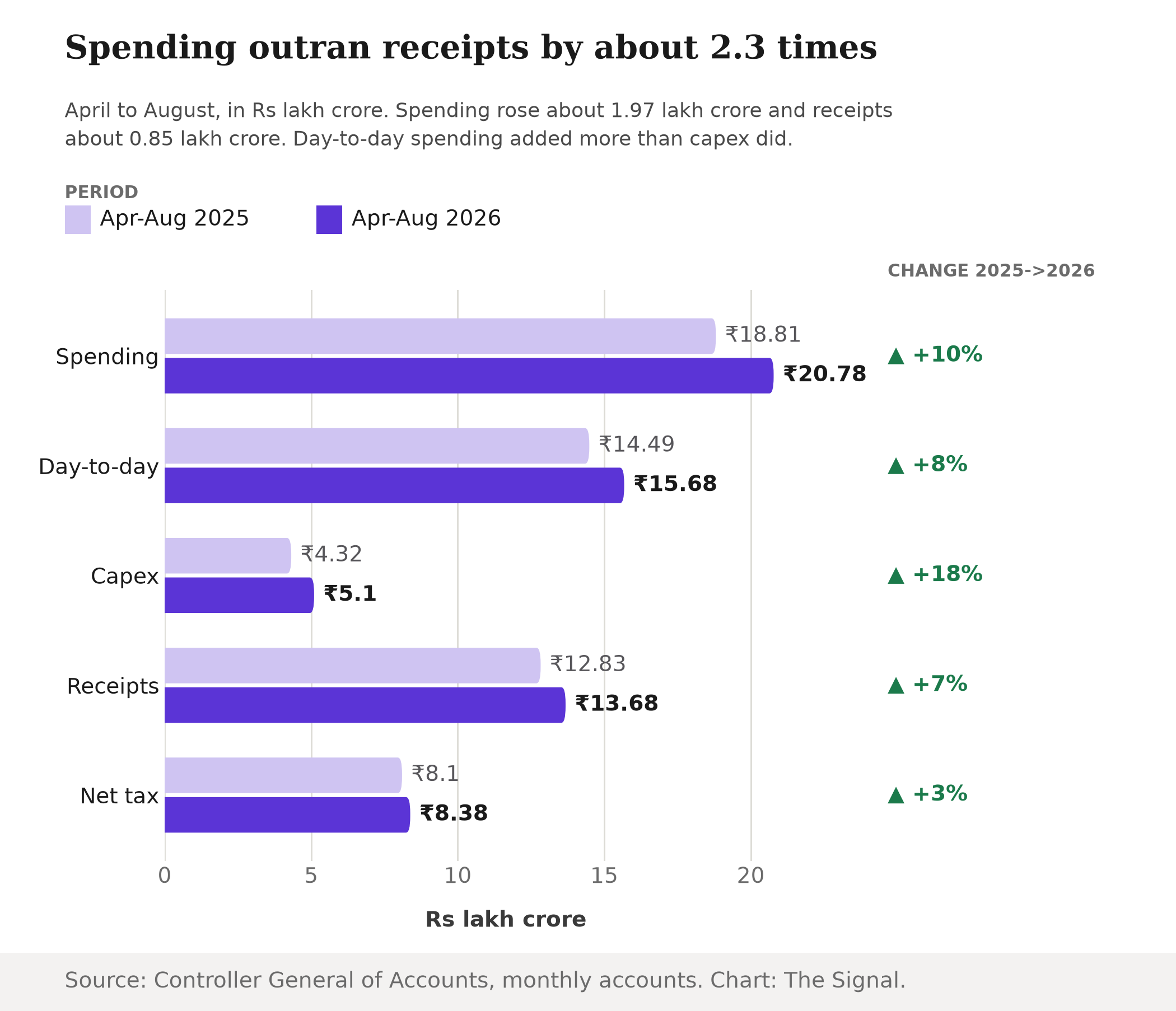
A tempting explanation is that the government front-loaded infrastructure spending. Capital expenditure is real money here. It reached Rs 5,09,949 crore, 41.7% of the Budget Estimate, against Rs 4,31,579 crore in April to August 2025. That is an 18% rise.
But it explains only part of the year-on-year gap. Total spending in April to August 2025 was Rs 18,80,862 crore, so spending rose by about Rs 1.97 lakh crore this year. Capex accounts for about Rs 0.78 lakh crore of that, or 40%. The other 60% is day-to-day spending: revenue expenditure of Rs 15,68,009 crore against Rs 14,49,283 crore a year earlier, an 8% rise.
Interest payments did not add to the pressure. Interest was Rs 5,14,810 crore, slightly below the Rs 5,28,668 crore paid in the same months of 2025. That makes the primary deficit, which strips out interest, look larger: Rs 1,95,439 crore, 67.0% of its estimate, against 23.7% a year earlier. It is about 2.8 times last year's level. The government is spending more on things other than interest, and collecting less of it back from taxes than it is spending.
The honest objection
Tax collection is seasonal. Advance tax instalments are concentrated late in the year, so a tax line that is behind a straight line in August is normal. Last year showed the pattern: net tax revenue was Rs 8,10,407 crore by August 2025, 28.6% of the estimate, and the year was not derailed.
That is a fair objection, and it explains why taxes being behind is not by itself a sign of trouble. But it cuts both ways. A tax line that is normal for August is also not evidence that the target is safe. This year's ratio is 29.2% against 28.6%, so taxes are tracking last year's seasonal shape. What has changed is the non-tax side, which is 68.2% of its estimate against 75.5% a year earlier. The cushion is smaller than it was, and it is already largely used.
The Signal
The number to hold onto is 29.2%. That is how much of the year's net tax estimate the Centre has collected. To finish the year on target, net tax revenue must deliver the other Rs 20.29 lakh crore (28,66,922 less 8,37,921) in seven months, roughly Rs 2.90 lakh crore a month, against about Rs 1.68 lakh crore a month so far. Advance tax will help. It cannot do all of it.
Watch the September and October accounts. If tax collections catch up while non-tax revenue stays near its current level, the deficit will stay near its straight line and the 4.3% target holds. If taxes lag again, the arithmetic leaves two exits: slower spending in the second half, or a bigger deficit. A deficit on schedule is only as good as the revenue that funds it.
Reporting basis: every figure is from the Controller General of Accounts' monthly "Union Government Accounts at a Glance" tables for the end of August 2026, July 2026 and August 2025, which are unaudited provisional figures, except the 4.3% of GDP target, which is from the Ministry of Finance's Union Budget 2026-27 highlights as published by the Press Information Bureau. The piece therefore rests on two origins, and the CGA tables carry nearly all of the weight. The straight-line pace, the tax and non-tax gaps, the August-only movement, the capex share of extra spending, the monthly averages, the August-only receipts and spending, and the required second-half tax collections are The Signal's calculations from those figures.