
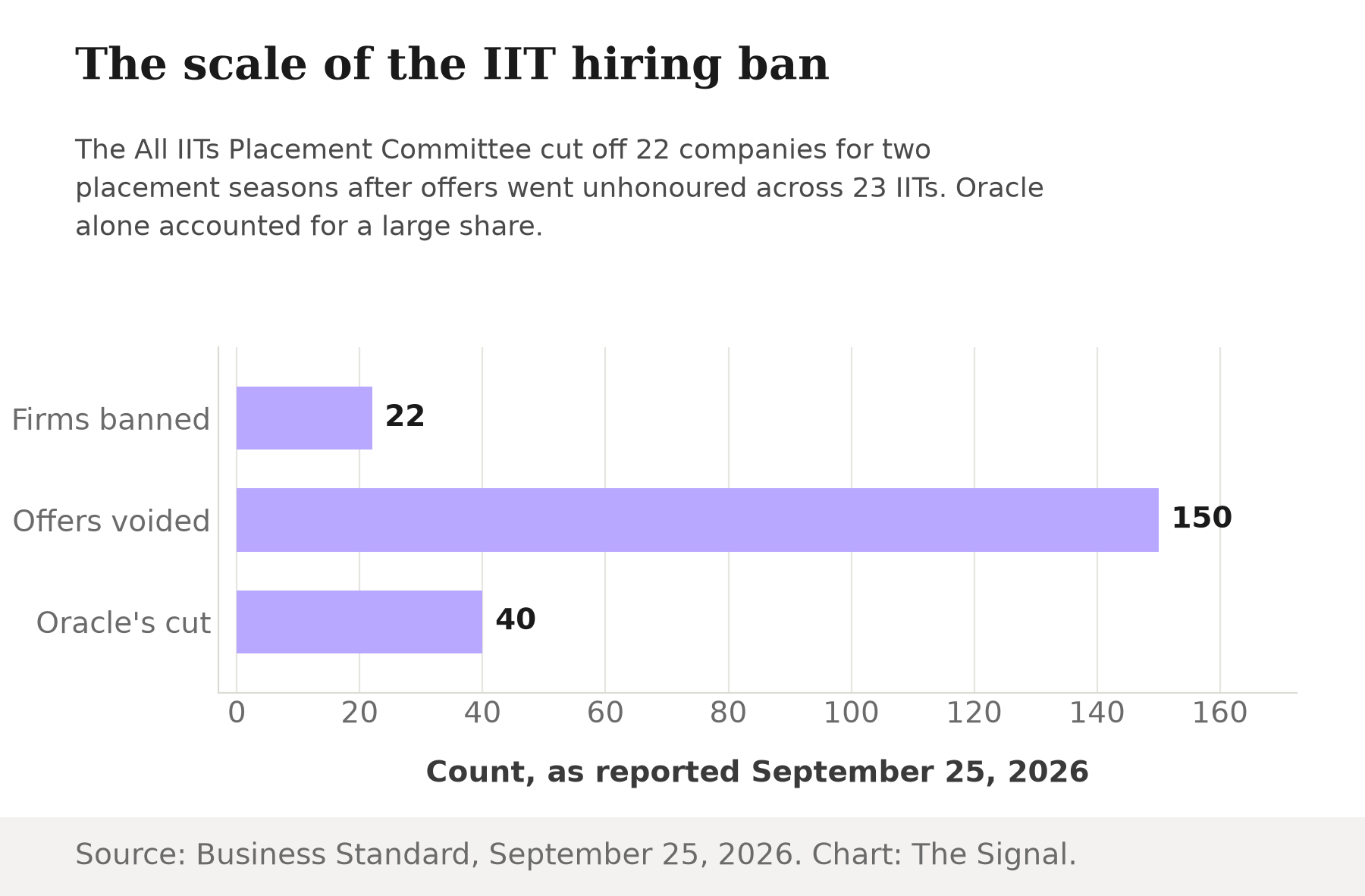
On September 25, 2026, the All IITs Placement Committee (AIPC) said it would stop cooperating with 22 companies for the next two placement seasons, after firms failed to honour offers made to students graduating in 2026, Business Standard reported. More than 150 offers were involved across 23 IITs, Business Standard reported. Oracle alone is reportedly facing the two-year exclusion after failing to honour around 40 of those offers, Business Standard reported. That works out to more than a quarter of every offer voided this season. AIPC convenor John Jose called this year's tally the highest in recent years, up from about 10 to 11 companies whose offers went unhonoured last year, Business Standard reported.
It is worth slowing down on that tally, because this is not the first time the AIPC has reached for this lever, and the lever has a specific weakness built into it. Nine months earlier, as the 2025-26 placement season opened on 1 December 2025, more than 20 companies were already barred from IIT campuses, having withdrawn offers made to the previous year's batch, some cancellations landing as late as June or July, right around the joining dates, Business Standard reported, citing a Times of India report.
The AIPC's only real weapon against a company that reneges is the threat of shutting it out of future hiring seasons. That threat bites exactly one type of company: one that still wants back in. Whether it wants back in is not something an IIT placement office controls. It depends on whether the company is hiring anyone at all, anywhere, two years from now.
A pattern, not an incident
The September ban did not appear out of nowhere. In June 2026, the AIPC asked more than 10 companies, including Oracle, Interview Kickstart and SuperAGI, to honour their offers or compensate the roughly 100 affected students with three months' salary, giving them until 15 August 2026 to comply or face exclusion from future campus recruitment drives, BW People reported, citing AIPC convenor John Jose's on-record comments to The Economic Times. The deadline passed without full compliance, and the September ban is the consequence.
Between one placement season and the next, the excluded-company count went up, not down, per Business Standard's December 2025 report and its September 2026 report.
| Announced | Companies affected | What triggered it |
|---|---|---|
| December 1, 2025 (2025-26 season opens) | More than 20 companies barred | Firms had withdrawn offers made to the prior year's batch, some cancellations landing in June or July, right around joining dates |
| September 25, 2026 | 22 companies barred for two seasons | More than 150 offers to the Class of 2026 went unhonoured across 23 IITs; Oracle alone accounted for about 40 |
Sources: Business Standard, December 2025; Business Standard, September 2026.
The firm at the centre was cutting, not hiring
The company anchoring this year's list was itself shedding staff, not adding it. Oracle's campus offer withdrawals followed a global restructuring that reportedly affected more than 30,000 employees worldwide, People Matters reported. A company that has just cut headcount at that scale loses less by sitting out two IIT placement seasons than a company that is actively racing to expand its India engineering base. The ban's cost to Oracle is not measured in seats it needed and didn't get. It is measured in seats it may not have wanted in the first place.
Corporate hiring itself is slowing
That is not just an Oracle story. Direct employment in India's technology sector is projected to grow just 2.3% year-on-year in FY26, to about 6 million people, a net addition of only 135,000 employees, as AI-driven productivity gains constrain headcount growth even as revenue keeps rising, Nasscom's Strategic Review 2026 estimates. Among the Sensex-30 companies that disclose year-by-year hiring data, total new hires at nine of them fell 27% in FY26 compared with FY24, with only two companies hiring more over the same period, a Mint analysis of Sensex-30 companies' disclosed hiring data finds.
Two separate data sets, from two separate origins, point the same way: corporate India is adding fewer jobs, not more.
| Signal (FY26) | What it shows | Source |
|---|---|---|
| Tech-sector employment, Nasscom estimate | Direct employment projected to grow just 2.3% year-on-year, to about 6 million, a net addition of 135,000 jobs | Nasscom |
| Sensex-30 fresh hiring, Mint analysis | New hires fell 27% at 9 of the 30 companies that disclose the figure; only 2 hired more | Livemint |
Sources: Nasscom, Strategic Review 2026; Livemint.
This is the mechanism the ban runs into. A two-year exclusion is a real cost only when the excluded firm expects to be hiring, at scale, from that exact pool, in 2028. For a recruiter that is barely growing headcount at all, or actively shrinking it, the AIPC's penalty and the company's own hiring plans are pointed in the same direction anyway. The ban does not need to work against a company that was not coming back regardless.
The honest objection
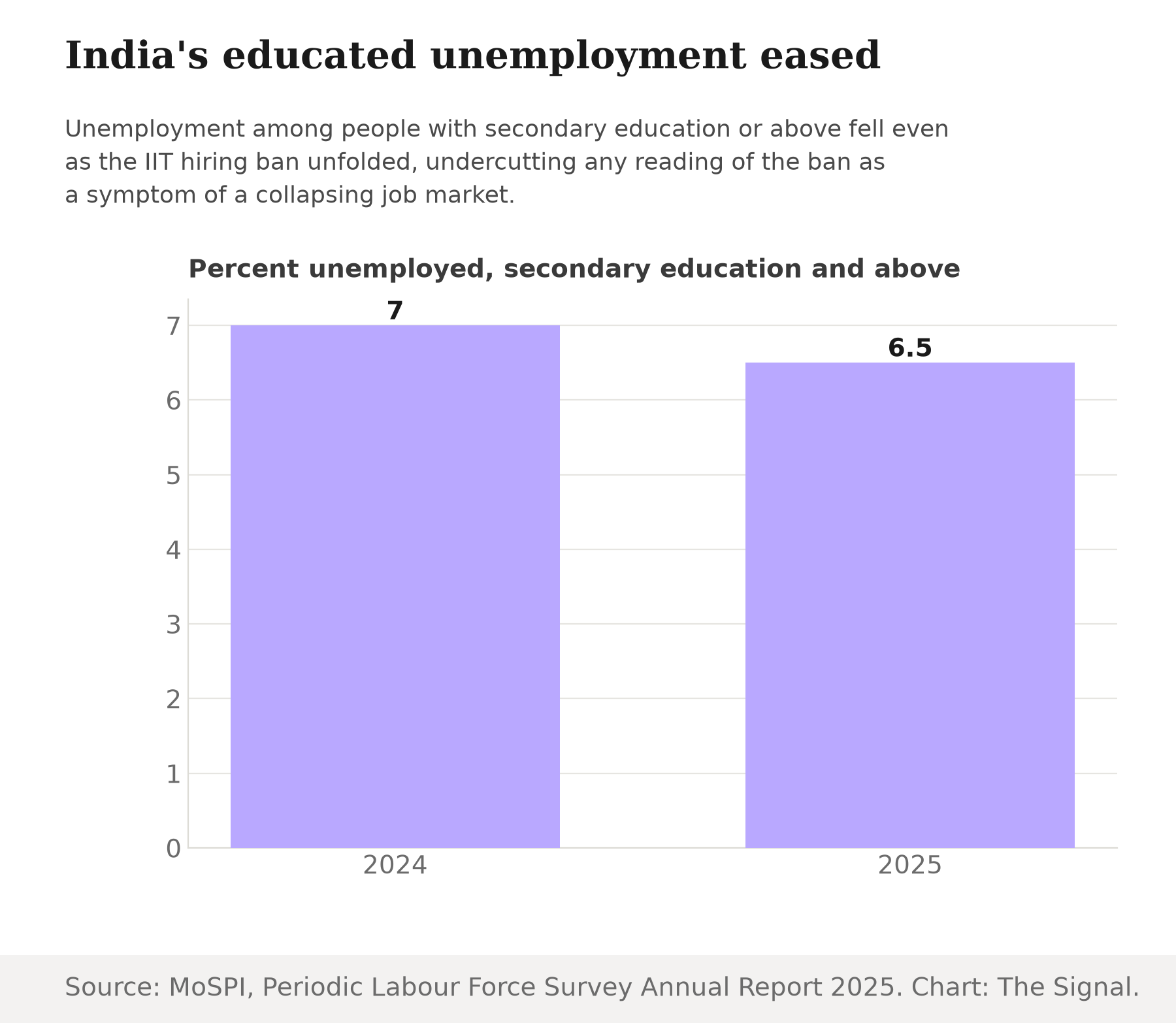
The strongest case against this reading is that the broader labour market is not deteriorating at all. India's unemployment rate among educated persons, those with secondary education and above, eased to 6.5% in 2025 from 7.0% in 2024, the Ministry of Statistics and Programme Implementation's Periodic Labour Force Survey Annual Report 2025 reports.
And the IIT credential itself is not losing its pull. At IIT Bombay alone in the 2023-24 academic year, 543 companies registered for campus placements, of which 364 companies actually made offers to 1,475 students, IIT Bombay's official Placement and Internship Report states.
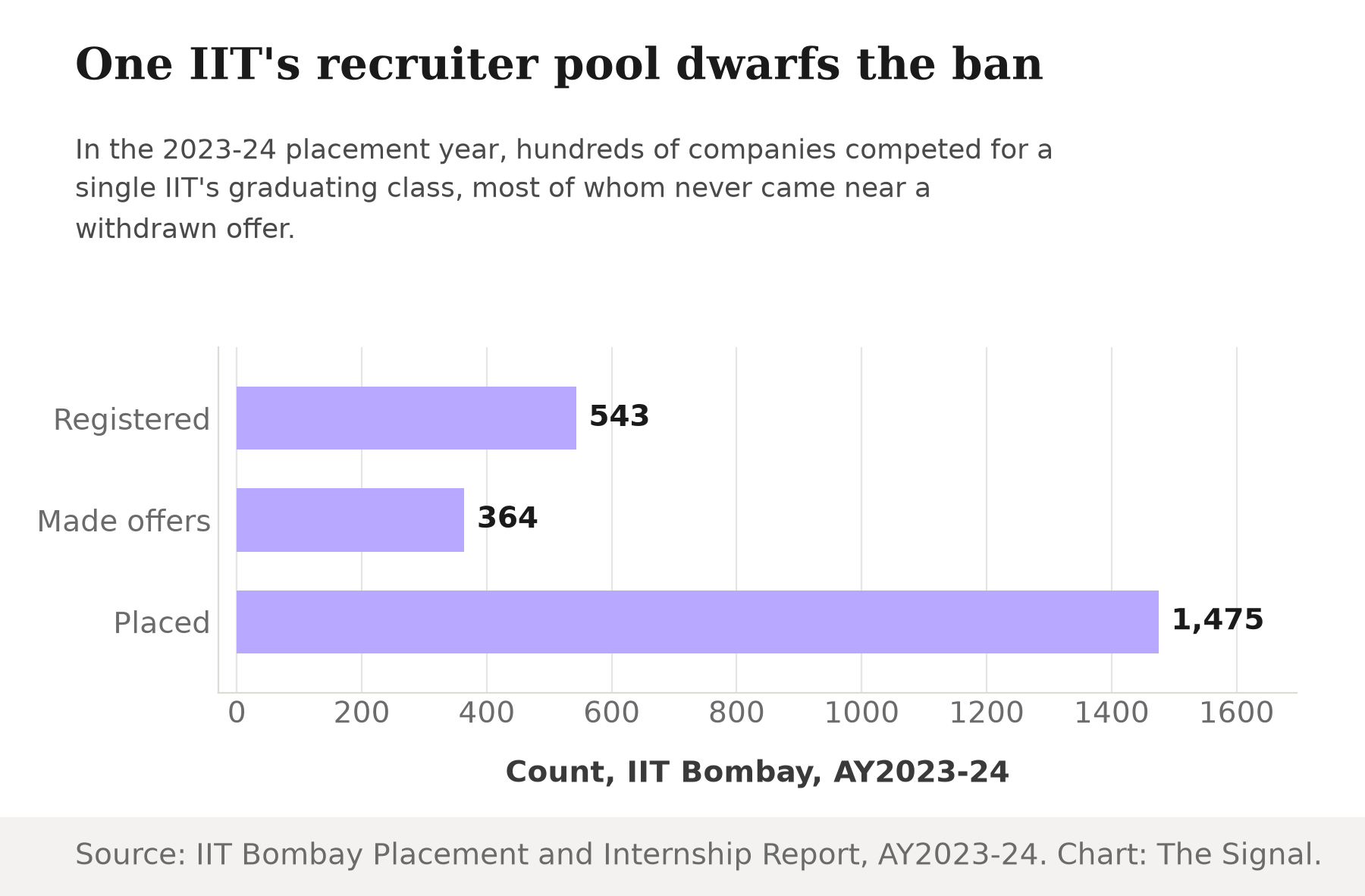
That scale is the real steelman. Lose access to 22 firms out of a recruiter pool in the hundreds, at a single IIT, and the placement office barely notices the gap. But the objection answers a different question than the one the ban is trying to solve. IITs are not worried about filling seats. They are trying to deter reneging specifically among the recruiters who dominate their placement lists, and those recruiters cluster in the same technology sector where Nasscom counts employment growth of just 2.3% and Mint counts hiring cuts at nine of India's thirty biggest listed companies, not in the broader labour market the PLFS is measuring. A national unemployment rate easing by half a percentage point does not, by itself, restore a technology recruiter's appetite for campus hiring.
The Signal
Every ban like this rests on an assumption the AIPC does not fully control: that the excluded company still wants what only an IIT placement season offers, first pick of the country's most competitive engineering graduates before any other recruiter gets a look. That assumption holds easily in a boom, when every recruiter is racing every other recruiter for the same seats. It is being tested now, in a season when corporate India is adding fewer jobs than it was two years ago and the biggest name on this year's banned list had just finished cutting its own headcount. The AIPC says it will formally notify all 22 companies by 30 September 2026, Business Standard reported. The number worth tracking after that is not this year's count of 22. It is next year's. If the tally falls, the ban deterred a would-be offender. If it climbs again, IITs are punishing companies that were never planning to come back.
Reporting basis: the September 2026 non-cooperation decision, the count of banned companies, the voided-offer tally, and Oracle's share of it are per Business Standard's report of the All IITs Placement Committee's decision, relayed from The Economic Times. The December 2025 count of barred companies is per Business Standard, citing a Times of India report. The June 2026 ultimatum to Oracle and other companies, and the compensation demand for affected students, are per BW People, citing AIPC convenor John Jose's on-record comments to The Economic Times. Oracle's global restructuring is per People Matters, citing Business Today and affected students' accounts. India's technology-sector employment projection is from Nasscom's Strategic Review 2026. The Sensex-30 hiring comparison is a Mint analysis of company-disclosed data. The educated-unemployment rate is from the Ministry of Statistics and Programme Implementation's Periodic Labour Force Survey Annual Report 2025. IIT Bombay's placement figures are from its own official Placement and Internship Report for academic year 2023-24. Oracle's share of this season's voided offers is The Signal's calculation from the Business Standard figures.