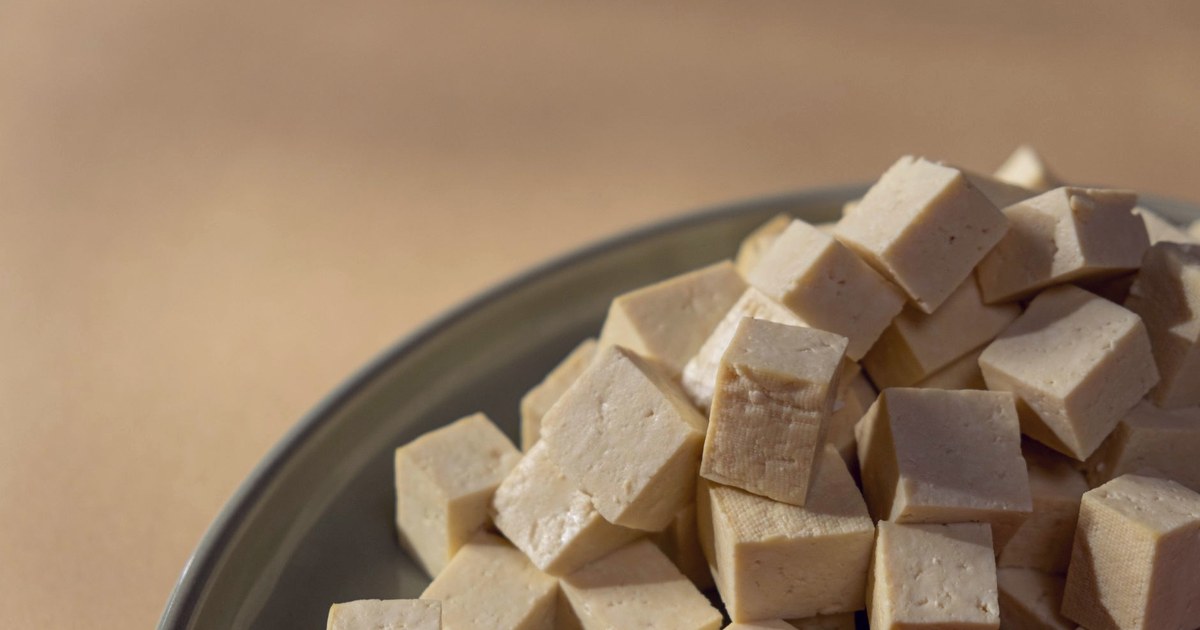
On September 22, 2026, the Food Safety and Standards Authority of India notified a draft rule that finally does what dairy processors have asked for over years: it defines paneer. FSSAI's draft amendment restricts the word "paneer" to milk-derived products and gives stakeholders 60 days to object before it is finalised. Products already licensed under FSSAI's own "Analogue in Dairy Context" category are the cheaper, non-dairy substitutes that restaurants and sweet shops routinely sell and menu as paneer. Under the new rule, they must now drop the word "paneer" from their nomenclature, labelling and marketing entirely. Read on its own, this looks like a clean regulatory win: a national food authority closing a labelling gap that let a soy or vegetable-fat block trade under a milk product's name.
The substitution the rule targets is not marginal on cost. Analogue paneer sold into commercial kitchens costs nearly half as much as dairy-based paneer, India's Consumer Affairs Secretary has said, arguing that hotels and restaurants using it should disclose the swap to customers. That gap, not the label, is what a kitchen weighs against a Rs 3 lakh fine it may never be asked to pay.
It is worth pausing on what the rule actually changes and what it leaves untouched. FSSAI is not creating a new inspection wing, a new lab test, or a new enforcement budget. It is attaching a legal definition to a penalty structure that has not moved since Parliament wrote it two decades ago.
That penalty is Section 52 of the Food Safety and Standards Act, 2006, which caps the fine for mislabelling a food product, such as calling a non-dairy analogue "paneer," at three lakh rupees, no matter the size of the business that pays it. GCMMF, the cooperative that markets Amul and calls itself India's largest FMCG organisation by revenue, reported a turnover of Rs 73,450 crore in FY2025-26, the year to March 2026, up 11.4% from Rs 65,911 crore the year before. Spread that turnover across the year, our calculation, and GCMMF took in roughly Rs 14 lakh every minute. The maximum fine FSSAI can levy on a company for calling a soy block "paneer" is smaller than what India's largest dairy cooperative earns before that minute is over.
The Section 52 fine cap is smaller than one minute of GCMMF's revenue.
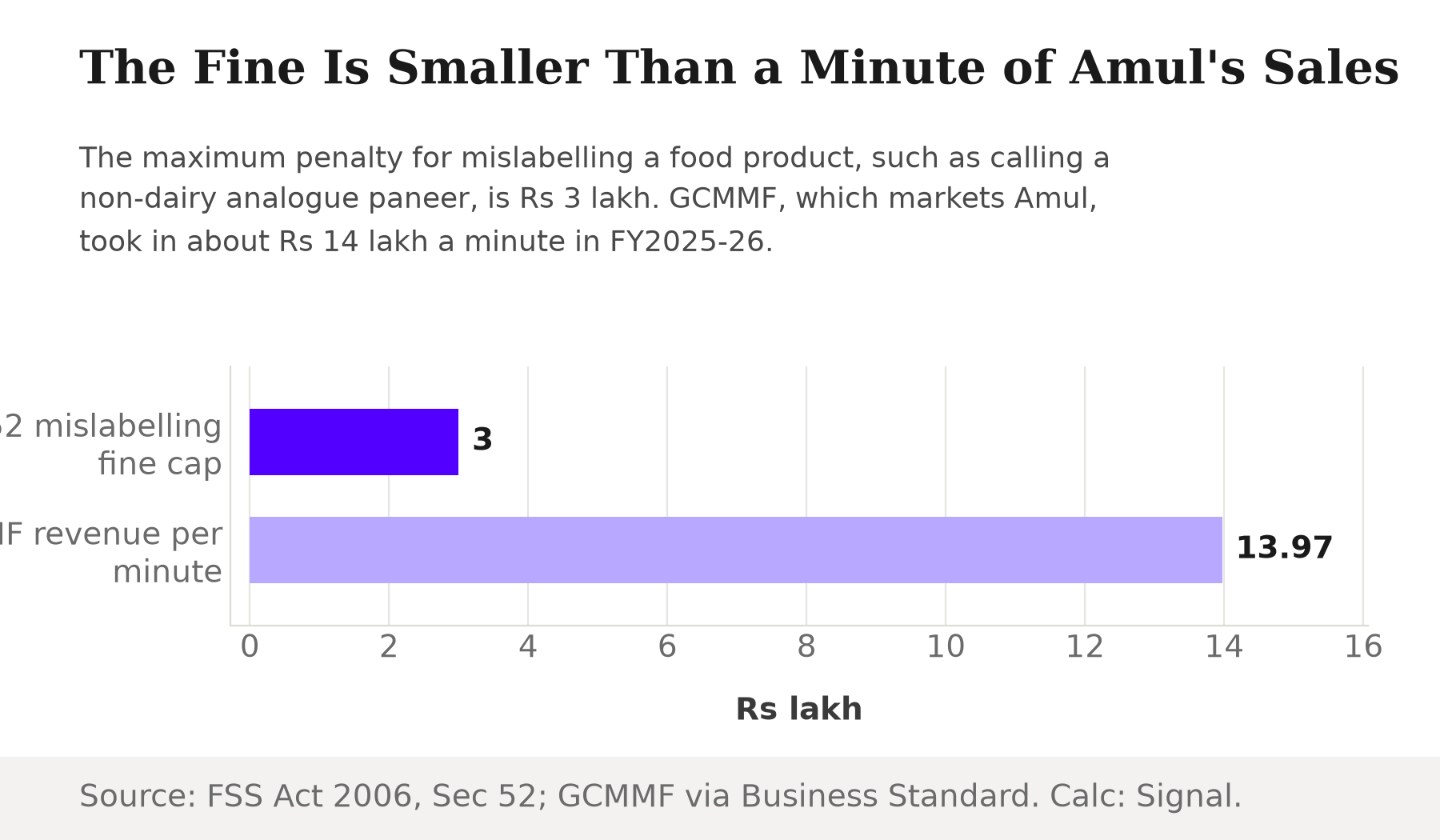
Source: Food Safety and Standards Act, 2006, Section 52; GCMMF turnover, via Business Standard. Per-minute figure is The Signal's calculation. Chart: The Signal.
A Penalty Frozen Since 2006
Section 52 is not the only lever available, and the comparison is sharper once the other one is on the table. Section 59 of the same Act sets the fine for selling unsafe food, as distinct from merely mislabelling it. Where no one is hurt, the fine is up to one lakh rupees. Where the food causes death, it rises to a minimum of ten lakh rupees, alongside imprisonment from seven years to life. Both figures were fixed when the Act was written and have not changed since.
A labelling violation and a fatality carry penalties fixed in the same 2006 law.
| Provision | What it punishes | Maximum penalty |
|---|---|---|
| Section 52 | Mislabelling, such as calling a non-dairy analogue "paneer" | Fine up to Rs 3 lakh |
| Section 59, no injury | Selling unsafe food | Up to 6 months' imprisonment, fine up to Rs 1 lakh |
| Section 59, death caused | Selling unsafe food that causes death | 7 years to life imprisonment, fine no less than Rs 10 lakh |
Source: Food Safety and Standards Act, 2006, Section 52 and Section 59. Table: The Signal.
The Enforcement Record Behind the New Rule
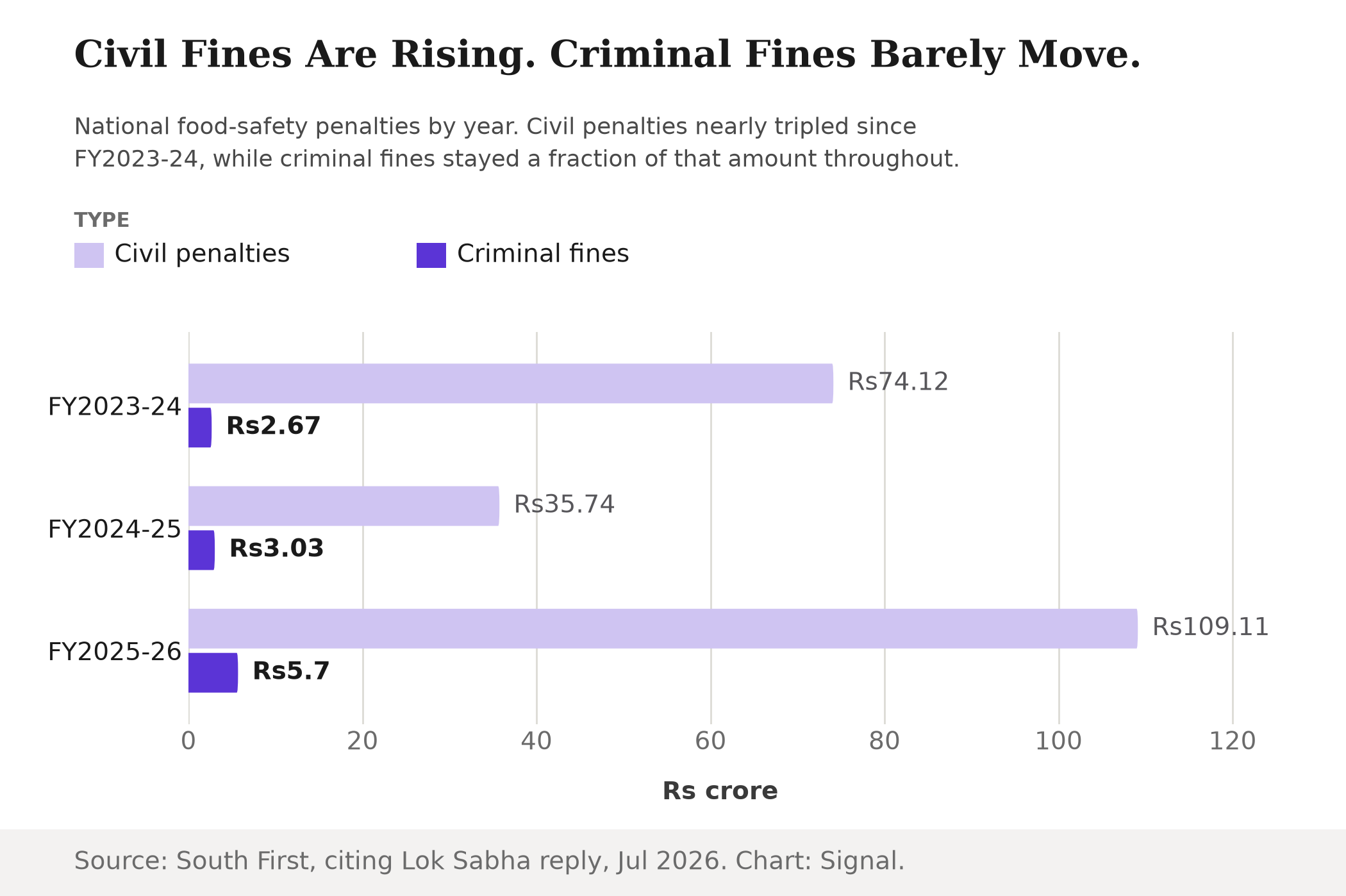
FSSAI's new definition will be enforced by the same national machinery that already handles food-safety violations, and that machinery's own numbers are the strongest reason to doubt the fine will change behaviour. Civil penalties collected under the Act rose to Rs 109.11 crore in FY2025-26, the year to March 2026, from Rs 35.74 crore the year before and Rs 74.12 crore in FY2023-24, while criminal fines over the same three years totalled just Rs 5.70 crore, Rs 3.03 crore and Rs 2.67 crore respectively.
Civil penalties have climbed sharply since FY2023-24; criminal fines have barely moved.
Source: Ministry of Health and Family Welfare, Lok Sabha reply, via The South First. Chart: The Signal.
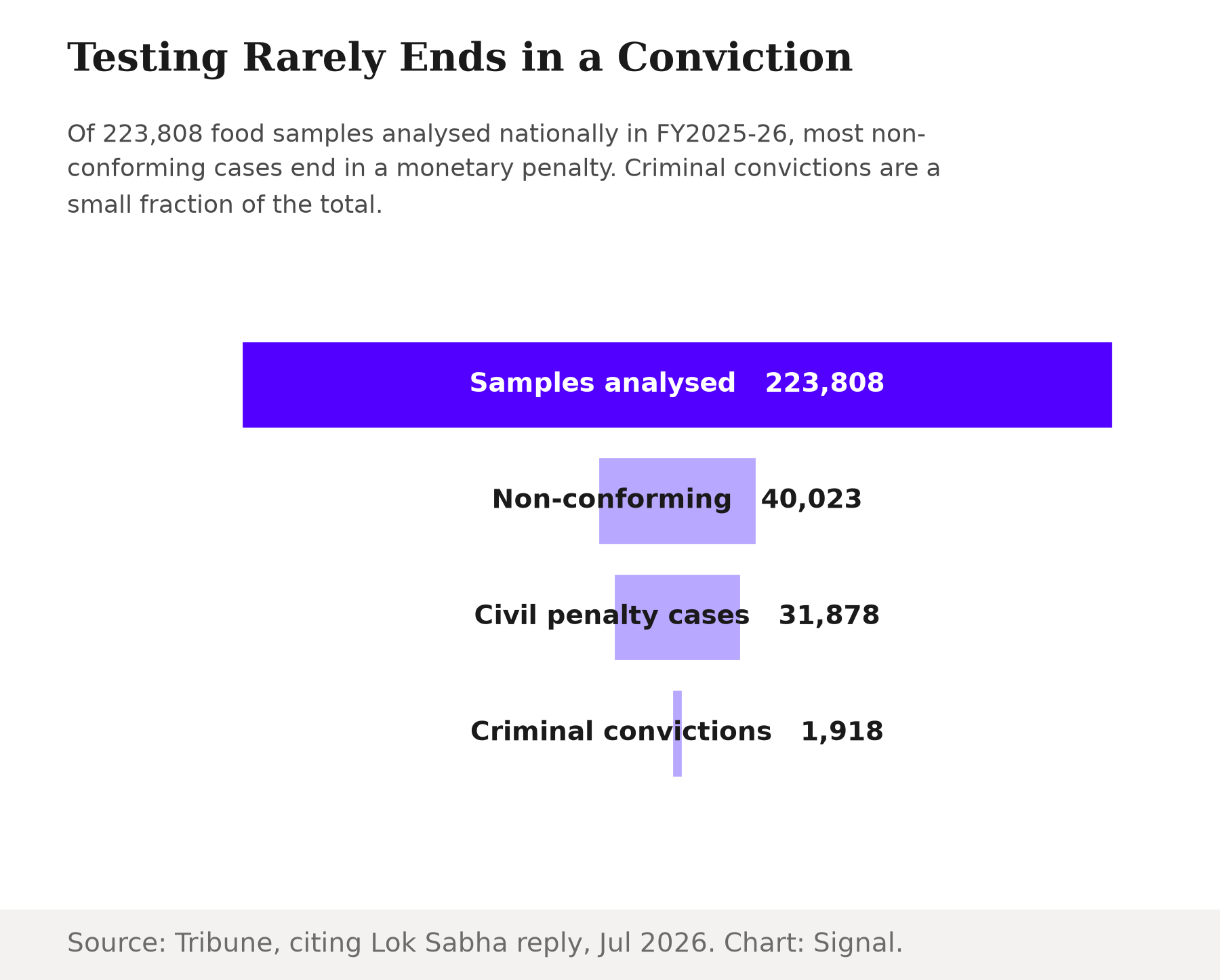
Civil penalties are rising because more cases are being processed, not because the fine per case has grown. In FY2025-26, authorities analysed 223,808 food samples nationally and found 40,023 non-conforming. Of those, 31,878 cases were closed with a civil monetary penalty, while only 1,918 ended in a criminal conviction, a finding of guilt in court rather than a fine paid to close the file.
A civil penalty, not a criminal conviction, is how a non-conforming case typically closes.
Source: Ministry of Health and Family Welfare, Lok Sabha reply, via The Tribune. Chart: The Signal.
That is not a one-year pattern. Over the five years to FY2025-26, only 3.3% of the 1,85,780 non-conforming food samples found nationally, 6,203 cases, ended in a criminal conviction, while 75%, or 1,39,507 cases, were settled with a penalty alone.
Dairy Already Fails Inspection Often
Paneer's new definition lands in a category regulators already flag at a high rate. In FY2024-25, the year to March 2025, FSSAI and state authorities analysed 33,405 milk and milk product samples nationally. Of these, 12,780 were found non-conforming and 12,057 cases were launched against the businesses responsible, a non-conformance rate of roughly 38%, our calculation. Dairy was already generating civil cases at scale under the same fine schedule before this rule existed. Naming "analogue paneer" as a specific violation adds a category to that pipeline; it does not add capacity or raise the stakes for the businesses moving through it.
That is not a hypothetical extrapolation; one state has already tested for it. Before FSSAI's national draft rule, Maharashtra's Food and Drug Administration tested 308 paneer and non-dairy analogue samples between April 2025 and March 2026 and found 109 of them, 35.4%, non-conforming, with 30 declared unsafe for consumption. It then banned analogue paneer's manufacture, storage, distribution and sale in the state for a year starting July 30, 2026. Even a state that moved early against analogue paneer specifically relied on the same civil-side instrument this piece has already shown dominates national enforcement: testing and an administrative order, not a criminal conviction.
The Honest Objection
The strongest defence of the new rule is that a fine was never the real point of defining "paneer." A clear legal definition lets FSSAI's inspectors seize mislabelled stock and act against a business's license without waiting for a criminal court, and it opens the door to Section 59's far steeper penalties in the rarer case where an analogue product turns out to be unsafe, not merely mislabelled. On that view, the Rs 3 lakh cap under Section 52 is beside the point: the definition, not the fine, is doing the work.
That case is real, but it has to survive contact with the same enforcement data cited above. Three-quarters of the country's non-conforming food cases over five years ended in a penalty and nothing else, while just 3.3% reached a criminal conviction. If "analogue paneer" cases move through the system the way food-safety cases generally have, most will produce the same instrument this piece opened with: a modest civil fine, not a license cancellation or a criminal case. A sharper legal definition helps inspectors identify a violation. It does not by itself change what happens once one is found.
The Signal
FSSAI has done the easy half of the job: it has written down, precisely, what paneer is, in a market large enough that one cooperative can report Rs 73,450 crore in a single year. It has not touched the fine that a restaurant or sweet shop actually weighs against the savings from cheaper non-dairy ingredients, and that fine remains smaller than a minute of that cooperative's revenue. Watch what FSSAI reports once the 60-day objection window closes in November 2026 and enforcement data for the new rule starts to accumulate: a visible rise in Section 52 penalty cases tied specifically to "analogue paneer" would show the definition is being acted on. A rule that sits on the books beside an unchanged, two-decade-old fine schedule would show it is a definition, not a deterrent. A word is not a price, and until the fine catches up to the size of the businesses it is meant to restrain, mislabelling will keep being the cheaper option.
Reporting basis: FSSAI's draft notification and its 60-day objection window are as reported by Business Standard, via Press Trust of India; the requirement that existing "Analogue in Dairy Context" products remove "paneer" from their labelling is per ThePrint's coverage of the same draft notification. The penalty structure is the Food Safety and Standards Act, 2006 itself: Section 52's mislabelling fine as reproduced by Assam's Food Safety Commissionerate, and Section 59's unsafe-food penalties from the statutory text via IndianKanoon. National civil and criminal penalty totals for FY2023-24 through FY2025-26 are from a Ministry of Health and Family Welfare reply in the Lok Sabha, as reported by The South First; the FY2025-26 sample, non-conformance and conviction counts are from a separate Lok Sabha reply, as reported by The Tribune; and the five-year conviction rate is from a Rajya Sabha reply, as reported by ThePrint. The FY2024-25 milk and milk-product sample data is from a Lok Sabha reply distributed via the Press Information Bureau. GCMMF's turnover figure is per Business Standard, citing the cooperative's own release. The analogue-versus-dairy price comparison is per Business Standard, via Press Trust of India, quoting India's Consumer Affairs Secretary; Maharashtra's pre-existing paneer and dairy-analogue testing data and its one-year state ban are per Business Standard's reporting on the state FDA's order. Amul's per-minute revenue rate and the milk-sample non-conformance rate are The Signal's calculations from those figures.