
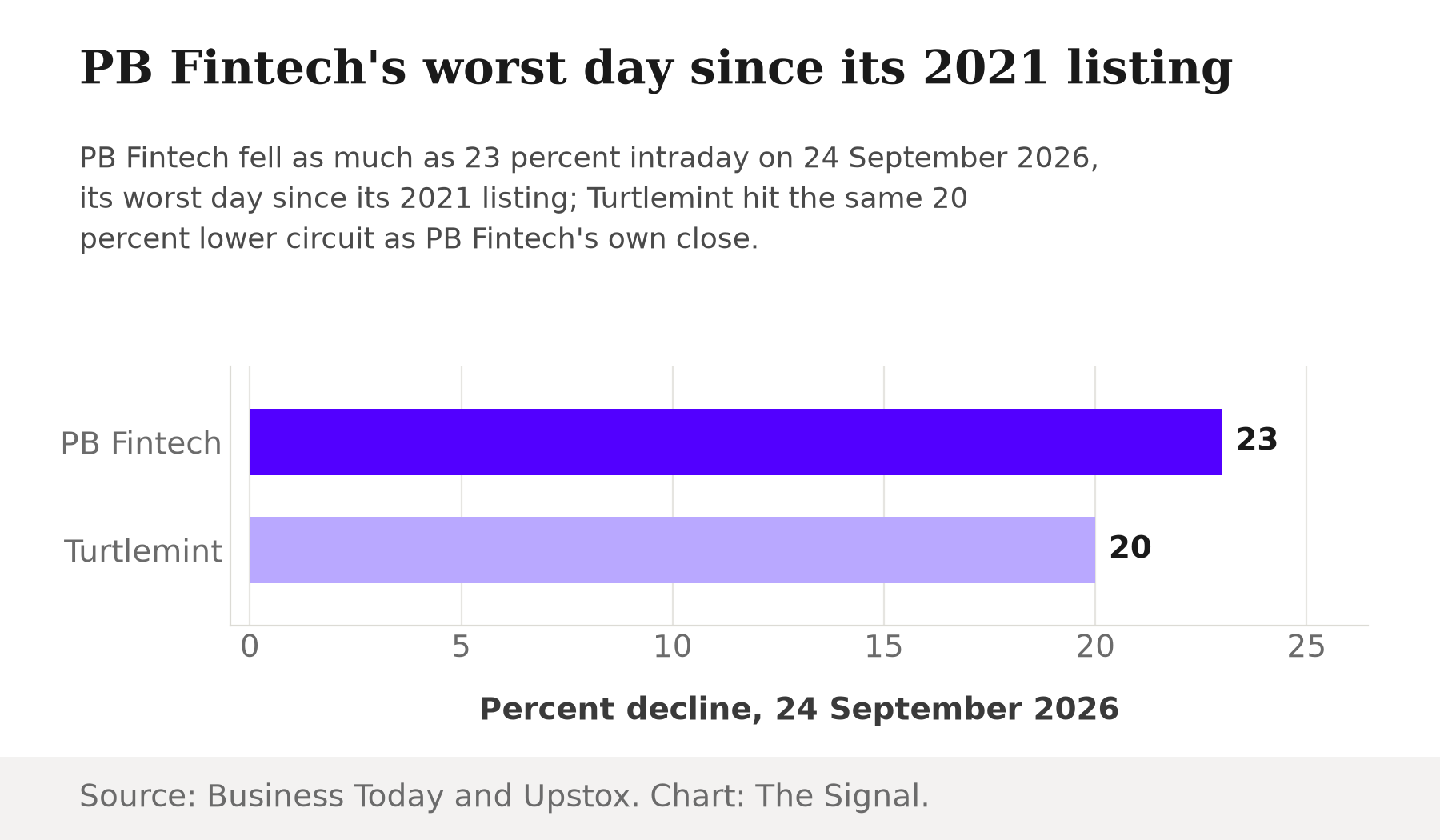
On 24 September 2026, PB Fintech and Turtlemint both hit their lower trading circuits, each losing a fifth of their value in a single session. PB Fintech shares fell as much as 23 percent intraday to a low of ₹1,455.30, the stock's worst single-day decline since its November 2021 stock-market debut. By the close, it was locked in at a 20 percent lower circuit at ₹1,508.90, down from the previous close of ₹1,886.30, and Turtlemint Fintech Solutions fell the same 20 percent to ₹109.04. The trigger was not an earnings miss or a scandal. It was a regulatory paper. The day before, both stocks had actually gained 4.5 percent, so this was not a decline the market had been pricing in for weeks. It arrived, and it arrived hard.
It is worth asking why a single consultation paper on insurance commissions could erase a fifth of a listed "insurtech platform's" value overnight. A technology company does not usually lose a fifth of its worth because a regulator touched a fee schedule.
The answer sits in PB Fintech's own numbers. In the quarter ended 30 June 2026, its core online business, Policybazaar and Paisabazaar together, generated ₹5,755 crore of insurance premium and ₹1,067 crore of insurance revenue, an implied take rate of about 18.5 percent of every rupee of premium that passed through the platform. That is a commission, not a software margin. PB Fintech's stock was never really pricing a technology premium. It was pricing an uninterrupted commission rate, and on 24 September 2026 the market found out that rate was about to be interrupted.
What IRDAI actually proposed
On 23 September 2026, the Insurance Regulatory and Development Authority of India released a Public Consultation Paper titled "Recalibrating Economics of Insurance Distribution," with comments due by 25 October 2026. Its core mechanism is a much tighter ceiling on the Expense of Management, the EoM: the cap on everything an insurer can spend on distribution and administration combined.
IRDAI wants insurers' overall distribution costs cut by roughly half within five years.
| Segment | Ceiling today | Proposed in 2 years | Proposed in 5 years |
|---|---|---|---|
| Life insurers | Around 30% of premium | 15% | 12.5% |
| General insurers | Around 30% of premium | 25% | 20% |
Source: IRDAI's consultation paper, Box 2: EoM Limits and Glide Path.
The paper sets life insurers on a glide path to an EoM of 15 percent of premium within two years and 12.5 percent within five, and general insurers to 25 percent within two years and 20 percent within five, replacing the more flexible entity-level regime insurers have operated under since 2023.
The caps that matter most
Inside that overall ceiling sit specific commission caps, aimed at exactly the products insurtech platforms sell.
Health commissions drop three to four times over when the same policy is sold alongside a loan.
| Product and channel | First year or new-business commission | Renewal commission |
|---|---|---|
| Individual health, standalone policy (distribution entities) | 15% | 5% |
| Individual health, standalone policy (agents) | 20% | 10% |
| Motor third-party cover, sold with a loan | Nil | n/a |
| Motor own-damage or personal accident, sold with a loan | 5% | n/a |
| Health cover, sold with a loan | 5% | 2.5% |
| Life term cover, single premium, sold with a loan | 2% | n/a |
Source: IRDAI's consultation paper, Box 4A, Box 4A-E on general insurance packaged with a loan and Box 4B-B on life insurance packaged with a loan.
IRDAI caps first-time individual health commissions at 15 percent of premium for distribution entities and 20 percent for individual agents, with renewals falling to just 5 percent and 10 percent. Insurance sold at the point of a loan is squeezed harder still: motor third-party cover bundled with a loan would carry no commission at all, motor own-damage or personal accident cover 5 percent, and health cover 5 percent new or 2.5 percent on renewal, while a single-premium credit-life term policy sold alongside a loan would earn a distribution-cum-lending entity just 2 percent in its first year.
Why the regulator moved now
IRDAI's own data explains the urgency, and it has nothing to do with any single company.
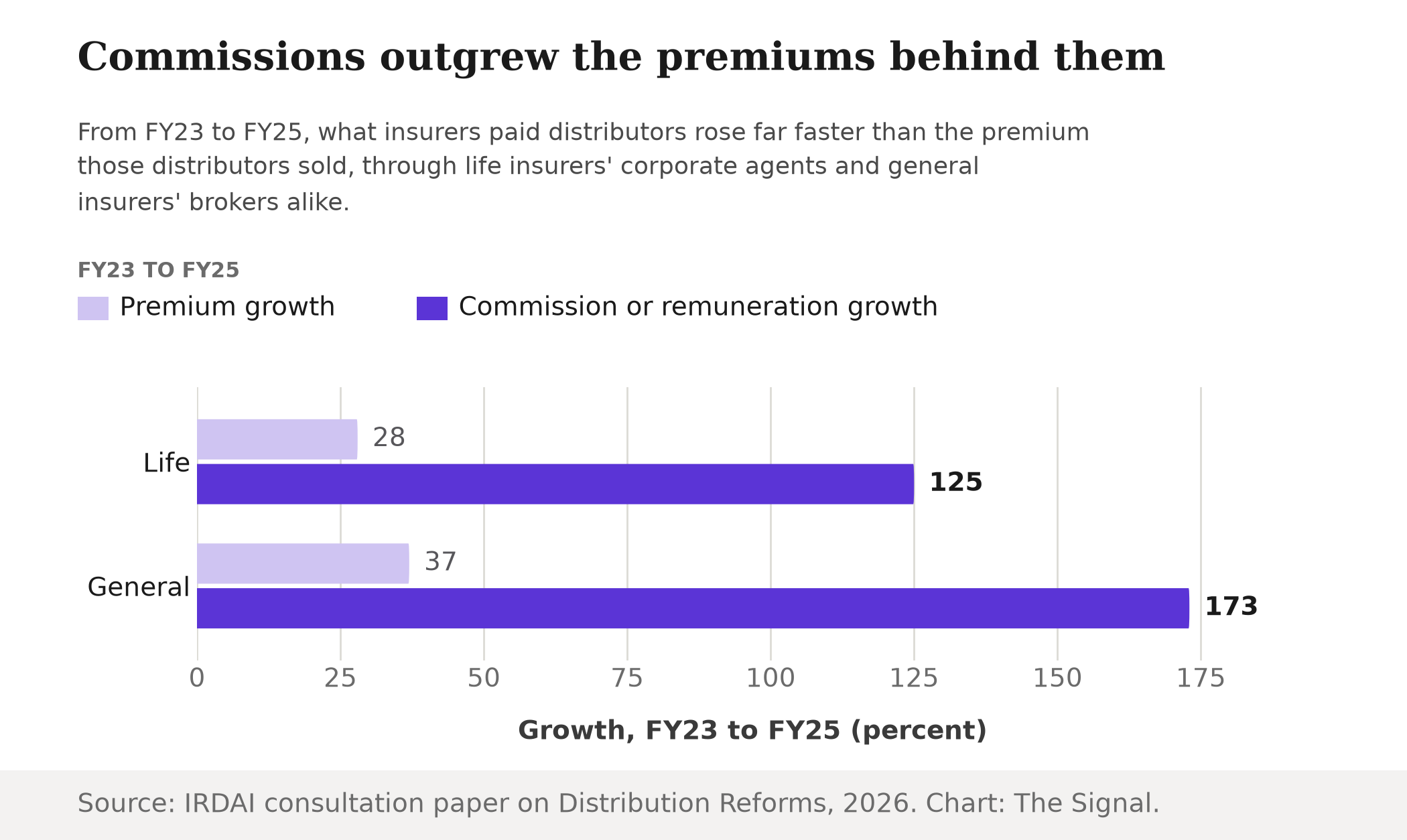
Across a representative sample covering about 92 percent of premium procured through corporate agents, new life insurance business grew 28 percent from FY23 to FY25 while total distributor remuneration rose 125 percent, nearly four and a half times faster. In the general insurance broker channel over the same two years, premium grew 37 percent while commissions paid rose 173 percent, and motor insurance commissions alone nearly tripled from around 9 percent to 25 percent of premium.
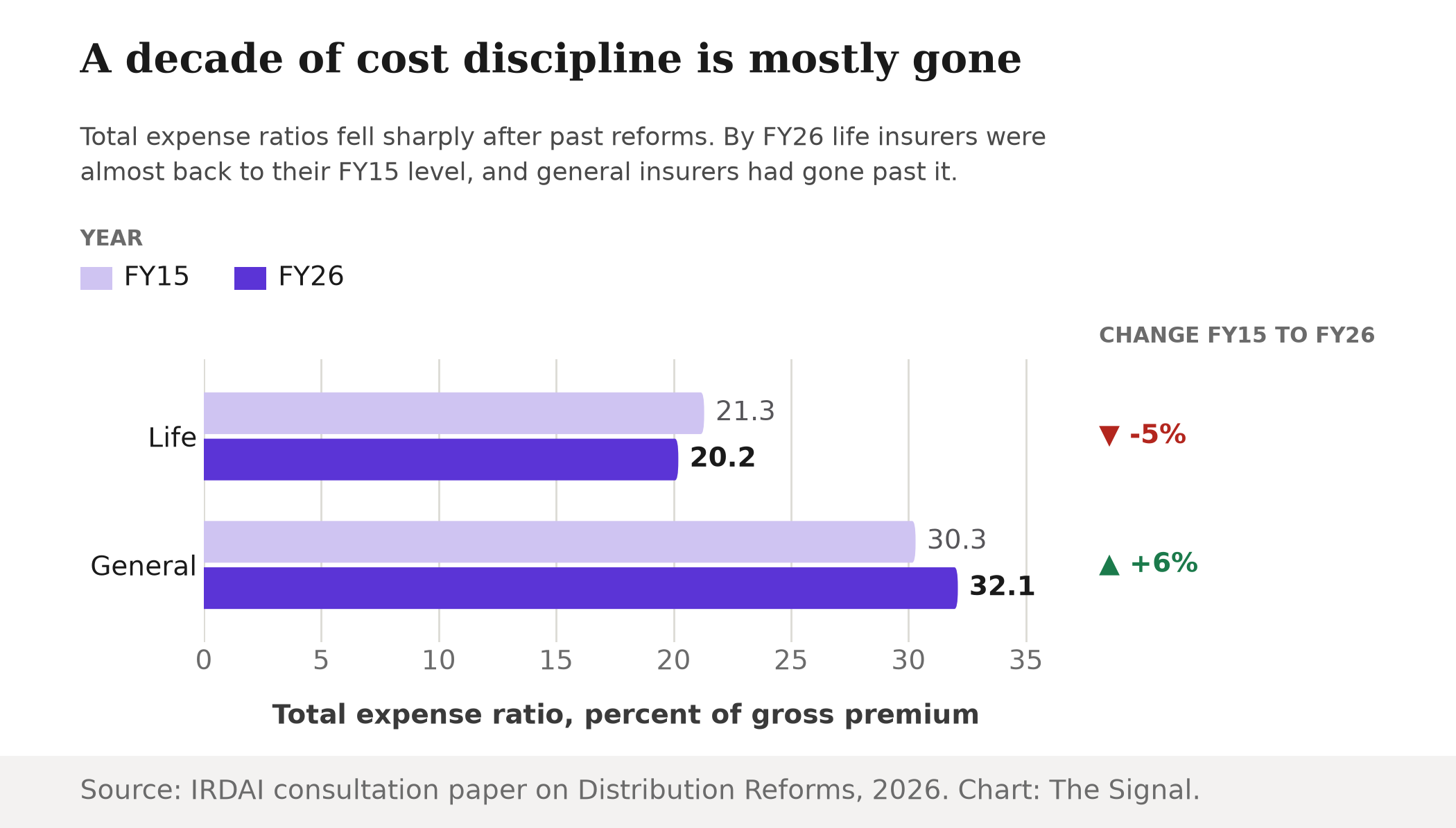
The result shows up in insurers' own cost lines. Private general insurers' total expense ratio climbed to 32.1 percent of gross premium in FY26, up from FY15's 30.3 percent, and private life insurers' expense ratio reached 20.2 percent in FY26, nearly back to FY15's 21.3 percent: a decade of cost discipline, largely undone since commissions were deregulated in 2023.
What PB Fintech's own numbers already say
PB Fintech's total revenue was ₹1,888 crore, up 40 percent year on year, and its profit after tax was ₹163 crore, up 92 percent year on year, a 9 percent PAT margin, in the quarter immediately before IRDAI's proposal. Those are strong numbers for a business investors have long treated as a technology platform trading on a technology multiple. But strip the framing away and the ₹5,755 crore of premium sitting behind ₹1,067 crore of insurance revenue tells the same story as the table above: PB Fintech's core business earns a commission on someone else's premium. The cap does not touch a feature or a user base. It touches the rate.
The honest objection
The strongest case for the sell-off being overdone is that nothing has actually changed yet. Comments on IRDAI's paper are due only on 25 October 2026, and consultation papers in India routinely soften between draft and final rule, especially on numbers this aggressive. PB Fintech is also less exposed than a pure insurance broker: its own quarter shows ₹2,617 crore of premium and ₹694 crore of revenue coming from "New Initiatives" outside the core online business, and credit already contributes alongside insurance within the core business itself. A company posting 40 percent revenue growth and improving margins, as PB Fintech was in the quarter before the paper landed, has more room to absorb a squeeze than a single-line insurance agent does.
That case is real, but it does not explain the size of the reaction. A draft that might still soften does not usually cost a stock a fifth of its value in one session. If the market had been convinced the core economics were safe, it would have waited for the final rule instead of selling first. The crash is the market's own admission that PB Fintech's premium was priced on the assumption commissions would stay where they were.
The Signal
Forget PB Fintech's stock price. The number to hold onto is the 18.5 percent take rate sitting behind it, and the fact that IRDAI has now published the exact numbers showing why that rate is under threat. A regulator that has just measured how far commissions outgrew premiums between FY23 and FY25 is not finished writing rules once its comment window closes on 25 October 2026. Every insurance distributor trading at a platform multiple, not just PB Fintech, is pricing the same bet: that a regulated pass-through will keep behaving like a technology margin. On 24 September 2026, for one afternoon, the market stopped believing it.
Reporting basis: the IRDAI consultation paper's release date, comment deadline, EoM ceilings and commission caps, and the FY23-to-FY25 premium, remuneration and expense-ratio data are all from IRDAI's own consultation paper and press release, "Recalibrating Economics of Insurance Distribution," published 23 September 2026. PB Fintech and Turtlemint's share price moves on 24 September 2026 are per Business Today and Upstox, and the prior session's gain is per Angel One; all three are markets-desk reports corroborated against each other and against the mechanical circuit-limit math. PB Fintech's premium, revenue and profit figures are from the company's own Q1 FY27 investor earnings presentation, dated 5 August 2026. The implied take rate is The Signal's calculation from PB Fintech's own disclosed premium and revenue figures.