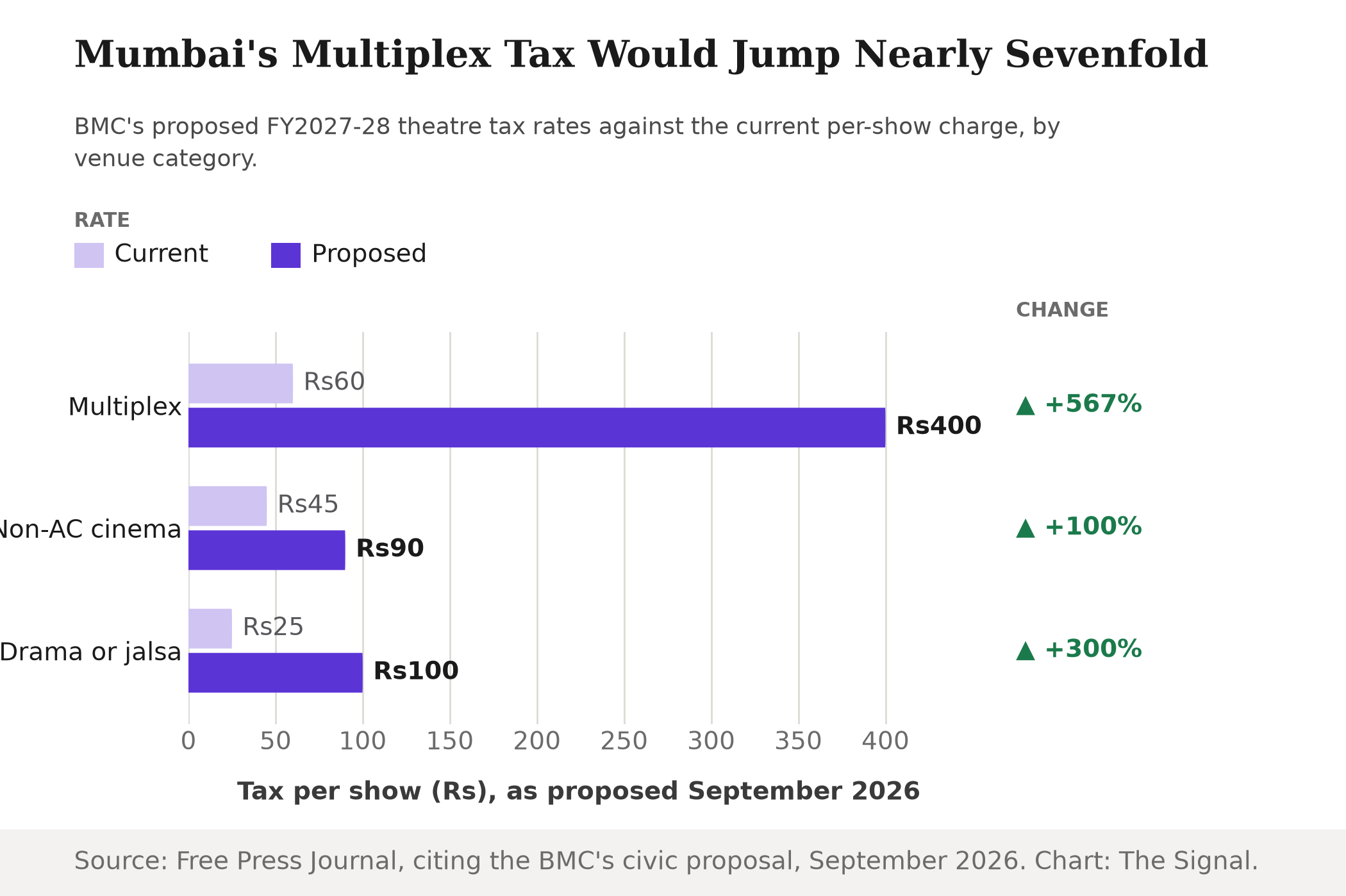
The Brihanmumbai Municipal Corporation wants to raise the tax on a multiplex movie ticket in Mumbai from Rs 60 to Rs 400 a show, a jump of roughly 567 percent, as its Law Committee has proposed for the 2027-28 financial year. Single-screen air-conditioned cinemas would move from Rs 60 to Rs 200 a show, non-AC halls from Rs 45 to Rs 90, and dramas, jalsas and other stage programmes from Rs 25 to Rs 100, pending sign-off from Maharashtra's Urban Development Department. Read as a headline number, it looks like Mumbai's civic body reaching further into ticket prices than it ever has.
It is worth slowing down on that number, because the more interesting fact is not how large the increase is, but that this tax exists at all. Since 1 July 2017, India has run a single nationwide Goods and Services Tax that most readers assume swallowed every levy that used to sit on a cinema ticket, including the old state entertainment tax. A CBIC/GST Council press release on the tax incidence of entertainment services states plainly that taxes on entertainments and amusements "have been subsumed under GST except to the extent of taxes on entertainments and amusements levied by a Panchayat or a Municipality". That final clause is doing all the work. Mumbai's theatre tax is not a GST loophole and not a state tax that quietly survived reform. It is a municipal tax that GST was designed, from the outset, to leave alone.
GST itself has not gone anywhere on that same ticket. A cinema ticket priced Rs 100 or less currently carries 5 percent GST, cut from 12 percent with effect from 22 September 2025, per the GST Council's own record of what its 56th meeting changed. That national tax and the BMC's local theatre tax are not alternatives charged on the same ticket. They stack, one federal and ad valorem, the other municipal and a flat rupee figure per show, and only the second one is what BMC's proposal would change.
Why GST could not touch it
The carve-out is not an accident of drafting. The Constitution (101st Amendment) Act, 2016, the same amendment that created GST, rewrote Entry 62 of the State List so that it covers only "taxes on entertainments and amusements to the extent levied and collected by a Panchayat or a Municipality or a Regional Council or a District Council". Before that amendment, Entry 62 let state governments tax entertainment broadly, which is how the old state entertainment tax on cinema tickets applied nationwide. The 2016 rewrite narrowed the states' own power down to almost nothing, and GST absorbed everything the states gave up. What the amendment did not touch was a separate, older power a municipality already held to levy its own local tax on amusements: that power sat one level of government below the one GST was reforming, so removing the state's slice of Entry 62 never required removing the municipal one.
BMC's proposed multiplex rate is nearly seven times the current one, the steepest jump of any venue category.
A power older than GST by nearly seven decades
That municipal power in Mumbai's case is not new, and it is not a workaround discovered after GST arrived. The Maharashtra Municipal Corporations Act, 1949 already lists a "theatre tax", defined in the Act itself as "a tax on amusements or entertainments", among the taxes a Corporation such as the BMC may impose under its own Chapter XI. The BMC has held the legal tool to tax movie and stage tickets since 1949, decades before GST existed and 77 years before this proposal. The 2026 rate hike is not a new front in taxation. It is the same lever the BMC has always held, pulled harder.
The full proposed rate table below lays out the new rate next to the old one for every venue category.
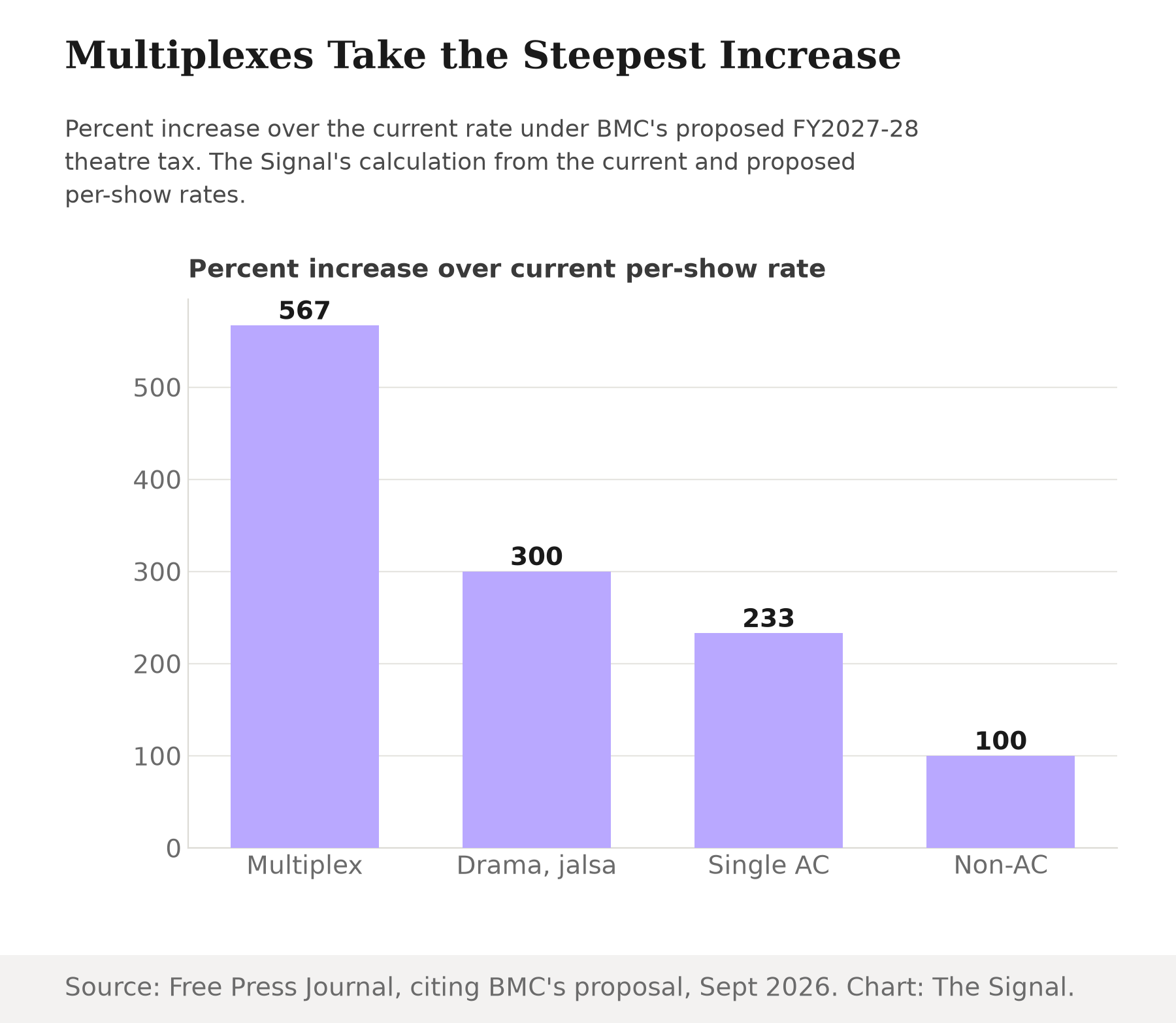
Every venue category in the proposal takes a jump, but multiplexes take by far the steepest one.
| Venue category | Current rate (Rs/show) | Proposed rate (Rs/show) | Increase |
|---|---|---|---|
| Multiplex | 60 | 400 | +567% |
| Single-screen AC cinema | 60 | 200 | +233% |
| Non-AC cinema | 45 | 90 | +100% |
| Drama, jalsa and other programmes | 25 | 100 | +300% |
Source: Free Press Journal, citing the BMC's civic proposal. Percent-increase figures are The Signal's calculation from the current and proposed rates.
What the BMC is chasing, and who else does this
The BMC's interest in this tax is not abstract. The civic body currently collects roughly Rs 360 crore a year from its entertainment tax, and estimates the proposed rates would take that to somewhere between Rs 500 crore and Rs 550 crore, a jump of nearly 50 percent. That is real money inside one of India's largest municipal budgets, and it is a plain, practical reason a 77-year-old power keeps getting revisited rather than left alone.
Mumbai is also not the only Indian city where a municipal body reaches directly into a cinema ticket. Greater Chennai Corporation levies its own Entertainments Tax on cinema exhibition, charged as a share of the ticket price rather than a flat rupee figure per show: 8 to 20 percent depending on the film's language. The two structures do not reduce to one number that says which city taxes a moviegoer harder. But they do show BMC's theatre tax is not a Mumbai-only anomaly. More than one Indian municipal corporation has its own hand on the same ticket, GST and the state entertainment tax aside.
The honest objection
The strongest case for the hike is that the BMC is not actually raising anyone's tax bill yet, and that its own proposal treats the increase as something to phase in cautiously rather than impose overnight. The BMC has proposed retaining the old theatre tax rates for 2027-28 until the state government clears the revised ones, so as of today nothing has changed for a moviegoer buying a ticket in Mumbai. The Rs 400 figure is what the BMC is asking Maharashtra's Urban Development Department to approve, not what is currently being charged. The proposed structure also keeps a full exemption for Marathi and Gujarati films, plays, one-act plays and tamashas, regardless of the type of theatre they run in, so the venues carrying the steepest increase are the multiplex and mainstream commercial circuit specifically, not the regional-language stage and cinema the exemption was built to protect.
That case is real, but it does not change the mechanism underneath it. Whether the state approves the proposed Rs 400 multiplex rate this year, a lower figure, or nothing at all, the tax that sets Mumbai's ticket price floor sits with a municipal corporation acting under an act that predates GST by nearly seven decades. Every future rupee will be decided at that level, by that logic, regardless of what the GST Council does to the rest of India's consumption tax code.
The Signal
Mumbai's cinema-goers have spent nine years assuming 1 July 2017 settled the question of what tax sits on a movie ticket. It settled the state's share. It never touched the municipality's, because the amendment that built GST was drafted to carve municipal entertainment levies out before the new tax could reach them, and Mumbai's specific version of that levy has existed since 1949. What the BMC is proposing now is not a new kind of tax. It is the same 1949 lever, pulled harder, on a charge GST was never built to reach in the first place. The number worth watching is not Rs 400, but whichever number the Urban Development Department eventually signs off on, because that department, not the GST Council, is the only body that actually sets the price of a Mumbai movie ticket's local tax.
Reporting basis: the BMC's proposed FY2027-28 theatre tax rates, the current rates they would replace, and the retained language exemption are per Free Press Journal's reporting on the civic proposal, which cites a BMC Law Committee member and a civic official. The GST carve-out for entertainment taxes levied by a Panchayat or a Municipality is per a CBIC/GST Council press release on the tax incidence of entertainment services under GST. The constitutional mechanism behind that carve-out, the rewritten Entry 62 of the State List, is per the text of the Constitution (101st Amendment) Act, 2016, as published by the GST Council. The BMC's underlying power to levy a theatre tax is per the official text of the Maharashtra Municipal Corporations Act, 1949. The current GST rate on lower-priced cinema tickets is per the GST Council's own record of its 56th meeting's rate changes. The BMC's current and projected annual theatre-tax revenue is per Zee Business's reporting on the proposal. Greater Chennai Corporation's cinema entertainment tax rates are per that corporation's own revenue department notice. The percentage changes by venue category, and the seventy-seven-year span between 1949 and this proposal, are The Signal's calculations from those reported figures.