This week, four of the world's most closely watched forecasters moved on India within days of each other. The OECD lifted its FY2026-27 growth forecast to 7.1 percent, an 80-basis-point jump from its June call of 6.3 percent. The Asian Development Bank put India's FY2026 growth, for the year ending 31 March 2027, at 7.0 percent in its September 2026 Asian Development Outlook. Fitch Ratings raised its FY27 call to 6.9 percent, up from 6.4 percent in June, and S&P Global Ratings raised its own FY27 forecast to 7 percent, from 6.6 percent previously. Read as a set, the headline writes itself: India keeps outrunning expectations, and the world's rating agencies are finally catching up to it.
It is worth slowing down on that. Fitch and S&P did not just raise a number; each paired its upgrade with an explicit call for India's central bank to raise interest rates, not hold or cut them. Fitch expects the RBI to raise the repo rate by 25 basis points to 5.5 percent at its October 2026 meeting, and S&P expects a 25-basis-point RBI rate hike at some point during FY27. That call lands seven weeks after the RBI's own Monetary Policy Committee did the opposite. On 5 August 2026 the RBI held the repo rate at 5.25 percent for a fourth consecutive meeting, with Governor Sanjay Malhotra saying the committee wanted "greater clarity" on the inflation outlook before acting. A growth upgrade that reads as unambiguous good news is, from two of its four authors, also a bet that borrowing costs are about to rise.
The number the RBI hasn't matched yet
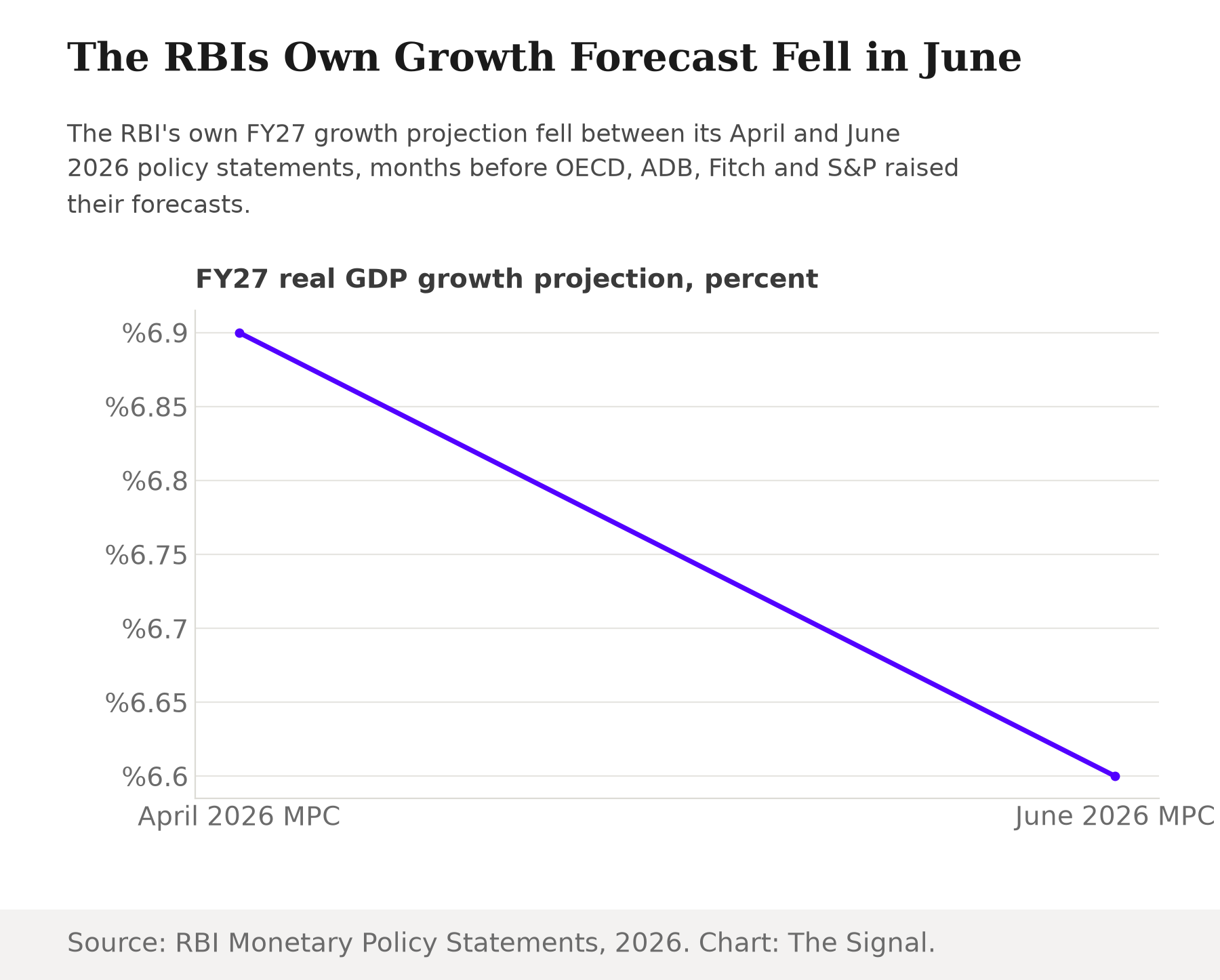
Here is the figure that carries the thesis. The RBI's own most recent published growth call for FY27, from its 5 June 2026 Monetary Policy Statement, was just 6.6 percent, below every one of the four external forecasts now on the table: OECD's 7.1 percent, ADB's 7.0 percent, S&P's 7.0 percent and Fitch's 6.9 percent. The institution that will actually decide whether to raise rates is, on its own last published word, the most cautious voice in the room about how fast the economy it oversees is growing.
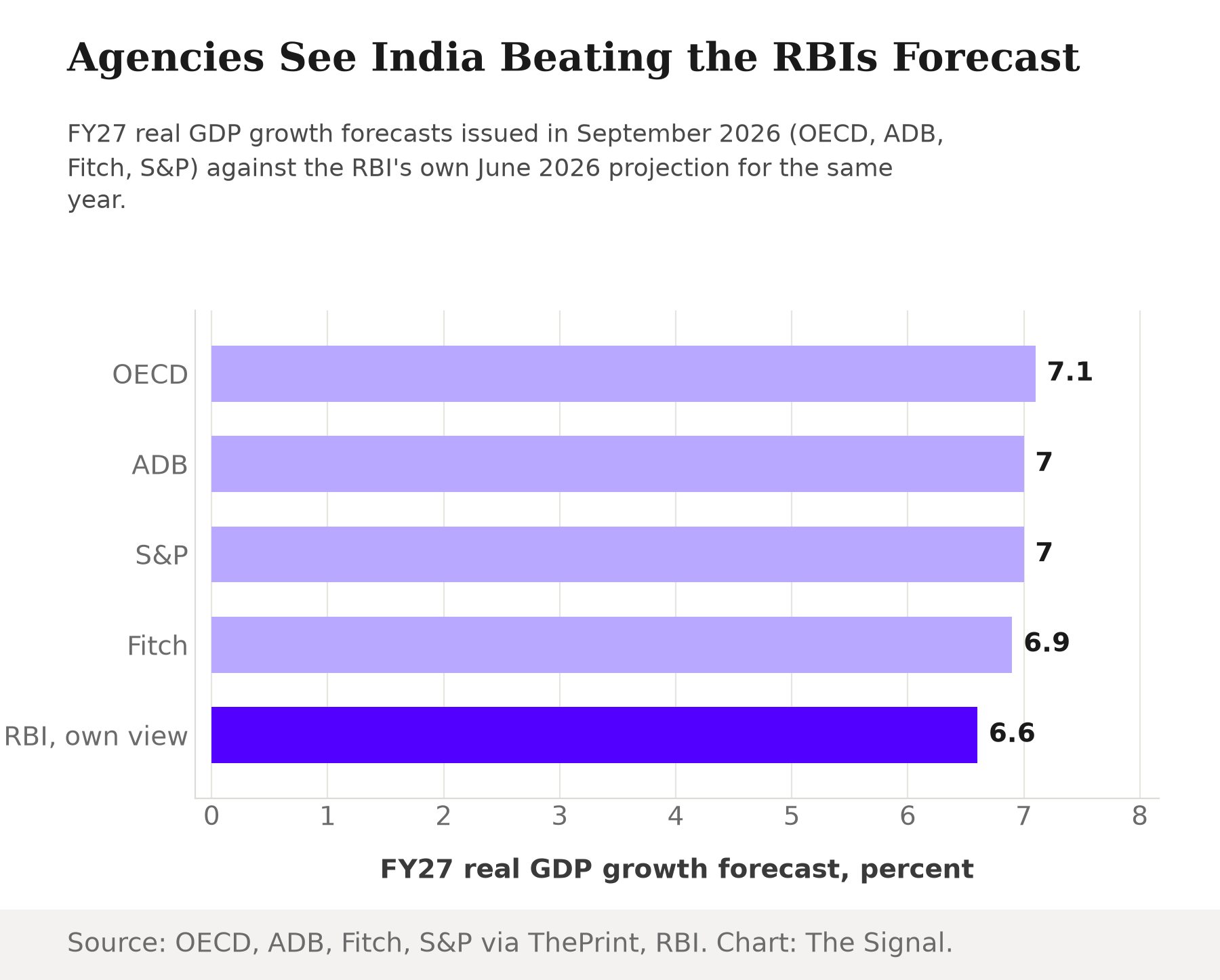
That gap did not appear overnight, and it did not move in one direction. The RBI's first FY27 policy statement, published 8 April 2026, had projected growth higher still, at 6.9 percent, roughly where Fitch sits today. By its June statement, the RBI's own number had fallen to 6.6 percent. The central bank turned more cautious about its own economy between April and June, in the same months the outside forecasters who would go on to leapfrog it were still sitting on lower calls of their own.
The quarter that flipped the argument
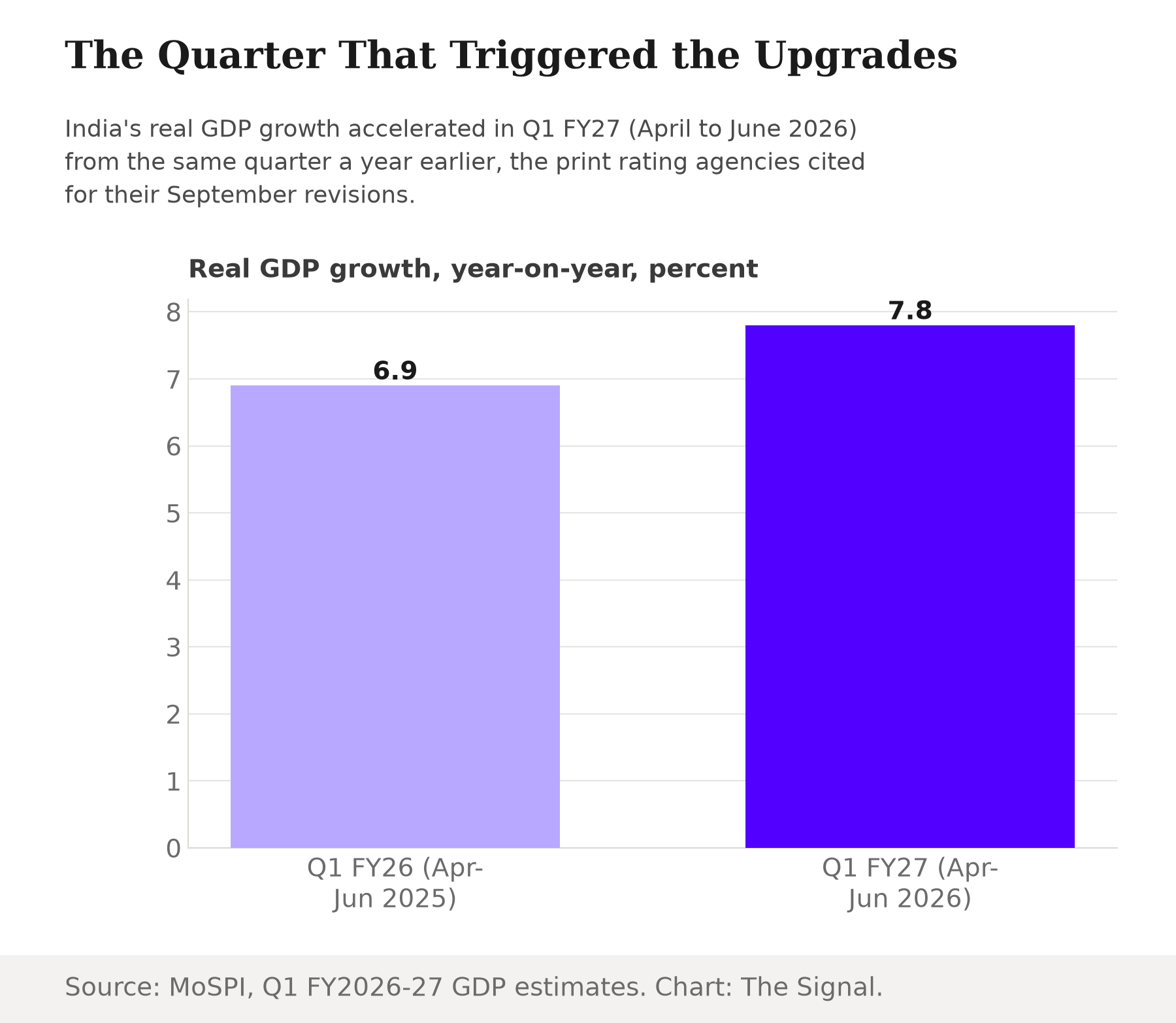
What changed between June and September was a single data print. India's real GDP grew 7.8 percent year-on-year in the April-June 2026 quarter, Q1 of FY27, up from 6.9 percent in the same quarter of FY26, according to the Ministry of Statistics and Programme Implementation. That is the print the rating agencies cite as the trigger for their September revisions, and it explains the growth upgrades cleanly enough. It does not, on its own, explain why two of the four forecasters walked away from that same print wanting higher interest rates rather than just a rosier outlook.
Fitch and S&P are pricing a hike off almost the same inflation number the RBI itself already published.
| Source | FY27 growth call | Rate call | FY27 inflation call |
|---|---|---|---|
| Fitch Ratings | 6.9%, up from 6.4% | 25 bps hike to 5.5%, October 2026 | Not stated |
| S&P Global Ratings | 7.0%, up from 6.6% | 25 bps hike, during FY27 | 5.1% average |
| RBI (own view) | 6.6% (June 2026) | Held at 5.25% for a fourth straight meeting (August 2026) | 5.1% (June 2026) |
Source: ThePrint, on Fitch Ratings; ThePrint, on S&P Global Ratings; Reserve Bank of India, June 2026 Monetary Policy Statement; Forbes India. Table: The Signal.
Look at that middle column and the disagreement gets sharper. S&P's own FY27 inflation call, 5.1 percent, is essentially identical to the RBI's own FY27 inflation projection of 5.1 percent, published in June. Two institutions are looking at close to the same number and reaching opposite conclusions: one treats 5.1 percent as consistent with holding, the other as the reason to raise. The disagreement is not really about the inflation forecast. It is about what that number is worth once the source of the risk behind it changes.
Why the same number reads two ways
That source is oil. India's dependence on imported crude touched a record 88.7 percent in FY2025-26, the highest share on record and the backdrop against which the West Asia oil shock is being read. A country sourcing less than 12 percent of its crude at home has little insulation left: a sustained rise in oil prices passes through to India's import bill, its currency and, eventually, retail fuel and transport costs more directly than in a year of higher domestic output. Fitch and S&P are not disputing that India's economy is strong. They are betting that strength, combined with record oil-import exposure, is the inflationary case for moving before the RBI's own number is tested by events rather than by forecast.
The honest objection
The strongest case for the RBI's side is in its own words. Explaining the August hold, Governor Sanjay Malhotra said the MPC wanted "greater clarity" on the inflation outlook before acting. A committee that has held rates for four consecutive meetings has shown more patience, in practice, than the rating agencies' calls assume it will keep showing. Central banks are entitled to see the same oil shock and GDP print that private forecasters see and reach a more cautious conclusion: wait for inflation to show up in the data rather than move preemptively on what a supply shock might do. If crude eases, or the pass-through proves smaller than feared, a hike engineered around a rating agency's forecast rather than the RBI's own reading would tighten policy into an economy that is already outperforming, for no reason that survives the following quarter.
That case holds up, but it does not fully answer the timing. Fitch's growth upgrade and its rate-hike call were published in the same report, not separately and later linked, and the same is true of S&P's upgrade and its own rate-hike call. And the RBI's own record cuts against the idea that its caution is fixed: its growth number already moved once, from 6.9 percent in April to 6.6 percent in June, before the picture got more complicated, not less. A central bank whose own view shifted down once in two months is not an obviously safe bet to hold a fifth time just because it held the first four.
The Signal
Every forecaster likes India's growth story; that part is genuine and the Q1 print backs it. What is easy to miss is that the two most rate-focused voices in the group, Fitch and S&P, are treating India's resilience to an oil shock as an inflation story rather than just a growth story, and are pricing that ahead of the institution that actually sets India's interest rate. Watch the RBI's next policy call for the answer. If it moves in October, the agencies read the room correctly. If it holds a fifth time, its caution was vindicated and the agencies priced a risk that never arrived. Either way, the number worth tracking from here is not the growth forecast. It is whether the rate follows it.
Reporting basis: the OECD's 7.1 percent FY27 forecast is per The Hans India's report of the OECD's Economic Outlook Interim Report, September 2026. The Asian Development Bank's 7.0 percent forecast is from its own Asian Development Outlook, September 2026 edition, accessed directly. Fitch Ratings' 6.9 percent forecast and its call for a 25-basis-point RBI hike in October 2026 are per ThePrint, relaying a Fitch statement; the underlying Fitch report was not independently accessed. S&P Global Ratings' 7.0 percent forecast, its rate-hike call and its 5.1 percent FY27 inflation projection are per a separate ThePrint report, relaying an S&P statement; the underlying S&P report was not independently accessed. India's Q1 FY27 GDP growth of 7.8 percent, against 6.9 percent in Q1 FY26, is from MoSPI's own press note. The RBI's April and June 2026 growth and inflation projections are from the RBI's own April and June Monetary Policy Statements. The RBI's 5 August 2026 hold and Governor Malhotra's remarks are per Forbes India's live reporting from the press conference; the RBI's own August resolution document was not independently accessed. India's 88.7 percent crude import dependence in FY2025-26 is per ThePrint, relaying the Ministry of Petroleum and Natural Gas's written reply to the Rajya Sabha; that reply itself was not independently accessed.