Civil Aviation Minister Ram Mohan Naidu confirmed on 22 September 2026 that the DGCA is now running operational and financial scrutiny of SpiceJet, telling reporters the ministry does not want "any lapse in safety." Read on its own, that sounds like routine regulatory caution: an airline is struggling, the safety regulator says it is watching. The DGCA already runs a large routine surveillance program on every Indian carrier. In 2025 alone it completed 4,522 planned checks, including 874 spot checks and 550 night surveillance runs, against a target of 4,630, and SpiceJet is simply inside that machinery like every other operator.
It is worth slowing down on that framing. This is not the DGCA's first look at SpiceJet's finances, and the airline has already been through this cycle once and come out the other side. The regulator placed SpiceJet under enhanced surveillance on 13 September 2024 over the same kind of financial strain, ran 266 spot checks under that program, and lifted the airline off the list only after it raised fresh funds. The informal-tolerance phase ran its course and ended quietly in 2024. What is different in September 2026 is that the minister is now naming financial scrutiny explicitly, not just safety surveillance, and the trigger this time is sharper.
SpiceJet has gone 3.5 months without paying staff.
As of 21 September 2026, SpiceJet was yet to pay salaries for the last 3.5 months, NDTV Profit reported. That is the specific, checkable fact the regulator's language has caught up to. A carrier that cannot make payroll for the better part of a fiscal quarter is not a company managing a rough patch; it is a company whose ability to fund normal operations is in question, which is exactly why a safety regulator starts asking financial questions too.
Where the traffic is actually going
The consensus story on a distressed low-cost carrier is that it loses passengers to whichever rival is cheapest or most convenient that week. What is happening to SpiceJet is narrower than that. SpiceJet's domestic market share has been sliding since February 2026, when it stood at 3.9 percent, falling to 1.9 percent in June and 1.6 percent in July: roughly halved in five months. In the same stretch, IndiGo's domestic market share hit a record 66.3 percent in June 2026, then rose again to 67.4 percent in July, the same month SpiceJet's share kept falling.
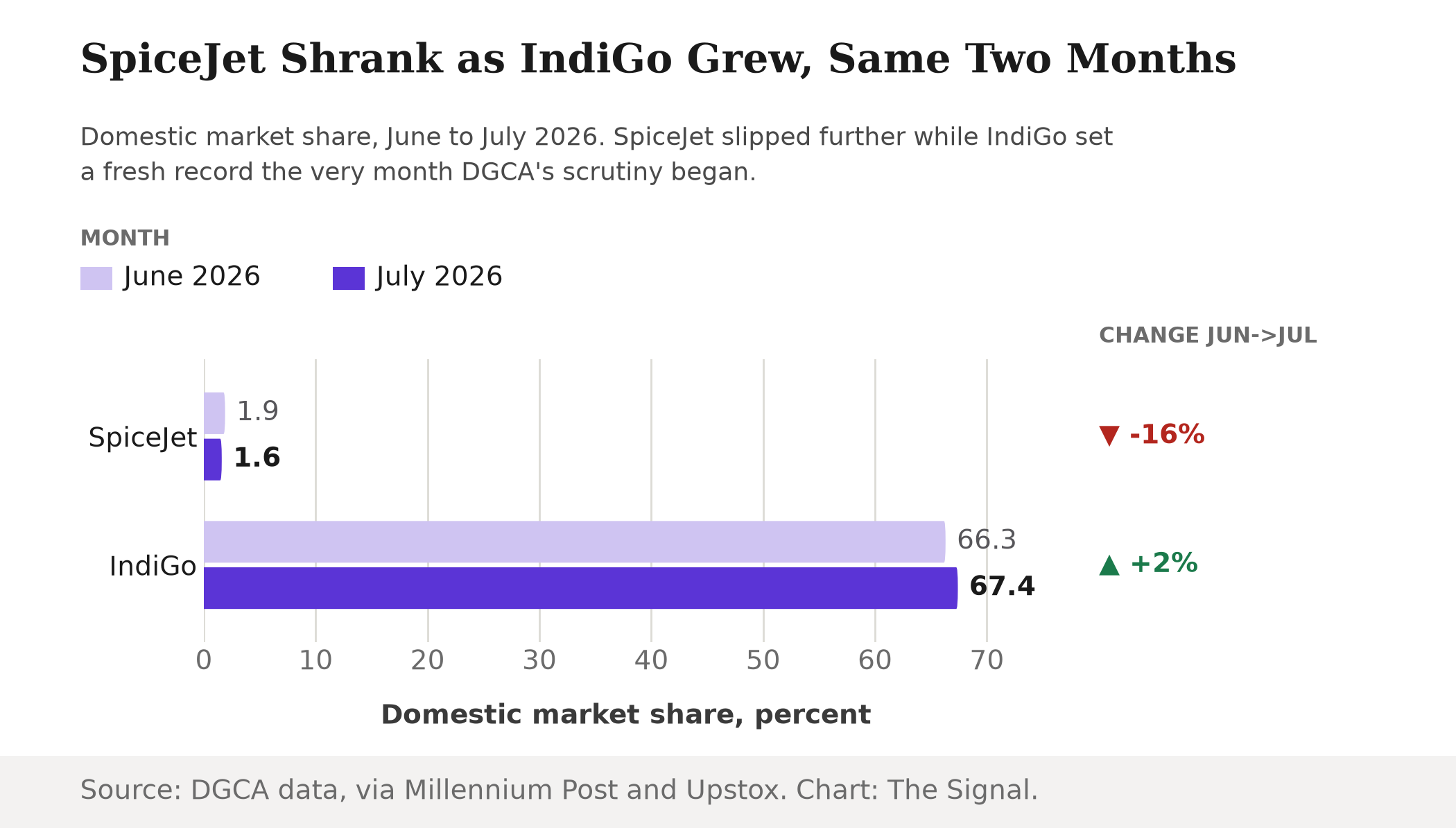
Source: Millennium Post; Aviation A2Z; Upstox. Chart: The Signal.
SpiceJet is not losing seats to a scattered field of competitors. It is losing them into a market that is already two-thirds IndiGo, which makes every point SpiceJet gives up a point IndiGo mostly absorbs. India's low-cost segment is consolidating around a single carrier, not fragmenting under the pressure.
The government is both the lender and the watchdog
SpiceJet's distress is not happening without state support. The Union Cabinet approved ECLGS 5.0 on 6 May 2026, earmarking ₹5,000 crore in credit-guarantee support specifically for airlines, with loans capped at up to ₹1,500 crore per borrower, a scheme built for carriers in exactly SpiceJet's position. SpiceJet drew on it in June 2026, receiving the first ₹150 crore tranche from Bank of India under the guarantee. That credit line was not the only thing SpiceJet was dealing with in June 2026. Tax authorities issued the airline a ₹124.65 crore GST demand notice in late May 2026, a bill nearly as large as the rescue tranche it had just banked.
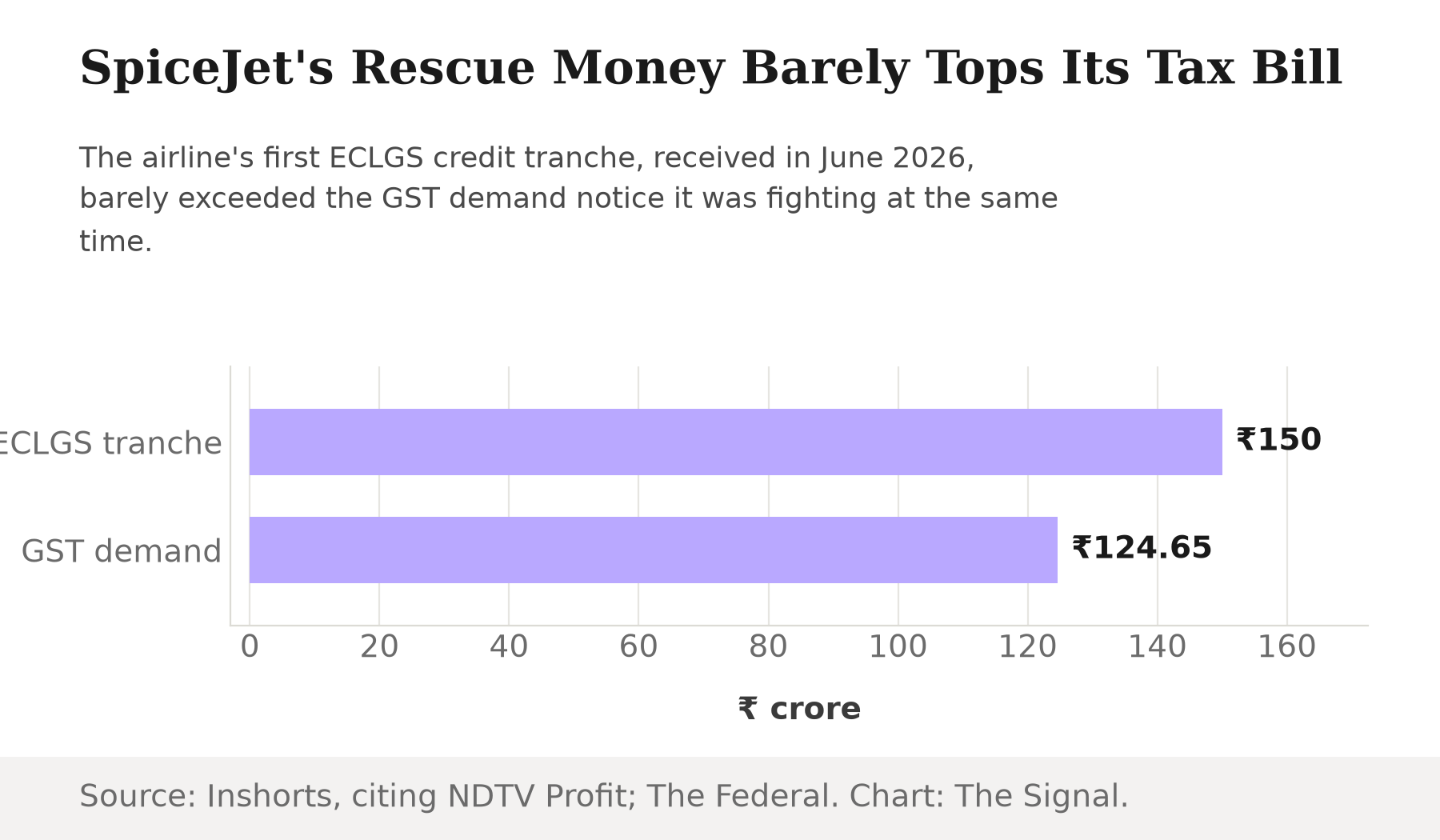
Source: Inshorts, citing NDTV Profit; The Federal. Chart: The Signal.
One arm of the state is guaranteeing SpiceJet's credit while another is billing it. Neither is unusual on its own: credit guarantees and tax enforcement run on separate tracks everywhere. But together they show that the ₹150 crore lifeline did not buy SpiceJet much room, and the airline's own operations have shrunk to match. By August 2026, its in-service fleet was down to just 11 aircraft, nine Boeing 737s and two DHC-8-400 turboprops, a fraction of what a national carrier needs to defend a market position.
The honest objection
The strongest case against reading this as an escalation is that the DGCA has been here before and stood down. It lifted the 2024 enhanced-surveillance order once SpiceJet raised fresh capital, and the regulator's routine machinery already runs thousands of checks a year on every carrier regardless of financial health, so a minister confirming oversight is not obviously a new signal. On that reading, this is the DGCA doing its ordinary job on an airline that has wobbled financially twice in two years, nothing more.
That case holds up for the safety half of the story but not for the financial half. The 2024 episode was framed as surveillance over maintenance obligations tied to the airline's financial constraints; the minister's September 2026 language explicitly names financial scrutiny alongside operational scrutiny, a distinction the ministry did not draw the first time. And the underlying numbers have moved further than they had in 2024: a fleet down to 11 aircraft, a market share down to 1.6 percent from 3.9 percent five months earlier, and a payroll gap that has already stretched to 3.5 months with no resolution announced. The regulator standing down once does not mean the airline has the same room to recover twice.
The Signal
The story here is not that SpiceJet is in trouble again; that has been true, on and off, for years. It is that the regulator's language finally caught up to the balance sheet, and the market it is watching is no longer standing still for it. Every percentage point SpiceJet loses is landing almost entirely with one competitor, and a segment that consolidates into a single dominant carrier is harder to reopen than one that simply loses a struggling entrant. Watch what the DGCA calls this scrutiny six months from now. If it quietly lifts, as it did in 2024, SpiceJet bought itself another cycle. If it hardens into a formal surveillance order, the airline is no longer being watched: it is being wound down in slow motion.
Reporting basis: the Civil Aviation Minister's confirmation of DGCA scrutiny is per ETV Bharat's report of his remarks on 22 September 2026. The unpaid-salary figure and the ECLGS tranche are as reported by NDTV Profit, via Inshorts. Domestic market-share figures for SpiceJet and IndiGo are official DGCA data, as reported by Millennium Post, Aviation A2Z and Upstox respectively. The Ministry of Civil Aviation's own 2025 annual report is the source for the routine surveillance volumes. The 2024 enhanced-surveillance episode and its lifting are per The Tribune. The GST demand notice and fleet count are as reported by The Federal and Travel Radar respectively. The ECLGS 5.0 Cabinet approval and its terms are from a Press Information Bureau release. The characterisation of the ECLGS tranche and GST notice as comparably sized, and the five-month market-share comparison, are The Signal's reading of those figures side by side.