On September 12, HDFC Bank's board did what succession planning is supposed to look like. It approved two candidates for managing director and chief executive and agreed to send their names, ranked, with proposed pay, to the Reserve Bank of India for a three-year term. The move follows incumbent Sashidhar Jagdishan telling the board he would not seek another term before his current one ends on October 26, 2026. Jagdishan had run the bank since October 2020, when he succeeded Aditya Puri, and was reappointed in 2023. The board said the process followed the Banking Regulation Act, 1949, and RBI's Commercial Banks Governance Directions, 2025, on the recommendation of its own governance committee. Read as a compliance story, it is unremarkable: a board doing its job, by the book.
It is worth slowing down on who RBI called next. The regulator has sought feedback from insurance regulator IRDAI and from Sandeep Bakhshi, chief executive of ICICI Bank, on the candidature of Anup Bagchi for the top job at HDFC Bank. ICICI Bank is HDFC Bank's closest domestic rival, and the executive whose read RBI wants has spent almost his entire career on the other side of that rivalry.
Anup Bagchi has spent almost his entire career inside the group that now competes hardest with HDFC Bank. He has led ICICI Prudential Life Insurance as managing director and chief executive since 2023, and before that was an executive director at ICICI Bank overseeing wholesale banking, transaction banking, markets and proprietary trading. The market read the review as a step forward for HDFC Bank's succession, not a threat to it: HDFC Bank shares rose 0.9 percent to Rs 746.50 on September 22, extending a 1.16 percent gain from the previous session.
Two banks, one shrinking gap
The reason ICICI Bank's chief executive has real standing to be asked at all is that his bank is no longer a distant second. As of August 31, 2026, ICICI Bank's market capitalisation of Rs 10.43 trillion trailed HDFC Bank's Rs 10.93 trillion by just Rs 49,167 crore, the narrowest gap between the two lenders since January 2015: roughly 4.5 percent of HDFC Bank's own value, our calculation from those two figures.
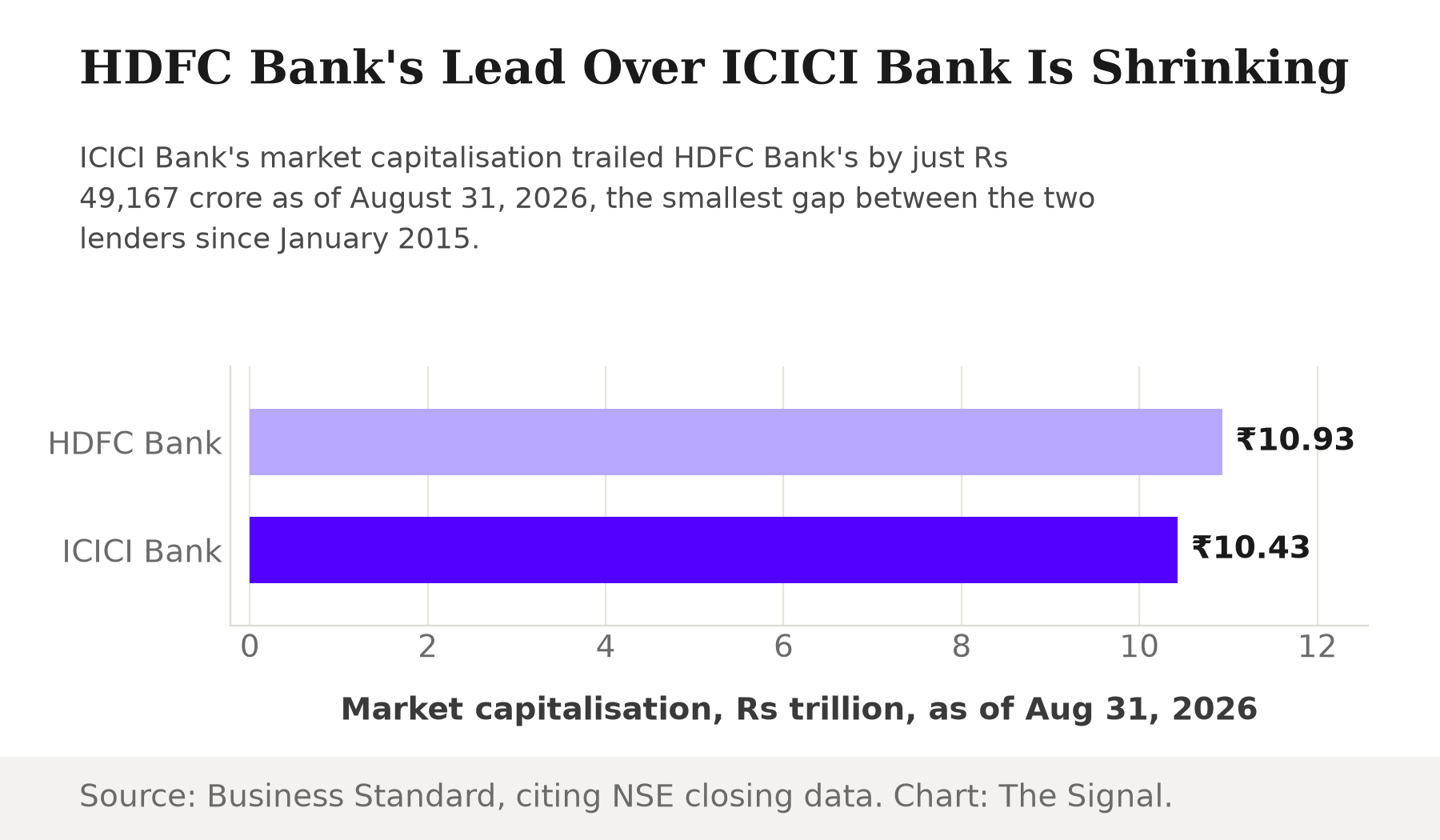
Bakhshi is being asked to weigh in with his own bank closer to overtaking HDFC Bank by value than it has been in over a decade, not as a distant follower.
The concentration at the top
HDFC Bank and ICICI Bank also share a shorter, more formal list. RBI's list of Domestic Systemically Important Banks, based on data as of March 31, 2025, names only three Indian lenders, State Bank of India, HDFC Bank and ICICI Bank, and places HDFC Bank in a higher systemic-risk capital surcharge bucket than ICICI Bank: an extra 0.40 percent of core capital against ICICI Bank's 0.20 percent.
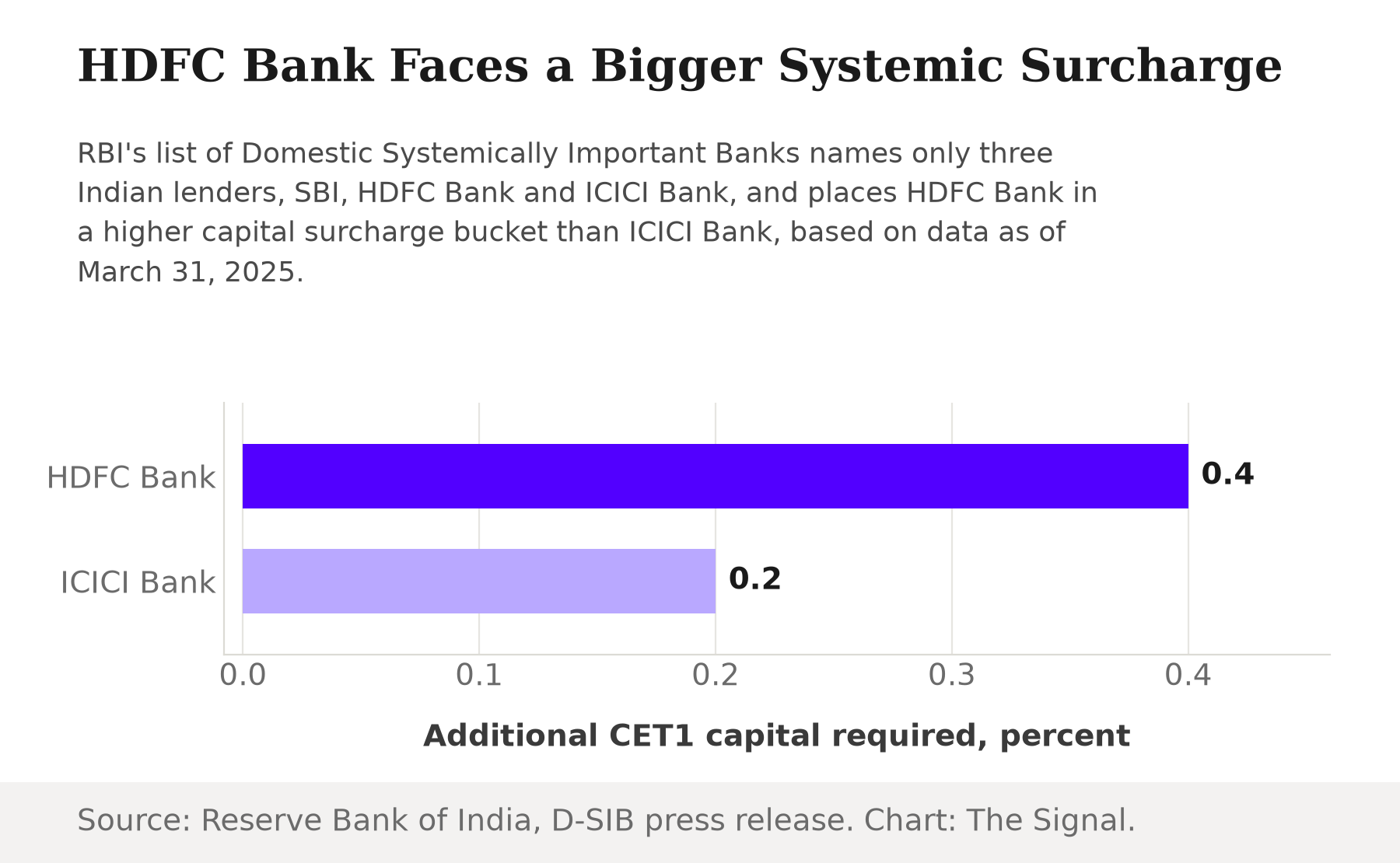
That short list doubles as the bench India's largest private banks draw leadership from. Bagchi's own path runs from ICICI Bank executive director to ICICI Prudential Life chief executive to a shortlisted candidate at HDFC Bank, almost entirely inside one group before touching its biggest rival. With only three lenders carrying this much systemic weight, the line between a rival offering an informed opinion and a rival shaping its competitor's leadership gets harder to hold.
The clock RBI keeps on bank chiefs
RBI already has a general answer for how much distance a senior banker needs from an institution before regulatory trust is restored. Its 2021 governance directions cap a private bank's MD and CEO or whole-time director tenure at 15 years and require a minimum three-year gap before re-appointment, during which the individual cannot be associated with the bank or its group in any capacity; the age limit for the role is 70 years.
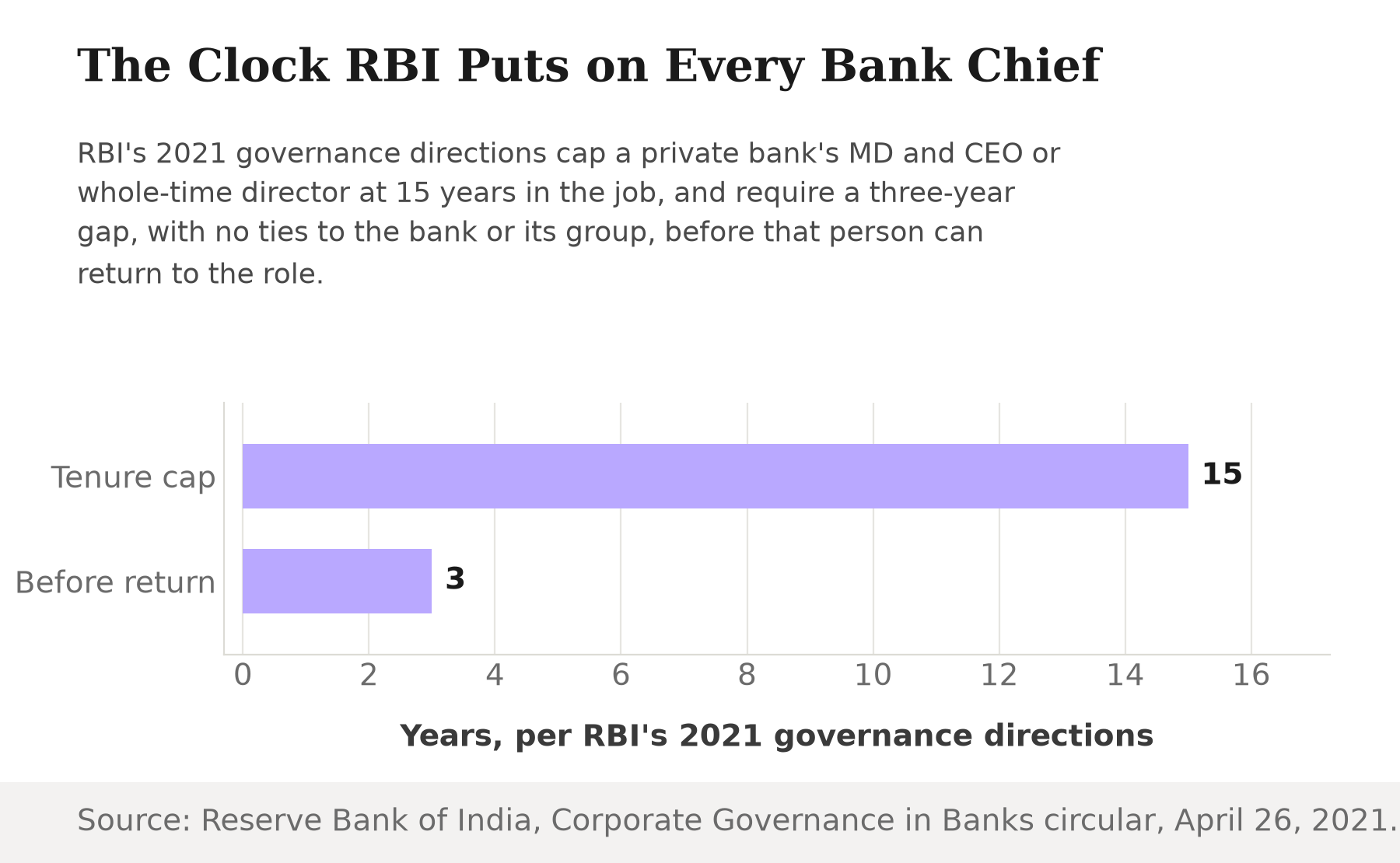
That clause governs a return to the same bank, not a lateral move to a rival's top job, so it does not literally apply to Bagchi. But its logic, that time and distance must separate an executive from an institution's pull before a regulator trusts them with a bank again, is what RBI's own review now tests informally: its outreach is aimed at assessing whether Bagchi can return to mainstream banking after more than three years leading ICICI Prudential Life.
HDFC Bank has run a compressed governance stretch in the fourteen months before this succession.
| Date | Event |
|---|---|
| October 2020 | Sashidhar Jagdishan takes charge as MD and CEO, succeeding Aditya Puri; reappointed in 2023. |
| July 27, 2026 | HDFC Bank's board issues warning letters and a Rs 1 lakh penalty each on Jagdishan, CFO Srinivasan Vaidyanathan and group head-retail assets Arvind Vohra over a Rs 45 crore MSRDC deposit arrangement. |
| August 31, 2026 | ICICI Bank's market cap trails HDFC Bank's by just Rs 49,167 crore, the narrowest gap since January 2015. |
| September 12, 2026 | HDFC Bank's board approves two MD and CEO candidates and submits their names, ranked, to RBI. |
| September 22, 2026 | RBI seeks feedback from IRDAI and ICICI Bank CEO Sandeep Bakhshi on Anup Bagchi's candidature; HDFC Bank shares rise 0.9 percent. |
| October 26, 2026 | Jagdishan's current term as CEO ends. |
Sources: Business Standard and Business Standard on HDFC Bank's board actions; Business Standard on the market cap gap; The Economic Times, via TradingView News on RBI's September 22 review.
The honest objection
The strongest case against reading any of this as a conflict is that RBI's outreach looks like ordinary due diligence, not a veto. Asking IRDAI is procedurally obvious: Bagchi currently heads an insurer that IRDAI regulates, and any regulator would check with a candidate's current regulator before a move into a different regulated sector. HDFC Bank's own board had already run its process by the book, endorsing two names through its Governance, Nomination and Remuneration Committee under the Banking Regulation Act and RBI's 2025 governance directions before RBI's review even began. And a reference check with a candidate's most recent employer is standard practice: Bagchi's last executive role inside a bank was at ICICI Bank itself, running wholesale banking, transaction banking, markets and proprietary trading. On this reading, Bakhshi is simply the best-placed person to describe how Bagchi performed in those roles, not a rival handed a veto.
That case holds cleanly for the IRDAI half of the outreach. It holds less well for the ICICI Bank half. A former colleague at almost any other lender would offer a reference with no stake in the outcome. Bakhshi runs the one bank whose market value has never sat this close to HDFC Bank's in more than a decade, and whose own competitive position shifts depending on who leads its rival next. What has been reported does not explain why ICICI Bank's chief executive, rather than a former HDFC Bank director or an outside search firm, was the reference point RBI chose. The instinct that a rival knows a candidate's competence best is also the instinct that makes a rival's judgment the least neutral one available.
The Signal
HDFC Bank's board has already done its part: two names, ranked, filed with RBI on schedule. What happens next is RBI's call, informed by an insurance regulator with an obvious institutional reason to be consulted and a rival bank's chief executive who does not have one. If the review simply confirms Bagchi's record and moves on, this will read, in hindsight, as an unusually public version of ordinary due diligence. A stall, or feedback from Bakhshi that visibly shapes the outcome, would leave every future HDFC Bank or ICICI Bank succession carrying a live question with it. Only three lenders in India carry the systemic weight that puts HDFC Bank in a higher capital surcharge bucket than the bank now being asked to vet its next chief executive. That is a small enough club that its members grading each other's homework was always going to force the question RBI has now made unavoidable: whether a rival's vetting catches a conflict of interest, or simply gives one a regulator's cover.
Reporting basis: HDFC Bank's board actions, including its September 12 shortlist and RBI submission and its July 27 penalties against Sashidhar Jagdishan, Srinivasan Vaidyanathan and Arvind Vohra, are per Business Standard, drawing on the bank's exchange filings and board statements; the regulatory basis of the September 12 filing is per the Free Press Journal, also citing that filing. RBI's request for feedback from IRDAI and ICICI Bank chief executive Sandeep Bakhshi is per The Economic Times, as carried by TradingView News. Bagchi's career history and HDFC Bank's September 22 share-price move are per the Free Press Journal. The market capitalisation comparison between ICICI Bank and HDFC Bank is per Business Standard, citing NSE closing data. RBI's Domestic Systemically Important Banks list and capital surcharge buckets, and the 2021 tenure and reappointment-gap rules, are both from Reserve Bank of India primary releases. The market cap gap's size as a share of HDFC Bank's own value is The Signal's calculation from those two figures.