In August 2025, the United States hit India with an extra 25 percent tariff on its exports and put the reason in writing. A Federal Register notice implementing the duty, issued under Executive Order 14329, tied it explicitly to India's continued imports of Russian-origin oil, effective August 27, 2025. Five months later, Washington looked ready to climb down. The Associated Press reported that President Trump said on February 2, 2026 that he would cut the tariff to 18 percent, because Prime Minister Modi had "agreed" to stop India buying Russian crude. Nine days later, the US made its own paperwork catch up, formally modifying the Russia-linked duties in a new executive order. Read only the American side and the arc is tidy: pressure applied, tariff imposed, India folded, tariff eased.
It is worth slowing down on that. A month later, India's government said on the record that no such surrender had happened: a Press Information Bureau statement, reported by The Moscow Times, said "India has never depended on permission from any country to buy Russian oil," and as of March 7, 2026 India was still importing it, with Russia still its largest crude supplier. Whatever was said in private, New Delhi was not willing to say in public that it had agreed to stop.
The figure that actually explains what happened next is the gap between $10 and $2. Russian Urals crude sold to India carried a discount to dated Brent of more than $10 a barrel in early July 2026. By the time cargoes were being offered for delivery in late August and early September, that discount had shrunk to just $1 to $2 a barrel. India did not need Washington's permission to keep buying Russian oil. It increasingly needed a reason to.
A fight fought on paper first
Four statements, on two sides of the fight, ran through the public record before the market made the argument moot.
| Date | Development |
|---|---|
| Aug 27, 2025 | US imposes an additional 25 percent tariff on Indian goods, citing Russian-oil imports |
| Feb 2, 2026 | Trump says he will cut the tariff to 18 percent after Modi "agreed" to stop the purchases |
| Feb 11, 2026 | Washington formally modifies the Russia-linked duties in a new executive order |
| Mar 7, 2026 | India's government says it never needed any country's permission, and is still buying |
Source: US Federal Register, Executive Order 14329; The Associated Press; US Federal Register, Executive Order 14384; The Moscow Times.
The bill nobody canceled
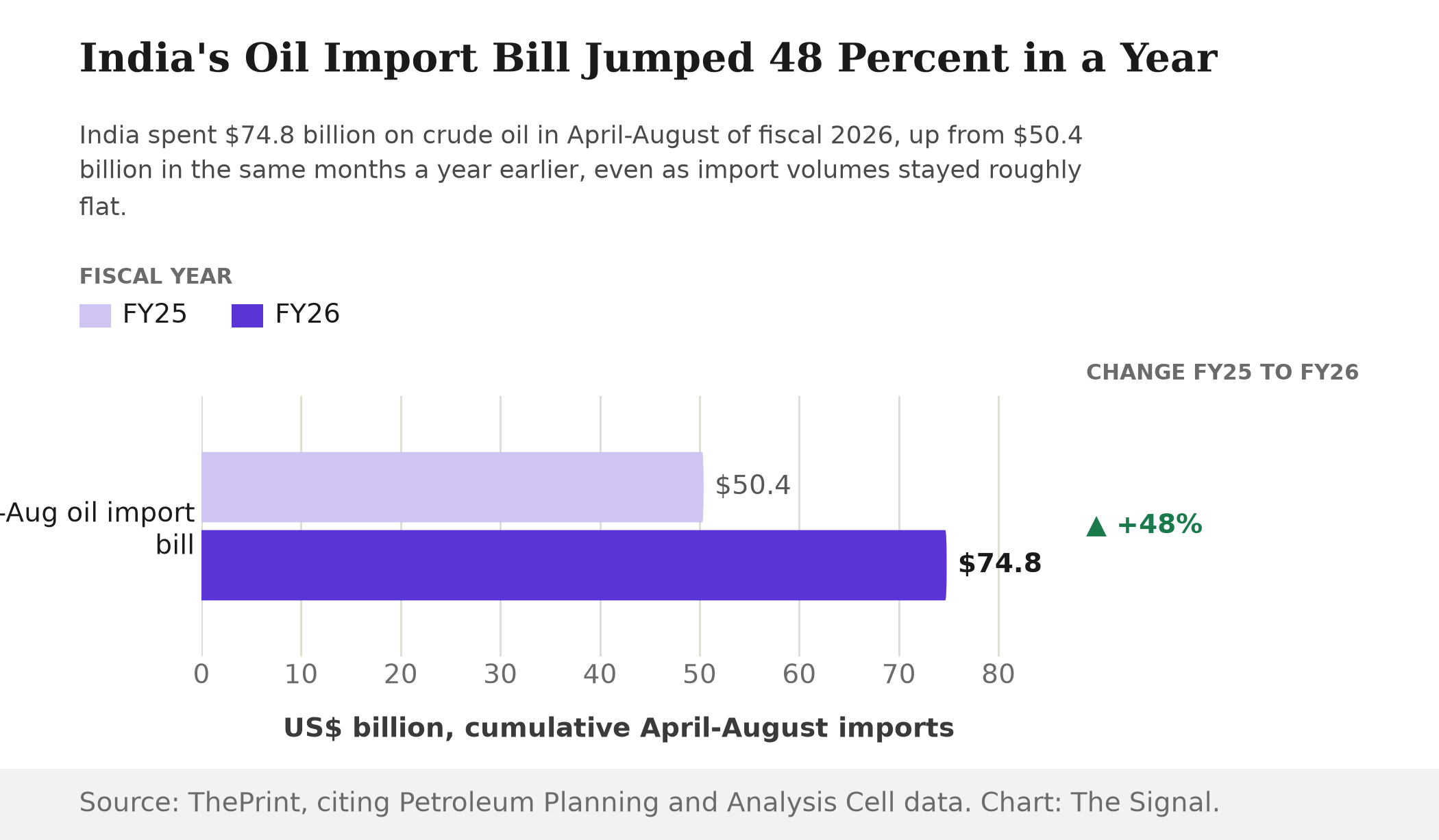
None of this ran against a calm backdrop. India's crude oil import bill jumped 48.4 percent to $74.8 billion in April-August 2026, up from $50.4 billion in the same months a year earlier, even though import volumes barely moved: almost the entire increase was price, as the Indian basket crude price rose to $90.19 a barrel in August 2026 from $82.04 in July 2026 and $69.11 in August 2025.
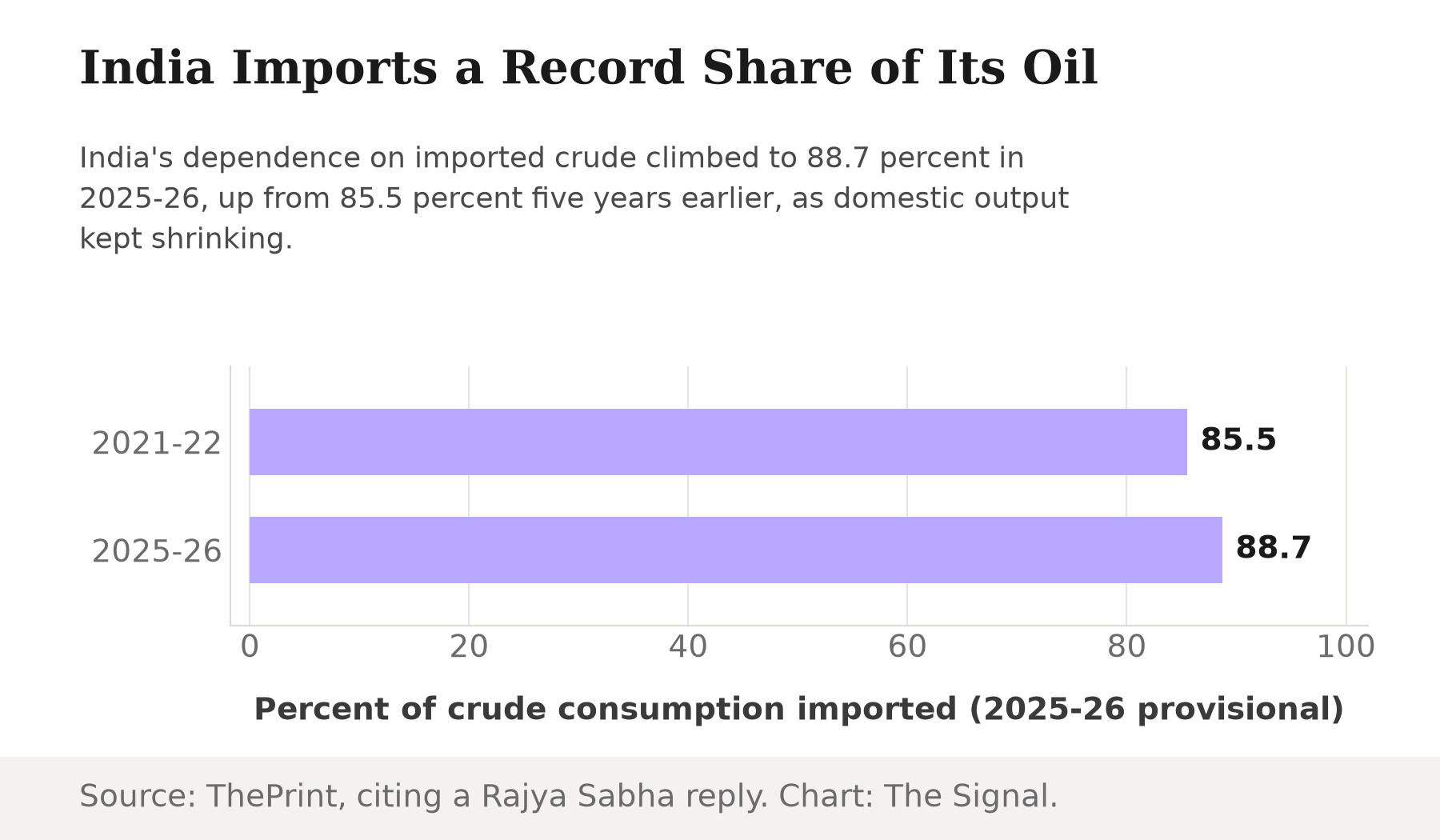
Domestic production kept falling too, pushing India's dependence on imported crude to a record 88.7 percent in 2025-26, up from 85.5 percent five years earlier, a gap of 3.2 percentage points.
The rupee was trading near ₹95.91 to the dollar in September 2026, still well off the all-time low of ₹99.82 it hit in March 2026 but nowhere near the level it held before the tariff fight began. India was paying more for oil, importing a larger share of what it burns, and doing both with a currency that had not fully recovered.
The discount that made the standoff cheap
The Russian-oil argument was never really a matter of permission. It was a matter of price: a barrel bought at a steep discount and refined into fuel sold at world prices was close to free money for an Indian refiner, tariff fight or not. That is exactly the arithmetic that stopped working over the summer of 2026.
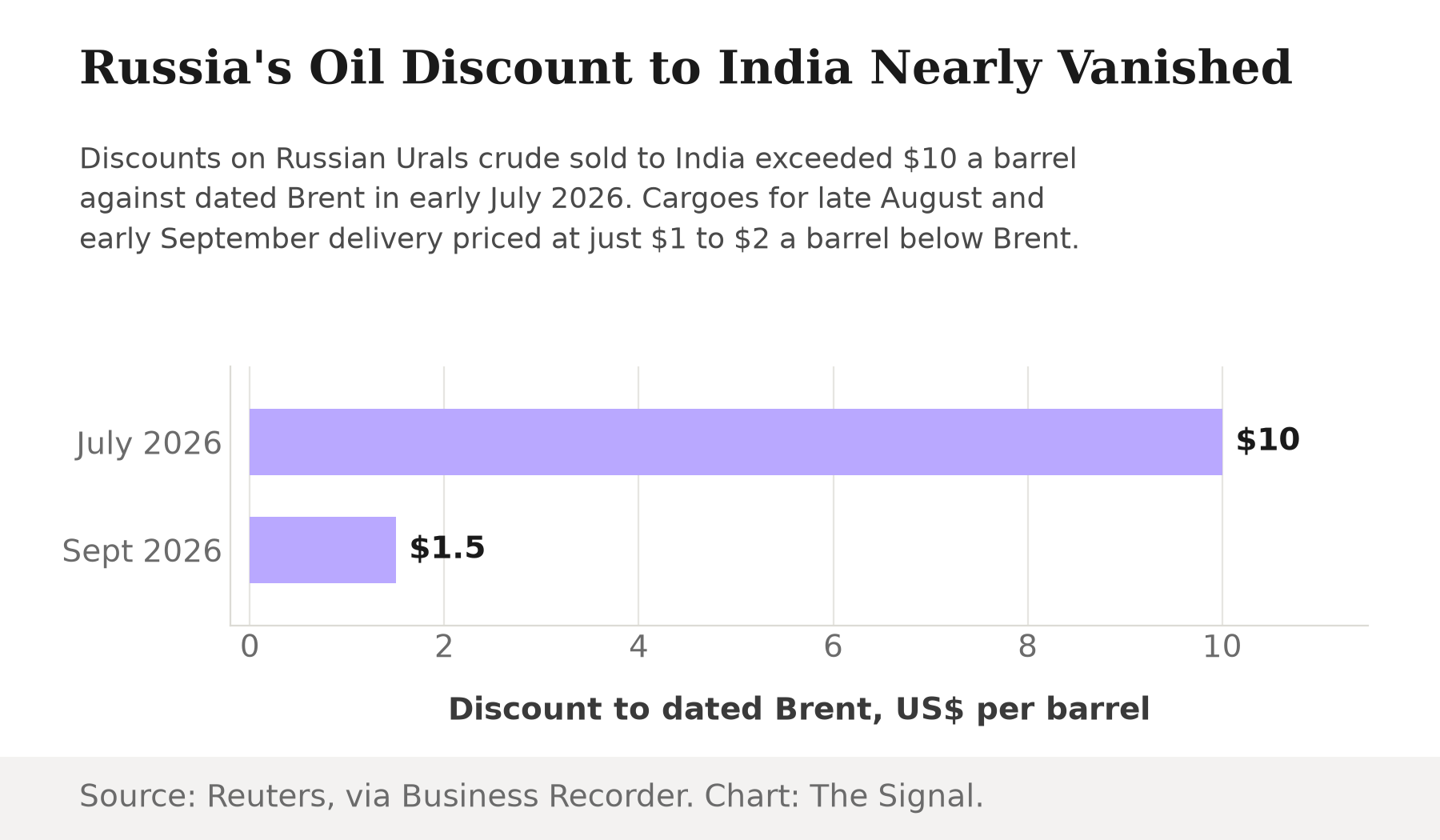
A barrel priced $1 to $2 below Brent barely covers the extra shipping distance, insurance and payment friction that come with buying oil under Western sanctions scrutiny to begin with. India's public position, that it answers to no one on where it buys crude, was easy to hold when the discount was worth defending. It got harder to justify on economics alone once the discount itself had all but disappeared.
Where the missing barrels went
The volumes moved with the price. India's Russian crude imports fell to 2.1 million barrels a day in August 2026, down from 2.7 to 2.8 million barrels a day in July, cutting Russia's share of India's total crude imports to about 45 percent from roughly 53 to 56 percent. Kpler's trade-data analysis attributed the decline to a combination of refinery maintenance, a normalization after heavy buying in prior months, lower Russian export availability, and stronger competition from China for the same discounted barrels. Some of that lower export availability had a concrete cause: Russia's Sheskharis terminal at Novorossiysk, which normally ships out about 650,000 barrels a day, stopped loading tankers for days in late July 2026 under the threat of Ukrainian drone strikes, squeezing the volumes available to any buyer, India included. China was not settling for India's leftovers. It was outbidding India for the same cargoes, and the Urals discount that resulted was too thin for India to keep filling up on Russian barrels at the earlier pace.
The honest objection
The strongest case against reading any of this as a retreat is that India got the more durable win regardless of the oil market. A White House fact sheet confirms the US did lower its Reciprocal Tariff on India from 25 percent to 18 percent, explicitly crediting India's stated commitment to stop purchasing Russian oil, a seven-point saving on the price of everything India ships to the United States and, on paper, a bigger and steadier number than any single month's crude discount. On that reading, buying Russian oil at $1 to $2 below Brent instead of walking away entirely still preserves supply diversity and refinery flexibility built up over years, even if the margin has thinned, and refusing in public to call it a surrender costs India nothing at all.
Even that "durable win" does not hold up as evidence of a bargain kept, though. By late February 2026 the operative US tariff on India had dropped further still, to a temporary 10 percent, not because of anything India did on Russian oil but because the US Supreme Court had struck down the prior tariffs and Washington had to replace them under different legal authority. The tariff relief India can actually point to traces to an American court ruling, not to its own conduct on Russian crude.
That case is real, but it does not explain why the underlying numbers moved the wrong way at the same time. The oil import bill still rose 48.4 percent, import dependence still hit a record, and the rupee stayed depressed, even as the one lever that was supposed to be cushioning all three, the Russian discount, shrank toward nothing. A genuine economic win would show up in at least one of those numbers. None of them moved in India's favor.
The Signal
India's government held its ground in public: no country's permission was ever required, and the buying never stopped. What changed the trade was not Washington and not New Delhi. Tighter Russian export availability and China's own appetite for the same discounted barrels did what a year of tariff threats could not: they took most of the profit out of buying Russian. Watch the discount, not the diplomacy. If it stays near $1 to $2 a barrel, continuing to buy Russian crude becomes a political stance India is paying to hold rather than a trade it is winning. Widen back out, and the case that this was cost-free vindication holds up after all. Either way, the tariff headline was never the number that mattered.
Reporting basis: the two US tariff actions are per Federal Register notices for Executive Order 14329 and Executive Order 14384. President Trump's February 2026 tariff-cut remark is per the Associated Press, as carried by the Anchorage Daily News; the cut's size and its Russian-oil rationale are confirmed in a White House fact sheet, and the further tariff reduction, tied to a US Supreme Court ruling rather than India's oil purchases, is per the White House as reported by News on AIR. India's government statement rejecting the "agreed to stop" framing is per The Moscow Times, citing India's Press Information Bureau. The oil-import-bill and Indian basket crude price figures are Petroleum Planning and Analysis Cell data, as reported by ThePrint. The import-dependence figures are from a Rajya Sabha written reply by the Ministry of Petroleum and Natural Gas, as reported by ThePrint. The Urals-Brent discount figures are from Reuters wire copy, carried by Business Recorder. The Russian crude-import volumes and China-competition context are Kpler trade-data analysis, as reported by ThePrint; the Sheskharis terminal detail is Bloomberg reporting carried by The Moscow Times. The rupee figures are Trading Economics market data. The percentage-point gap in import dependence is The Signal's calculation from those figures.