On 4 September 2026, MoSPI Secretary Saurabh Garg went on the record to defend the growth number the government had been citing. India's real GDP grew 7.8% in the April-June 2026 quarter, up from 6.9% a year earlier, MoSPI's press note on Q1 FY27 GDP estimates states. Asked why the comparison looked so favourable, Garg's answer was procedural, not political: he told Business Today that "when you change the base year, obviously, the level of the items and GDP numbers change. So whenever comparison is done, you need to compare apples to apples rather than apples to oranges."
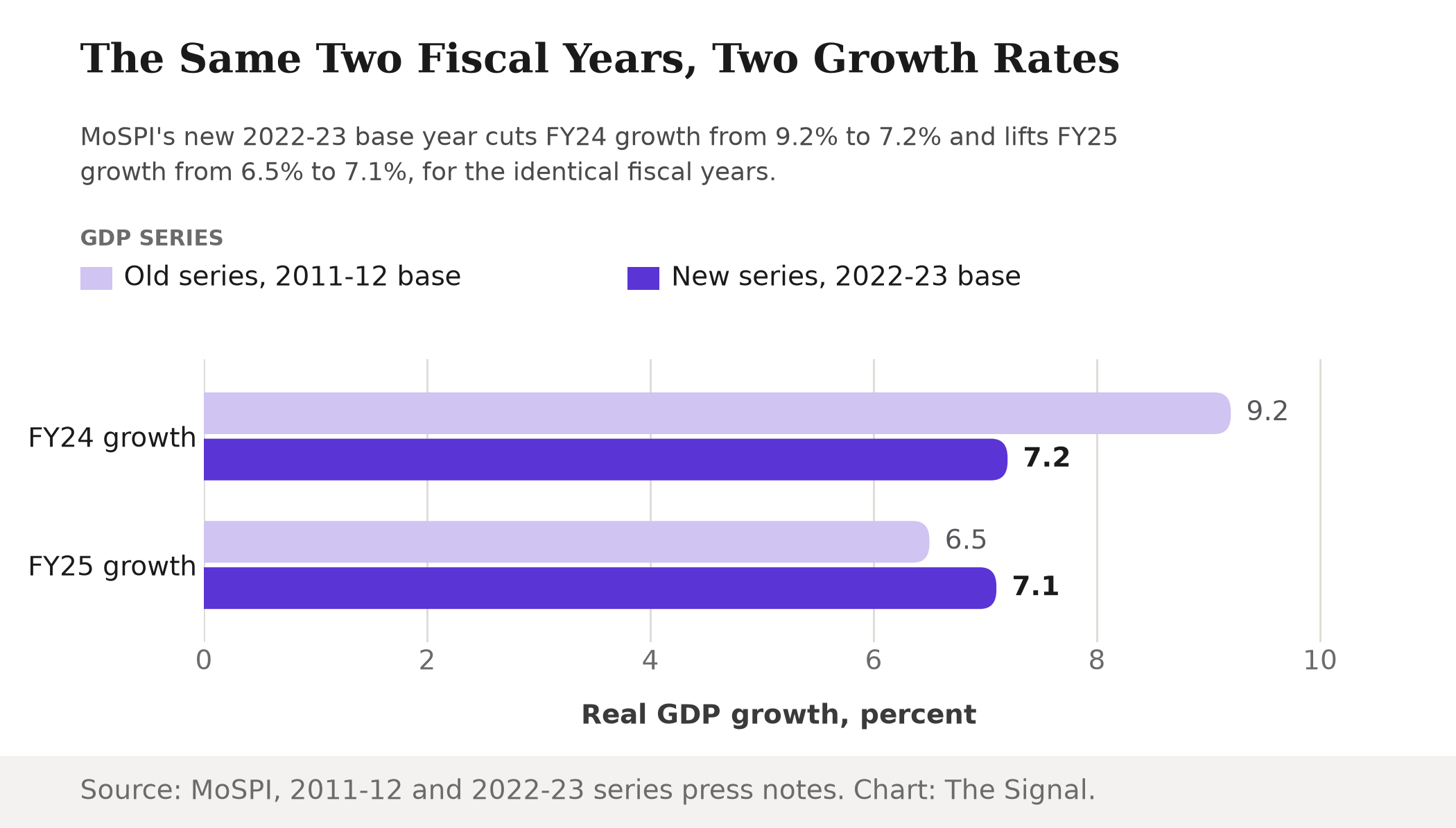
He had reason to get ahead of the question. On 27 February 2026, MoSPI replaced India's GDP series, built on 2011-12 prices, with a new series based on 2022-23 prices; under that new series, real GDP for FY24 reached ₹280.01 lakh crore and for FY25 reached ₹299.89 lakh crore, growth of 7.2% and 7.1% respectively, MoSPI's official press note states. Those two growth figures look routine until you check what they used to be.
It is worth pausing there. Those same two years were reported once before, under the old base. Under the 2011-12 series, MoSPI's First Revised Estimates put FY24 real GDP growth at 9.2%, and FY25 growth, in the Provisional Estimates released under that same old series, came in at 6.5%. Rebase those identical years to 2022-23 prices and FY24's growth drops from 9.2% to 7.2%, more than two full percentage points lower. FY25 moves the other way, from 6.5% up to 7.1%. Same fiscal years, same underlying economy, two different growth rates, depending only on which base year did the counting.
Why the same year now has two growth rates
A base year is not decoration, it is the price structure the whole series is built from: every year's output is valued at the base year's relative prices, then carried forward. MoSPI's press note on the new series puts the base-year GDP itself at ₹261.18 lakh crore for 2022-23. Move that anchor eleven years forward and the relative weights inside the economy shift, which is exactly the kind of change that can turn a 9.2% growth year into a 7.2% one without a single fact about output changing.
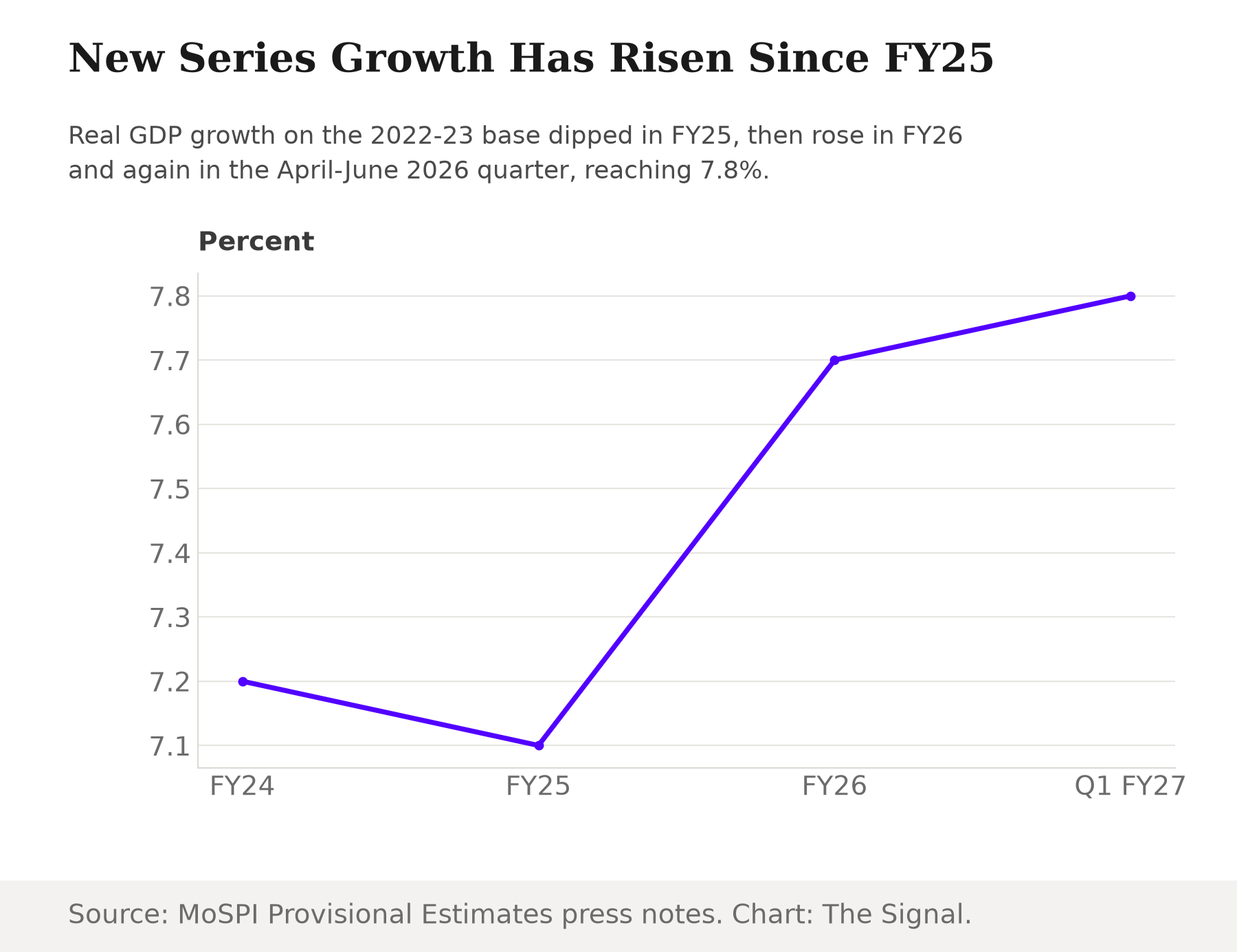
That alone would be a one-off story. The newer numbers are now carrying real weight on their own. MoSPI's Provisional Estimates for FY 2025-26 put real GDP at ₹323.12 lakh crore, growth of 7.7% over the restated FY25 figure of 7.1%, and Q1 FY27 growth reached 7.8%. Stack that run on top of the FY24 rebasing, and the case that Indian growth is durably running above 7% depends on trusting the new numbers over the ones they replaced, for years the public had already been told to trust the first time.
34 of India's 36 States and Union Territories are still measuring themselves on the base year India is retiring nationally. India comprises 28 States and 8 Union Territories, so all but two are still on the old base.
| Status | Detail |
|---|---|
| States/UTs compiling GSDP on the 2011-12 base | 34 of 36, as of 7 May 2026 |
| States/UTs excluded from that count | Lakshadweep and Dadra & Nagar Haveli and Daman & Diu |
| MoSPI's onboarding step | A Uniform Guideline issued 7 May 2026, moving all States/UTs to the 2022-23 base |
| National back series (years before FY23, recomputed) | Expected by December 2026 |
Source: MoSPI's press release on GSDP base-year onboarding, 7 May 2026; MoSPI's press note on the new GDP series; PIB, on India's 28 States and 8 Union Territories. Table: The Signal.
The debate the rebasing has already started
The case for doing this is not hard to make. The IMF's November 2025 Article IV review gave India's national accounts data a "C" grade, its second-lowest rating, citing an outdated base year of 2011-12 among its methodological weaknesses, Scroll.in reported months before the new series arrived. A rebase that modernises the price structure to 2022-23 addresses exactly that complaint.
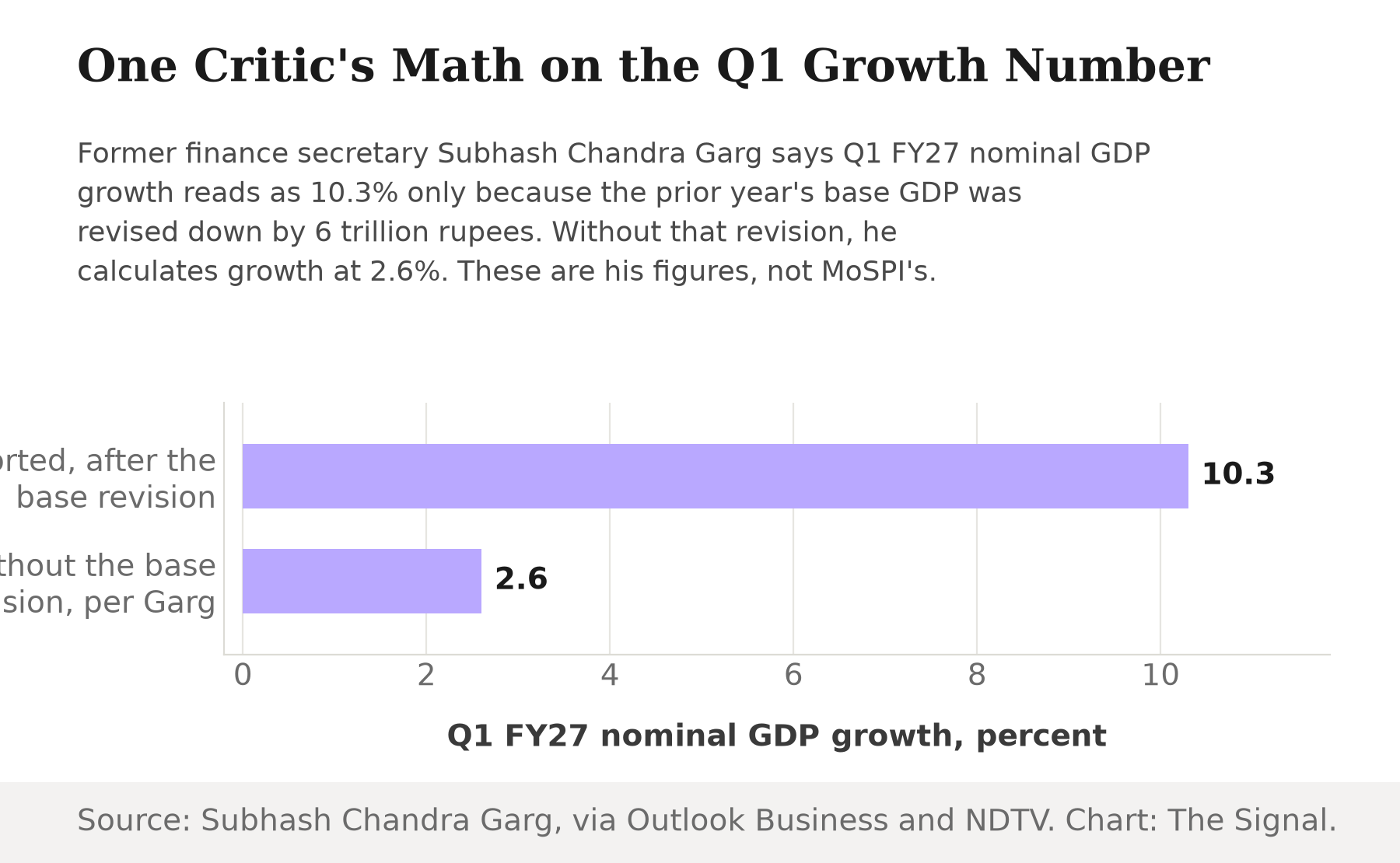
What it does not settle is how to read a growth number computed across the switch. Former finance secretary Subhash Chandra Garg made the sharpest version of that objection about the same quarter MoSPI's Secretary was defending. Garg said the prior year's current-price GDP, reported at ₹86 trillion, was revised down to ₹80 trillion, and that the ₹6 trillion cut alone pushed the current quarter's reported growth to about 10.3%, versus 2.6% without it, as reported by Outlook Business. That is a critic's arithmetic on nominal GDP, not MoSPI's figure, and a different measure from the 7.8% real GDP growth MoSPI reported. But it is the clearest illustration on record of how much a base revision can move a growth number both sides are citing as though it settles an argument.
What happens when the older years get the same treatment
The FY24 and FY25 swings happened to years MoSPI has already recomputed. The larger test is still ahead. MoSPI's press note on the new series says the back series, recalculating years before FY23 on the 2022-23 base, is expected by December 2026. Two days later, MoSPI Secretary Saurabh Garg confirmed the timeline directly: the ministry will also be releasing the back series of GDP estimates for the updated base year by the end of the year, he told Business Today.
Nobody outside MoSPI yet knows which pre-FY23 years will move up and which will move down once recalculated. What is already on the record is the direction of travel: the one year already redone, FY24, moved from 9.2% growth to 7.2%, more than two points lower, while FY25 gained. If that pattern extends into the boom years both sides have already built arguments on, a recalculation billed as housekeeping will read as vindication to some and as suspicion confirmed to others, regardless of what the recalculation actually shows.
The honest objection
The strongest case for MoSPI's position is that the critics are making exactly the mistake a base-year change is designed to correct. MoSPI Secretary Saurabh Garg's answer, that comparisons across a base-year change must be apples to apples, not apples to oranges, is not spin, it is how every national statistics office treats a base revision: growth is calculated within one series, and levels shift when the price structure does. On that reading, the FY24 swing from 9.2% to 7.2% is not evidence of manipulation. It is what an overdue update to a national accounts framework the IMF itself had marked down to a "C" grade for its outdated base year was always going to produce.
That case holds for the mechanics. It strains once the same recalculation explains why a government defending its best growth quarter in years keeps reaching for whichever version reads highest. MoSPI's own Q1 FY27 figure, an acceleration to 7.8% from 6.9% a year earlier, is real GDP on the new base throughout, so it is not directly comparable to Garg's nominal-growth argument. But both arguments are fights over the same underlying fact: a base year decides which growth number gets remembered as this decade's story, and 34 of India's 36 states and Union Territories are still measuring their own economies on the base year now being retired nationally.
The Signal
By December 2026, on MoSPI's own timeline, the back series recalculating the entire pre-FY23 growth history is due. The honest test is not whether the numbers change. A base revision always changes the numbers; that is the point of doing one. The test is which years move the way FY24 moved, down, from a headline-grabbing 9.2% to a more ordinary 7.2%, and which move the way FY25 did, up, from 6.5% toward 7%. If the politically inconvenient years shrink and the politically convenient ones hold or rise, the back series will read as vindication to whoever is in office when it lands, whatever the recalculation itself actually reveals. A base year is supposed to be the most boring number in a GDP release. This one is about to decide which growth story India tells about the years everyone already thought they knew.
Reporting basis: the new series' base-year figures and the FY24 and FY25 growth rates under it are from MoSPI's press note on the 2022-23 series. The FY26 provisional growth figure and the restated FY25 figure are from MoSPI's Provisional Estimates press note for FY 2025-26, and the Q1 FY27 growth figure is from MoSPI's press note on Q1 FY 2026-27 GDP estimates. FY24 and FY25 growth under the old series are from MoSPI's First Revised Estimates and Provisional Estimates press notes respectively. State-level rebasing status and the December 2026 back-series timeline are from MoSPI's press release on GSDP onboarding and MoSPI's press note on the new series; the total count of 28 States and 8 Union Territories is per a PIB Year End Review press release for the Department of School Education & Literacy. Saurabh Garg's on-record confirmation of the timeline and his apples-to-apples rebuttal are as reported by Business Today. The IMF's "C" grade for India's national accounts is per its November 2025 Article IV review, as reported by Scroll.in. Subhash Chandra Garg's nominal-growth counterfactual is his own calculation, as reported by Outlook Business, not MoSPI's figure. The percentage-point comparisons between the old and new series are The Signal's calculations from those figures.