The headlines about oil this year have mostly been about crude. Crude surged past $100 a barrel in 2026, up from roughly $73 before West Asia hostilities involving Iran, Israel and the United States intensified in late February. Read only that thread and India's 2022 diesel export curbs, the windfall tax that briefly made refiners the villains of a fuel-price panic, look like a closed chapter: an emergency response to a war-shocked market, retired once prices calmed.
It is worth slowing down on that read. The tax India built in 2022 was never retired for good, and it is not merely at risk of a repeat. It is already back, it has been back for six months, and the finance ministry is still actively adjusting it every two weeks.
The number that gives it away
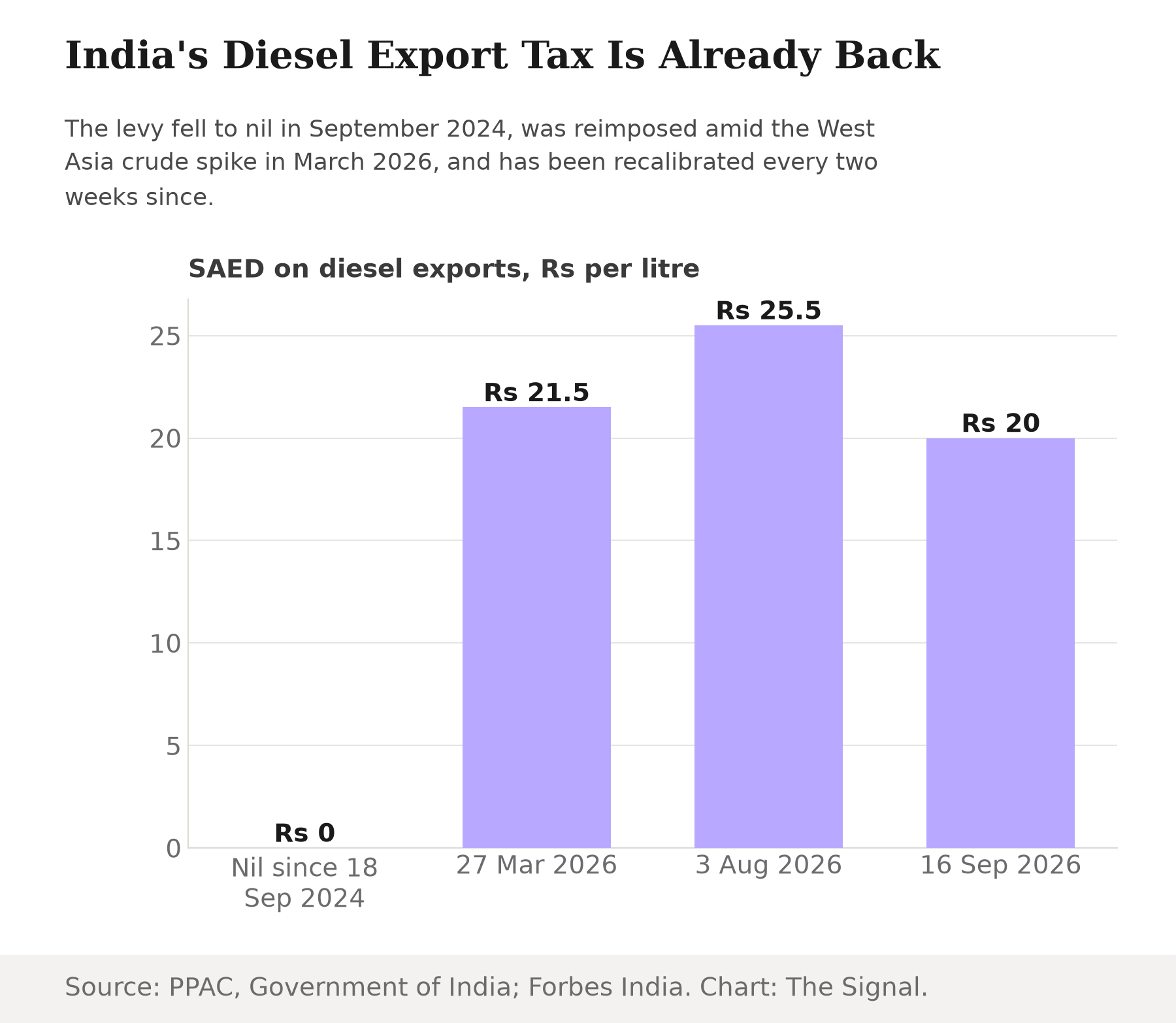
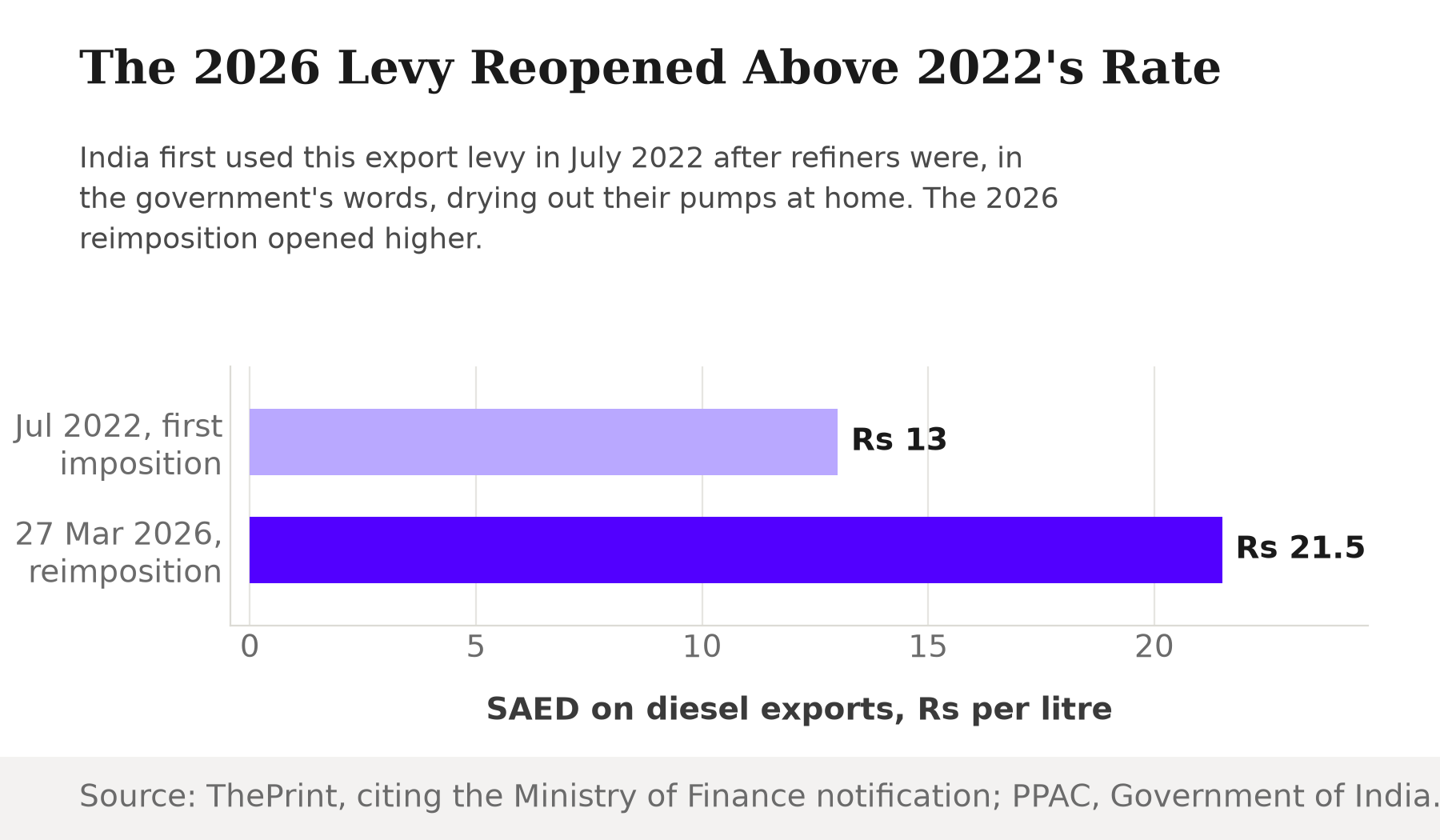
India's Special Additional Excise Duty on diesel exports, which had sat at nil since 18 September 2024, was reimposed at a combined Rs 21.50 a litre on 27 March 2026 amid the West Asia crude spike, PPAC data show. That alone would be a one-line news item. What makes it a story is what happened next: the finance ministry did not set the rate once and move on. It has recalibrated the levy on a fortnightly cadence since, and the rate most recently stood at Rs 20 a litre, with jet fuel taxed at Rs 15 a litre, effective 16 September 2026. In between, the duty climbed by Rs 10 a litre, from Rs 15.5 to Rs 25.5, by early August 2026 as crude kept rising.
That is not a policy sitting on the shelf in case of emergency. It is a policy running in real time, tracking a market that will not sit still.
A tax built for exactly this moment
The mechanism itself is not new. India first used it in July 2022, imposing a Special Additional Excise Duty of Rs 13 a litre on diesel exports, Rs 6 a litre on petrol and jet fuel exports, and Rs 23,250 a tonne on domestic crude, because, in the government's own words at the time, certain refiners were "drying out their pumps in the domestic market" to chase richer prices abroad. The logic was blunt: when the export price for a litre of diesel is worth more than the domestic price, a refiner with no obligation otherwise will ship it out, and Indian pumps run short. The tax closes that gap by taxing the export margin away.
The 2026 reimposition did not just reuse the mechanism. It reopened well above where the mechanism started: the Rs 21.50 rate set on 27 March 2026 was already about 65 percent above the Rs 13 rate India first used in July 2022, our calculation from those two figures.
The constraint has moved from the wellhead to the refinery
What is different this time is what is actually scarce. In 2022 the story was mostly crude getting pricier, with refiners capturing the gap between that cost and the export price of the fuel they made from it. In 2026, the scarcer input is not crude. It is the refining capacity needed to turn crude into diesel at all.
Total US diesel inventories fell to 107.9 million barrels by 11 September 2026, the lowest for this time of year since records began in 1982, and the US diesel crack spread, the margin a refiner earns for converting crude into diesel, hit a record $118.62 a barrel on 14 September 2026, Reuters reported. Crude is a shared input, priced the same for every refiner; if crude alone were the constraint, margins would not be setting records. A record crack spread means the bottleneck is the conversion step itself, refining throughput the world cannot expand fast enough.
That squeeze has a documented structural driver. US distillate exports averaged 1.2 million barrels a day in the first half of 2025, 7 percent above the prior five-year average, a pull the EIA links to Europe replacing lost Russian diesel supply and to US refinery closures curbing domestic distillate production capacity. Fewer refineries chasing more export demand is a capacity story, and it predates the 2026 crude spike by a year.
Four separate numbers, from two continents, are describing the same squeeze.
| Metric | Figure | As of |
|---|---|---|
| US diesel inventories | 107.9 million barrels, lowest for this time of year since 1982 | 11 September 2026 |
| US diesel crack spread | $118.62 a barrel, a record | 14 September 2026 |
| US distillate exports, 1H 2025 | 1.2 million barrels a day, 7% above the prior 5-year average | June 2025 |
| India refined product exports | About 930,000 barrels a day, lowest since October 2022 | May 2026 |
Sources: Reuters, via Investing.com; EIA; Kpler, via Business Today.
Reliance sits on both sides of the squeeze
India's own refining base makes this personal for one company more than any other. As of 30 July 2026, India's total refining capacity stood at 248.866 million tonnes a year, and Reliance Industries' two Jamnagar refineries alone accounted for 68.2 million tonnes of it, the largest private-sector share and roughly a quarter of the national total. No other private refiner in India comes close to that scale, and Jamnagar's diesel is exactly the product this global squeeze has made more valuable to ship abroad than to sell at home.
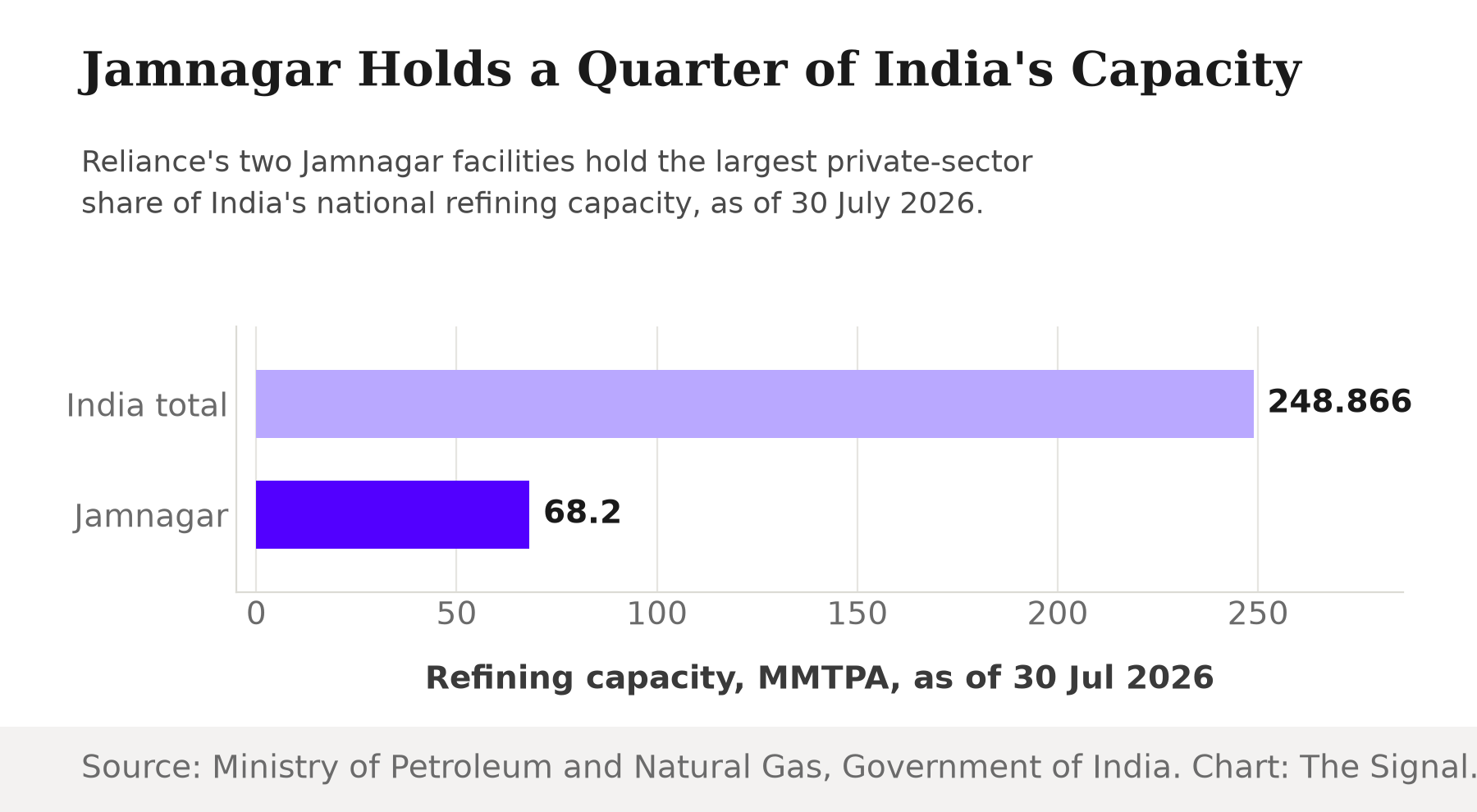
That is the mechanism the 2022 tax was written to interrupt, and it is the same mechanism behind the 2026 reimposition: a refiner with export-oriented capacity earns more from a scarce, high-margin product abroad than from selling it at a regulated domestic price, so the government taxes the export margin to keep supply at home. Other refiners face the SAED too, but Jamnagar's scale is why India's export-curb policy exists in its current form: a refining base concentrated enough that one company's export decisions move the domestic market.
The honest objection
The strongest case against reading this as a repeat of 2022 is that India's own export volumes have already fallen, not risen, this year. India's refined petroleum product exports fell to about 930,000 barrels a day in May 2026, the lowest monthly level since October 2022, largely because scheduled maintenance at Reliance's Jamnagar refining complex cut throughput and refiners redirected volumes toward the domestic market, Kpler analyst Sumit Ritolia told Business Today. If exporters were chasing margins the way the government accused them of in 2022, exports should have risen alongside the crack spread, not fallen. On this reading, the SAED's return is precautionary policy responding to a global price shock, not a correction of Indian refiners actually starving the domestic pump.
That case is real for May specifically, but it does not explain why the tax stayed on, and kept moving, for the four months since that maintenance shutdown ended. A one-off supply dip would justify a one-off response. A rate the finance ministry has adjusted fortnightly since March, from 21.50 to 25.50 and back to 20.00, is a standing mechanism tracking a margin that keeps moving, which is exactly what the SAED was built to do.
The Signal
The 2022 framing was a crisis that came and went: a war shocked crude prices, refiners chased the export math, India taxed the gap, and the tax lapsed once prices settled. The honest 2026 update is that the crisis framing was wrong from the start. The underlying condition, a shortage of global refining capacity that makes diesel worth more abroad than the price regulators want it sold for at home, is structural enough that the same tax mechanism has now been switched on, adjusted fortnightly, and left running for six straight months. Watch the SAED rate the way you would watch a thermostat, not a fire alarm: every fortnight it moves is the government reading a margin that a handful of large refiners, Reliance's Jamnagar complex chief among them, are positioned to capture if the tax is not there to intercept it.
Reporting basis: India's refining capacity figures, including Reliance's Jamnagar share, are from the Ministry of Petroleum and Natural Gas. The SAED rate history, from its lapse in September 2024 through its reimposition and subsequent fortnightly changes to 16 September 2026, is from PPAC, the Petroleum Planning and Analysis Cell. The 2022 precedent and the government's original rationale are as reported by ThePrint, citing the Ministry of Finance notification. The US diesel inventory and crack-spread figures are per Reuters, via Investing.com. US distillate export data and its structural drivers are from the US Energy Information Administration's Today in Energy. India's May 2026 export volumes and the Jamnagar maintenance explanation are per Kpler analyst Sumit Ritolia, as reported by Business Today. The crude price move and the August 2026 duty level are as reported by Forbes India. The percentage difference between the 2022 and 2026 opening rates is The Signal's calculation from those figures.