On paper, the 2017 Doklam standoff was a dispute over high ground in the eastern Himalayas, worked out through military posturing and diplomatic talks between Delhi and Beijing. Neither government ever announced an economic response to it. Read that way, the episode left no mark on the financial system at all.
It is worth slowing down on that. Far from the plateau, in Mumbai, a single bank branch was already reacting to the standoff in a way no government order required and no public disclosure mentioned for nine years.
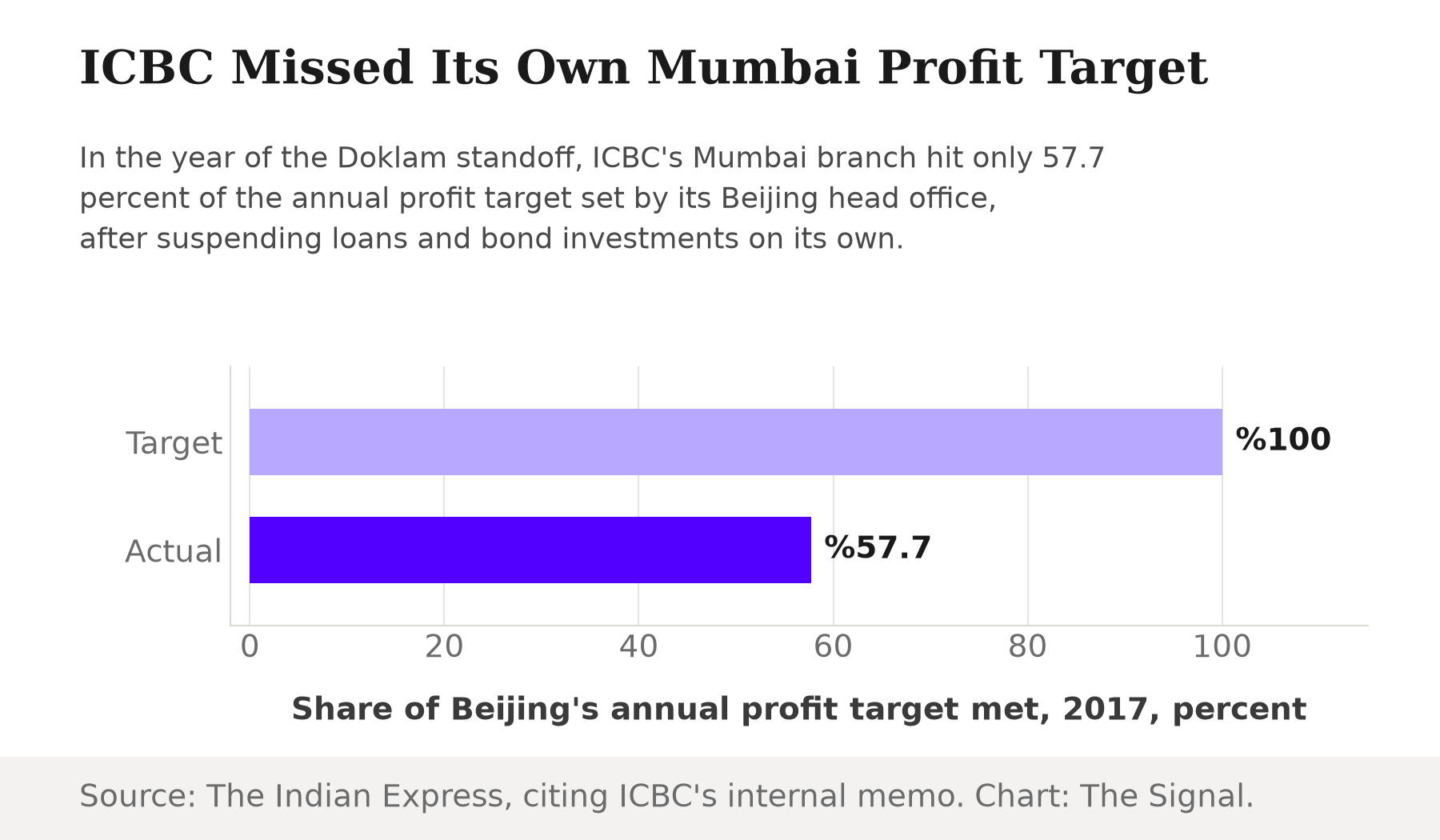
During the standoff, ICBC's Mumbai branch, its only branch in India, suspended disbursement of 11 approved but undisbursed loans and bond investments worth $185 million. The pullback cut the branch's operating revenue by about $6.36 million and left it meeting just 57.7 percent of the annual profit target Beijing had set for 2017, according to the bank's own confidential internal work summary, dated January 2018, a shortfall of more than 42 percentage points on that target.
Beijing's bank, Beijing's orders
The Mumbai numbers surfaced through the China Capital investigation, built from a cache of 4.8 million internal ICBC records spanning 2005 to 2024. The International Consortium of Investigative Journalists says the records were obtained by hacking groups and then leaked to it anonymously, before it coordinated 75 journalists across 24 newsrooms, including The Indian Express, to work through them.
The same trove explains why an internal decision, not a government directive, is the right frame for what happened in Mumbai. In cases unrelated to India, ICIJ's investigation finds that ICBC officers acted at the direction of the bank's Beijing headquarters to pursue explicitly political objectives for the Chinese state, its majority shareholder, and that the bank breached its own sanctions and anti-money-laundering policies to do it. A bank whose branches already take political direction from Beijing, and bend their own compliance rules to do it, does not need a formal order to ration credit somewhere else when tensions rise. It only needs a signal.
The gate that came three years later
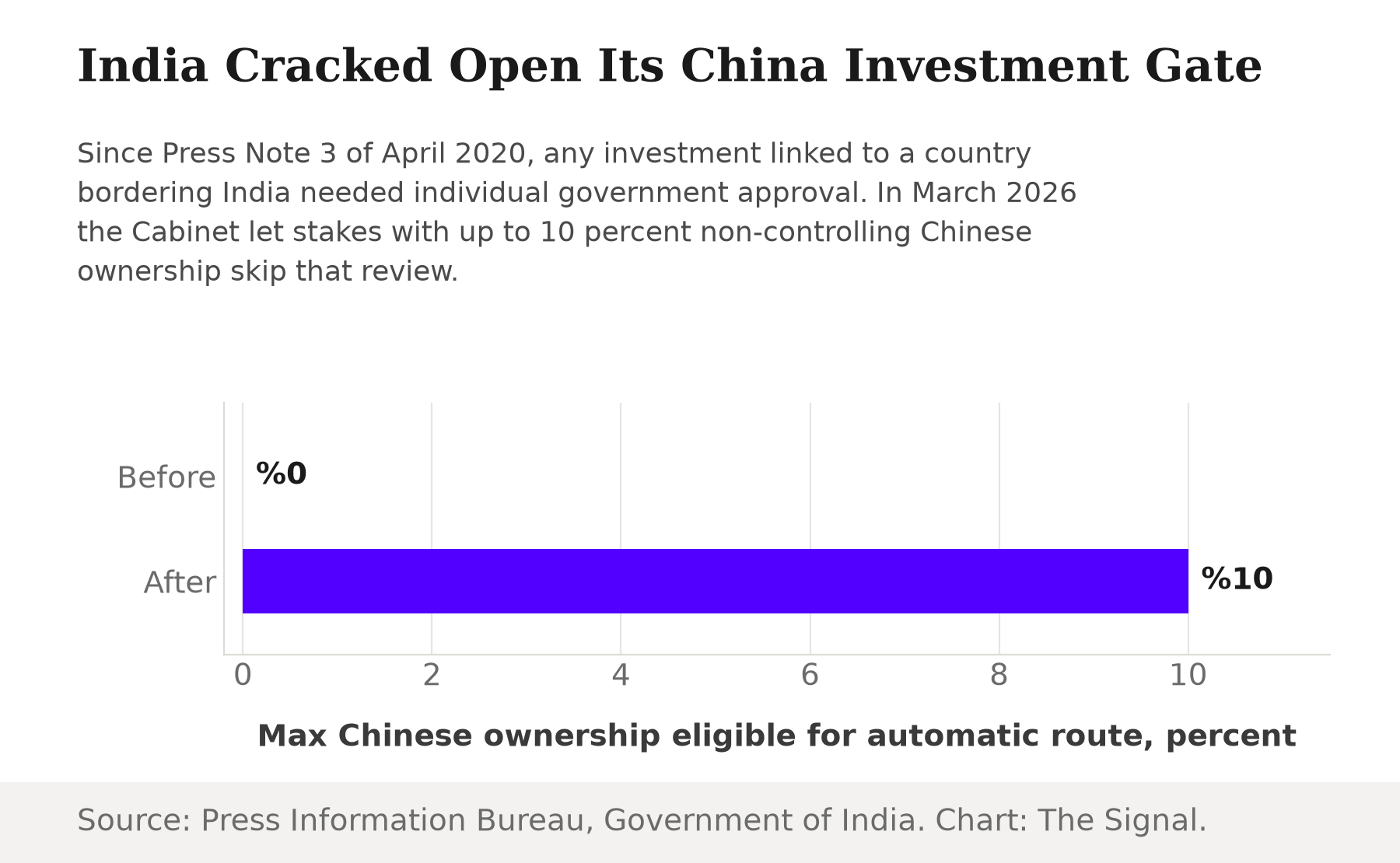
India did eventually build a formal lever aimed at Chinese money, just not until well after Mumbai's freeze. Press Note 3, dated April 17, 2020, requires any investment from an entity in a country sharing a land border with India, or beneficially owned by one, to go through the government's individual approval route rather than the automatic one. ICBC's branch had already rationed its India lending more than two years before that rule existed.
The government keeps adjusting that lever today, in the open. As recently as March 10, 2026, the Union Cabinet approved changes letting investments with up to 10 percent non-controlling Chinese beneficial ownership use the automatic route, and created a 60-day expedited approval track for seven manufacturing sectors. That is precisely the kind of formal, publicly deliberated action the Mumbai freeze bypassed entirely.
Formally, India regulates Chinese money in public. Informally, a single branch did it first, in private.
| Date | Event | A public, deliberated government action? |
|---|---|---|
| December 2017 | ICBC's Mumbai branch suspends $185 million in loans and bonds | No, an internal bank decision |
| April 2020 | Press Note 3 requires government-route approval for investment tied to a bordering country | Yes |
| March 2026 | Cabinet lets stakes with up to 10 percent non-controlling Chinese ownership use the automatic route | Yes |
Source: The Indian Express, citing ICBC's internal January 2018 work summary; Press Information Bureau, Government of India. Table: The Signal.
The honest objection
The strongest case against reading Mumbai's freeze as a deliberate lever is a boring one: any large bank trims a risky branch's lending when a border crisis raises uncertainty. That is ordinary credit-risk management, not a weapon aimed at India specifically, and it is exactly what a wholly domestic bank would do too.
That case would be more persuasive if ICBC's political conduct stopped at ordinary risk management everywhere else. It does not. The same leaked records that show ICBC officers acting on Beijing's direction to pursue explicit political objectives also show the bank breaching its own sanctions and anti-money-laundering policies to do it. A bank willing to bend its own compliance rules for Beijing's political goals elsewhere does not look like a bank that treated a Mumbai lending decision as pure, apolitical accounting. Missing a Beijing-set target by more than 42 points is not proof either way on its own. Set beside how the same institution behaves when it is following instructions, it reads less like caution and more like compliance.
One branch was rationed. The rest of the bank kept lending.
The reaction to the China Capital revelations elsewhere shows what a public reckoning with this risk actually looks like, and how absent that reckoning has been in India so far. Within a day of the revelations that ICBC had extended nearly $1.7 billion in loans to UK water and energy companies, the House of Lords held a debate, on September 15, 2026, warning that this poses a financial security risk, especially since ICBC has continued to accept business from Russian and Belarusian clients.
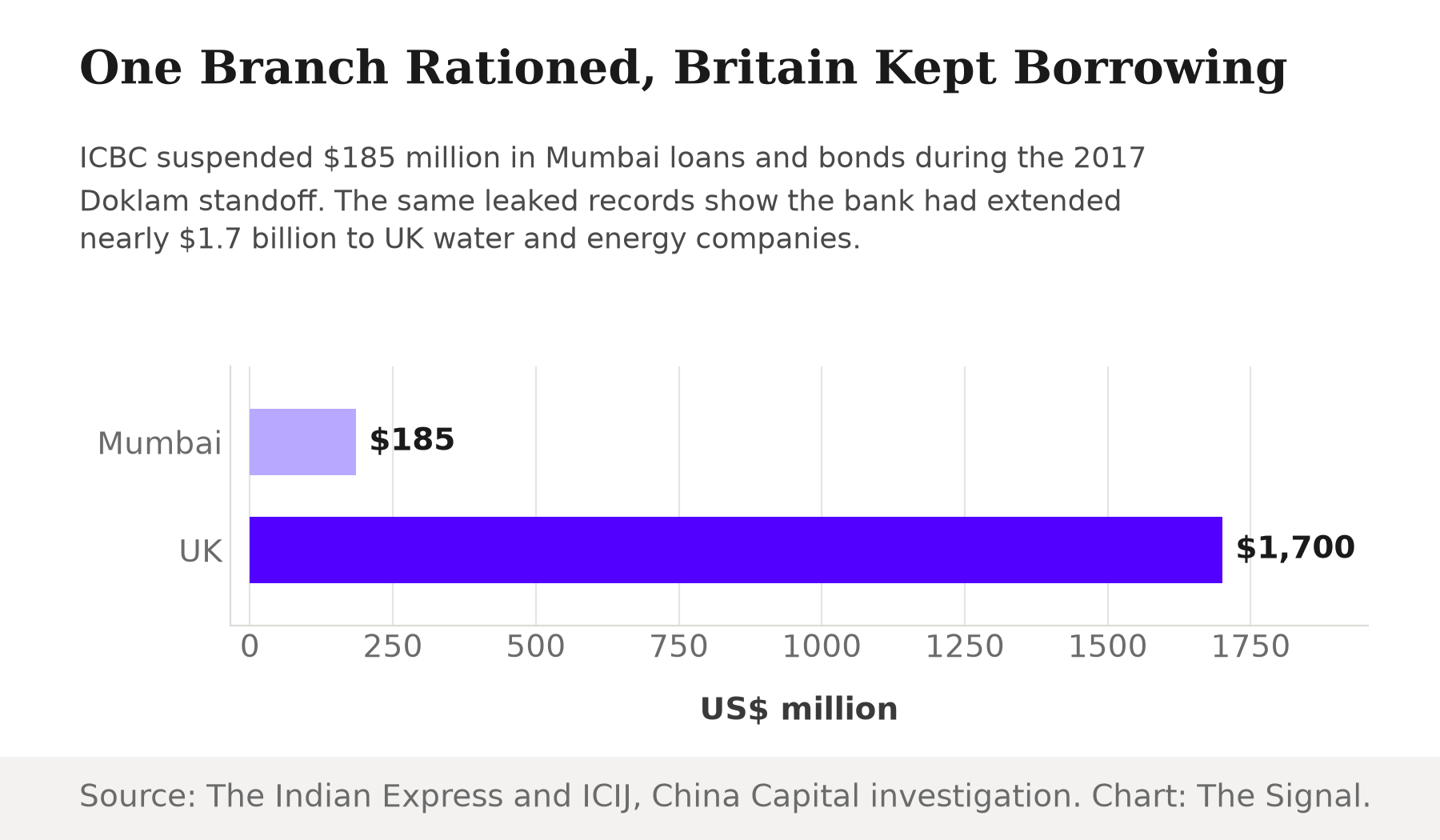
The contrast is the point. ICBC is the world's largest bank by assets, holding $6.3 trillion as of mid-2024, a scale at which $185 million is a rounding error and $1.7 billion is still a small slice of the balance sheet. The bank did not run short of money in 2017. It chose where to keep lending and where to pull back, inside the one Indian branch it had, the Mumbai office it had first announced plans to open back in March 2010, when ICBC was already China's largest bank.
The Signal
Regulators built Press Note 3 and its 2026 amendments to govern investment they can see: a filing, a stake, a beneficial owner on a form. What happened in Mumbai in 2017 left no filing behind at all. An ICBC branch quietly adjusted its own lending during a diplomatic crisis, on instructions or instincts no regulator was positioned to observe, and the fact only surfaced because a hacking group, not a supervisor, got there first.
That is the hidden channel: a state-linked bank can throttle a country's credit exposure without ever appearing in that country's capital-control statistics, its parliamentary debates, or its own regulatory filings. Watch what China Capital surfaces next. If the same pattern of Beijing-directed lending turns up in other Indian branches of Chinese institutions, or in trade financing during some future standoff, the 2017 freeze will look less like an anomaly and more like an early, documented instance of a lever no regulator yet knows how to watch.
Reporting basis: the $185 million Mumbai loan freeze, its revenue impact, and the 57.7 percent profit-target figure are per The Indian Express, drawing on ICBC's internal January 2018 work summary reviewed as part of the ICIJ-coordinated China Capital investigation. The scope of the leaked ICBC trove, 4.8 million records spanning 2005 to 2024, and the finding that ICBC officers acted on Beijing's political direction and breached the bank's own sanctions and anti-money-laundering policies, are per ICIJ's own published account of that investigation. The House of Lords debate and the $1.7 billion UK infrastructure-lending figure are per ICIJ's reporting on the parliamentary reaction. Press Note 3's terms and the March 2026 Cabinet amendments are per Press Information Bureau releases from the Government of India. ICBC's ranking as the world's largest bank by assets is per Fortune, citing S&P Global Market Intelligence, and the 2010 Mumbai branch announcement is per Business Standard's contemporaneous PTI report. The profit-target shortfall and the time gap between the 2017 freeze and Press Note 3 are The Signal's calculations from those figures.