
On September 18, 2026, the Reserve Bank of India removed Maharashtra's Cooperation Minister from the board of a bank most Indians have never heard of. The RBI ordered Babasaheb Patil off the board of the Latur District Central Cooperative Bank for allegedly violating the rules that govern how long a cooperative bank director can serve. Read as a single act, it looks close to administrative housekeeping: a director stayed past a limit, and a regulator stepped in to enforce it. The order cites Section 10A(2A)(i), read with Section 56, of the Banking Regulation Act, 1949, a clause written for exactly this kind of enforcement.
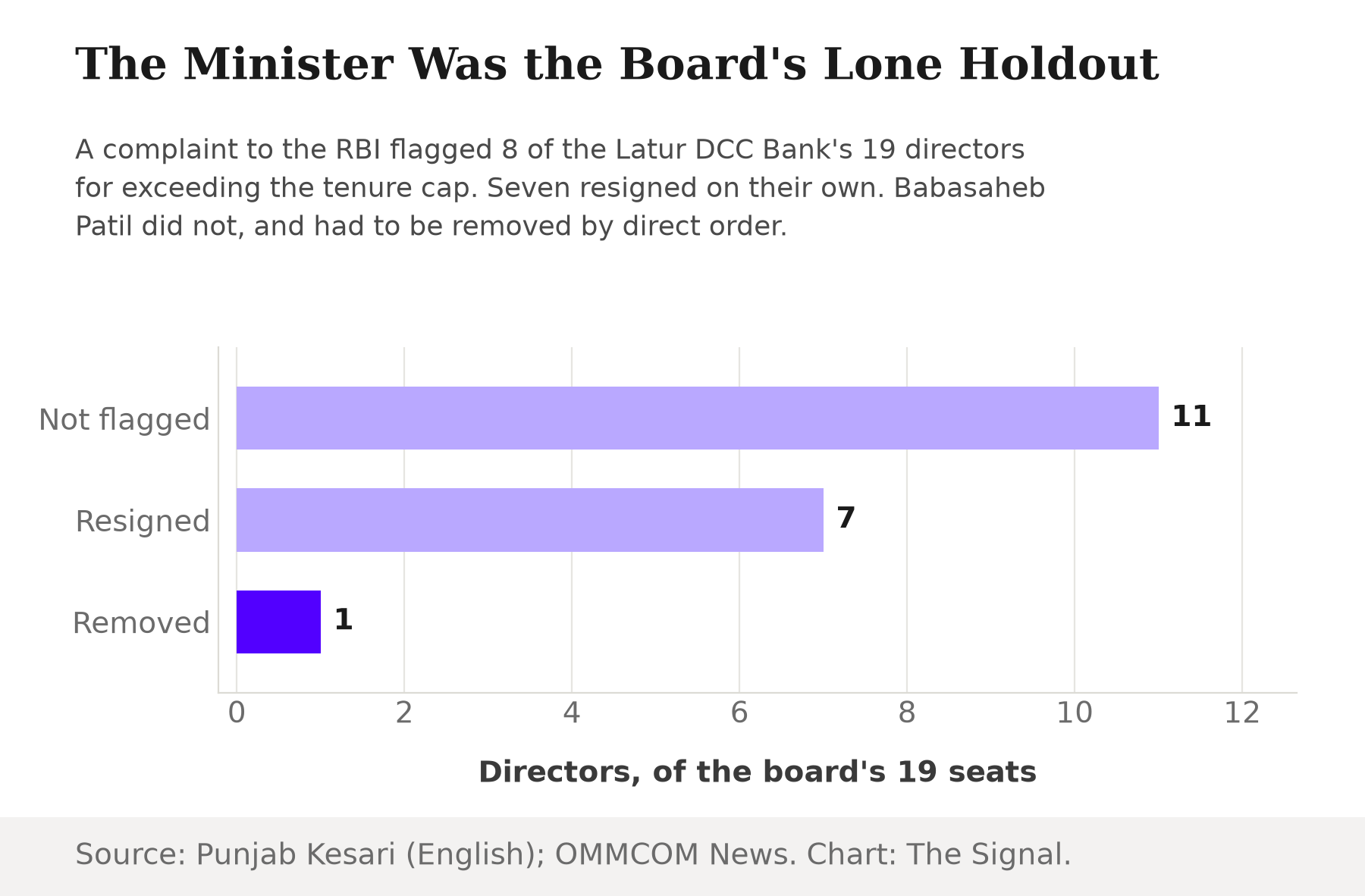
It is worth slowing down on that reading. Patil was not removed alone, and he was not removed first. Seven other directors named in the same complaint had already resigned once they were flagged; only Patil refused to go, which is why the RBI had to issue him a direct removal order. The minister who holds Maharashtra's own cooperative-banking portfolio was the one name on the list that a regulator had to force out.
Eight of the bank's 19 directors were on that list.
The complaint alleged that 8 of the Latur DCC Bank's 19 board members, including Patil, had held their seats for more than 10 years, in violation of the tenure cap: 42 percent of the board, on one complaint, all past the same limit. Of those eight, seven left the moment they were named. One did not.
A cap that had just been raised, and still wasn't enough
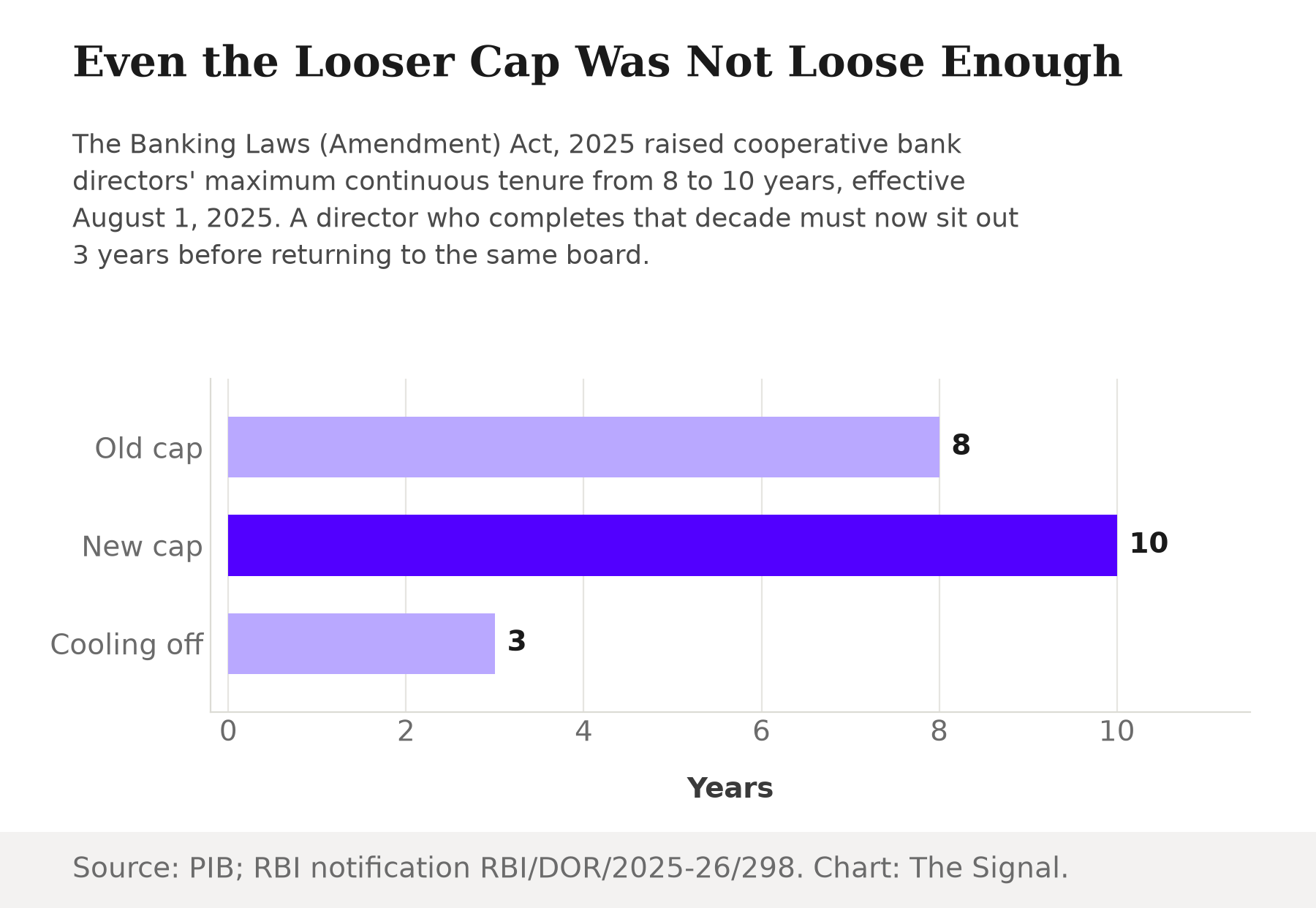
Babasaheb Patil is Maharashtra's Cooperation Minister and a Nationalist Congress Party leader, which makes the specific rule he broke pointed. Cooperative bank director tenure is not an obscure technicality; the central government had just made it more generous. The Banking Laws (Amendment) Act, 2025 raised the maximum continuous tenure for cooperative bank directors from 8 to 10 years, excluding the chairperson and whole-time director, effective August 1, 2025. The eight flagged directors at Latur, on the complaint's own account, had still served past even that raised ceiling.
The RBI had also, separately, tightened what happens after a director hits that ceiling. Under the RBI's Rural Co-operative Banks (Governance) Directions, 2025, a director who completes a continuous 10-year term is eligible for re-appointment to the same board only after a minimum 3-year cooling-off period. Both changes were already in force before the Latur complaint was filed.
How a routine complaint became a regulator's order
The case moved through an ordinary enforcement path, not a political one. A Latur DCC Bank member, Satish Jadhav, filed the tenure complaint on May 25, 2026. The Aurangabad bench of the Bombay High Court, on August 3, 2026, directed the competent authority to decide the complaint on its merits within six weeks. The RBI's order followed on September 18, roughly six and a half weeks later, close to the court's own clock (our calculation from those two dates).
| Date | What happened |
|---|---|
| Aug 1, 2025 | The director tenure cap rises from 8 to 10 years under the Banking Laws (Amendment) Act, 2025 |
| Nov 28, 2025 | The RBI's Rural Co-operative Banks (Governance) Directions add a 3-year cooling-off period after a 10-year term |
| May 25, 2026 | Bank member Satish Jadhav files a complaint naming 8 of 19 directors, including Patil, as tenure violators |
| Aug 3, 2026 | The Bombay High Court's Aurangabad bench orders a decision within six weeks |
| Sept 18, 2026 | The RBI removes Patil; the seven other named directors had already resigned |
Sources as linked in each row above.
What the order doesn't reach
Every fact in that timeline concerns one man's seat, not how he reached it. Directors on boards like Latur's are not appointed by the RBI or by the state government; they reach the board through elections rooted in the district's cooperative structure, the same broad network that elects officeholders across rural cooperative banking in India. Latur DCC Bank is one of 31 District Central Cooperative Banks in Maharashtra alone, part of a 350-strong all-India network of such banks: the removal order reaches exactly one seat on one of them. That structure put Patil in his seat, and it put his now-resigned colleagues in theirs, long before any complaint was filed. The RBI's order removes Patil. It does not touch the process that placed him, or them, there to begin with.
The RBI's own governance directions come closer to addressing that than the removal order does. A director who completes a full ten-year term must now sit out a minimum three-year cooling-off period before returning to the same board, which is a structural change, not a personal penalty: it stops an ousted director from simply standing again next cycle. But a cooling-off period constrains one name for a few years on one board. It says nothing about who else the same election process puts forward in that director's place, or whether that process concentrates seats among a small, repeat-serving group to start with. The individual is barred, but the mechanism that selects individuals remains untouched.
The honest objection
The strongest case against reading anything structural into this is that the RBI has, in fact, already acted structurally: it added the three-year cooling-off rule in November 2025, months before this case, and then enforced that rule against a sitting minister with no visible hesitation. That is not a regulator protecting insiders. A single removal order, backed by a genuinely new cooling-off requirement, is real reform in progress, and it is unreasonable to expect one order to also redesign how rural cooperative elections work.
That case holds as far as it goes. But it describes a regulator tightening the exit door, not the entry one. Seven of eight flagged directors resigned rather than contest the finding, which suggests the tenure violation itself was never seriously in dispute, only Patil's willingness to leave quietly. Nothing in this case, or in the rules applied to it, changes who gets nominated, who gets elected, or how contested those elections actually are. A cooling-off period slows down one name's return. It was never built to change who else is standing.
The Signal
The RBI enforced a rule it had strengthened months earlier, against the single holdout on an eight-name list, and the system worked exactly as designed: complaint, court deadline, order, in about four months start to finish. What it did not do, because it was never asked to, is explain how a sitting cabinet minister came to hold a cooperative bank board seat for longer than the law allowed, or why seven of his colleagues were in the identical position. The next name to sit past the limit will go through the same process this one did. The seat itself was never the thing being examined.
Reporting basis: the RBI's removal order and its legal basis are as reported by Deccan Chronicle and Outlook Business; the detail that seven other directors resigned while Patil alone required a direct order is per OMMCOM News, the digital news desk of Odisha Television Ltd. Patil's ministerial and party affiliation is per NewsX. The underlying tenure complaint, including the 8-of-19 figure and the May 25, 2026 filing date, is per Punjab Kesari's English edition, citing complainant Satish Jadhav; the Bombay High Court's August 3, 2026 directive is per The Daily Jagran. The Banking Laws (Amendment) Act, 2025 tenure cap is from a Press Information Bureau release of the Ministry of Finance, and the cooling-off provision is from the RBI's own notification RBI/DOR/2025-26/298. The board-composition share and the elapsed time between the High Court's directive and the RBI's order are The Signal's own calculations from those figures.