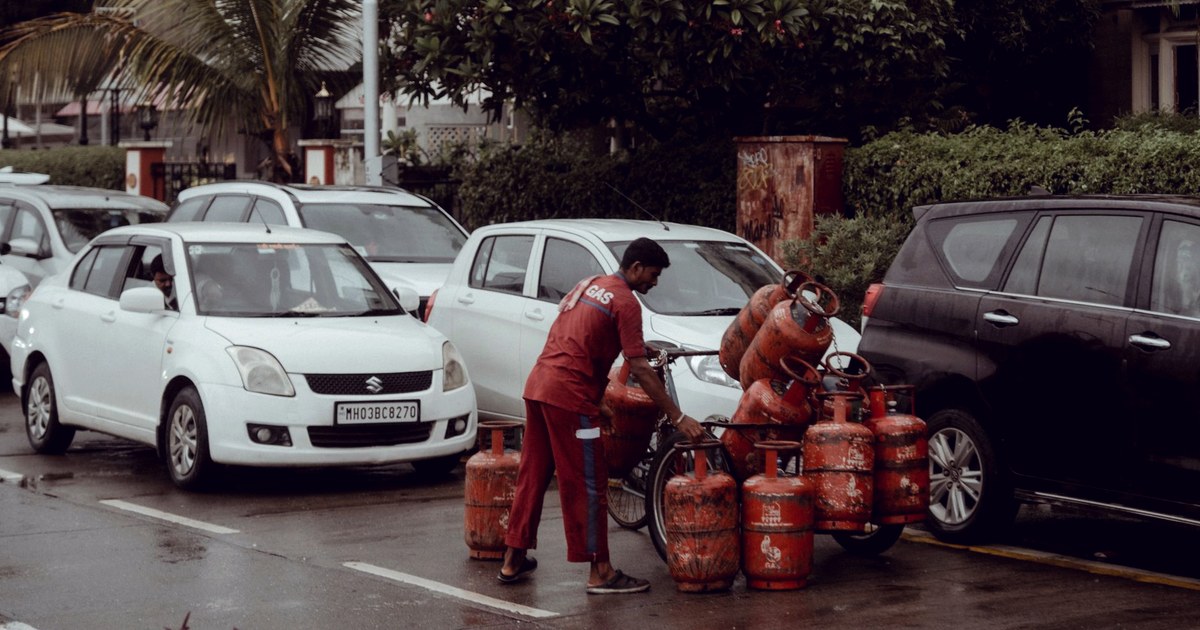
From October 1, 2026, an Indian household cannot book a subsidised LPG refill without first clearing a fingerprint or iris scan. The Ministry of Petroleum and Natural Gas says Biometric Aadhaar Authentication becomes mandatory that day for domestic LPG consumers, and as of 19 September 2026 the government reports 27.43 crore consumers, 89.9 percent of the active base, had already completed it. Read as a compliance story, that is nine in ten of an enormous consumer base clearing a new identity check within months. The government has been unambiguous about why the check exists. The same ministry told the Rajya Sabha that 4.08 crore duplicate, fake, or inactive LPG connections had already been blocked or deactivated by 1 July 2025 under the Aadhaar-linked PAHAL scheme. This is a fraud-control program, and by its own numbers, it has been effective at finding fraud.
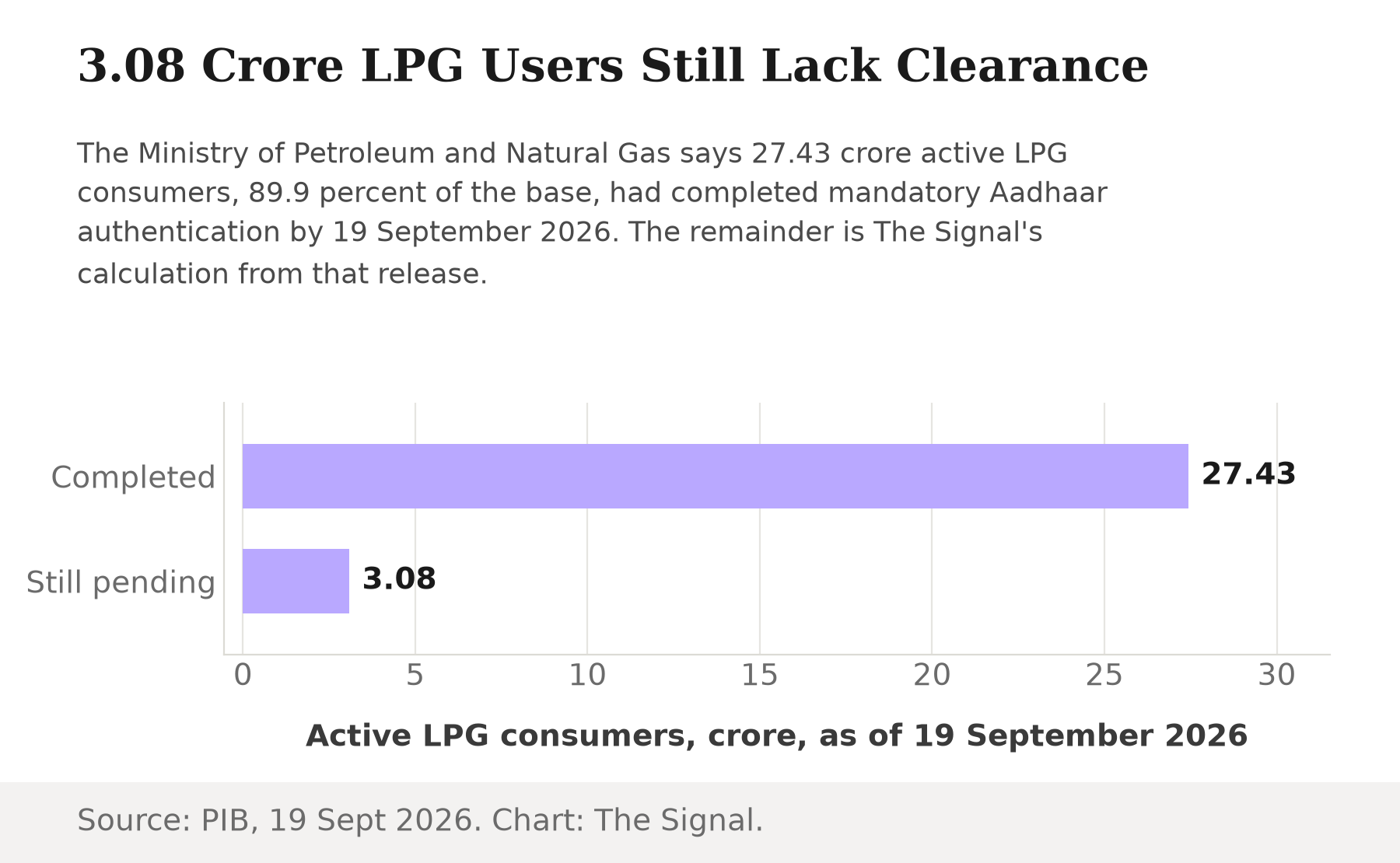
It is worth slowing down on that framing. The 89.9 percent figure implies that just over 3.08 crore active consumers, our calculation from the same release's total and completion rate, had not cleared the check with eleven days left before the deadline. Under the new rule, they do not lose LPG outright. They can still buy 5 kg or 10 kg cylinders at market price, without subsidy, subject to local availability. The size of that group matters less than who is in it, and India has run this exact experiment before, with a documented answer.
3.08 crore LPG consumers had not cleared biometric authentication with eleven days to go.
The completed majority dwarfs the remainder, but the remainder is where the mechanism's failure mode concentrates.
The people already behind
The same Rajya Sabha reply that reported 4.08 crore blocked connections also gave a completion breakdown by consumer type: 92.44 percent of the 33.05 crore active LPG consumer base had their Aadhaar seeded as of 1 July 2025. Beneficiaries of the Pradhan Mantri Ujjwala Yojana, the deposit-free LPG scheme built for poor households, lagged well behind at only 67 percent, a gap of 33 percentage points against the general population on the same date. PMUY is not a marginal program. It covered about 10.33 crore connections as of 1 July 2025, and the Union Cabinet approved a targeted subsidy of Rs 300 per 14.2 kg cylinder for up to nine refills a year, at a cost of Rs 12,000 crore for FY2025-26. This is the population the subsidy exists to protect, and it is also the population furthest behind on the checkpoint now guarding it.
| Population | Metric | Share completed | As of |
|---|---|---|---|
| All active LPG consumers | Aadhaar seeded | 92.44% | 1 July 2025 |
| PMUY (Ujjwala) beneficiaries | Biometric authentication completed | 67% | 1 July 2025 |
Source: Ministry of Petroleum & Natural Gas, Rajya Sabha reply, via PIB.
The subsidy itself is not small money to protect. The Union Cabinet had already approved Rs 30,000 crore in compensation to the three public-sector oil marketing companies, IOCL, BPCL and HPCL, for under-recoveries on domestic LPG sales, paid over twelve tranches, because rising international prices were not being passed on to consumers. A program that size justifies a real fraud check, though its size alone does not say whether the check's design puts the burden on the fraud or on the household.
What biometric failure has looked like before
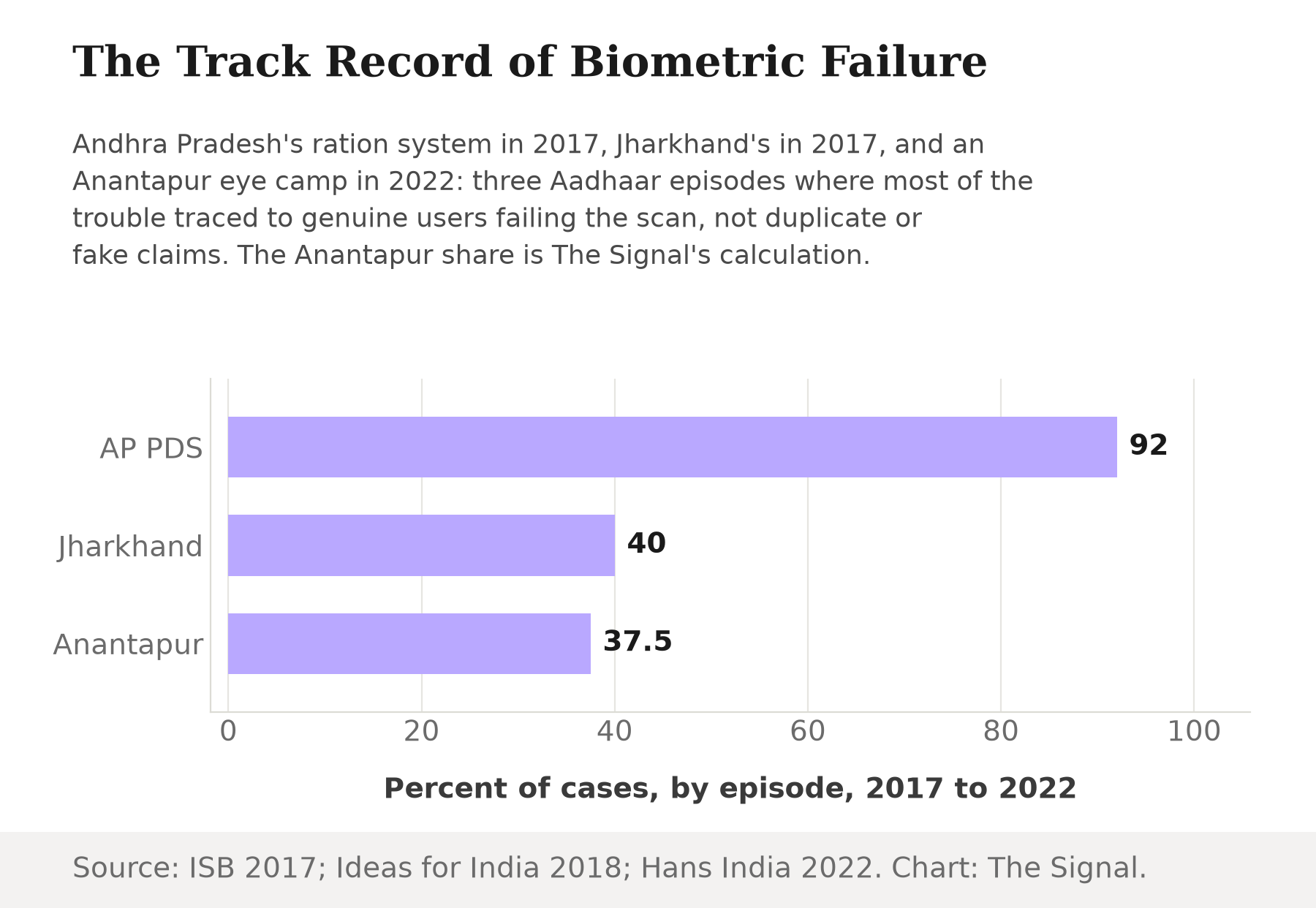
India has already run large-scale Aadhaar biometric authentication through a welfare program, the Public Distribution System, and the results are on the record. A December 2017 study of 3.77 million authentication attempts in Andhra Pradesh's PDS by the Indian School of Business's Digital Identity Research Initiative found a 2.5 percent failure rate, and 92 percent of those failures were caused by biometric mismatch, not by fraud detection working as intended. In Jharkhand's Ranchi district, a January 2018 analysis by economist Nazar Khalid for Ideas for India found the monthly transaction rate for Aadhaar-authenticated ration purchases held around 80 percent through the first seven months of 2017, meaning roughly 81,000 of the district's 407,000 cardholders missed their rations in an average month, and more than 40 percent of non-transacting households blamed authentication problems, with elderly couples and widows living alone most at risk since fewer people could attempt the scan.
The mechanism behind that risk has a physical explanation, and it has been reported directly. At an eye-cataract camp in Anantapur district, Andhra Pradesh, The Hans India reported that roughly 30 of about 80 elderly patients referred for treatment, or 37.5 percent, were turned back because their fingerprints, worn smooth by age, were not accepted by the verification machines. None of these three episodes were fraud. They were genuine, entitled users whose bodies did not register on a sensor built around an assumption of unworn skin.
In three separate Aadhaar authentication episodes, most of the trouble traced to real users failing the scan, not fake claims.
The share varies by setting, but the direction does not: biometric mismatch, not duplication, caused 92 percent of the Andhra Pradesh failures.
The network doing the checking
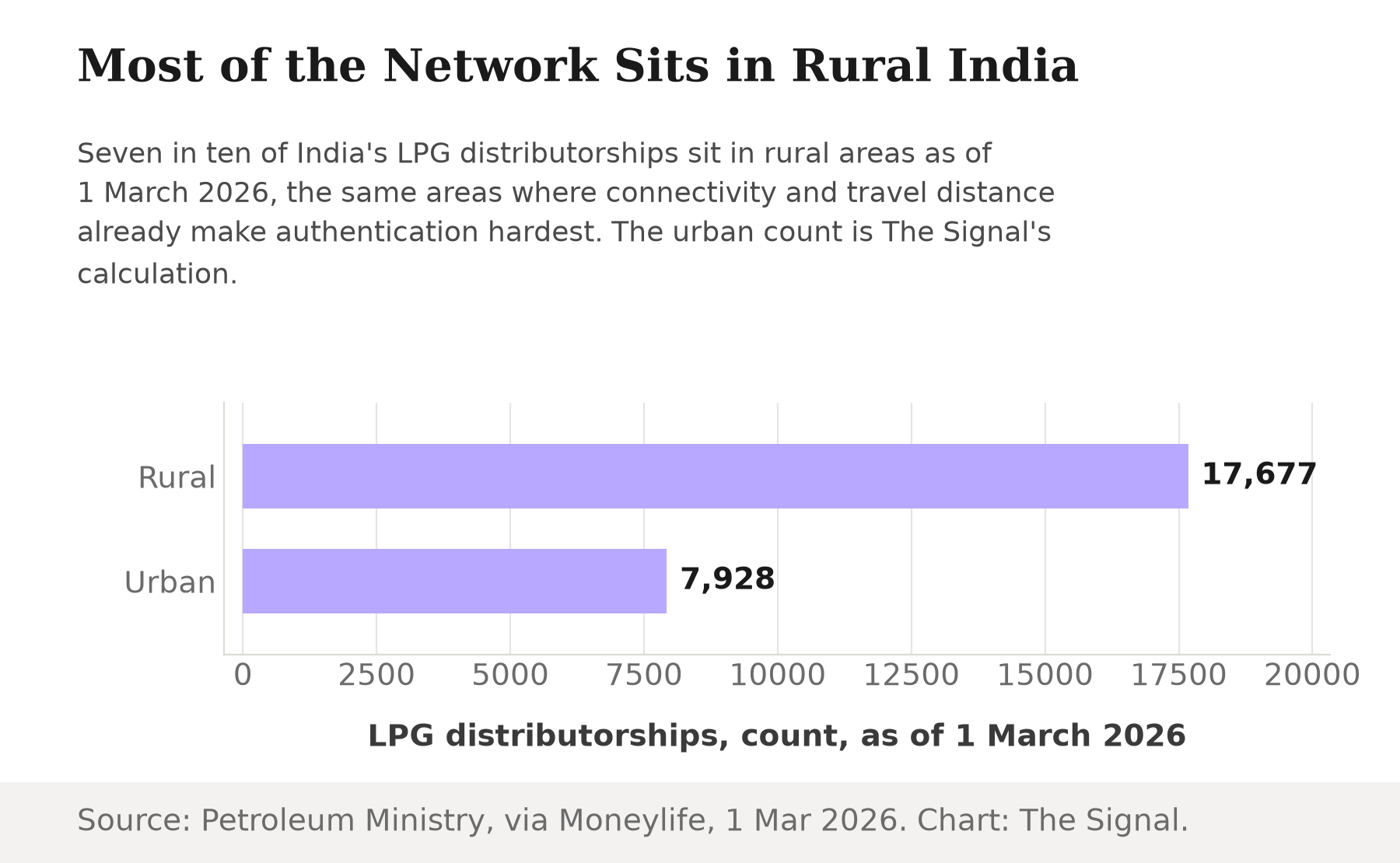
The LPG mandate runs through a delivery network that is disproportionately rural, the same geography where the PDS failures concentrated. As of 1 March 2026, India had 25,605 LPG distributorships, of which 17,677, or 69 percent, were in rural areas, leaving about 7,928 in urban areas, the remainder of the same total. Moneylife reported Union Minister of State Suresh Gopi telling the Rajya Sabha that elderly consumers, manual labourers, and agricultural workers whose fingerprints have been worn smooth by years of physical work routinely fail the biometric scanners used for LPG e-KYC, confirming the same failure mode the PDS record already showed.
The honest objection
The strongest case for the mandate is that it already works, faster than most identity rollouts manage. Compliance moved from a standing start to 89.9 percent of a base measured in hundreds of millions inside months, after the original 30 June 2026 deadline was extended seven times, to 31 July, 7 August, 15 August, 23 August, 31 August, 7 September, and finally 14 September 2026. Each extension gave more consumers a chance to reach a distributor, and none of the people still failing the scan lose LPG entirely, only the standard cylinder and its subsidy. A duplicate-connection scheme that has already blocked 4.08 crore fraudulent accounts is not a paper exercise, and a government that keeps moving its own deadline is, at minimum, not trying to force a cliff edge.
That case is real. It does not answer the design question. Extending a deadline seven times, from 30 June to 14 September 2026, gives more people more chances to pass a test; it does nothing for the person whose fingerprint simply will not register no matter how many chances they get. The PDS record already shows what happens to that person: in Jharkhand, elderly couples and widows living alone were named as the highest-risk group precisely because fewer household members were available to keep attempting the scan. A seven-time extension solves for people who are late, not for someone whose biometrics simply do not work.
The Signal
The LPG e-KYC mandate is being run and reported as an anti-fraud program, and the 4.08 crore blocked connections back that framing up. But the enforcement mechanism it uses, fingerprint and iris matching at the point of delivery, has an independently documented failure mode that has nothing to do with fraud: it fails hardest on the elderly, manual labourers, and agricultural workers whose fingerprints have been worn smooth by physical work, and on smaller households with fewer people available to keep trying. Those are not incidental edge cases. PMUY beneficiaries, the program's own poorest and most female-headed segment, were already 33 percentage points behind the general population on this exact check as of 1 July 2025. The number to watch after October 1 is not the compliance rate, which will keep climbing toward 100 percent as it always does. It is who makes up the remainder once the climbing stops, and whether that group looks like duplicate connections or like the same worn fingerprints India has already been documenting for a decade.
Reporting basis: the Biometric Aadhaar Authentication mandate, the 1 October 2026 deadline, the seven deadline extensions, and the 89.9 percent completion figure are per a Ministry of Petroleum & Natural Gas press release via the Press Information Bureau. The Rs 30,000 crore oil-marketing-company compensation is per a separate PIB release on a Union Cabinet decision. The blocked-connection count, the Aadhaar-seeding rate, and the PMUY biometric-completion rate are per the Petroleum Minister's written Rajya Sabha reply, also via PIB. The PMUY connection count and its FY2025-26 subsidy are per a Prime Minister's Office release. The Andhra Pradesh authentication-failure study is from the Indian School of Business's Digital Identity Research Initiative. The Jharkhand transaction-rate analysis is a single Ideas for India research piece by economist Nazar Khalid, and rests on that one source. The Anantapur eye-camp reporting is from The Hans India, citing Lions Club Gooty and local officials. The rural distributorship count and the ministerial quote on worn fingerprints are as reported by Moneylife, citing a Rajya Sabha reply. The implied non-completed consumer count, the PMUY completion gap in percentage points, the Anantapur failure share, and the urban distributorship count are The Signal's calculations from those figures.