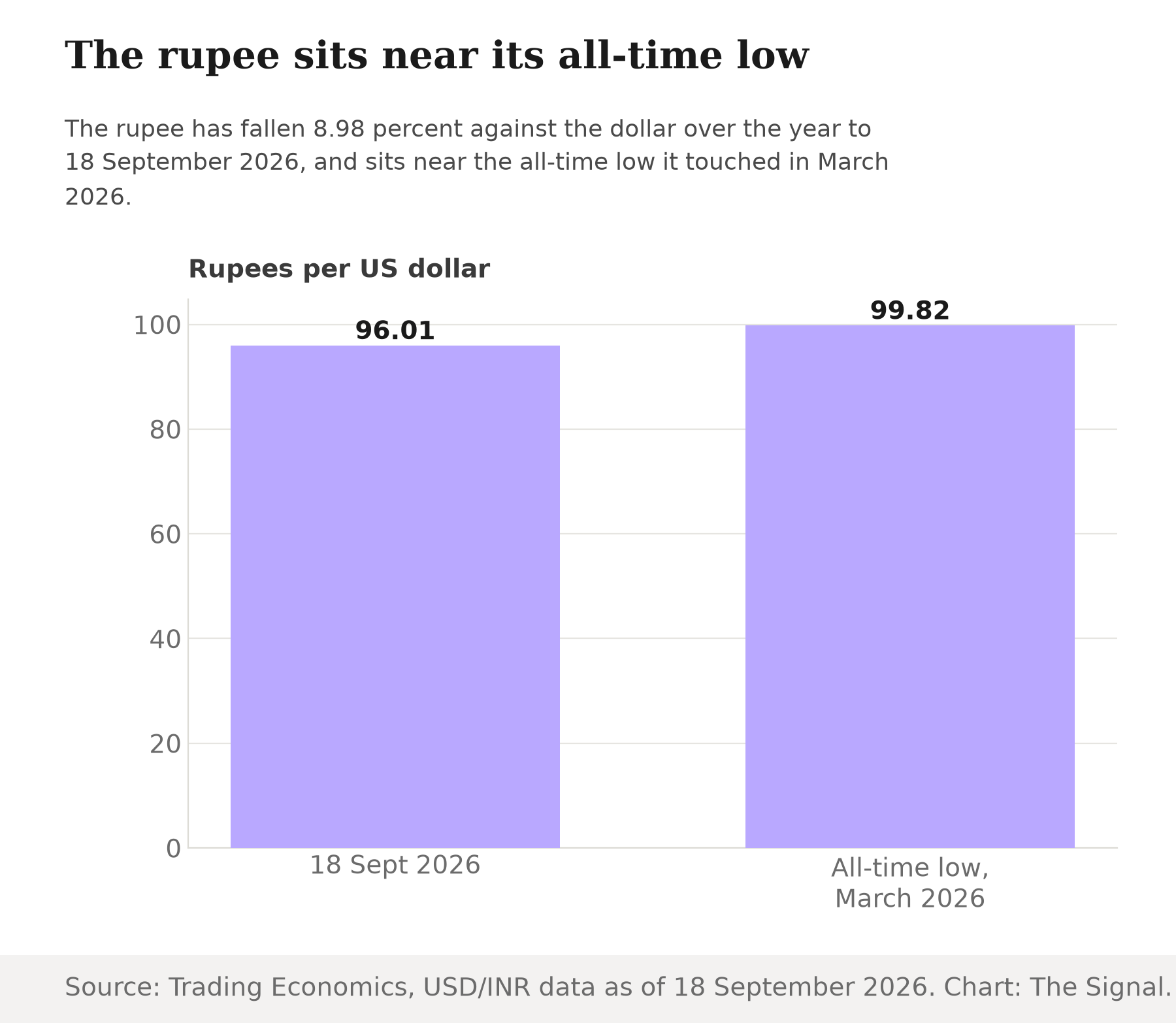
The rupee has been sliding for a year, and by the usual textbook logic that should be good news for India's exporters. It traded at about ₹96 to the dollar on 18 September 2026, down 8.98 percent over the trailing twelve months and only just off the all-time low of 99.82 it touched in March 2026. A weaker currency is supposed to work like an automatic discount: a country's goods get cheaper for foreign buyers without anyone cutting a price list. The exporters expected to feel that discount first are the labour-intensive ones, garments, leather, handloom, because their dollar selling price barely moves while their rupee costs, mostly wages, stay fixed. A cheaper rupee, on that story, is close to free margin.
It is worth checking that story against what actually shipped, month by month, rather than against the theory.
The same month, two different exports
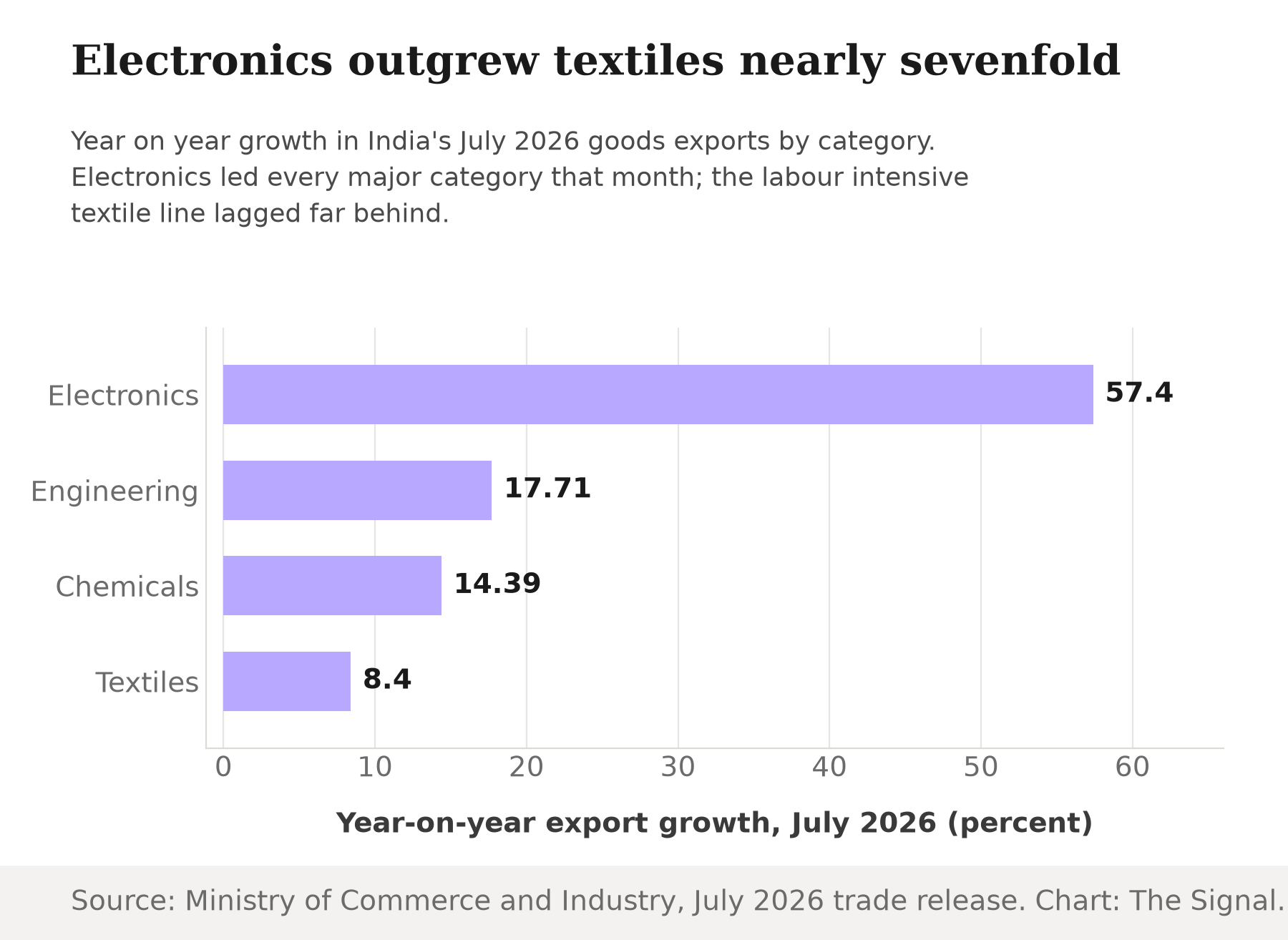
July 2026 is the cleanest test, because the commerce ministry reported every category off the same base month. Electronic-goods exports grew 57.40 percent year on year that month, engineering goods grew 17.71 percent, and organic and inorganic chemicals grew 14.39 percent, while cotton yarn, fabrics, made-ups and handloom products, the labour-intensive line, grew just 8.40 percent. Electronics did not merely lead. In the same month, under the same currency move, it grew nearly seven times faster than the textile category a weaker rupee is supposed to help most.
The next month's release made the gap wider still. Electronic-goods exports rose 89.82 percent year on year in August 2026, from $2.93 billion to $5.55 billion, the sharpest growth of any major export category that month. A rupee that fell one way produced a category growing at nearly 90 percent and a category growing at under 10 percent, in the same trade window.
Where the labour-intensive story breaks down
The textile numbers are not a one-month blip. Leather and leather-product exports grew just 0.36 percent year on year in April 2026, a category the commerce ministry's own release named, alongside cotton yarn and handloom products, as one of the few textile lines managing any growth at all that month.
The reason is not that a weaker rupee stopped mattering to these exporters, but that it stopped being free. Welspun Living, one of India's largest home-textile exporters, laid the mechanism out on an earnings call in May 2026. Chief executive Dipali Goenka said the company benefits from the rupee's fall, but that the cost of imported crude, cotton, yarn and polymers rose 10 to 40 percent over the same period:
"There is no net delta gain, even with the rupee where it is."
A garment or towel exporter sells in dollars but buys a large share of its inputs in dollars too, once the raw cotton, synthetic yarn and polymer chips are traced back. When the rupee weakens, both sides of that ledger move together, and the currency gain that was supposed to be pure margin gets eaten before it reaches the export invoice.
Pharma and engineering follow the same script
Electronics is not an isolated case. Across other months, the categories with more processing, branding or patent content behind them kept compounding gains that the labour-intensive lines did not match. India's drugs and pharmaceuticals exports rose 7.12 percent year on year in April 2026, from $2.49 billion to $2.66 billion, the same month leather managed 0.36 percent. Engineering-goods exports rose 20.74 percent year on year in June 2026, from $9.51 billion to $11.48 billion. Different months, different sub-sectors, the same pattern: the exporters with pricing power and dollar-denominated end markets keep pulling ahead of the ones competing purely on labour cost.
| Category | Month reported | Year-on-year growth |
|---|---|---|
| Electronic goods | August 2026 | 89.82% |
| Engineering goods | June 2026 | 20.74% |
| Drugs and pharmaceuticals | April 2026 | 7.12% |
| Leather and leather products | April 2026 | 0.36% |
Source: The Ministry of Commerce and Industry's monthly trade releases for the months shown. Table: The Signal.
The honest objection
The cleanest challenge to a straightforward capital-versus-labour story is auto components, a sector that is neither raw commodity nor low-skill assembly and is usually filed alongside electronics as a capital-intensive winner. India's auto-component exports rose just 5 percent to $24 billion in FY26, even as auto-component imports grew faster, up 13 percent to $25.4 billion, over the same year. Engine components, along with drive transmission and steering systems, made up more than half of the sector's exports, and Europe recorded the strongest export growth.
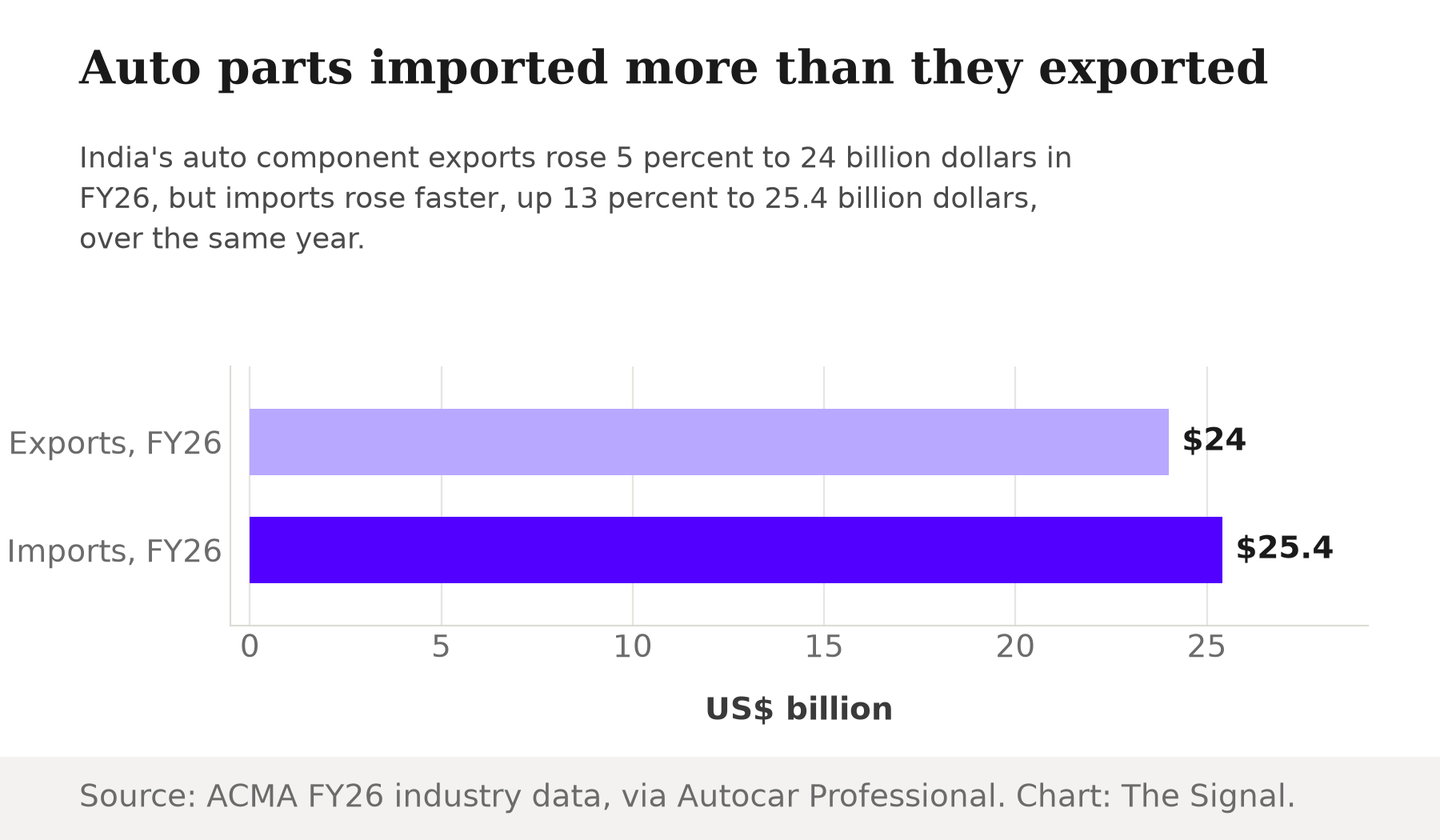
If technology intensity alone decided the outcome, auto components should look like electronics. It does not. Its import bill outpaced its export earnings while the currency was supposedly on its side. That case is real, and it means the divide running through this data runs on import content and pricing power against everyone else, not simply "high-tech" against "labour-intensive." Electronics assembly in India still imports heavily too, but it prices its output in dollars against global demand that keeps expanding regardless of the exchange rate. Auto components compete on a global supply chain where India is still a net buyer of the more sophisticated parts it fits into finished vehicles, so a cheaper rupee raises its input bill nearly as fast as it raises its revenue.
The Signal
A weaker rupee is not a subsidy that lands evenly across an economy. It is a redistribution, moving through Indian trade in one direction: toward exporters that invoice in dollars and hold pricing power over their own export price, and away from exporters that also buy in dollars, just further up the same supply chain. Garment and leather workers were promised a lifeline in every conversation over a weaker rupee. The trade data have not delivered it. Electronics, pharmaceuticals and engineering goods kept compounding gains through April, June, July and August; leather and cotton textiles kept posting growth too small to move the needle.
Watch two things from here. If the rupee keeps drifting toward the low it touched in March 2026, the textile releases are the test: a currency doing what it is supposed to do would finally show up as an acceleration in cotton and leather exports, not just electronics. And watch whether auto components' import bill keeps outrunning its export bill, because that would confirm the divide runs through buying dollars as much as selling them. A weaker currency does not choose winners by how hard someone works. It chooses them by which side of the ledger keeps the difference.
Reporting basis: the monthly export growth figures for electronic goods, engineering goods, chemicals, drugs and pharmaceuticals, cotton yarn and handloom products, and leather and leather products are all from the Ministry of Commerce and Industry's DGCIS-based monthly trade releases, via the Press Information Bureau, for the specific months named in the text. The USD/INR exchange rate and its twelve-month change come from Trading Economics. The Welspun Living cost breakdown and chief executive's quote are as reported by Bloomberg News and carried by Business Standard, a single origin for that data point. The auto-component export and import figures are from the Automotive Component Manufacturers Association of India's FY26 industry data, as reported by Autocar Professional. The multiple-of comparison between electronics' and textiles' July 2026 growth rates is The Signal's calculation from those two figures.