
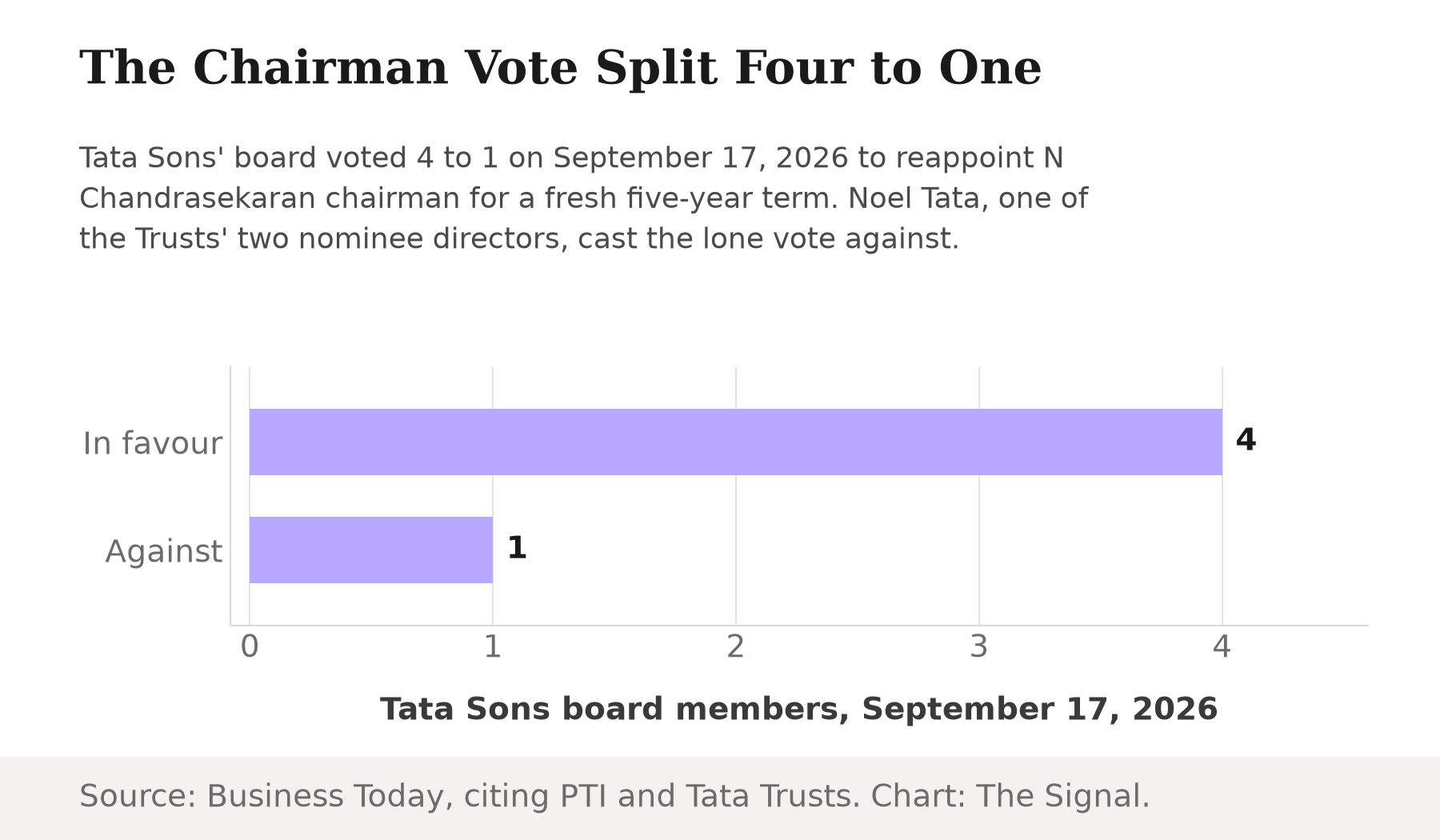
On September 17, 2026, Tata Sons' board gave N Chandrasekaran a fresh five-year term as chairman. As a consequence of that vote, the chairman-selection process the Sir Dorabji Tata Trust had already initiated was paused or discontinued, Business Today reported, citing PTI. Read as a single headline, it looks like routine corporate housekeeping: an incumbent renewed, a parallel process wound down.
It is worth slowing down on that framing. Tata Trusts responded the same day, calling the board's resolution "legally void and without any basis," Business Today reported, citing the Trusts' statement. Their objection was specific, not rhetorical. Four Tata Sons directors voted in favour of the resolution; Noel Tata, one of the Trusts' two nominee directors on the board, voted against it, and the Trusts said the vote was void because their reading of the Articles of Association requires both Trust nominee directors to approve a chairman's reappointment. Only one voted at all.
The board proceeded anyway.
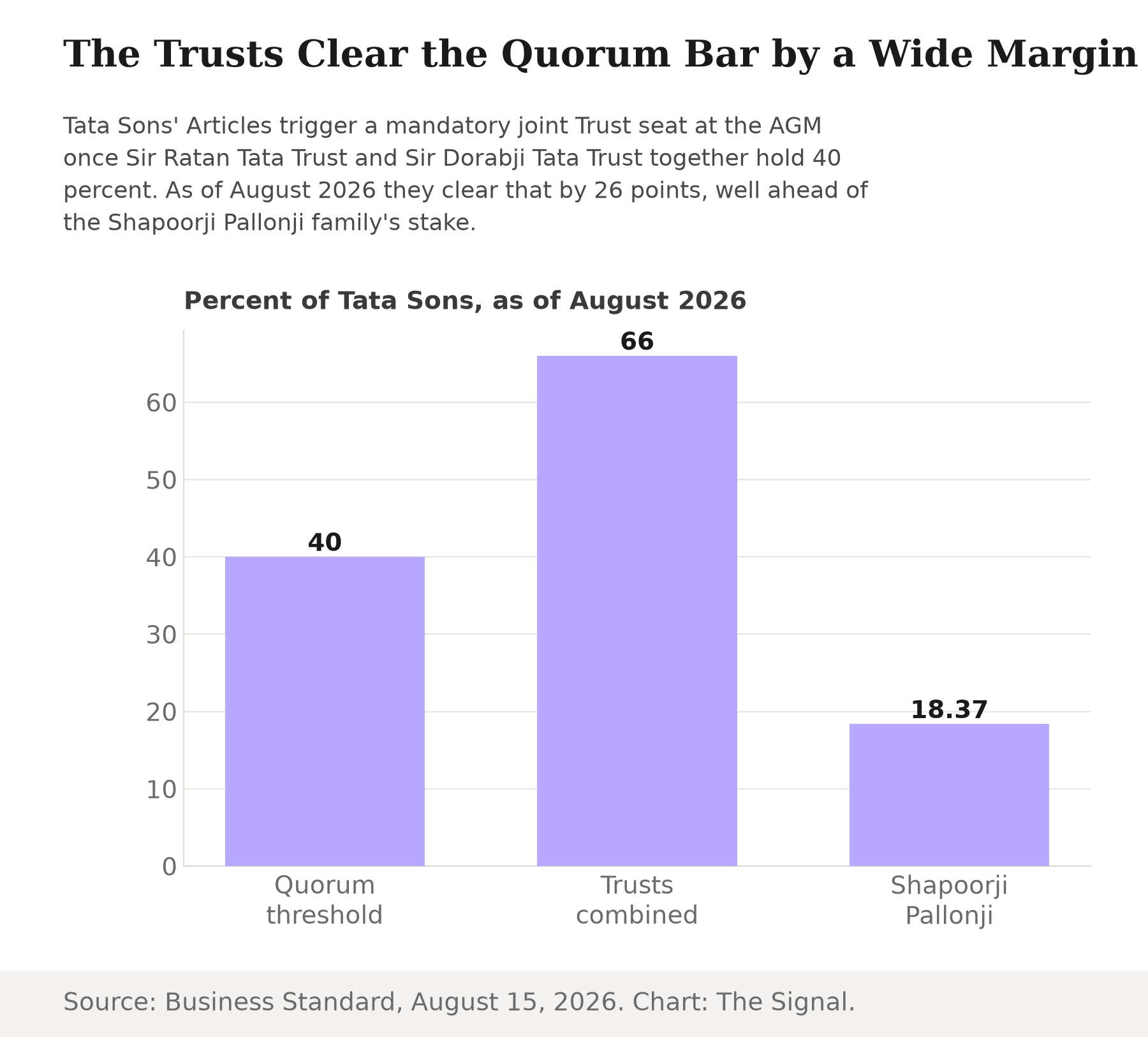
What makes that worth pausing on is not the vote count. It is the ownership behind it. Sir Ratan Tata Trust holds 23.56 percent of Tata Sons and Sir Dorabji Tata Trust holds 27.98 percent, a combined stake Business Standard puts at about 66 percent of the company. Tata Sons' own Article 86 treats that combined stake as consequential: once the two trusts together clear 40 percent, the Articles require a jointly nominated Trust representative to be personally present for an annual general meeting to have quorum at all. A shareholder written into the company's own constitution as a structural check just lost a boardroom vote on the one question, a chairman's tenure, that its board seats exist to protect.
Two votes lost in the same sitting
The chairman vote was not the only one Noel Tata lost that day. The same board also approved a plan to list Tata Sons on a stock exchange, amid what Business Standard describes as a renewed RBI push for the company to meet its upper-layer NBFC listing requirement, with Tata Trusts chairman Noel Tata again outvoted by the other directors. Two governance questions, one afternoon, the same result each time: the board's operating majority moved, and the Trusts' board presence did not stop it.
Two governance checks were built into Tata Sons' structure this year. Both failed to hold in 2026.
| Governance check | What it is meant to guarantee | What happened |
|---|---|---|
| AGM quorum (Article 86) | A representative jointly nominated by SRTT and SDTT must be personally present once their combined stake tops 40 percent | The 108th AGM, held August 18, 2026, was adjourned for lack of quorum, the first time that has happened in Tata Sons' history |
| Chairman reappointment, on the Trusts' reading of the Articles | Both Trust nominee directors must approve | Board approved the reappointment 4 to 1, with only one of the two Trust nominee directors' votes cast in favour, on September 17, 2026 |
Source: Business Standard, August 15, 2026; Business Today, citing the Tata Trusts' statement, September 17, 2026; Storyboard18, September 17, 2026.
Not the first check to fail this year
The quorum failure is worth its own line, because it was not a one-off procedural slip. Tata Sons' 108th annual general meeting, held August 18, 2026, was adjourned for lack of quorum, the first time that has happened in the company's history, Storyboard18 reports. The Registrar of Companies has since extended the deadline to convene it to December 31, 2026, from the original September 30 deadline. A month later, the board did not wait for that rescheduled AGM before acting on the chairman question. It moved at the board table instead, where the numbers run differently: five directors, one of them a Trust nominee, rather than a shareholder register where the Trusts hold roughly two thirds.
The regulatory clock behind the boardroom
Some of the board's urgency traces to a pressure that has nothing to do with the Trusts. The RBI defines a Core Investment Company, the category that places Tata Sons under its NBFC oversight, as an NBFC holding at least 90 percent of its net assets in the equity, preference shares, debt or loans of group companies, the RBI's NBFC FAQ page states. The RBI first classified Tata Sons among 16 NBFCs in its upper layer on September 30, 2022, starting a three-year clock for listing that expired unmet on September 30, 2025, Business Standard reports. In a letter dated September 11, 2026, six days before the chairman vote, the RBI rejected Tata Sons' application to voluntarily surrender that registration, reviving the listing requirement, Business Standard reports. The RBI's list of Upper Layer NBFCs for 2026-27, released August 6, 2026, had already named Tata Sons again, noting that the inclusion was without prejudice to the outcome of its pending deregistration application. A company that spent three years trying to argue its way out of a listing mandate was told, twice in six weeks, that the mandate stands. Days later the RBI issued updated NBFC FAQs that, Business Standard reports, ground the rejection in three definitions, what counts as a CIC, what counts as an NBFC's "principal business," and what counts as "public funds," and note that a company's own debt-free status does not by itself settle whether it has indirect access to public funds through group entities' borrowings and debentures. Tata Sons argued it no longer needed CIC oversight because it had cleared its own debt; the regulator's answer was that the group around it had not. Listing and a settled chairman are the two things a market regulator and an IPO process both want answered before either can move. The board answered both on the same afternoon, over one dissent it did not have the second Trust vote to prevent, on the Trusts' own reading of the rule.
A pattern that predates this year
This is not the first time a Tata Sons chairman's tenure has turned into a fight over what the Articles of Association actually require. Cyrus Mistry's October 2016 removal as chairman went through the same escalation, the NCLT and then the NCLAT, before reaching the Supreme Court, whose March 2021 ruling in Tata Consultancy Services Ltd v Cyrus Investments Pvt Ltd examined Tata Sons' Article 118, the Selection Committee mechanism for recommending a chairman, and Article 121, the board's voting requirement for that appointment, and ultimately upheld the board's decision to remove him. The court sided with the board then, too. One structural change did follow: Tata Sons later amended its Articles so the chairman of Tata Trusts and the chairman of Tata Sons cannot be the same person, which is why Noel Tata, as Trusts chairman, was never a candidate for the Tata Sons chair this time, only a dissenting vote on the board that picks it. The 2016 dispute produced a rule separating the two roles, not one that stopped the board from outvoting the Trusts on who fills either one.
The honest objection
The strongest case for the board is that a corporate board is not a shareholder meeting, and the Trusts' roughly 66 percent combined stake was never a boardroom veto by itself. Board resolutions pass by director votes, not by the equity each director represents, and whether Article 86 truly requires both Trust nominees' assent for a chairman vote, rather than merely applying to the AGM quorum it explicitly names, is a legal reading the Trusts asserted but did not yet win in a court or tribunal. On that view, the RBI's rejected deregistration bid and revived listing clock gave the board a genuine, regulator-driven reason to move rather than wait out a dispute the Trusts might lose anyway.
That case is real, but it does not explain the pattern, only one instance of it. The quorum failure in August, the chairman vote in September and the listing vote in the same September sitting are three separate mechanisms, an AGM presence rule, a chairman-approval reading, and a director's floor vote, and all three resolved the same way in a single six-week stretch. A single contested legal reading is a dispute. Three consecutive governance checks failing to constrain the operating board, while the Trusts' combined ownership stayed exactly where it was, looks less like one bad legal argument and more like where the company's real decision-making has settled.
The Signal
Ownership of Tata Sons has not moved. Sir Ratan Tata Trust and Sir Dorabji Tata Trust still hold the roughly two-thirds combined stake they held before any of this started. What has moved is which mechanism translates that ownership into control, and this September, none of them did: not the AGM quorum rule, not the Trusts' reading of the chairman-approval requirement, not a board seat held by the Trusts' own nominee. The next test is concrete and dated. Tata Sons now has until December 31, 2026 to convene the AGM the quorum failure postponed. If it clears quorum on that try, the Trusts still have a functioning lever, just a slower one. There is a second, earlier date to watch first. Noel Tata is reported to be planning to remove Chandrasekaran as a Tata Sons director at Tata Trusts' own AGM, which must also be held before December 31, 2026, a route that would end his board eligibility regardless of the September 17 resolution, The Week reports, citing Moneycontrol. That plan depends on legal questions around Sir Ratan Tata Trust's own standing being resolved first. If neither the Trusts-AGM route nor the Tata Sons AGM changes the outcome, the gap between owning a company and controlling it will have shown itself for a third time in five months.
Reporting basis: the September 17, 2026 board votes on Chandrasekaran's reappointment and the Trusts' response are per Business Today's reporting, citing PTI for the reappointment and citing the Tata Trusts' own statement for their objection and vote count. The board's listing decision and Noel Tata's second outvote are per Business Standard's reporting. The trusts' shareholding, the Article 86 quorum mechanics and the August 18 AGM's shareholding backdrop are per a separate Business Standard report. The AGM adjournment itself, its status as a first in Tata Sons' history, and the Registrar of Companies' extended deadline are per Storyboard18. The RBI's Core Investment Company definition and its 2026-27 Upper Layer NBFC list are from the RBI's own FAQ page and press release; the classification history, the missed 2025 listing deadline and the September 11, 2026 rejection of Tata Sons' deregistration bid are per Business Standard's reporting on RBI correspondence. The RBI's stated reasoning for that rejection, and the Cyrus Mistry-era history of Article 118 and Article 121, are per separate Business Standard reports. Noel Tata's reported plan for the next Tata Trusts AGM is per The Week, citing Moneycontrol. The 26-point margin by which the Trusts' combined stake clears the Article 86 quorum threshold is The Signal's calculation from those two cited figures.