For a research budget that barely moved for years, India's official R&D spending has suddenly leapt. In a written reply tabled in Parliament on 29 July 2026, the Department of Science and Technology reported that India's Gross Expenditure on Research and Development reached Rs 244,767.81 crore, 0.84% of GDP, in 2023-24, up from Rs 127,380.96 crore, 0.64% of GDP, in 2020-21. Alongside that, the government points to India's climb to 38th place in the WIPO Global Innovation Index 2025 as further proof that the country's research effort is paying off. Read only the headline numbers and the case looks solid: more rupees going into research, and a better global ranking to show for it.
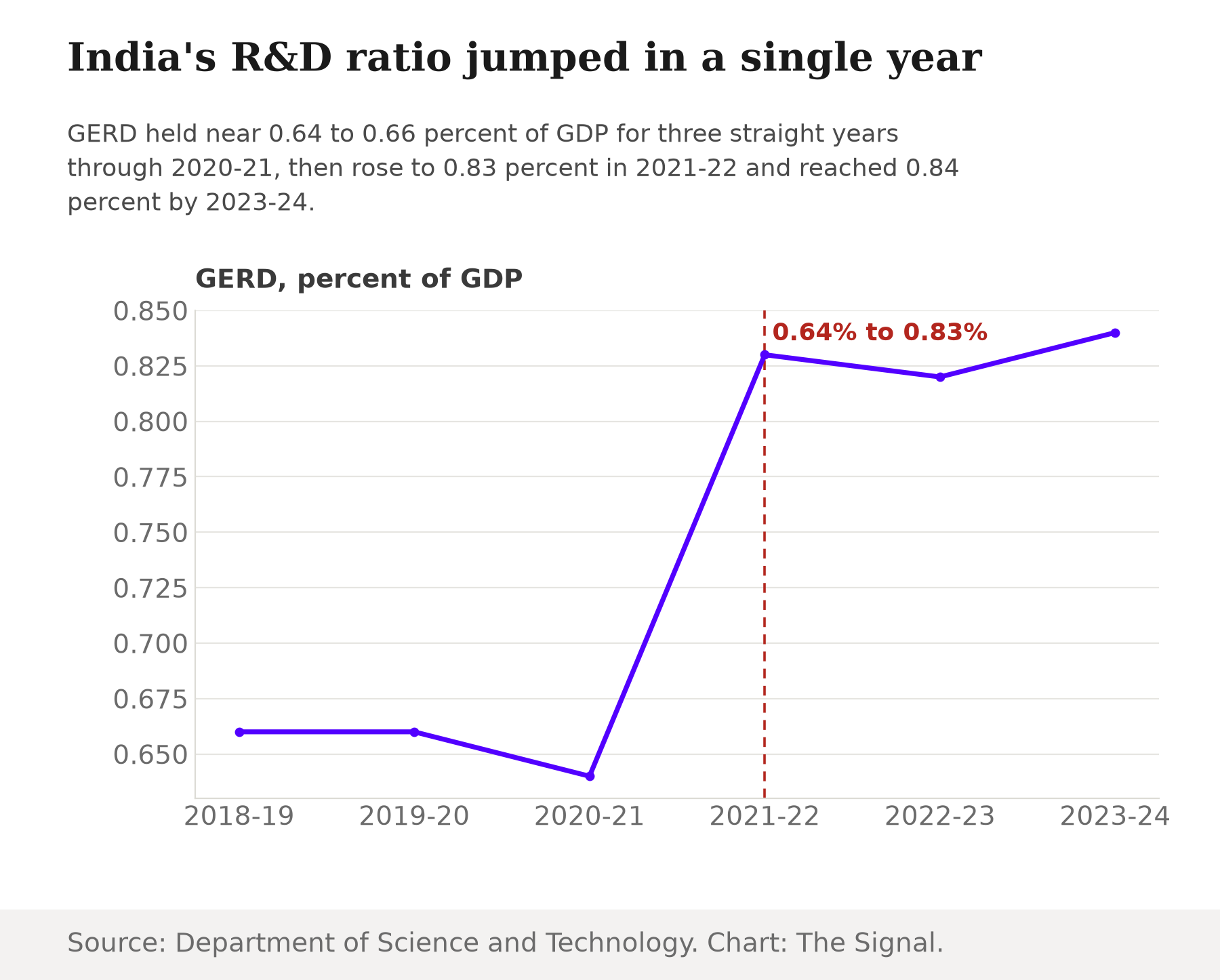
It is worth slowing down on that comparison. Between 2020-21 and 2021-22 alone, officially reported GERD jumped from Rs 127,380.96 crore, 0.64% of GDP, to Rs 194,810.83 crore, 0.83% of GDP, a 53% rise in rupee terms in a single year, before reaching 0.84% of GDP by 2023-24. That one-year jump followed the opposite pattern in the years before it: the ratio had held nearly flat at 0.64% to 0.66% of GDP for three straight years, from 2018-19 through 2020-21. A number that sits still for three years and then rises 53% in the fourth is not a research economy compounding. It is a series that changed shape.
That shape change has a documented cause, in DST's own words. DST's Research and Development Statistics at a Glance 2022-23 report states that the survey's coverage was enlarged to include multinational companies and enterprises that the Department of Scientific and Industrial Research's recognition scheme had not counted before, and the same widening shows up further downstream: the share of MNCs in India's total business-sector R&D spending rose from 49.9% in 2020-21 to 71.3% in 2023-24, the exact years the reported ratio jumped. A one-year 53% rise in rupee terms is easier to explain as newly counted R&D units entering the survey than as newly built ones.
The jump happened in one year, not over a decade.
The capacity picture behind the ratio
If real research capacity had jumped the way the reported ratio did, the composition of that spending should show it happening. It does not, at least not at the point the jump occurred. As of 2020-21, the last year before the reported jump, India's private sector accounted for only around 36% of GERD, whereas in the US, China and South Korea private-sector contributions were more than 70%. A country with that shallow a private research base does not typically go from flat to a 53% one-year rise in rupee terms purely on the strength of new corporate labs opening within the same twelve months.
The one number that did genuinely move
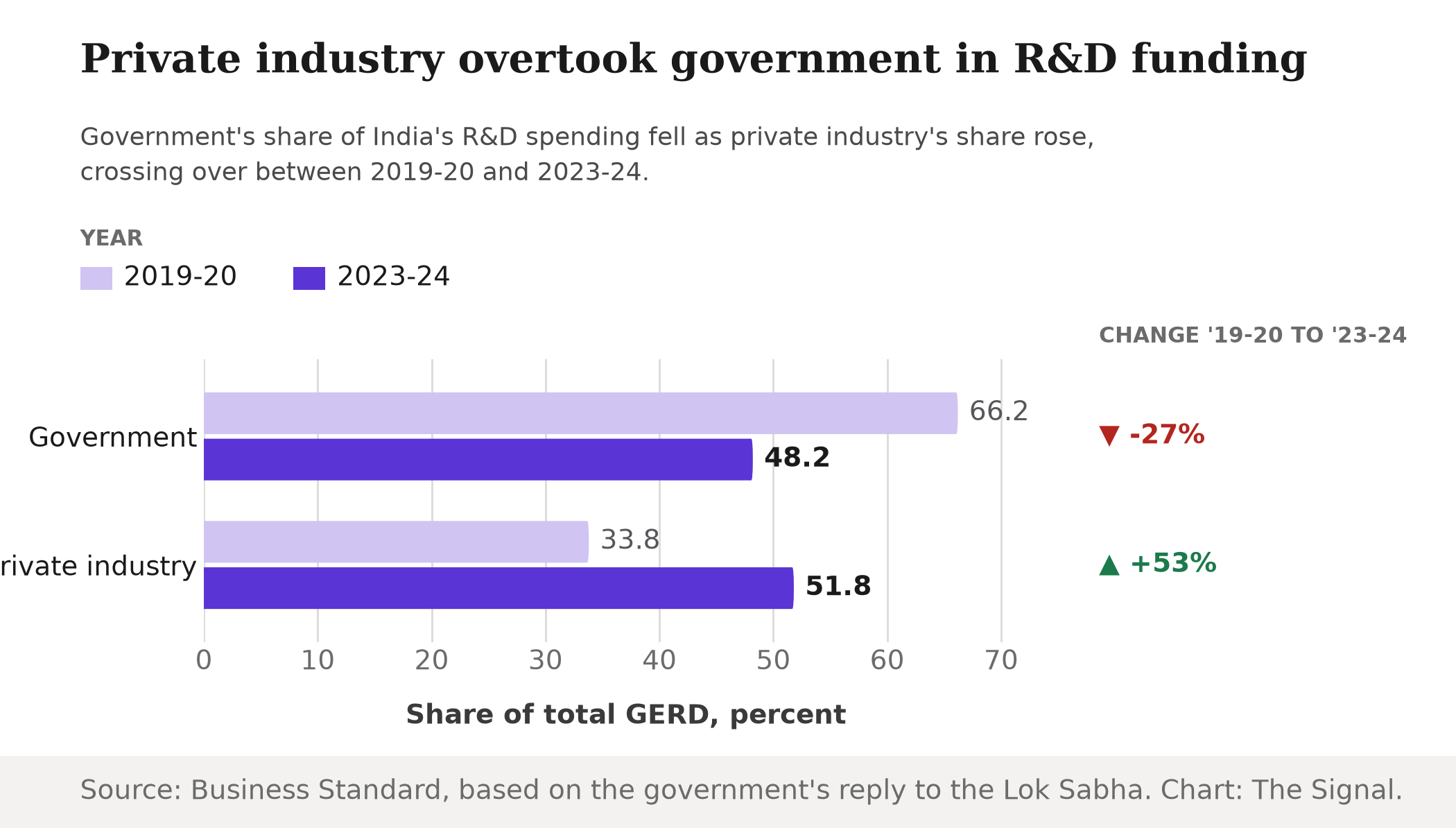
By the time the government's fuller FY2023-24 accounting comes into view, one part of the story has actually shifted position, and it is worth crediting. Between 2019-20 and 2023-24 the government's share of India's R&D spending fell from 66.2% to 48.2% while private industry's share rose from 33.8% to 51.8%, a 27.52% compound annual growth rate, marking the first time private capital accounted for the majority of India's R&D spending. That is a real change in who is paying for research, not simply a redefinition of what counts as research.
Private industry crossed half of GERD for the first time on record.
Even so, India's 0.84% of GDP in 2023-24 still trails China's 2.69% of GDP in 2024, Brazil's 1.19% in 2023 and Russia's 0.94% in 2024, each well above India's current level. The private-sector shift is real, but it has not closed the gap with peer economies. It has changed the internal split of a total that itself moved for reasons the funding-share data alone does not explain.
Even the government's own planners are using the old number
The clearest sign that the higher ratio has not yet been treated as the new baseline sits inside the government's own paperwork. In May 2026, in a report covered by Business Standard, NITI Aayog said there is "an urgent need to significantly enhance the national investment in R&D, from the current level of 0.64 per cent to at least 2 per cent of GDP in the next four to five years". That is the pre-jump number. Two months later, the Department of Science and Technology tabled the reply in Parliament showing GERD had already reached 0.84% of GDP for 2023-24. NITI Aayog's 0.64%-to-2% target implies a climb of 1.36 percentage points. Measured against DST's newer 0.84% baseline, the same 2% target is only 1.16 percentage points away, a distance roughly 15% shorter on paper, without a single additional researcher, patent or laboratory added in between (our calculation from the two reports' figures). The government's chief planning body and its own statistics arm were, within the same year, working off two different pictures of how far India has left to go.
The same NITI Aayog report goes beyond the topline target with concrete asks aimed at capacity rather than accounting: it recommends restoring the 5% GST slab that applied to R&D procurement until June 2022, since replaced by GST charged at the standard rate, and a tax deduction of at least 125% for individual and CSR contributions to funds supporting R&D under the new Income Tax Act. Those are proposals to lower the real cost of doing research, not to redefine what counts as research, which suggests the country's own planners see the gap as more than definitional even while their headline target is measured against the old, pre-jump baseline.
The honest objection
The strongest case against calling this a pure accounting story is the private-sector shift itself. A rise from 33.8% to 51.8% of GERD at a 27.52% compound annual growth rate is a genuine structural change in who funds Indian research, not a reclassification, and it happened over the same years the ratio jumped. If companies are truly putting more real money into research, that is capacity growth, not paperwork.
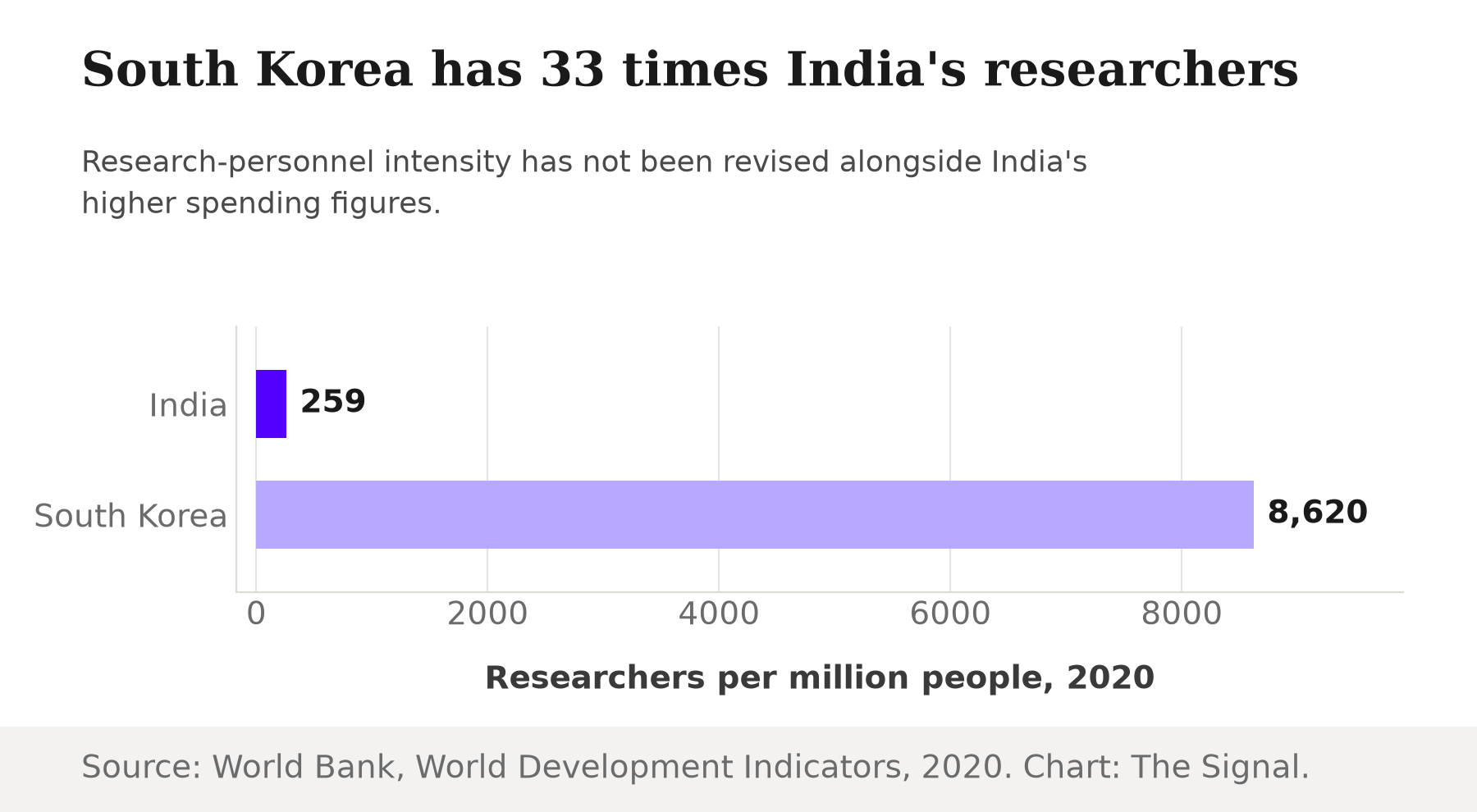
That case holds for the funding side. It does not extend to the people who actually do the research. India had just 259 researchers per million people in 2020, the most recent year in the World Bank's series, versus 8,620 per million in South Korea the same year, a roughly 33-fold gap in research-personnel intensity that has not been revised alongside the higher spending figures. A country that had genuinely multiplied its real research effort in step with its reported spending ratio would show it first in headcount. On the most recent data available, it has not.
South Korea still has 33 times as many researchers per capita.
DST's own head-count survey, which uses a different methodology from the World Bank/UNESCO series and reaches past 2020, tells a similar story more recently. Full-time-equivalent researchers per million population in India rose from 262 in 2020-21 to 354 in 2023-24, a genuine 35% increase, but nowhere near the 53% one-year jump in reported rupee spending over roughly the same span, let alone South Korea's headcount advantage.
The Signal
None of this means India's research effort is fake. Private industry funding the majority of GERD for the first time is a real shift, and a 38th-place finish in the WIPO Global Innovation Index 2025 reflects more than an accounting change. What it means is that the headline ratio, 0.64% rising to 0.84% of GDP, is not a clean measure of how much closer India has come to its own 2% target, because the government's own planning arm was still budgeting against the old number two months before its statistics arm published the new one. Watch what happens to the 2% target now that 0.84% is the official base: if the policy conversation quietly resets to a 1.16-point gap instead of a 1.36-point one, the country will have covered most of the remaining distance to its research goal without building a single new lab. A target measured in rupees can be met by redefinition. A target measured in researchers per capita cannot.
Reporting basis: the 2020-21 through 2023-24 GERD figures, the pre-jump 2018-19 to 2020-21 series, the private-sector comparison with the US, China and South Korea, and India's 38th-place Global Innovation Index 2025 ranking are all from the Department of Science and Technology's written replies to Parliament and year-end review, via Press Information Bureau releases. The government-versus-private funding shift and the international comparison with China, Brazil and Russia are per Business Standard's report on the government's reply to the Lok Sabha, and NITI Aayog's May 2026 target is per Business Standard's report on the NITI Aayog document. The survey-scope note and the MNC share of business R&D spending are from DST's R&D Statistics at a Glance 2022-23 and 2025-26 editions respectively. NITI Aayog's GST and CSR tax-deduction recommendations are from its "Ease of Doing Research & Development in India" report. The researchers-per-million comparison is from World Bank data, sourced from the UNESCO Institute for Statistics, alongside DST's own more recent full-time-equivalent researcher count. The percentage-point gap between NITI Aayog's target math and DST's newer baseline is The Signal's calculation from those two reports' figures.