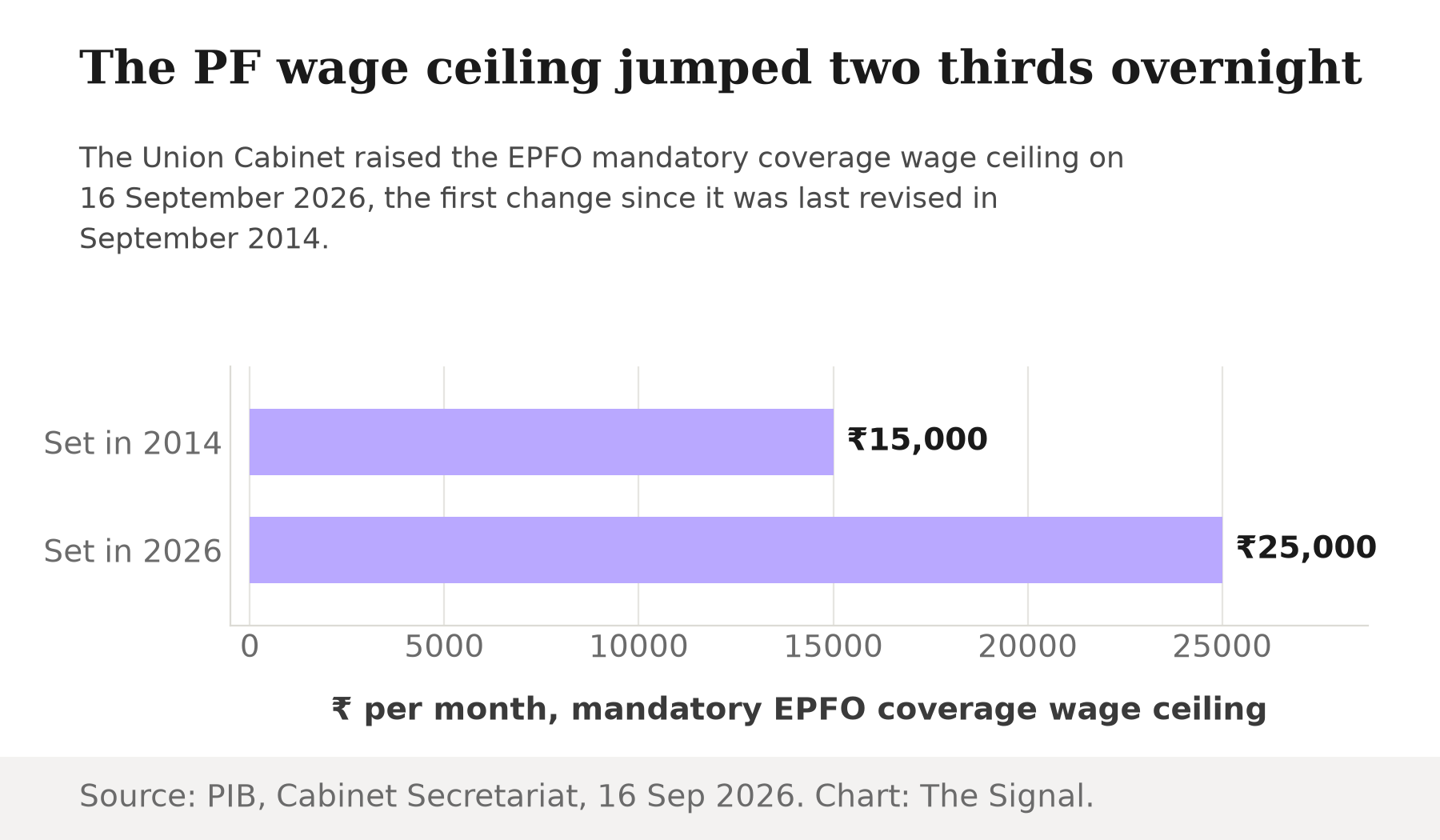
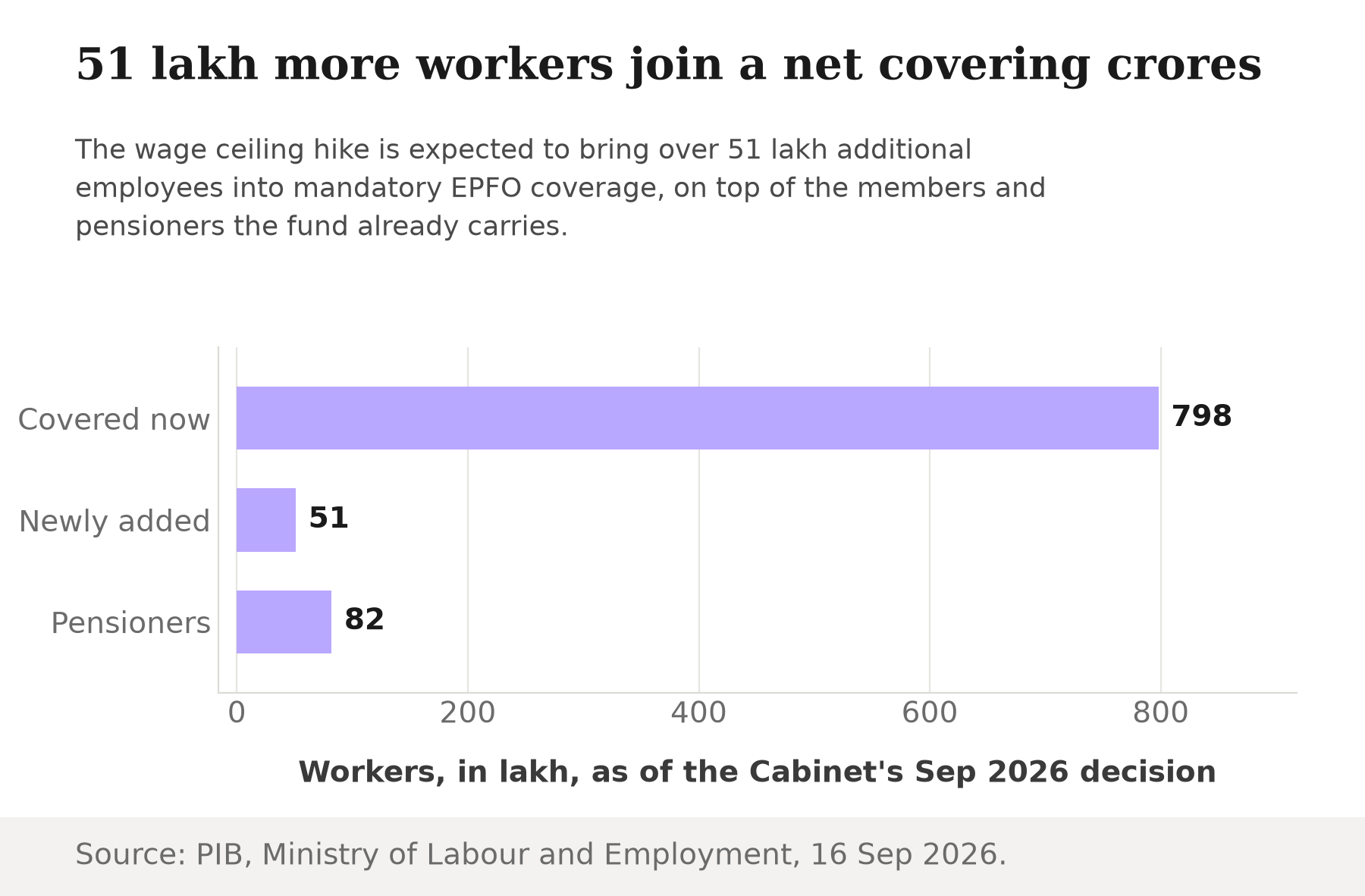
The Union Cabinet raised the wage ceiling for mandatory Employees' Provident Fund coverage from Rs 15,000 to Rs 25,000 a month on 16 September 2026, a Press Information Bureau release on the decision states, the first change to that ceiling since it was last revised in September 2014. Anyone drawing wages up to the new limit must now be enrolled in the EPFO by law, not by an employer's discretion. The Ministry of Labour and Employment's release on the decision states it is expected to bring more than 51 lakh additional employees into mandatory coverage, on top of a base of about 7.98 crore existing contributing members across roughly 7.68 lakh establishments, with the Employees' Pension Scheme already paying pensions to about 82 lakh people. Read as a headline number, this is straightforward: India's retirement safety net just got structurally wider, in one Cabinet order, for the first time in twelve years.
It is worth slowing down on that. A mandatory-coverage rule does two things at once. It guarantees a worker a savings account and an employer contribution they did not have before. And it raises, immediately and by law, what it costs an employer to keep that same worker on formal payroll rather than off it. Both effects are real. Only one of them shows up in the announcement.
The math a small employer runs
Under the Employees' Provident Fund and Miscellaneous Provisions Act, 1952, the standard contribution is 12 percent of covered wages from the employee and a matching 12 percent from the employer, and a Press Information Bureau release on EPF contribution relief explains what that rate means in practice: on Rs 10,000 of monthly EPF wages, the employer's share alone comes to Rs 1,200 a month. Before 16 September 2026, that mandatory employer contribution applied only up to Rs 15,000 of wages. It now applies up to Rs 25,000, a wage band nearly two thirds wider than before, and every rupee an employer pays a worker inside that band now carries a 12 percent EPF add-on it did not carry the day before.
The state is absorbing a version of the same jump. The same Cabinet release states the annual government outgo tied to EPFO is estimated at about Rs 11,339 crore, against existing annual budgetary support of about Rs 10,250 crore, roughly Rs 1,000 crore more a year, with an estimated cost of about Rs 56,696 crore over five years. If the exchequer's own support bill rises by about a tenth to fund this widening, the matching cost on the private side of the same ledger, the employer's own contribution, is not trivial either.
A safety net for a quarter of the workforce
The rules EPFO enforces only bind one kind of job in the first place: regular wage or salaried employment, the category with a payslip and a named employer. MoSPI's Periodic Labour Force Survey Annual Report 2025 shows that only 23.6 percent of India's workforce was in regular wage or salaried employment in 2025, up marginally from 22.4 percent in 2024. Three quarters of working India sits outside the category this ceiling change governs at all, doing work a mandatory-coverage rule cannot reach because there is no formal wage relationship to attach it to. The Cabinet's order does not touch that other three quarters. What it can do is change how many of the workers currently inside the salaried quarter an employer keeps in that column, versus how many get pushed, or simply hired from the start, into the columns the rule cannot see.
Where the cheaper alternative already exists
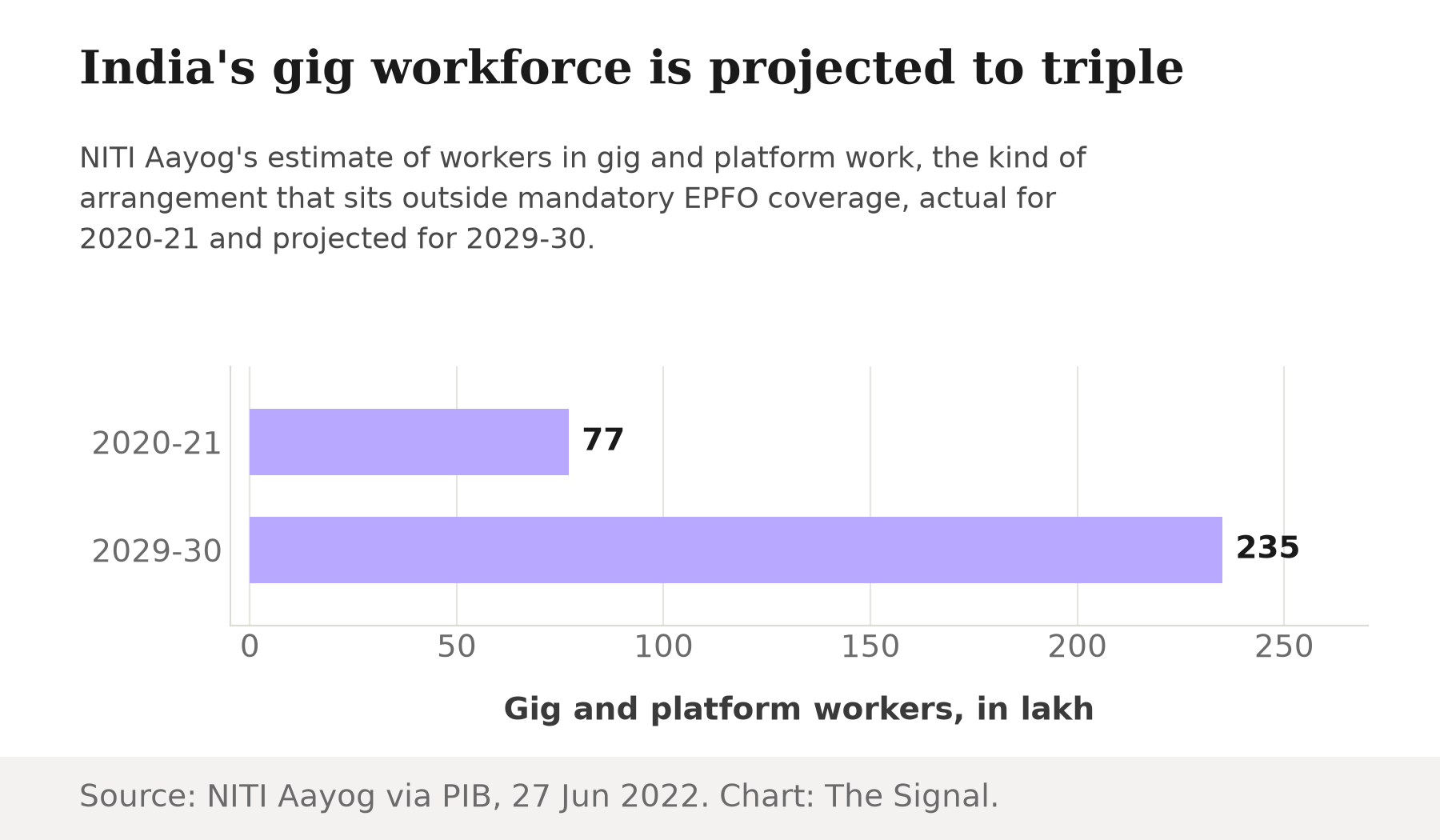
That alternative is not hypothetical. It is already the fastest-growing segment of India's labour market. NITI Aayog's report on India's gig and platform economy estimates that 77 lakh workers, about 1.5 percent of the total workforce, were in gig work in 2020-21, and projects that to more than triple to 2.35 crore workers by 2029-30. Separately, MoSPI's Annual Survey of Unincorporated Sector Enterprises 2025 shows the number of unincorporated, non-agricultural enterprises, the small and informal business universe that sits largely outside EPFO's registered-establishment net, grew from 7.34 crore in 2023-24 to 7.92 crore in 2025, a rise of about 7.97 percent, adding more than 74.52 lakh jobs over that period.
The informal alternative to a salaried EPFO job is already growing faster than the salaried category itself.
| Measure | Earlier period | Latest period | Change |
|---|---|---|---|
| Regular wage/salaried share of workforce | 22.4% (2024) | 23.6% (2025) | +1.2 points |
| Gig and platform workers | 77 lakh (2020-21) | 2.35 crore, projected (2029-30) | more than triple |
| Unincorporated enterprises | 7.34 crore (2023-24) | 7.92 crore (2025) | +7.97% |
Sources: MoSPI, PLFS Annual Report 2025; NITI Aayog, India's Booming Gig and Platform Economy; MoSPI, ASUSE 2025.
None of these three series was produced to answer a question about the wage ceiling. Put together, they describe the terrain the ceiling change lands on: a salaried workforce inching up by about a percentage point a year, sitting next to a gig economy on course to more than triple and an informal enterprise sector adding tens of lakhs of jobs a year on its own. A higher cost of formal coverage does not need to convert a single existing worker to matter. It only needs to tilt where the next low-wage hire goes, and the informal side of that choice is already the one growing faster.
The honest objection
The strongest case against this reading is that the ceiling was overdue and the workers it adds are genuinely better off. The Cabinet's own release notes the ceiling stood still through the entire decade from 2004 to 2014 before that revision to Rs 15,000, so a second freeze lasting twelve more years, to 2026, would have let inflation quietly erase the coverage the 2014 change bought. A government prepared to commit about Rs 56,696 crore over five years to fund the gap is not making a token gesture, and 51 lakh workers gaining a mandatory employer pension contribution they did not have on 15 September is a real, measurable gain that a hiring-margin story should not talk past.
That case is real, and it is also not in tension with the cost story. Nobody currently drawing a salary and already covered loses anything; the mechanism this piece describes bites at the hiring margin, on the next low-wage worker a small employer takes on, not on the worker already at the desk. The objection explains why the policy is defensible. It does not explain away the incentive it creates for the marginal hire, and the growth already under way in gig and informal work shows that incentive has somewhere real to land.
The Signal
The Cabinet's order is not a wash between a gain and a cost that cancel out; it is two effects with different addresses. The gain lands on workers already inside the formal system, whose EPF coverage now survives a bigger slice of a raise, while the cost falls on the decision an employer makes about the next low-wage hire who is not there yet, a decision that now has a cheaper answer than it did on 15 September 2026. Watch EPFO's own membership additions over the next few quarters against the 51 lakh figure the government itself is projecting. Track that number and the mandate is doing what it says. Fall short of it while gig and informal hiring keep climbing, though, and the ceiling did not fail to reach those workers. It gave employers a reason not to.
Reporting basis: the Cabinet's approval of the wage ceiling increase and its cost estimates are per a Press Information Bureau release from the Cabinet Secretariat and the Ministry of Labour and Employment, dated 16 September 2026. The projected coverage addition and the EPFO's existing membership base are per a separate Ministry of Labour and Employment and EPFO press release issued the same day. The standard EPF contribution rate and its illustrative rupee figure are per a Ministry of Labour and Employment and EPFO press release on EPF contribution relief from 19 May 2020. The regular wage and salaried employment share is from MoSPI's Periodic Labour Force Survey Annual Report 2025, released 27 March 2026. The gig and platform workforce estimate and projection are from NITI Aayog's report on India's gig and platform economy, launched 27 June 2022. The unincorporated enterprise and employment figures are from MoSPI's Annual Survey of Unincorporated Sector Enterprises 2025, released 24 March 2026. All six releases are distinct primary releases distributed via the Press Information Bureau. The wage-band comparison, the government outgo increase, and the framing that ties the labour-market series to the ceiling decision are The Signal's own analysis of those figures.