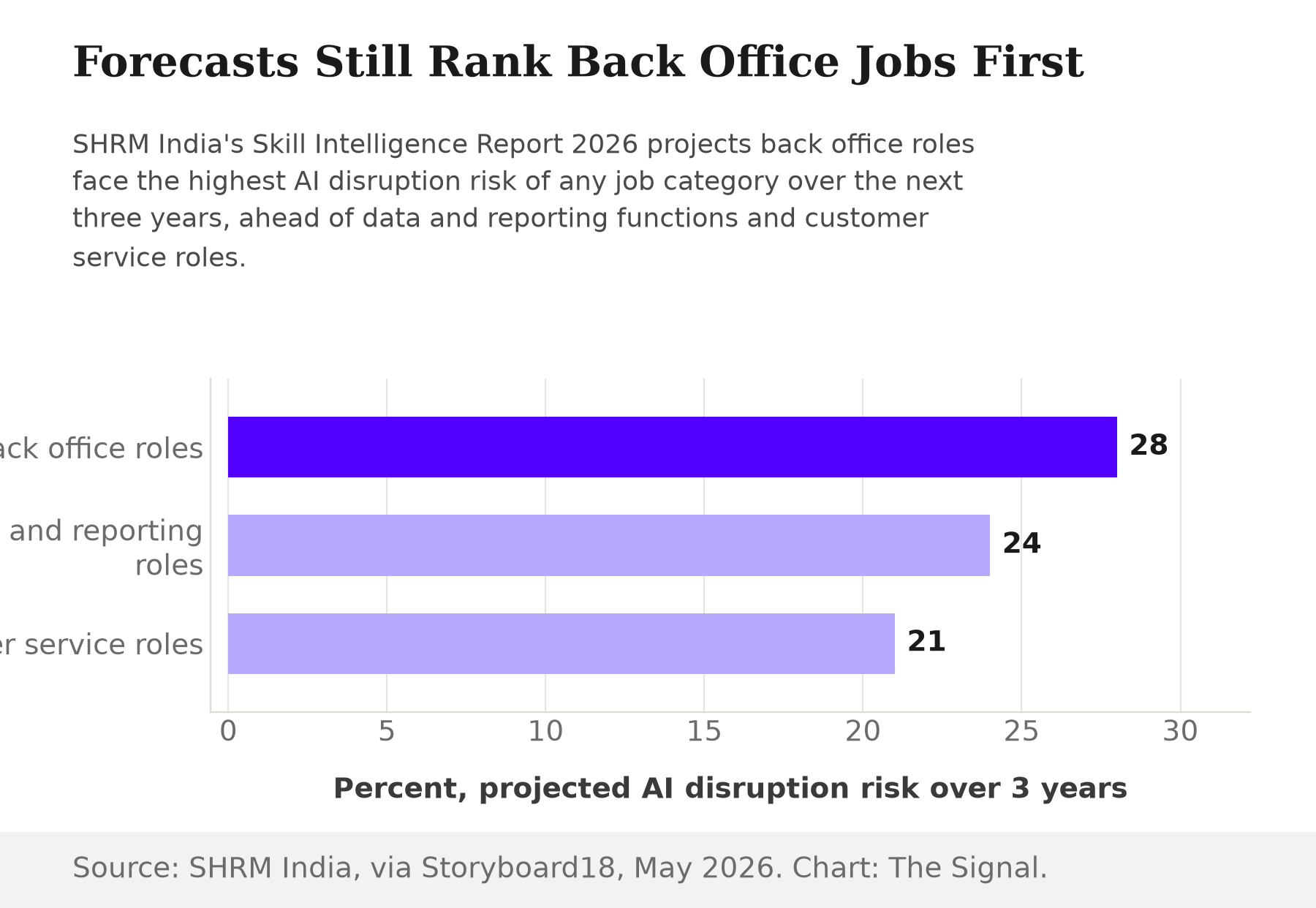
Ask an Indian workforce researcher which jobs artificial intelligence will hit first, and the answer is not creative work. The SHRM India Skill Intelligence Report 2026 puts back office roles at the top of the list, at up to 28% AI disruption risk over the next three years, ahead of data and reporting functions at 24% and customer service roles at 21%. That is the shape almost everyone expects: AI eats the routine, script-following, back-office work first, while specialised and creative judgment stays safe for longer.
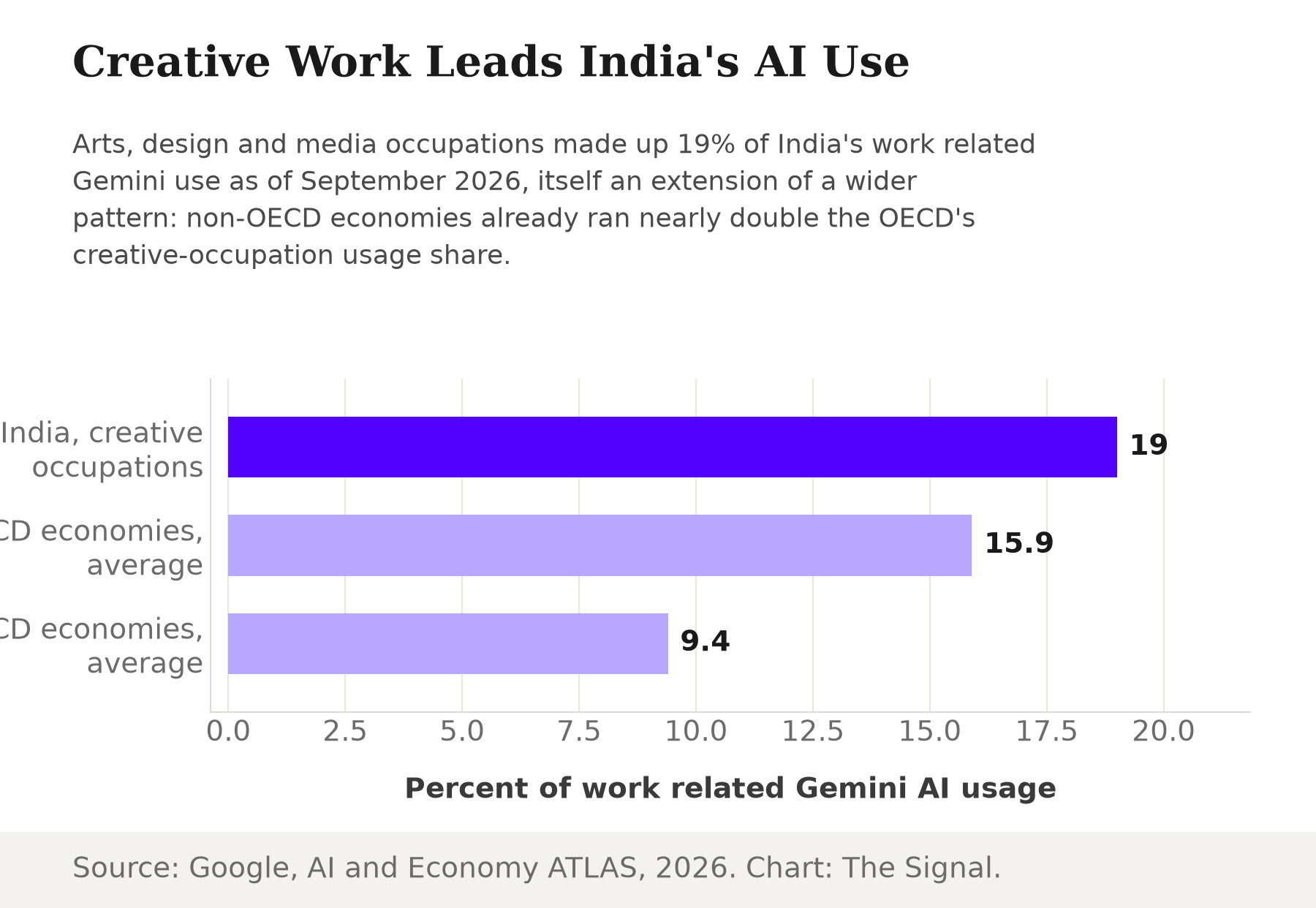
It is worth slowing down on that forecast, because the country's actual AI usage does not run through the jobs it names. Arts, design and media occupations account for 19% of India's work related Gemini usage, 1.6 times the global average share for creative work, according to a September 2026 update to Google's AI & Economy ATLAS research. The country's heaviest AI users at work, on Google's own numbers, are not the back office staff the disruption models flag first. They are the designers, writers, editors and other creative professionals nobody in that forecast was worried about.
A pattern that shows up everywhere Google looks
India is not an isolated case; it is an extreme version of a pattern the same research finds worldwide. In the United States, computer and mathematical occupations account for 30% of work related AI usage, double the share seen in the rest of the world, the mirror image of India's creative-led pattern. Widen the lens to every non-OECD economy and the divide holds at the aggregate level too: arts, design, entertainment, sports and media occupations make up 15.9% of Gemini interactions in non-OECD countries against 9.4% in OECD countries, roughly 70% higher, while OECD usage skews toward computer/mathematical and business/financial roles instead.
Why creative work absorbs so much AI use
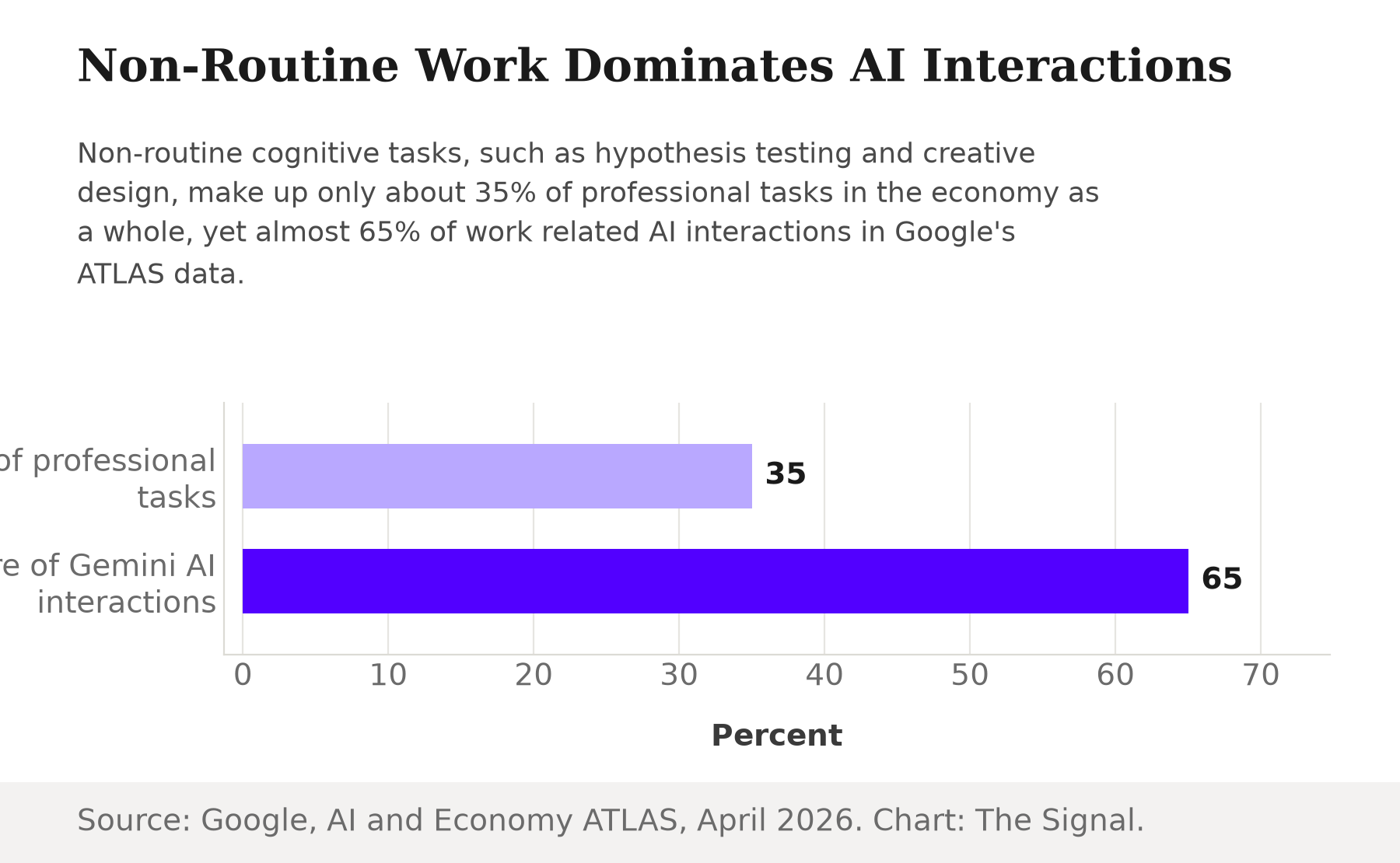
The reason is not that creative jobs are the easiest to replace. It is closer to the opposite: non-routine cognitive tasks, the kind that includes hypothesis testing and creative design, make up only about 35% of professional tasks in the economy as a whole, yet account for almost 65% of work related AI interactions in Google's data. People reach for Gemini precisely for open-ended, judgment-heavy work, the kind large language models are genuinely useful for, not for the mechanical tasks a disruption forecast assumes get automated first.
That heavy usage is also not the same thing as automation. End-to-end automation is the intent of less than 10% of AI conversations even within non-routine cognitive work: most of the usage is collaborative, drafting, reviewing and looking things up, rather than replacing the person doing the job. Cognitive tasks, routine and non-routine combined, account for 73% of tasks where any Gemini usage appears at all, rising to 86% when weighted by interaction volume, while manual and interpersonal tasks, 28% and 22% of the underlying O*NET task taxonomy respectively, shrink to just 5% and 9% of that interaction volume. AI use at work in India is landing overwhelmingly on cognitive, judgment-based tasks, and creative occupations happen to be unusually dense with exactly that kind of task.
India's AI habit is deepening either way
Whichever forecast turns out right about which jobs move first, the overall appetite for AI in Indian workplaces is not in question.
AI's footprint in Indian white-collar work is expanding on measures that have nothing to do with the creative-jobs finding.
| Measure | Figure |
|---|---|
| AI skills mentioned in Indian tech job postings, 2020 | 0.9% |
| AI skills mentioned in Indian tech job postings, 2026 | 15.4% |
| Indian professionals reporting AI saves at least 8 hours a week at work | 70% |
Source: Storyboard18, citing the Naukri World AI Day Report 2026, and Storyboard18, citing BCG's AI at Work 2026 report.
AI skills now feature in 15.4% of technology job descriptions in India, up sharply from just 0.9% in 2020, a nearly 17-fold increase in employer demand over six years. And the workforce is already leaning on the tools it has: India tops global AI workplace adoption, with 70% of Indian professionals surveyed saying they save at least eight hours a week, a full working day, using AI on the job. Neither number says which jobs are safest. Both say the baseline of AI use this argument is playing out against is already large and still climbing.
The honest objection
The strongest case for the SHRM forecast is that usage share and disruption risk are not the same measurement, and nothing above proves they move together. A worker who does forty things a day and asks Gemini to help polish three of them counts as a heavy "user" in ATLAS's data even though none of that work disappears. Consider, by contrast, a back office employee whose entire ticket queue could plausibly be handled by a well-tuned model. That employee might barely touch Gemini today and still lose the job within three years. Google's own paper effectively concedes the distinction: automation is the explicit intent of under one in ten AI conversations even in the non-routine cognitive work that dominates usage. It is entirely possible for creative occupations to be the heaviest users of AI today and for back office roles to still be the biggest losers of jobs to AI over the next three years, if what eventually happens inside those back office workflows differs in kind from what a designer or copywriter is doing with the same tool right now.
That case is real, but it prices the two forecasts as compatible on outcomes while ignoring what the SHRM number's own logic assumes: that AI substitutes for structured, repetitive work more readily than for creative judgment. The usage data says Indian workers are not behaving as if that substitution is already underway. If routine back office tasks were the easiest for AI to absorb, that is where the heaviest usage should already be concentrating, ahead of any layoffs. Instead, the heaviest usage sits in exactly the least routine, least script-following occupations, the ones the disruption models rank as comparatively safe.
The Signal
Two numbers describe two different futures for India's white-collar workforce, and only one of them shows up in how Indians actually use AI today. The standard forecast still ranks back office work as the single most exposed job category. The usage data says creative, non-routine work is where the country's actual Gemini habit already sits, concentrated in occupations 1.6 times more likely to touch AI than the global creative-worker average. Both can be true at once only if today's usage pattern is a poor guide to tomorrow's job losses, which is possible but is not what anyone has yet shown. Watch which number moves first. If AI-related hiring keeps compounding anywhere near the pace of the nearly 17-fold rise in AI-skill mentions in India's tech job postings since 2020, that demand is originating on the creative and cognitive side of the economy, not from a wave of back office layoffs. The professions everyone assumed would be first in line for AI to replace have so far been first in line for the tool itself.
Reporting basis: the core finding about how much of India's work related Gemini usage comes from arts, design and media occupations is from Google's AI & Economy ATLAS research team, in a September 2026 blog update built on the same team's v1.0 working paper published in April 2026, which is also the source for the United States technical-usage mirror pattern, the international occupational usage comparison, the task-share figures, the automation-intent figure, and the cognitive-task interaction-volume breakdown cited above. The back office disruption forecast is from the SHRM India Skill Intelligence Report 2026, carried by Storyboard18. The AI related job posting growth figure is from Naukri's World AI Day Report 2026, also carried by Storyboard18. The time savings figure is from BCG's AI at Work 2026 report, again carried by Storyboard18. No figure in this piece is The Signal's own calculation.