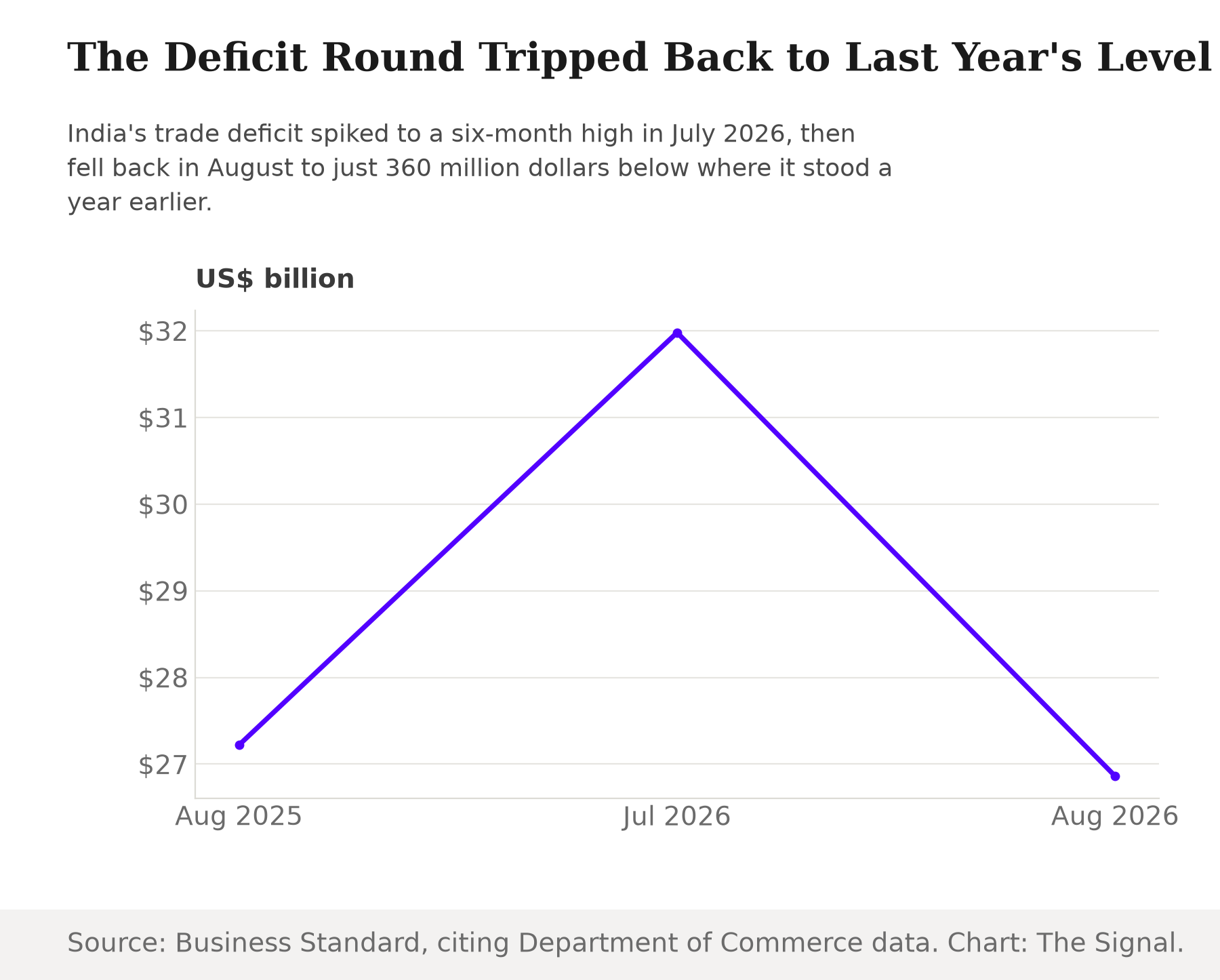
The headline number in India's August 2026 trade data is built for good news. Goods exports jumped 26 percent year on year to a record $43.81 billion, the strongest export month India has recorded. Coming right after a rough July, the obvious read is that India's chronic trade gap is finally starting to close under its own weight, with exporters pulling the country's books back toward balance.
It is worth slowing down on that read. Imports grew too, up 14 percent year on year to $70.67 billion in August, and imports start from a far bigger base than exports do. When both sides of the ledger move at once, a percentage headline on the smaller side can flatter the picture.
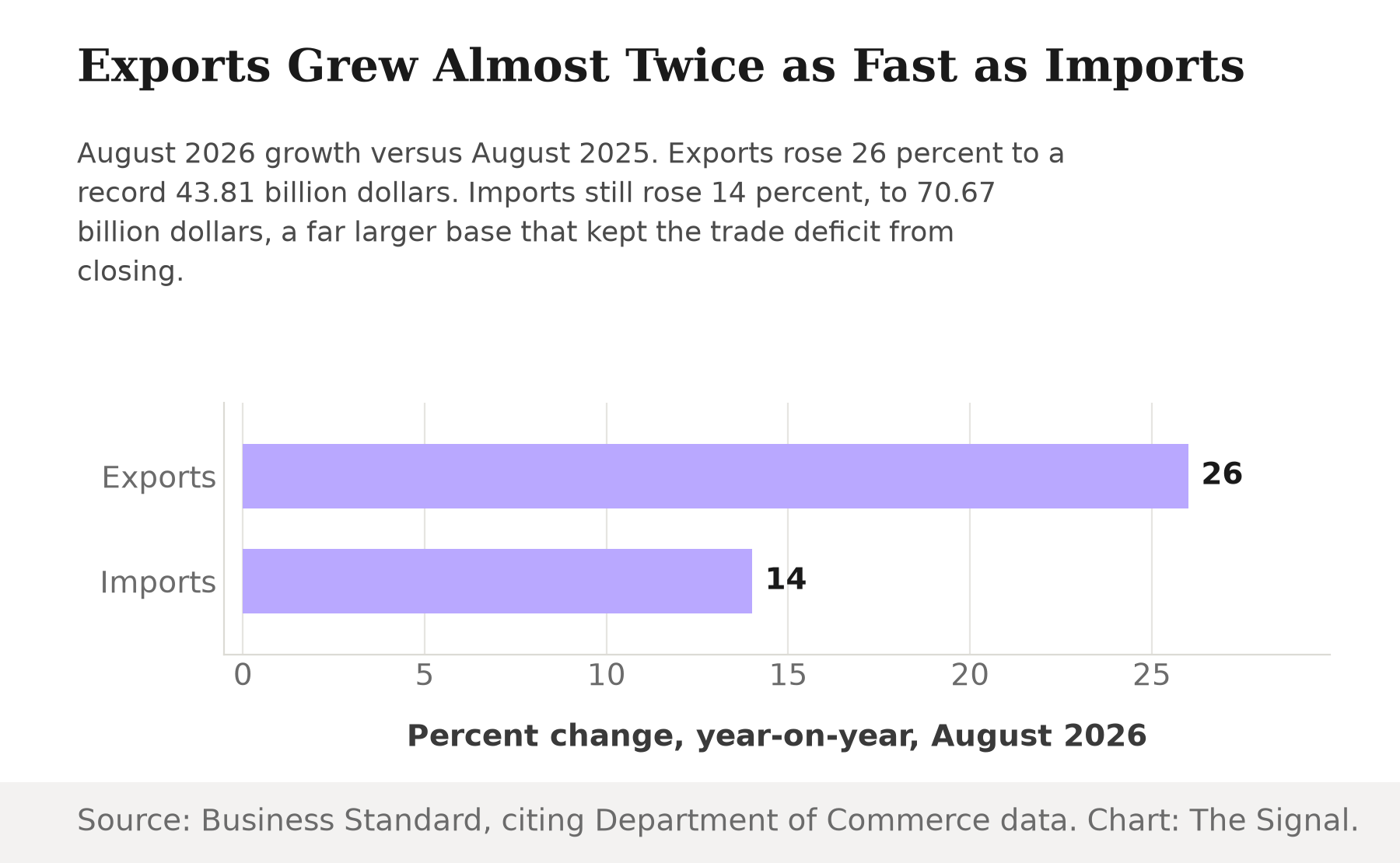
The trade deficit narrowed by $360 million. India's trade deficit eased to $26.86 billion in August, down from $27.22 billion a year earlier: a gap that closed by barely a third of a billion dollars in a month that also delivered a record export haul. Whatever rebalancing this month's number shows, it is a slow one.
Imports Have Been Outrunning Exports for Months
August's mismatch is not new. In July 2026, the trade deficit widened to a six-month high of $31.98 billion, as imports surged 17.5 percent year on year to a nine-month high of $76.22 billion while exports rose 19.6 percent to $44.24 billion. The pattern goes back further still. In June 2026, merchandise imports jumped roughly 31 percent year on year to $70.84 billion, from $54.08 billion in June 2025, far outpacing the 15.5 percent rise in exports that month, to $40.41 billion from $34.98 billion. Every one of the last three reported months shows the same shape: imports accelerating alongside exports, and sometimes ahead of them.
What the Export Record Is Actually Made Of
Part of the reason the export side keeps setting records is that a few volatile categories are doing outsized work. Petroleum products exports rose 67.64 percent year on year in July 2026, to $6.92 billion, a category whose dollar value moves with global crude prices as much as with anything India's refiners produce. That is not a hypothetical link: Brent crude averaged $91 a barrel in August 2026, up $7 a barrel from July, as constrained Middle East exports pushed prices higher, the same stretch in which India's refined-fuel export value was jumping by double digits. Cumulative merchandise exports for April to July of FY2026-27 were up 17.04 percent year on year, at $173.78 billion, a figure that carries the same petroleum-heavy mix. Electronic goods exports rose 40.3 percent year on year in April 2026, to $5.18 billion from $3.69 billion, the one category in the numbers growing off a broader industrial base rather than a commodity price swing. A record built partly on refined-fuel prices is not the same as a record built on manufacturing volumes, even when the two show up as the same percentage on the same government release.
The Full Year Looks Worse, Not Better
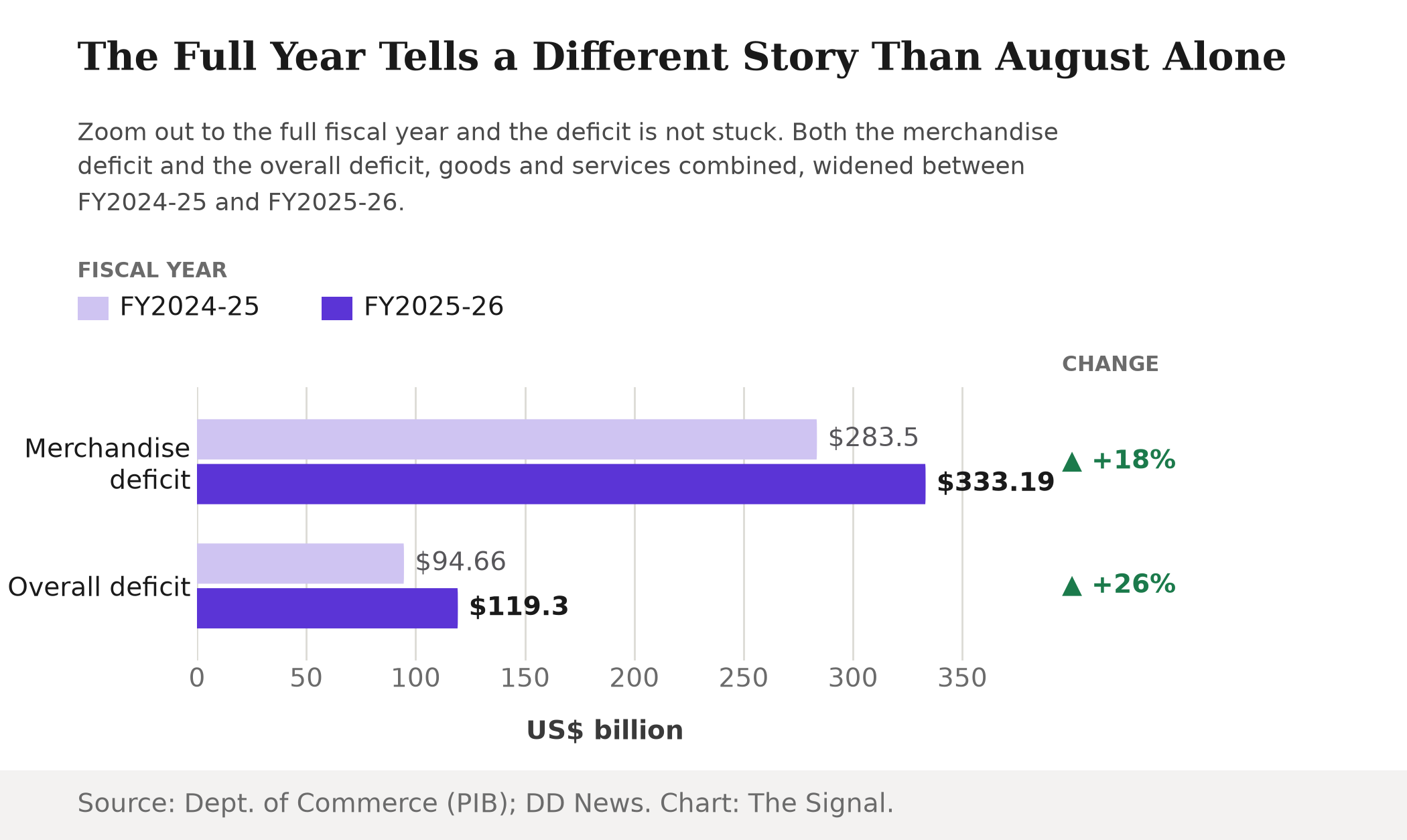
Zoom out from any single month and the rebalancing story gets harder to tell. India's merchandise trade deficit widened to $333.19 billion in fiscal year 2025-26 (April to March), up from $283.50 billion in FY2024-25, as imports of $774.98 billion outgrew exports of $441.78 billion for the full year. The broader, goods-and-services trade deficit widened to $119.30 billion in FY2025-26 from $94.66 billion in FY2024-25, Commerce Secretary Rajesh Agrawal has said, because total imports grew 6.47 percent against export growth of just 4.22 percent. One narrower August gap does not reverse a full fiscal year of the deficit moving the other way.
The Honest Objection
The strongest case for reading August as good news anyway is that a record month is still a record month. Exporters did not fail to deliver: a $43.81 billion export month is real revenue, real shipments, and real demand for what India makes and refines, whatever the deficit does elsewhere on the balance sheet. A trade deficit that narrows even slightly in a month when exports hit a record is also directionally better than one that widens on both counts, which is exactly what happened the month before.
That case is real, but it rests on treating one month in isolation. Imports grew 14 percent in August after growing 17.5 percent in July and roughly 31 percent in June, so the deficit's brief narrowing looks less like a turn and more like August landing on a smaller gap than July's spike, not a smaller gap than the trend. The fiscal year 2025-26 merchandise deficit widened by nearly $50 billion from the year before, and that is the pattern one record month has to overcome. It has not yet.
The Signal
August's export record is genuine, and so is the modest narrowing of the deficit that came with it. What it is not is evidence that India's imports are losing their grip on the trade balance. Imports have outgrown exports across fiscal year 2025-26 on the merchandise measure and on the combined goods-and-services measure, and even the export side's best month leans on categories like refined petroleum, whose export value moved 67.64 percent year on year in a single month, more with world prices than with anything India chooses to build. The number to watch next is not another month's export record. It is whether a record export month can ever show up as a shrinking deficit two months running, instead of one good month erasing the damage of the one before it. On August's evidence alone, it has not.
Reporting basis: the August and July 2026 trade figures, including the year on year import and export growth rates and the size of the trade deficit, are Department of Commerce data as reported by Business Standard for August and for July, in separate articles covering each month's release. The June 2026 trade figures, the April-July 2026-27 cumulative export figure, the petroleum products export growth, the April 2026 electronic goods export growth, and the FY2025-26 merchandise trade figures are all from Press Information Bureau releases citing the Department of Commerce's DGCI&S trade data. The Brent crude oil figure is from the U.S. Energy Information Administration's Short-Term Energy Outlook for September 2026. The FY2025-26 overall, goods and services combined, trade deficit and its comparative import and export growth rates are as reported by DD News, citing Commerce Secretary Rajesh Agrawal. The $360 million narrowing of the year on year deficit and the nearly $50 billion widening of the FY2025-26 merchandise deficit are The Signal's calculations from the Department of Commerce's own reported figures.