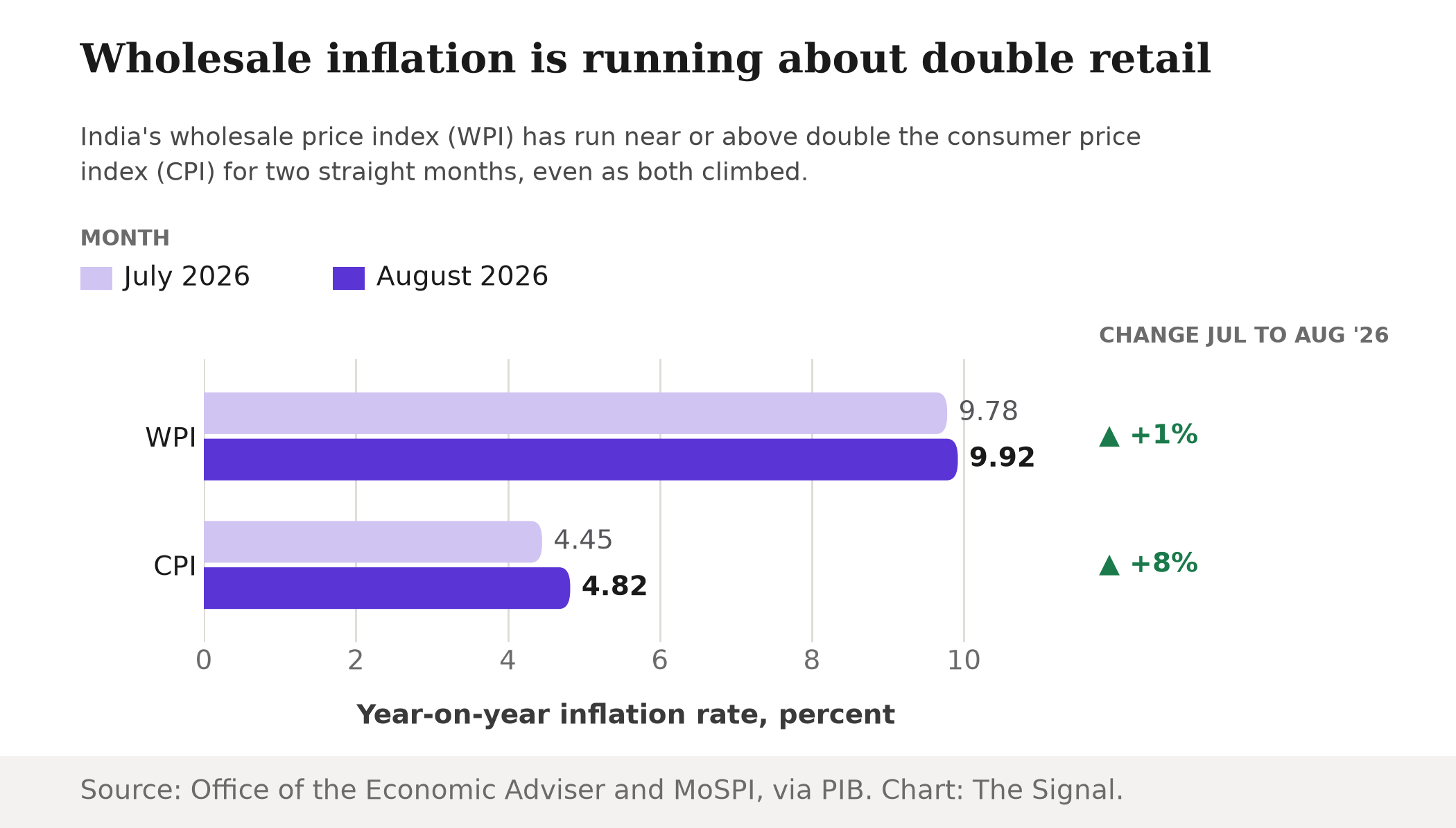
Two numbers landed on the same day. India's wholesale price index rose 9.92 percent year-on-year in August 2026, up from 9.78 percent in July, the Office of the Economic Adviser reported. Retail inflation, the number that actually tracks what households pay, came in at 4.82 percent for August, up from 4.45 percent in July, MoSPI's National Statistics Office reported the same day. Read the two releases side by side and the story looks simple: inflation is edging up, mildly, across the board.
It is worth slowing down on that. Wholesale inflation is not edging anywhere near where retail inflation sits. At 9.92 percent against 4.82 percent, wholesale prices are running just over double the pace retail prices are, and that has now held for two straight months: in July it was 9.78 against 4.45, again roughly double. The consensus assumption, baked into how these two releases usually get covered, is that wholesale and retail inflation move together, with wholesale simply a leading indicator of what retail will do next. That assumption does not survive a look at the actual numbers.
Wholesale inflation has run about double retail inflation for two straight months.
The food index narrows the gap, it does not explain it
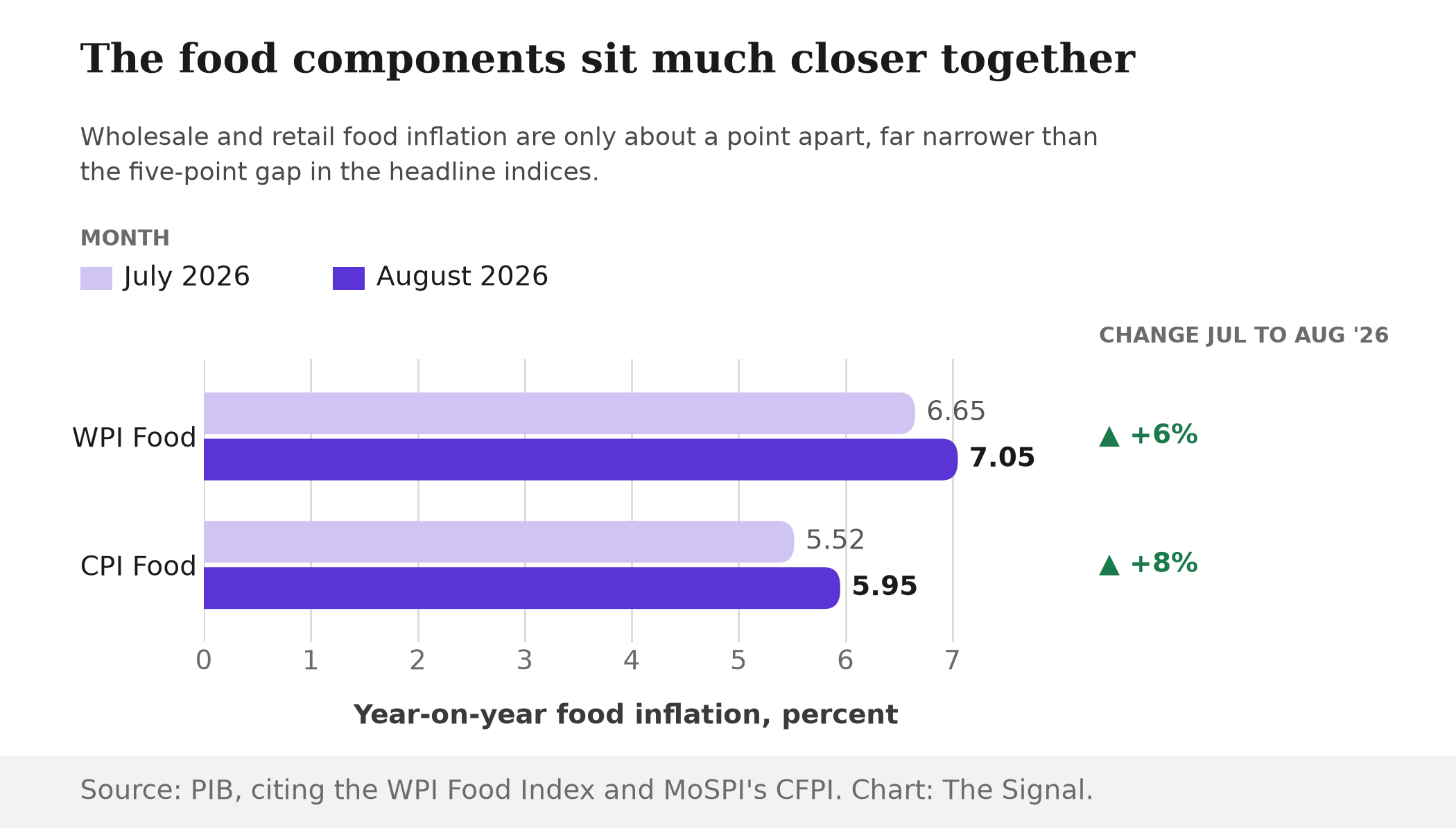
The obvious next question is whether food is doing all the work. Food is the most visible, most politically salient part of any inflation print, and both gauges have a food component. The WPI Food Index rose 7.05 percent year-on-year in August, up from 6.65 percent in July, while the Consumer Food Price Index (CFPI) rose 5.95 percent, up from 5.52 percent. Those two food gauges sit about 1.1 percentage points apart in August. The headline WPI and CPI sit about 5.1 points apart in the same month, our calculation from the wholesale and retail figures above. Food alone cannot be the reason wholesale and retail inflation have pulled apart; whatever is driving the wider headline gap is sitting somewhere outside food.
The wholesale-retail gap in food inflation is far narrower than the gap in the headline numbers.
That matters because the RBI's own August 2026 Bulletin describes headline CPI's rise as food-driven, with core inflation stable. The central bank is telling households the story is about food. The wholesale side tells a different story: food is actually the part of the WPI-CPI gap that is smallest, not largest. Two readings that both center on food are, on close inspection, both pointing away from food as the explanation for the size of the overall gap.
So what is doing the work outside food? The Office of the Economic Adviser's own release breaks the WPI into its three major groups, and one of them stands apart. Fuel and Power inflation accelerated to 22.93 percent year-on-year in August, up from 20.05 percent in July, while Primary Articles came in at 7.76 percent (down from 8.52 percent) and Manufactured Products at 8.37 percent (up from 8.29 percent). Fuel and Power is running at more than double the headline WPI rate and nearly three times the Manufactured Products rate. Of the three non-food WPI groups, it is the only one running hot enough to plausibly account for most of the gap left once food is excluded.
This was not a one-month spike
Retail inflation did not jump out of nowhere in August. It had already climbed to 4.45 percent in July, up from a finalized 4.38 percent in June, a steady creep rather than a jolt. What changed between July and August is the pace, not the direction: retail inflation accelerated by about 8 percent between the two months (4.45 to 4.82), while wholesale inflation barely moved, up about 1 percent (9.78 to 9.92). Retail is catching up faster in relative terms, but starting from so far behind that the absolute gap has barely narrowed at all.
The natural reading of a persistent, roughly two-to-one gap is that producers are not passing their higher costs through to the prices households see. A wholesale index running near 10 percent while the retail print that shares many of the same underlying goods sits under 5 percent implies someone in the supply chain, a manufacturer, a wholesaler, a retailer, is eating the difference rather than charging it forward.
The honest objection
The strongest case against reading too much into this is that WPI and CPI are not the same measurement and were never supposed to move in lockstep. WPI tracks prices at the factory gate and in bulk wholesale markets; CPI tracks what a household actually pays at the point of sale, after retail markups, transport, and the taxes and margins layered on along the way. The two baskets weight items differently, and a bulk commodity price swing can show up in WPI long before, or without ever fully showing up in, what a shopper sees. On this view, a persistent gap is not a mystery to be solved. It is simply two different rulers measuring two different things.
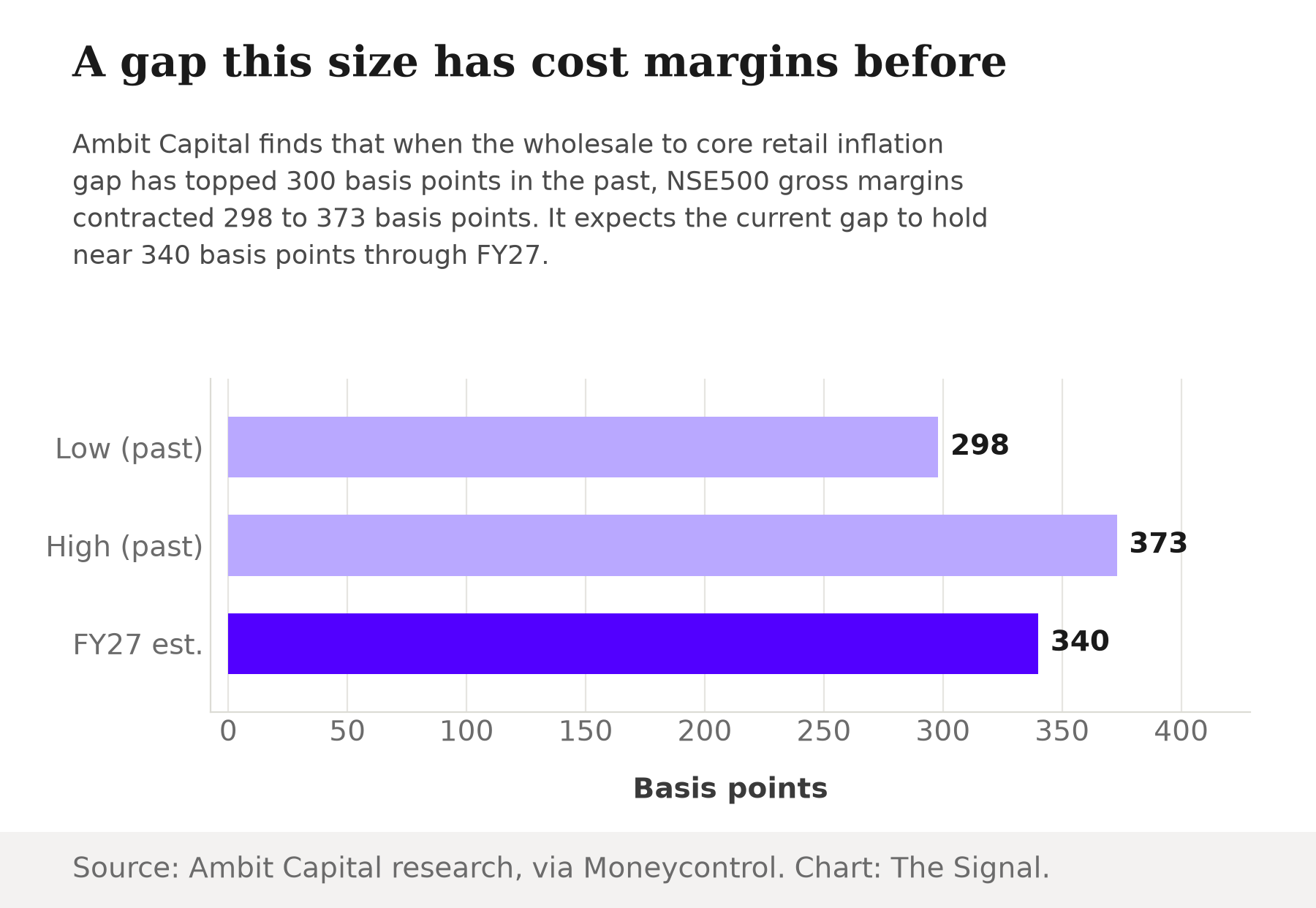
That case has real force, but it does not sit comfortably with what happens when a gap of this size has occurred before. Ambit Capital's research, as reported by Moneycontrol, finds that in past episodes when the WPI-to-core-CPI gap exceeded 300 basis points, NSE500 companies' gross margins contracted by roughly 298 to 373 basis points, and the brokerage expects the current gap to hold around 340 basis points through FY27. If this were simply two rulers measuring different things with no real economic consequence, that historical margin pattern would not exist. A gap this size has, in the past, come out of somebody's income statement.
A wholesale-retail gap of this size has coincided with real margin contraction before.
What the central bank does next
None of this is happening in a vacuum for policy. The RBI's inflation target remains 4 percent CPI inflation with a tolerance band of 2 to 6 percent, a target the government retained for the five years to March 2031. August's 4.82 percent print sits comfortably inside that band, above the midpoint but nowhere near the upper limit, which is one reason the RBI's own Bulletin can describe the move as food-driven and core as stable without much alarm. The RBI's Monetary Policy Committee is next scheduled to meet October 5 to 7, 2026, the first meeting where it will have both August prints in hand together.
That meeting will not be reacting to a retail inflation crisis. The CPI number alone gives the MPC little reason to move. What it cannot fully see in the CPI print is the pressure sitting one step back in the supply chain, already quantified above.
The Signal
The comfortable version of this story is that India's retail shopper is barely feeling the inflation wholesale markets are already living through. The uncomfortable version is that someone still has to absorb the difference, and the historical pattern is that when a gap this size has appeared before, corporate margins have been the shock absorber. Watch two things from here: whether retail inflation keeps closing the gap from below, since it is already accelerating faster than wholesale in relative terms, and whether the margin compression Ambit is projecting through FY27 actually shows up in quarterly results. A gap this size does not close for free. Somebody pays for it, and right now it is not the person doing the shopping.
Reporting basis: the August 2026 wholesale price figures are from the Office of the Economic Adviser's press release; the WPI Food Index figure is per the Press Information Bureau's release of the same data. The August 2026 retail price and food inflation figures are from MoSPI's National Statistics Office, via a Press Information Bureau release; the July and June 2026 retail figures are from MoSPI's own July press release. The RBI's inflation target and tolerance band, its Monetary Policy Committee calendar, and its characterization of headline CPI as food-driven with core inflation stable are all from RBI publications. The margin-contraction findings are from Ambit Capital's research, as reported by Moneycontrol and syndicated via TradingView, and rest on that single analysis. The size of the food-versus-headline gap and the month-on-month percentage changes in each index are The Signal's calculations from those figures.