On September 11, 2026, the Reserve Bank of India sent Tata Sons a letter that closed an argument two and a half years in the making. The Tribune reports, citing sources familiar with the decision, that the RBI rejected Tata Sons' March 2024 application to surrender its Core Investment Company and NBFC registration. That filing was the one route that could have let the Tata Group's holding company sidestep a mandatory stock listing altogether. Read only that much and the story looks simple: Tata Sons has finally been told to go public.
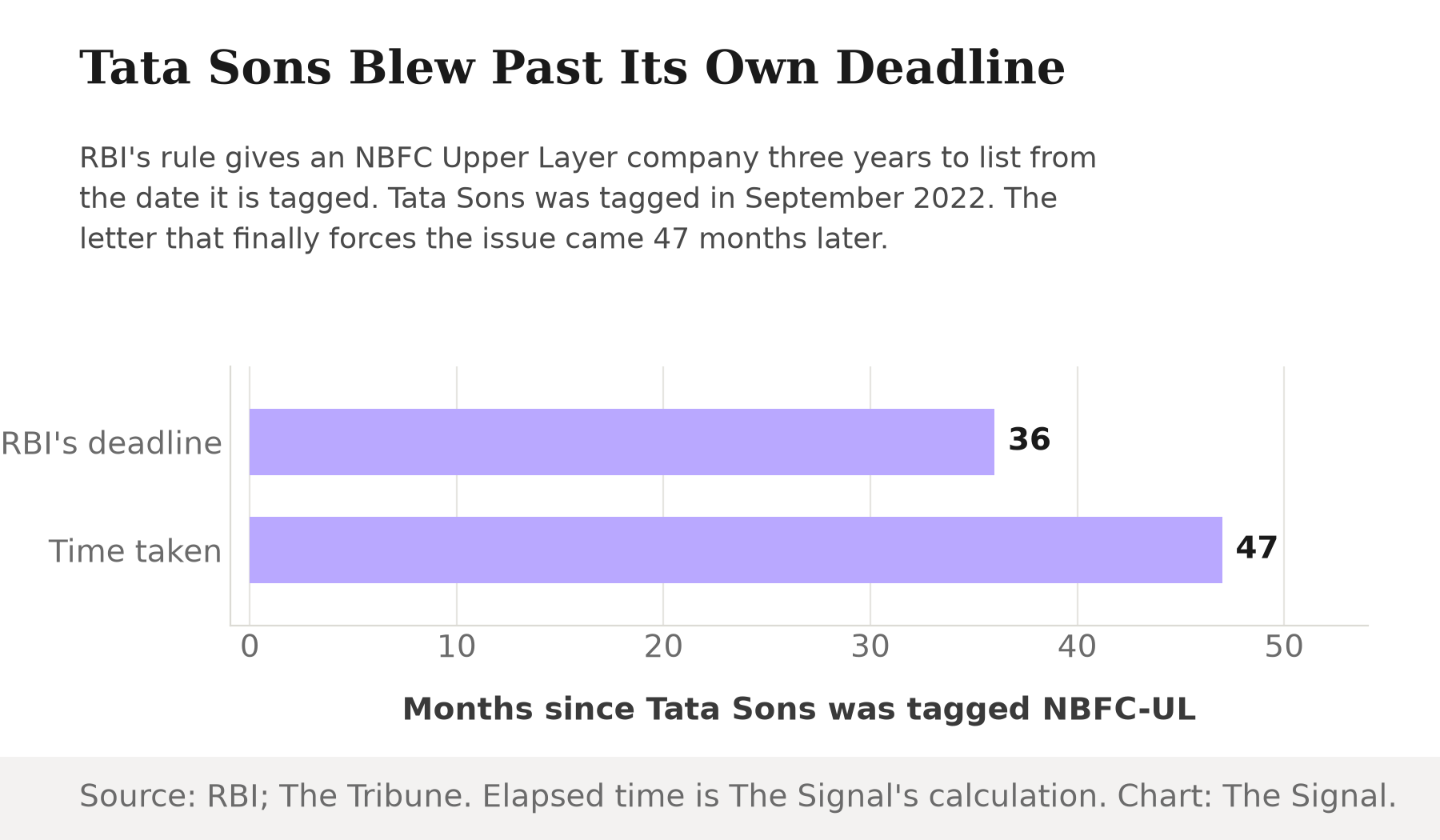
It is worth slowing down on that. RBI's Scale Based Regulation framework requires any NBFC placed in the Upper Layer to be mandatorily listed on a stock exchange within three years of that designation, a rule the central bank set out in an October 2021 circular. RBI put Tata Sons on that Upper Layer list on September 30, 2022, one of 16 NBFCs identified that day. By the regulator's own clock, Tata Sons should have been trading publicly by September 30, 2025. It was not, and for most of the time since, it was not trying to comply. It was trying to leave the framework entirely.
The exit that wasn't
Tata Sons had applied in March 2024 to surrender its NBFC and Core Investment Company registration, and RBI's September 2026 letter finally closed that route, on the grounds that the group did not meet the criteria for deregistration. Telangana Today reports that Tata Sons repaid more than Rs 21,000 crore of debt in 2024, part of a deleveraging exercise carried out while that application sat with the regulator. Paying down that much debt while asking to be released from NBFC status only makes sense as an attempt to reshape the balance sheet enough to qualify for exit. It is not what ordinary treasury management looks like.
The bright line RBI drew
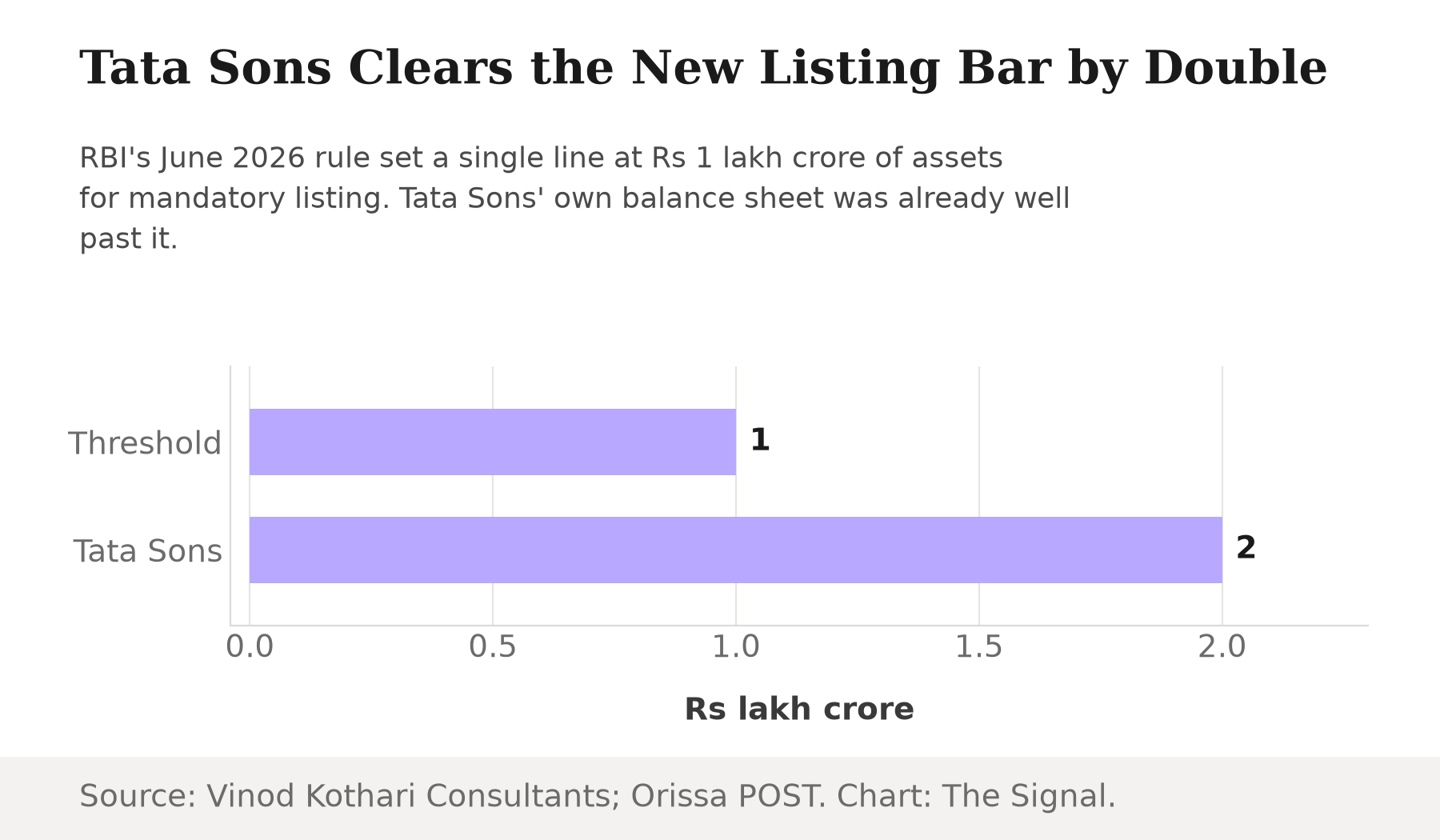
Any doubt about whether Tata Sons still belongs in the Upper Layer was closed by a rule change that raises the bar rather than lowering it. RBI's revised directions, effective June 24, 2026, replaced the earlier multi-factor scoring system for Upper Layer classification with a single test: any NBFC with Rs 1 lakh crore or more in assets on its latest audited balance sheet now qualifies as Upper Layer. Tata Sons' standalone assets stood at over Rs 2 lakh crore as of March 2026, clearing that line by a wide margin.
There is also no ownership escape hatch left to try. The same June 2026 amendment exempts government-owned NBFC-ULs from the mandatory listing requirement, while a privately held one like Tata Sons must still list within three years of being recognised as Upper Layer. Tata Sons is not state owned, so that carve-out does not reach it.
Who wants this, and who doesn't
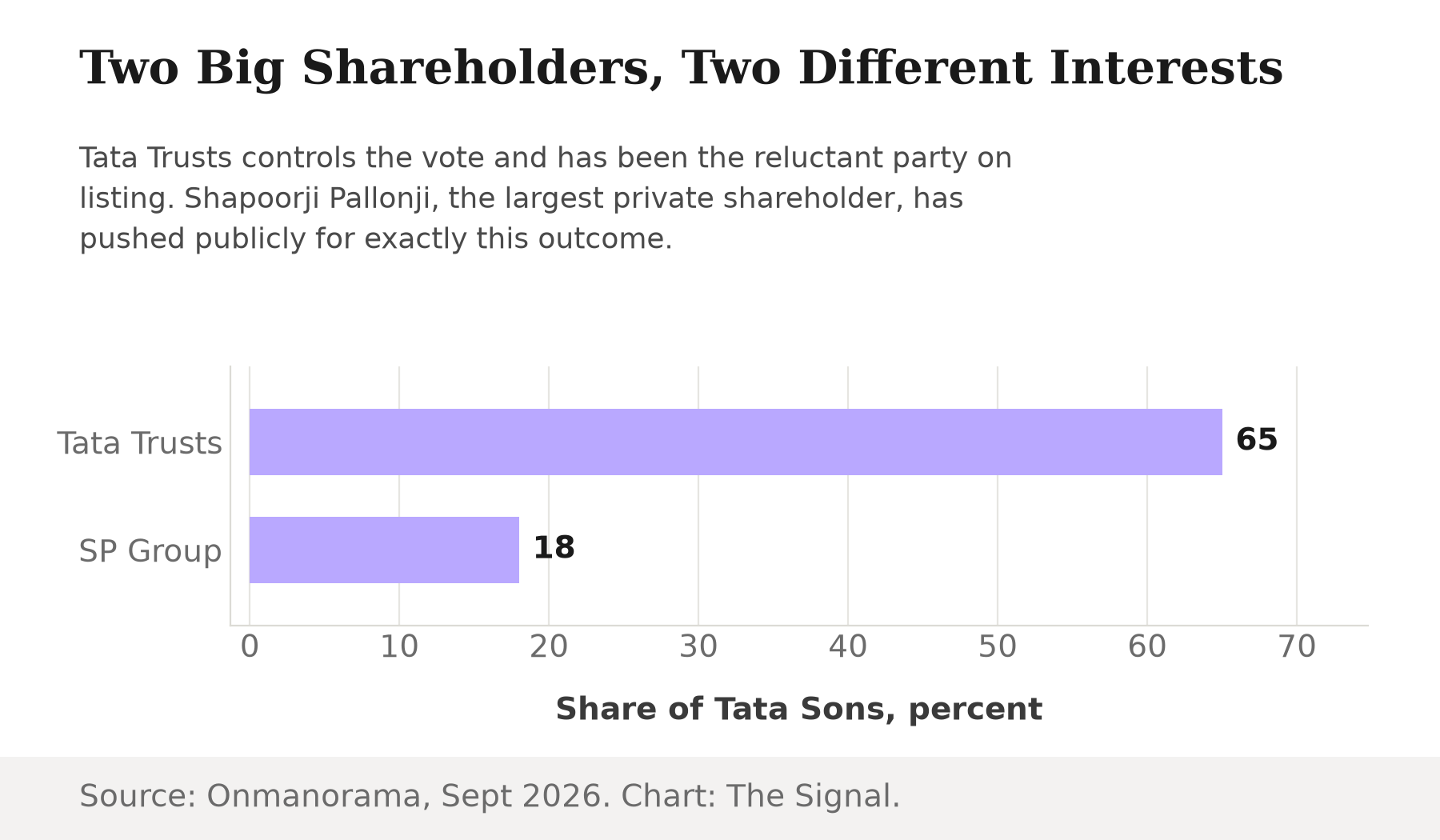
Tata Trusts, led by Noel Tata, hold over 65 percent of Tata Sons and have been the reluctant party on listing, while Shapoorji Pallonji Group, the largest private shareholder at around 18 percent, has pushed publicly for exactly this outcome. Neither side's reasoning is spelled out in the reporting, but the positions are opposite and long-standing: the shareholder that controls the vote has resisted a listing for years, and the largest private shareholder has been asking, in public, for the opposite outcome.
The honest objection
The strongest case for Tata Sons is that a deregistration bid is not automatically a dodge. The Tribune's own sourcing frames RBI's rejection as a judgment against specific criteria, not as a verdict on Tata Sons' motives. A conglomerate that had genuinely cut its debt and reshaped its balance sheet could reasonably ask whether it still belonged in the Upper Layer at all. Seeking an exit is not, by itself, proof of bad faith.
That case holds up until the timing is put back in. Tata Sons repaid its debt in 2024, the same year it filed to deregister. That filing landed about eighteen months before the three-year listing deadline set by RBI's own rule was due to expire, a deadline running from Tata Sons' September 2022 designation. A company confident it belonged outside the framework did not need to be the one asking to leave it just as its own deadline approached. RBI did not have to establish motive to reach its decision. It only had to say the criteria were not met.
The Signal
The letter forces the question RBI's rule was built to force: not whether Tata Sons eventually becomes a listed company, but how much longer a regulatory deadline can be treated as a starting point for negotiation rather than an endpoint. The trusts that control the vote have run out of room to negotiate. The shareholder that has been asking for a listing has just gotten the regulator to agree with it. What to watch next is not the debt or the balance sheet, both already settled facts, but the calendar Tata Sons now has to keep. It spent four years finding reasons a three-year clock did not quite apply to it. It has run out of reasons.
Reporting basis: the rule requiring Upper Layer NBFCs to list within three years is per RBI's own circular, and Tata Sons' September 2022 designation as one is per RBI's press release. The rejection of Tata Sons' deregistration application is per The Tribune's report on RBI's letter, citing people familiar with the decision; the same outlet, in a separate report on RBI's amended asset-threshold rule, is also the source for the government-ownership exemption. Tata Sons' 2024 debt repayment is per Telangana Today. The new asset threshold is per Vinod Kothari Consultants' regulatory note on RBI's amendment, and Tata Sons' balance-sheet figure is per Orissa POST. The ownership stakes of Tata Trusts and Shapoorji Pallonji Group are per Onmanorama. The elapsed time from Tata Sons' designation to RBI's rejection letter, and the gap between the deregistration filing and RBI's own listing deadline, are The Signal's calculations from those dates.