
On September 13, 2026, PwC US and PwC India signed a joint venture combining PwC India's Consulting business with PwC US Advisory's India-based capabilities, structured to be jointly owned and governed by both member firms. Sanjeev Krishan, PwC India's Chairperson, was named the incoming CEO of the combined entity (PwC's own joint press release states). The transaction is expected to close in the first half of calendar year 2027, subject to regulatory approvals, and the financial terms were not disclosed (per the same release). Read quickly, this is routine consolidation: two units of one network tidying an org chart, dressed up in the language every Big Four merger uses about growing and competing "at greater speed and scale."
It is worth slowing down on that framing. A joint venture between two member firms of the same network is not, on its own, news. What makes this one different is the identity of the chief executive. Sanjeev Krishan already runs PwC India. Under this deal he becomes the top executive of a business built by combining an American firm's India-based delivery capacity with an Indian firm's consulting practice, reporting to a jointly governed board rather than to PwC US alone. The leadership seat for a business built partly in America has moved to India, at the exact moment the network's headcount is shrinking everywhere else.
That is the number that carries this story. PwC's global headcount fell by 5,600 in its 2025 financial year (the year to June 2025) even as its Advisory revenue grew. PwC's global network reported 364,000 people across 137 countries and territories as of its FY25 results, the year to June 30, 2025 (PwC's own global press release states). Getting there meant cutting 5,600 jobs over that same year, even as network-wide Advisory (consulting) revenue rose 4.5% to $24.3 billion (Consulting.us reports, based on PwC's FY25 results). The business consulting firms sell got bigger. The number of people needed to sell and deliver it got smaller. That is the paradox the new joint venture sits inside, and it is why an India-based CEO is not a footnote to the deal. It is the deal.
What the joint venture actually combines
The mechanics matter before the interpretation does. The new entity unites PwC India's existing Consulting business with the India-based capabilities of PwC US Advisory, meaning the US firm's India-based consulting staff and the India member firm's own practice now sit inside one jointly owned, jointly governed structure (PwC's own joint press release states). It is not a full merger of PwC US and PwC India, nor a takeover of PwC's entire global consulting arm. It is a negotiated combination of two firms' India-facing consulting capacity, governance split between the two parents, not expected to close until the first half of 2027.
What is unambiguous is the leadership choice. PwC did not install a US Advisory executive to run a business that includes American clients and American-trained delivery teams. It named the sitting chairman of its India member firm. For a network built for a century around US and UK head-office authority, choosing an India-based chief executive for a business explicitly built to include American capacity is the clearest single data point that decision rights, not just delivery headcount, are shifting toward India.
The growth case sits in India
PwC has already told investors where it expects growth to come from. PwC India's Vision 2030 strategy, announced in August 2025, targets threefold revenue growth over five years and plans to create 20,000 additional jobs, expanding the India workforce toward a 50,000-strong headcount (PwC India's Vision 2030 press release states). Work backward from those two figures and PwC India's headcount, as of that August 2025 announcement, was roughly 30,000 (our calculation, from the plan's own target and its own stated addition), meaning the firm plans to grow its India workforce by more than three-fifths this decade even as its global headcount shrank in FY25 (the year to June 2025).
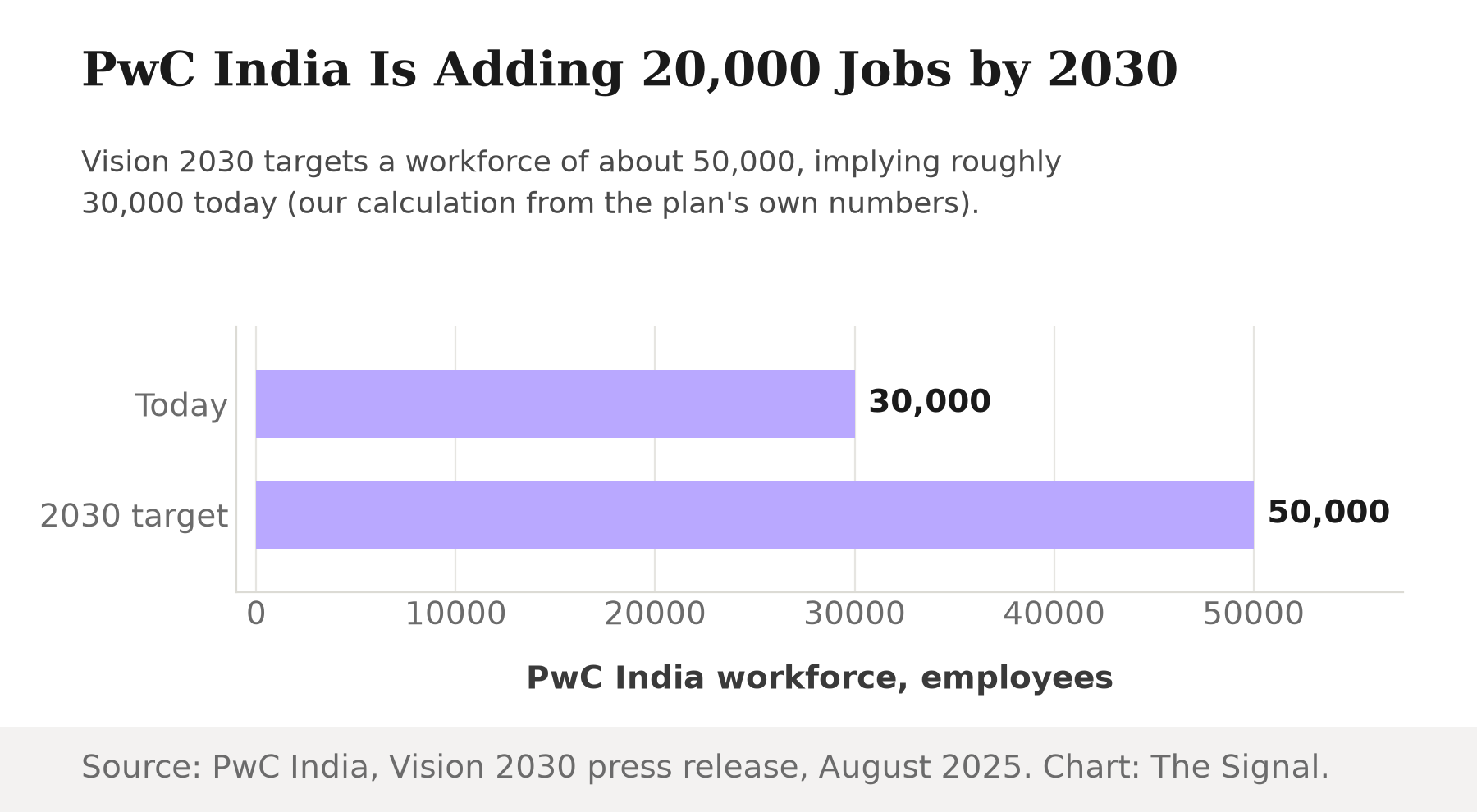
Source: PwC India's Vision 2030 press release. The 2025 headcount figure is The Signal's calculation.
India's pull is bigger than one firm's ambitions. The country now hosts 2,117 Global Capability Centres employing about 2.36 million professionals and generating $98.4 billion in revenue in FY2026, up 32% since FY2021, with 506 Forbes Global 2000 companies now running a GCC in the country (the Zinnov-Nasscom India GCC Landscape 2026 report finds). That works out to an FY2021 base of roughly $74.5 billion (our calculation, from the report's own growth rate and current total).
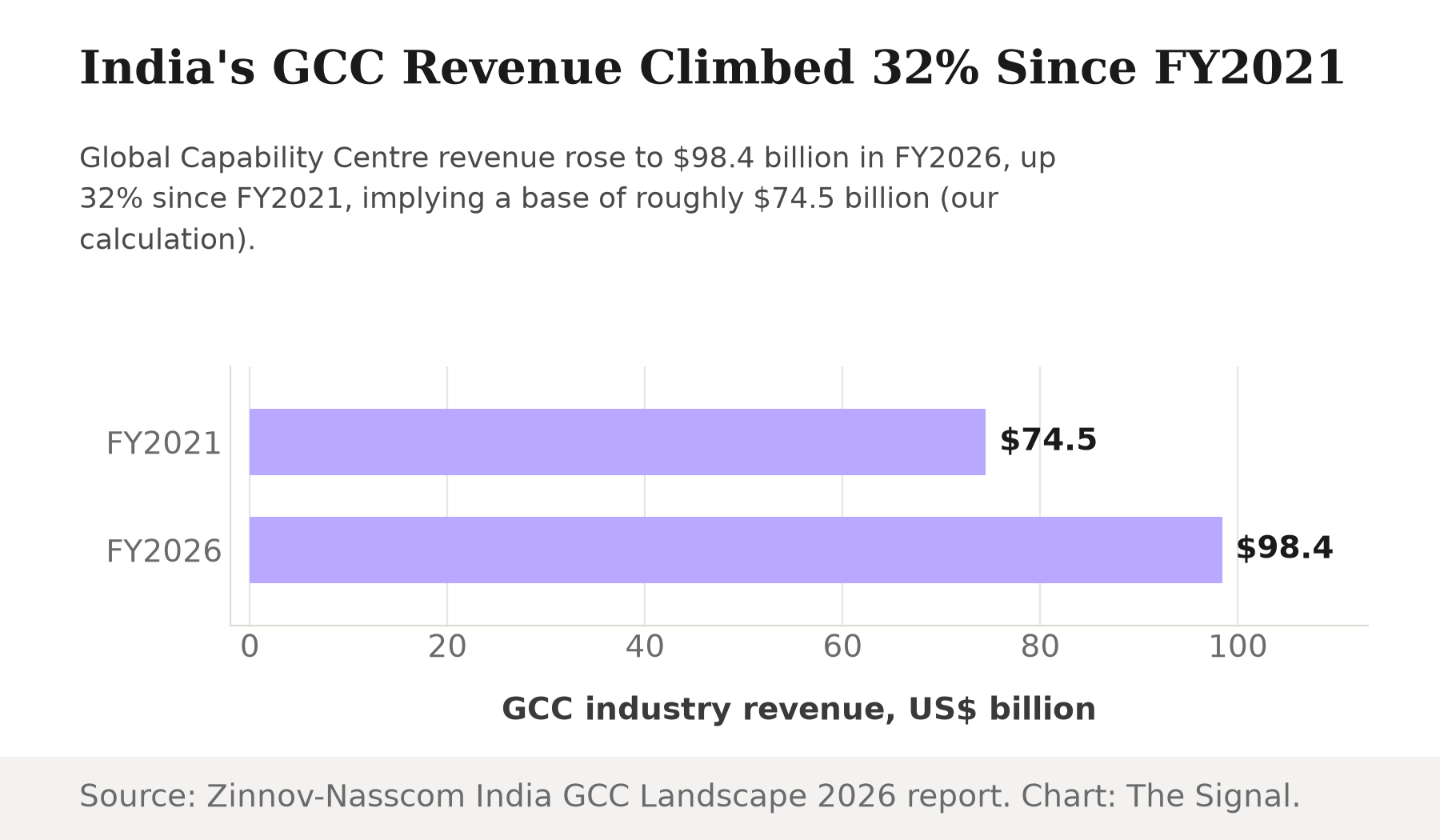
Source: Zinnov-Nasscom India GCC Landscape 2026 report. The FY2021 base is The Signal's calculation.
PwC's new venture is not being built in a vacuum: multinationals already run 2,117 back-office and delivery centers in India, with the infrastructure, talent pipeline and cost base for this kind of consulting delivery already at scale.
The pressure sits everywhere else
Set that growth story against what is happening to consulting headcount outside India, and the contrast sharpens. PwC's own global cut of 5,600 jobs in FY25 was not an isolated data point (Consulting.us reports, based on PwC's FY25 results).
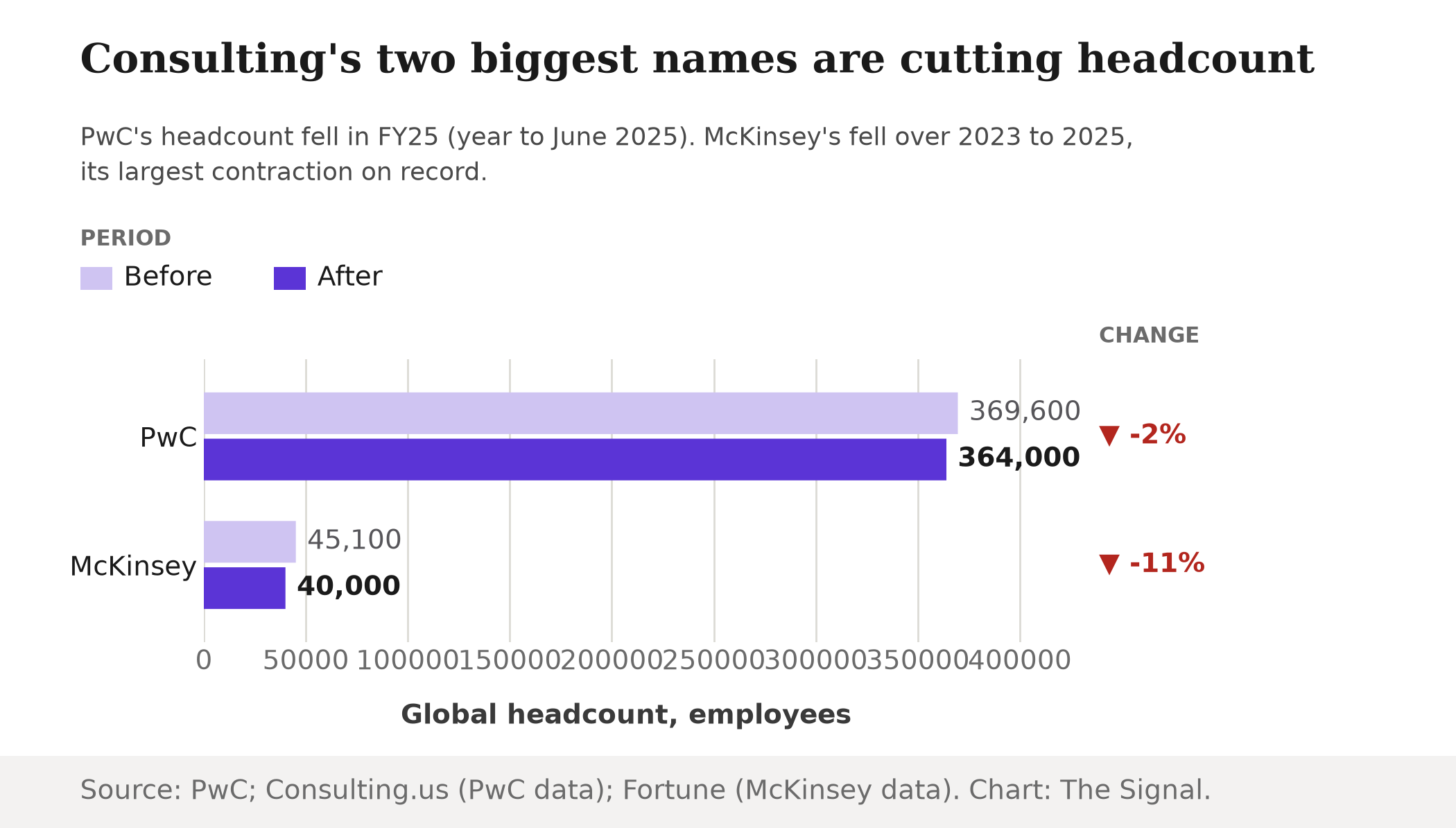
Source: Consulting.us, based on PwC's FY25 results; Fortune. The percentage changes are The Signal's calculations.
McKinsey's headcount fell from about 45,100 employees at the end of 2023 to about 40,000 by mid-2025, a decline of more than 10% in 18 months that the firm itself describes as the largest in its history, though McKinsey attributes the drop to normal attrition rather than to AI (Fortune reports). PwC's own units outside India are cutting at the entry level specifically. The table below lays out four separate signals from three parts of the same industry.
Entry-level and junior hiring is being cut across the Big Four and MBB, even as senior structures consolidate.
| Firm / unit | What changed | Detail | Reported |
|---|---|---|---|
| PwC UK (graduate hiring) | Intake cut | 1,300 graduate hires in 2025, down 200 from 1,500 in the prior intake | September 2025 |
| PwC US (entry-level hiring) | Planned cut | Documented plans to cut entry-level hiring by almost a third over three years | September 2025 |
| PwC UK (risk and consulting) | Divisions merged | Roughly 5,000 professionals combined into one group (300+ partners and MDs, 500 directors, 4,500+ others) | April 2026 |
| McKinsey (global headcount) | Headcount fell | About 45,100 employees at end-2023 to about 40,000 by mid-2025 | May 2025 |
Source: Fortune, Consultancy.uk, Fortune.
PwC UK's chief, Marco Amitrano, has been direct about why: AI is "reshaping roles," and graduate intakes across the industry are under pressure (Fortune reports). Boston Consulting Group's own numbers show where the growth that remains is going: AI- and tech-focused services made up over 40% of BCG's total 2025 revenue, driven by 25% year-over-year growth in AI services, as the firm's overall revenue grew to $14.4 billion (BCG's own press release states). Consulting demand for AI-adjacent work is not falling. The number of junior humans needed to staff traditional billable-hour work is.
The honest objection
The strongest case against reading this as a shift in control is the deal's own structure. PwC has explicitly said the new venture will be jointly owned and governed by PwC US and PwC India, not owned or controlled by the India firm alone (PwC's own joint press release states). The financial terms are undisclosed, which cuts both ways: there is no public evidence of what each side contributed or what each side gets, so no one outside the two firms can say precisely how the economics split. And CEO appointments in professional-services joint ventures are sometimes symbolic, a client-facing signal rather than a real transfer of authority. On that reading, PwC has simply picked its best available executive for a genuinely dual-headquartered venture, and the location of his home office says less than this piece wants it to.
That case is real, but it does not explain the timing or the direction. PwC did not need an India-based CEO to run a jointly governed venture; it is common for a joint venture to be led from the stronger-revenue partner's country, especially when that partner is a US firm with a larger global Advisory business. PwC chose the opposite, and it chose it in the same year its global headcount fell by 5,600 (Consulting.us reports, based on PwC's FY25 results), the same year PwC UK cut its graduate intake and merged its risk and consulting divisions, and the same year PwC US documented plans to cut entry-level hiring by close to a third. A structural governance split does not require a symbolic leadership choice pointing toward the country doing the hiring, not the countries doing the cutting.
The Signal
None of this means PwC's US or UK operations are being wound down, and the joint venture's own paperwork is explicit that governance stays shared (PwC's own joint press release states). But watch what each side is doing with its own numbers, not just its own press release. India is the side adding 20,000 jobs toward a 50,000-strong PwC India workforce by 2030 (PwC India's Vision 2030 press release states). The US and UK are the sides cutting graduate intakes, planning entry-level reductions of almost a third, and absorbing a net loss of 5,600 jobs globally in a single year. When a business built partly on American capacity needs a chief executive, the network reached for the executive already running the unit that is growing, not the units that are shrinking. That is not a headcount story. It is a decision-rights story, and the venture closing in the first half of calendar year 2027 is the test of how far it goes.
Reporting basis: the joint venture's structure, ownership, governance, incoming CEO and closing timeline are per PwC US and PwC India's own joint press release. PwC India's Vision 2030 targets are per PwC India's own press release. PwC's global headcount and country count are per PwC's own global press release; the FY25 headcount cut and Advisory revenue growth are as reported by Consulting.us, drawing on the same PwC results. PwC UK's graduate-intake cut and PwC US's entry-level hiring plans are per Fortune, as is McKinsey's headcount decline. PwC UK's risk-and-consulting merger is per Consultancy.uk. BCG's revenue and AI-services share are per BCG's own press release. India's Global Capability Centre count, revenue and employment are per the Zinnov-Nasscom India GCC Landscape 2026 report. PwC India's implied current headcount, the GCC industry's implied FY2021 revenue base, and the percentage headcount changes shown in the charts are The Signal's calculations from those figures.