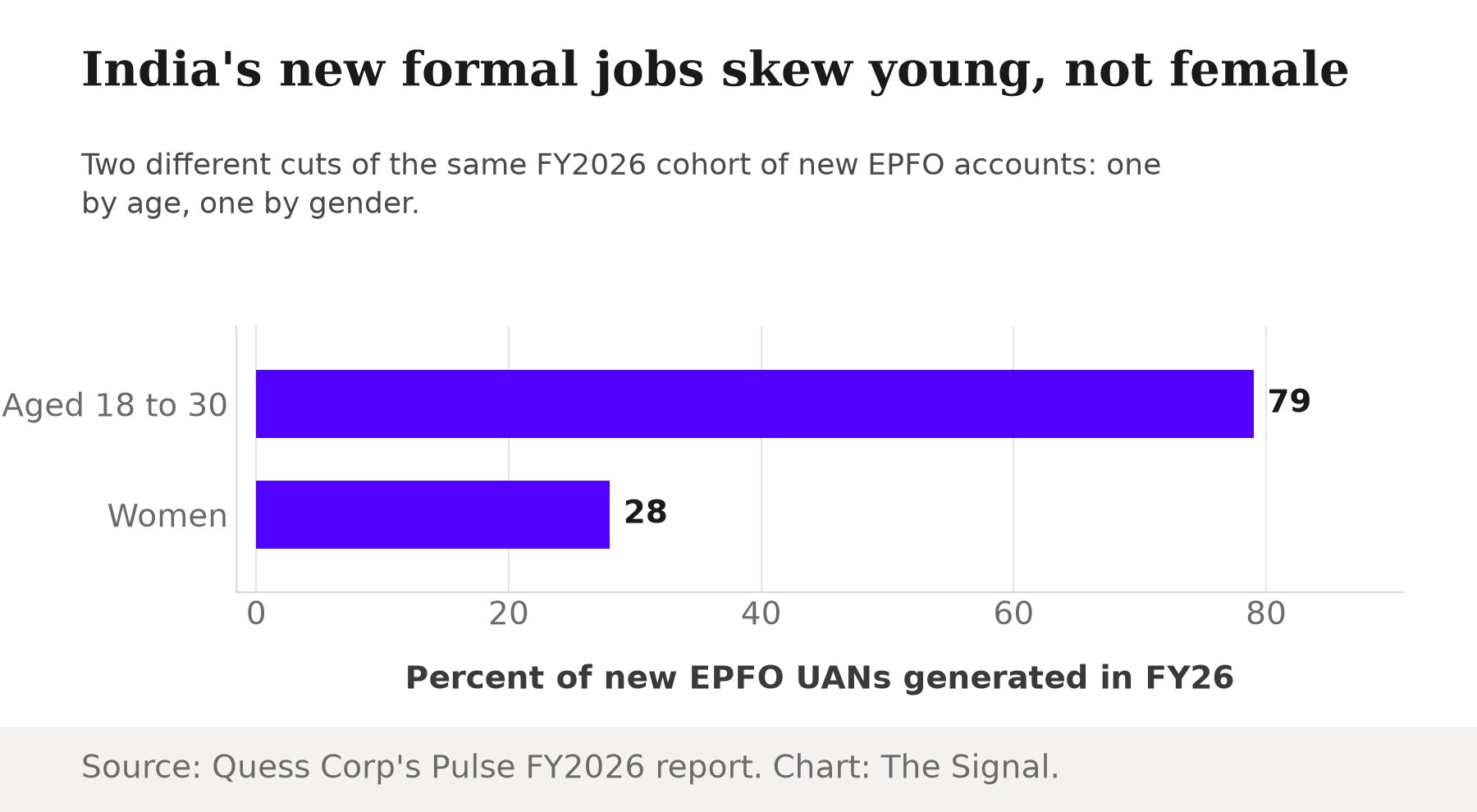
India's Employees' Provident Fund Organisation (EPFO), the retirement-savings body every formal-sector employee is enrolled in, just posted a youth-heavy year in new account creation. Employees aged 18 to 30 generated 79 percent of the new Universal Account Numbers (UANs) that EPFO created in the financial year ended March 2026, according to Quess Corp's Pulse FY2026 workforce report, as reported by The Tribune. Read only that number and the story writes itself: India's formal economy is being built by its youngest workers, at a pace most labour ministries would envy.
It is worth slowing down on that reading. The same FY2026 cohort splits a second way, by gender, and that split does not move with the age story. Women accounted for only about 28 percent of the new UANs generated in FY26, per the same Quess Corp Pulse FY2026 report, as reported by CXOtoday. A workforce getting younger and a workforce getting more evenly split by gender are two different trends. In FY2026, only one of them shows up in the numbers.
Where the corroboration comes from
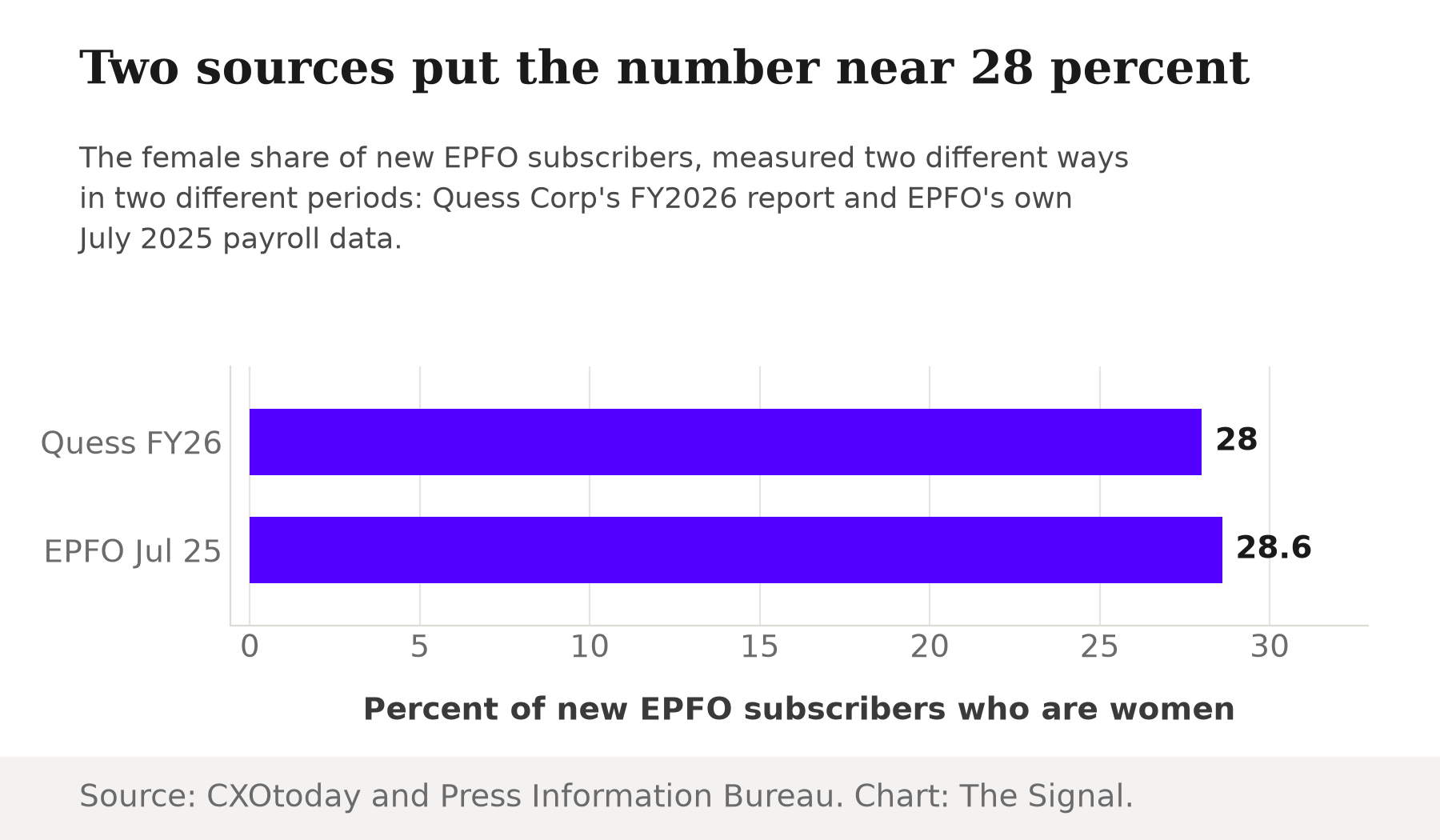
This is not one private report's arithmetic standing alone. EPFO's own official payroll release put new female subscribers at 2.80 lakh out of 9.79 lakh total in July 2025, about 28.6 percent, from provisional data reported by the Press Information Bureau on behalf of the Ministry of Labour and Employment. That is a different month and a narrower measure than Quess's full-year FY26 estimate, but it lands in the same range. The age story checks out independently too: EPFO's official data for June 2025 showed workers aged 18 to 25 made up 60.22 percent of that month's new subscribers, again from a Press Information Bureau release on Ministry of Labour and Employment data. Both halves of the FY26 finding, the youth surge and the shortfall in female accounts, show up separately in the government's own monthly releases, even though the two months cannot be added into one FY26 figure.
A pattern that predates FY26, on one side only
The youth skew is not a one-year spike. A year earlier, in FY25, workers aged 18 to 25 alone already made up nearly 59 percent of all new EPFO subscribers, per Business Today's reporting on the same Quess Corp report. That is a narrower age band than FY26's 18-to-30 count, so the two figures do not chart a smooth line, but they show the youth-heavy pattern was already visible before FY26.
No equivalent FY25 figure exists in this reporting for the female share of new UANs, so it is not possible to say whether FY26's 28 percent female share is higher, lower, or unchanged from a year earlier. The honest reading is a snapshot: a young, heavily male cohort of new formal workers in FY2026, not a documented decline or a multi-year stall.
Apprenticeships land in the same range
Two different entry points into India's formal workforce produced almost the same female share in FY2026.
| Entry point (FY2026) | Women's share |
|---|---|
| New EPFO UAN registrations | 28% |
| National Apprenticeship Promotion Scheme (NAPS) contracts | 26% |
Source: CXOtoday, citing Quess Corp's Pulse FY2026 report; LatestLY, citing the same report.
The report's own framing treats the apprenticeship number as roughly in line with the UAN number, not an improvement on it: women secured about 26 percent of NAPS apprenticeship contracts awarded in the same period. A permanent EPFO registration and a fixed-term apprenticeship contract are different kinds of formal-sector entry, and both produced close to the same female share.
The national backdrop
None of this happens against a backdrop of gender parity to begin with. India's overall female labour force participation rate stood at 40.0 percent in calendar year 2025, against 79.1 percent for men, in usual-status terms for people aged 15 and above, per the Periodic Labour Force Survey Annual Report 2025, released via the Press Information Bureau. On the monthly current-weekly-status measure, female labour force participation reached a yearly high of only 35.3 percent in December 2025, against an overall rate of 56.1 percent, per the PLFS Monthly Bulletin for that month, also released via the Press Information Bureau.
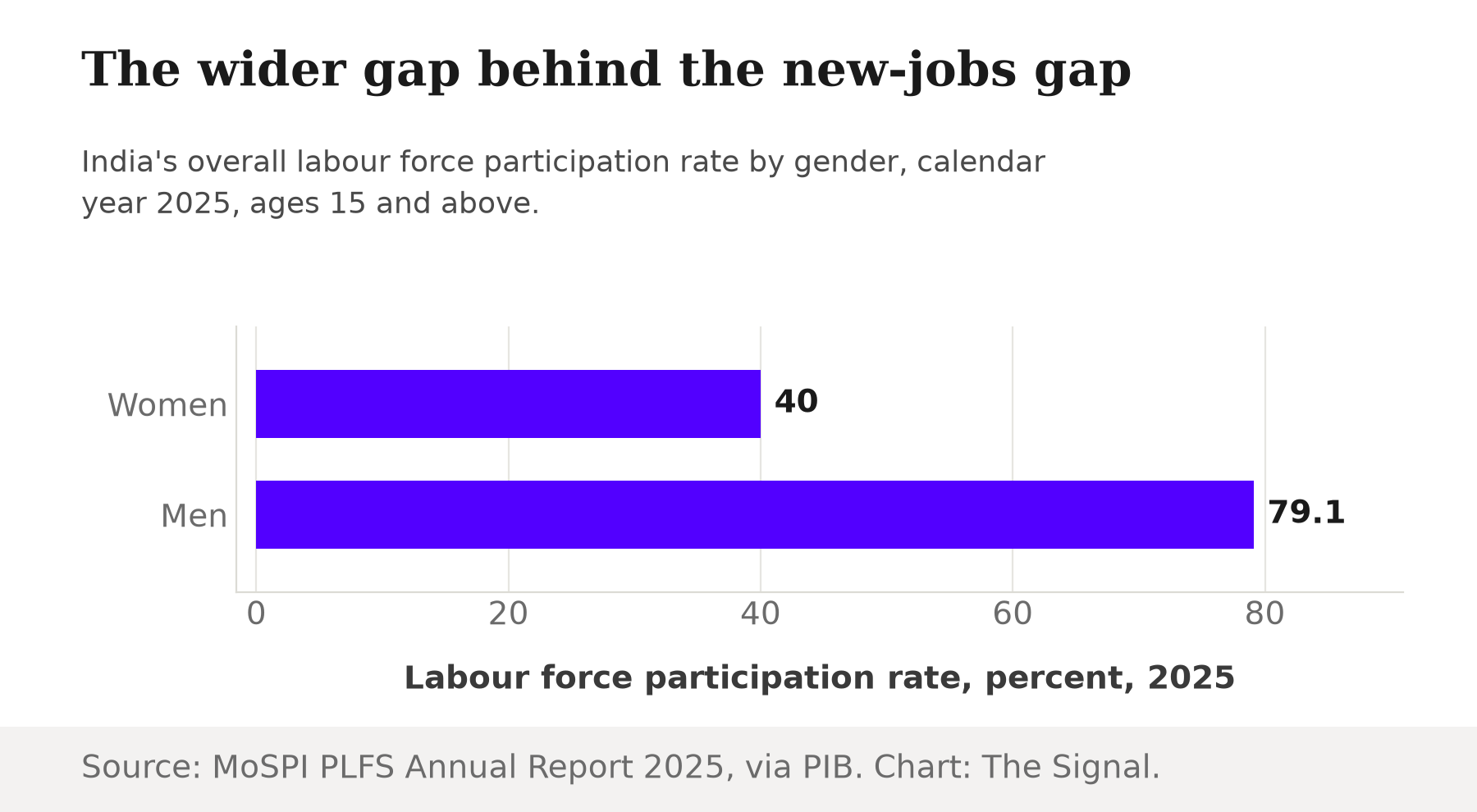
Set against that backdrop, women's 28 percent share of new formal-sector accounts is not an anomaly. It is close to the national default.
The honest objection
The strongest case against reading this as a stalled gender story is that two of the underlying data points point the other way. MoSPI's December 2025 bulletin describes female labour force participation as having risen every month since June 2025 to reach its highest point of the year. And PTI's reporting on EPFO data describes the six-year run of net new subscriber additions, from about 61 lakh in FY19 to 139.78 lakh in FY25, as driven partly by women's participation, not youth alone. On that reading, women's presence in India's formal workforce is expanding too, just more slowly than men's or Gen Z's.
That case is real, but it describes a direction, not this year's numbers. No source in this reporting gives a FY25 female share of new UANs to compare against FY26's 28 percent, so the honest reading is a snapshot, not a measured decline or a proven stall. What is verified, by two separate official releases in two different months, is that new entrants to India's formal payroll system in 2025 and FY2026 alike skewed heavily towards men and heavily towards the young, and those two skews arrived together, not as substitutes for each other.
The Signal
Gen Z's rush into EPFO is a genuine story. A payroll system that added 139.78 lakh net new subscribers in FY25 alone, more than double the roughly 61 lakh added in FY19, is adding real accounts to a real system. But growth in the pipeline does not automatically become growth in who is inside it. Watch the next Quess report or the next EPFO monthly release for one number: the female share of new UANs. If it climbs well past 28 percent, the formalisation wave has finally started reaching the workers it has so far bypassed. If it holds near 28, this year's youth boom was mostly a headcount story about men in their twenties, not a story about India's formal workforce coming to look more like India.
Reporting basis: the FY2026 age and gender splits of new EPFO UANs are Quess Corp's Pulse FY2026 report's figures, as carried by The Tribune (the 79 percent age share) and CXOtoday (the 28 percent female share); the FY2026 apprenticeship figure is the same report's, as carried by LatestLY. The FY25 comparison for the 18-to-25 age band is the same report's, as carried by Business Today. Independent confirmation of the July 2025 female subscriber share and the June 2025 youth share comes from EPFO's own provisional payroll data, reported by the Press Information Bureau on behalf of the Ministry of Labour and Employment. The national labour force participation figures for 2025 are from the National Statistical Office's Periodic Labour Force Survey, released by the Ministry of Statistics and Programme Implementation via the Press Information Bureau. The FY19-to-FY25 subscriber growth figure is EPFO data as reported by PTI, via Outlook Money. No figure in this piece is The Signal's own calculation.