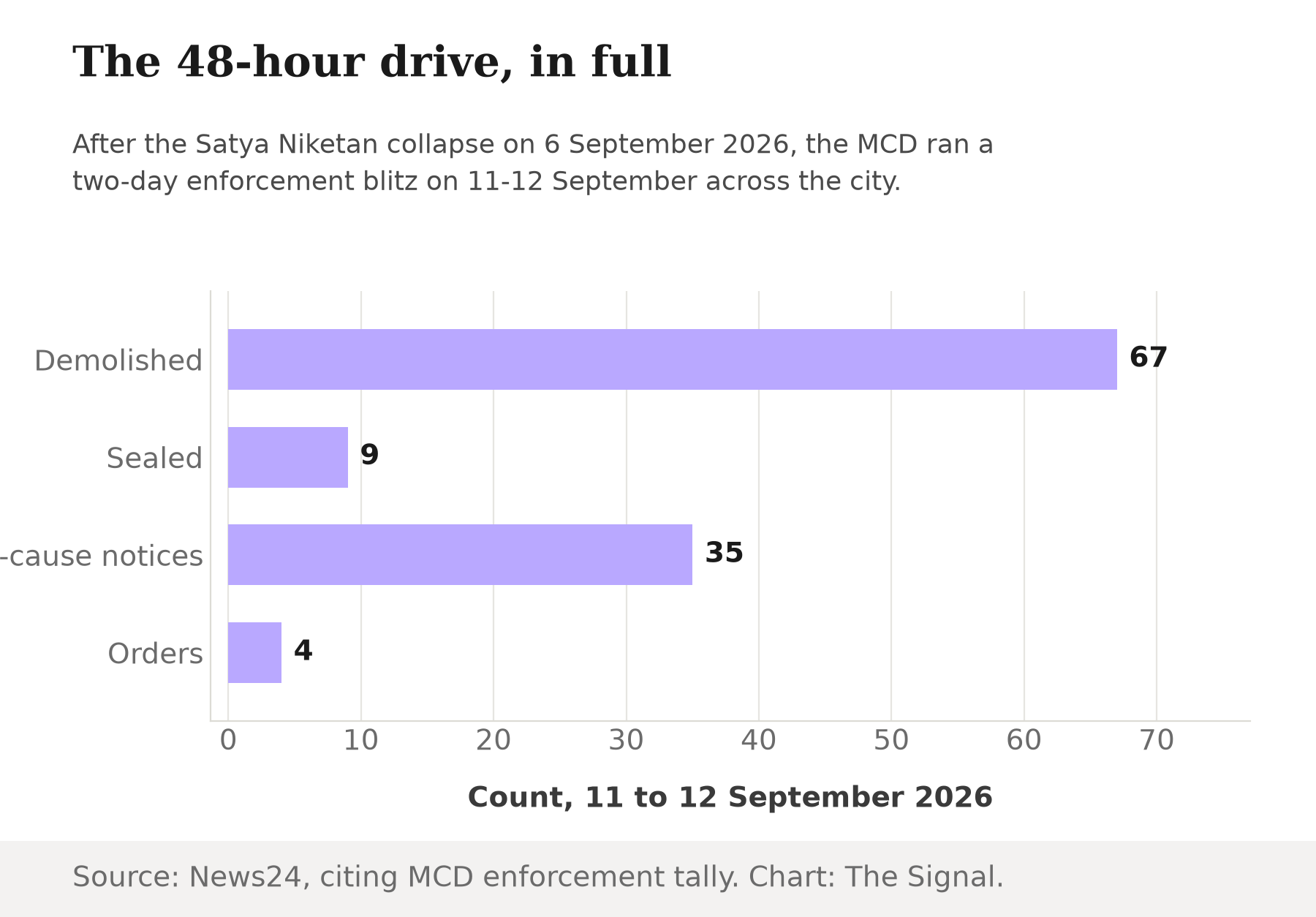
A five-storey building operating as a paying guest accommodation collapsed in Satya Niketan, south Delhi, on 6 September 2026, killing seven people and injuring at least five. Within days the Municipal Corporation of Delhi answered with a two-day blitz: on 11 and 12 September, it demolished 67 unauthorised properties and sealed nine others, alongside 35 show-cause notices and 4 demolition orders. Read as a headline, that is a civic body moving fast on the building that killed seven of its residents.
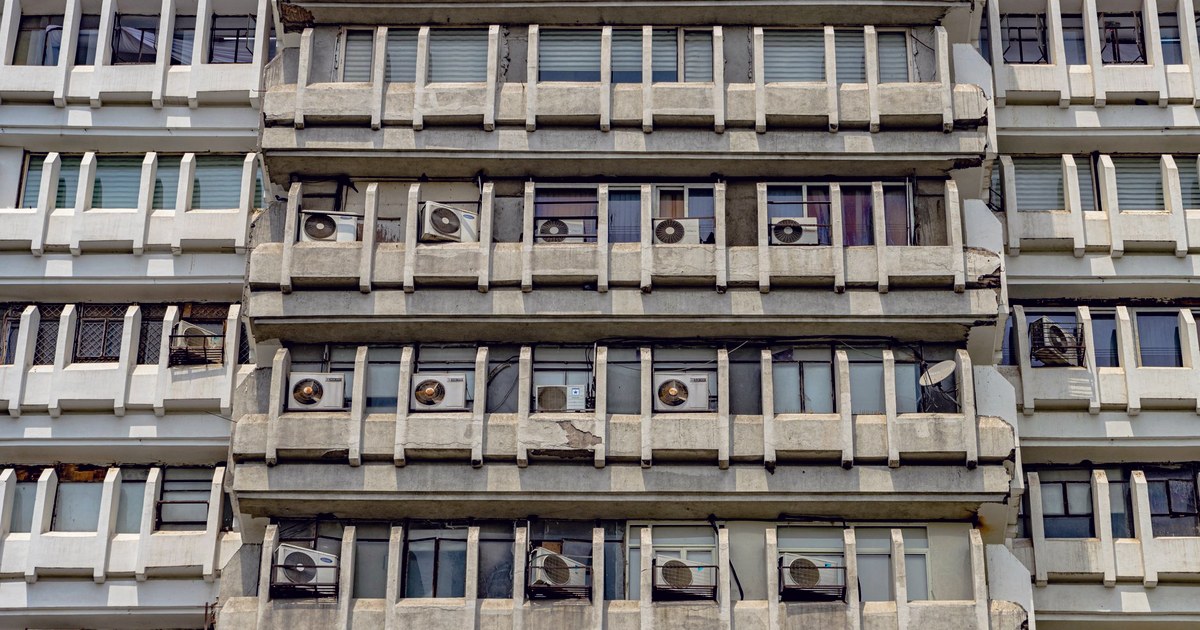
It is worth slowing down on that framing. Delhi's government has estimated that roughly 2 lakh rooms are being rented out as private hostel or PG accommodation across neighbourhoods including Mukherjee Nagar, Rajendra Nagar, Laxmi Nagar, Munirka and the areas around Delhi University, as of September 2026. Seventy-six properties actioned in 48 hours is a real number. It is also a rounding error against a market of two lakh rooms. A drive built to answer one collapse cannot, on its own arithmetic, reach the stock that produced it.
What the surveys actually found
The demolition tally was not the only check MCD ran that week. Between 7 and 9 September, before the drive began, MCD inspected 1,252 PG buildings citywide and found 1,201 visibly safe, 39 needing minor repairs, 9 needing major repairs, and 3 declared dangerous; a further 26 high-rises above four floors were put under closer monitoring. This was the citywide check run specifically because a PG building had just killed seven people, and it still cleared 1,201 of 1,252 buildings outright.
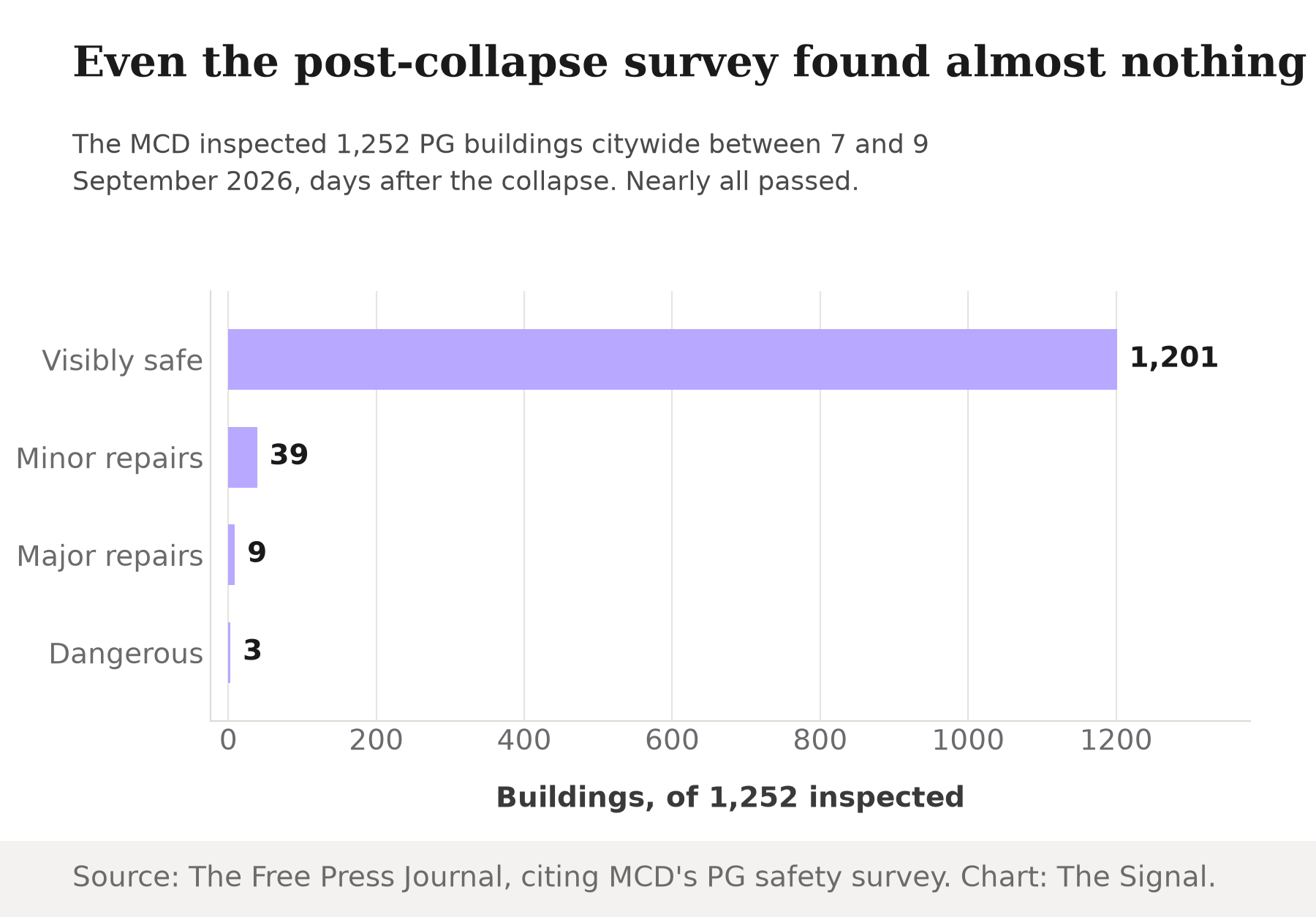
That is not a one-off result. It is the pattern MCD's own year-wise dangerous-buildings data show every year, collapse or no collapse, and both checks share a structural blind spot: they issue a single verdict per building, not per room, so a house quietly divided into a dozen rented rooms reads as one ordinary structure.
The routine baseline was already this thin
In its unrelated, routine pre-monsoon inspection, completed months before the collapse, MCD surveyed roughly 30.7 lakh buildings across Delhi and declared only 62 of them dangerous as of June 2026. The count has been falling for years: 428 buildings were declared dangerous in 2021, 266 in 2022 and 57 in 2023, before this year's 62, a decline of 85 percent from the 2021 peak by our calculation. A survey covering millions of structures a year has, for four years running, flagged well under 500 of them in any single cycle.
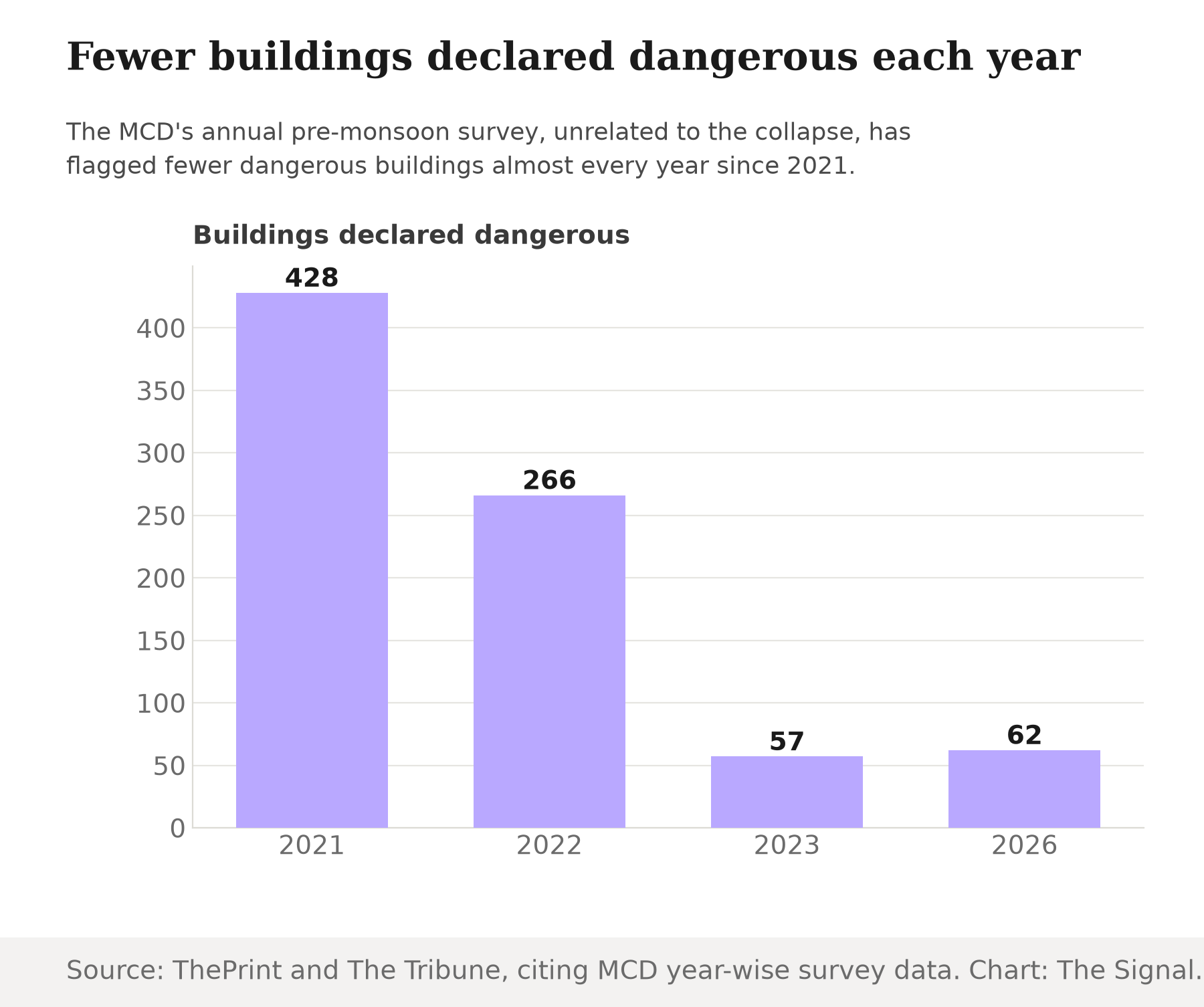
Neither the annual citywide survey nor the post-collapse PG check was built to find much wrong. Both grade whole buildings rather than the informally subdivided rooms inside them, and that gap is exactly where Delhi's estimated two lakh PG rooms live.
Where the market that enforcement can't see actually lives
The demand behind that market has a specific, named source: Delhi University's own hostel shortfall, per The Tribune and News24.
Delhi University has roughly one hostel room for every 31 students.
| Metric | Figure | As of |
|---|---|---|
| Students enrolled at DU overall | More than 7 lakh | 2024-25 |
| Students registered, 2024-25 session | About 2.5 lakh | 2024-25 |
| DU hostel rooms available | Roughly 7,000 to 8,000 | March 2025 |
| DU colleges with no hostel of their own | 71 of 91 | September 2026 |
Source: The Tribune; News24.
That shortfall does not sit in isolation. Delhi carries 1,731 unauthorised colonies under the PM-UDAY regularisation scheme, home to an estimated 40 lakh residents as of September 2026, per the Delhi Development Authority. Much of the city's rental housing, PG rooms included, sits inside or beside that informal stock: built, subdivided and let without the paperwork any inspection regime checks against.
A licence law with no map of what it is licensing
Delhi's government has drafted a response. Under the proposed PG regulation, operators would need a PG Operating Licence and both police and municipal verification before running an establishment, per Urban Development Minister Ashish Sood, and the draft bill also envisions a public registry of licensed PGs. That is sensible on paper. It also depends on operators who have run unregistered for years choosing to register now. That choice unfolds in a city whose own building-level inspection regime already finds almost nothing wrong at full citywide scale. A licence law does not, by itself, produce the map of the two-lakh-room market it is meant to govern.
The honest objection
The strongest case against calling this an enforcement gap is that Delhi's building risk may be improving overall. Delhi Fire Service logged over 330 building-related calls between 1 January and 6 September 2026, resulting in 30 deaths and 120 injuries, down from 446 calls, 46 deaths and 155 injuries in the same period of 2025. Fewer calls and fewer deaths, even in a year that includes the Satya Niketan collapse, is a real improvement, and MCD's 48-hour response shows the machinery can move fast once a case is in front of it.
That case holds for the reported, visible half of Delhi's building stock. It says nothing about the half that never generates a call, a complaint or a survey line item. Fire and enforcement data measure incidents someone reported; they cannot measure a room that was counted only as part of a larger, cleared building. Nationally, collapse of a dwelling house or residential building caused 1,217 deaths across 1,176 recorded cases in 2022, the most recent year in the National Crime Records Bureau's published data, a reminder that Satya Niketan sits inside a tracked, recurring national category, not an isolated event. A faster demolition drive after the fact changes none of that denominator.
The Signal
MCD's demolitions and seals, 67 and 9 respectively, were a real response to one collapse, not a plan for the market that produced it. The city's own instruments, the annual survey of 3 million-plus buildings and the emergency PG check run after seven people died, both come back with the same answer: almost nothing is wrong, because neither looks inside a subdivided room. The proposed licence law is the first tool aimed at that room-level market directly. Watch whether it comes with an inspection capacity that scales past 62 dangerous buildings a year, or whether it is paperwork layered onto a stock nobody has actually counted. Demolishing 67 buildings in 48 hours proved Delhi can move fast. It has not yet proved it can see far enough to know where to move next.
Reporting basis: the Satya Niketan collapse and its casualty count are per The Pioneer's reporting of MCD and police accounts. The 48-hour demolition and sealing tally is from MCD's own enforcement figures, as reported by News24. The post-collapse PG safety survey is from MCD's survey data, as reported by The Free Press Journal. The annual dangerous-buildings figures for 2026 and for 2021 through 2023 are from MCD's year-wise survey data, as reported by The Tribune and ThePrint respectively. Delhi Fire Service's call, death and injury counts are as reported by Millennium Post. The Delhi University enrolment, hostel-capacity and college-hostel figures are as reported by The Tribune and News24. The two-lakh-room PG estimate and the licence-and-registry provisions of the draft PG policy are as reported by The Hans India and Asianet Newsable, both citing the Delhi government's drafting process. The unauthorised-colonies count and resident estimate are the Delhi Development Authority's own published figures. The national building-collapse death and case count for 2022 is from the National Crime Records Bureau's Accidental Deaths and Suicides in India report. The per-cycle detection rate in the annual survey and the percentage decline in dangerous-building counts since 2021 are The Signal's calculations from those figures.