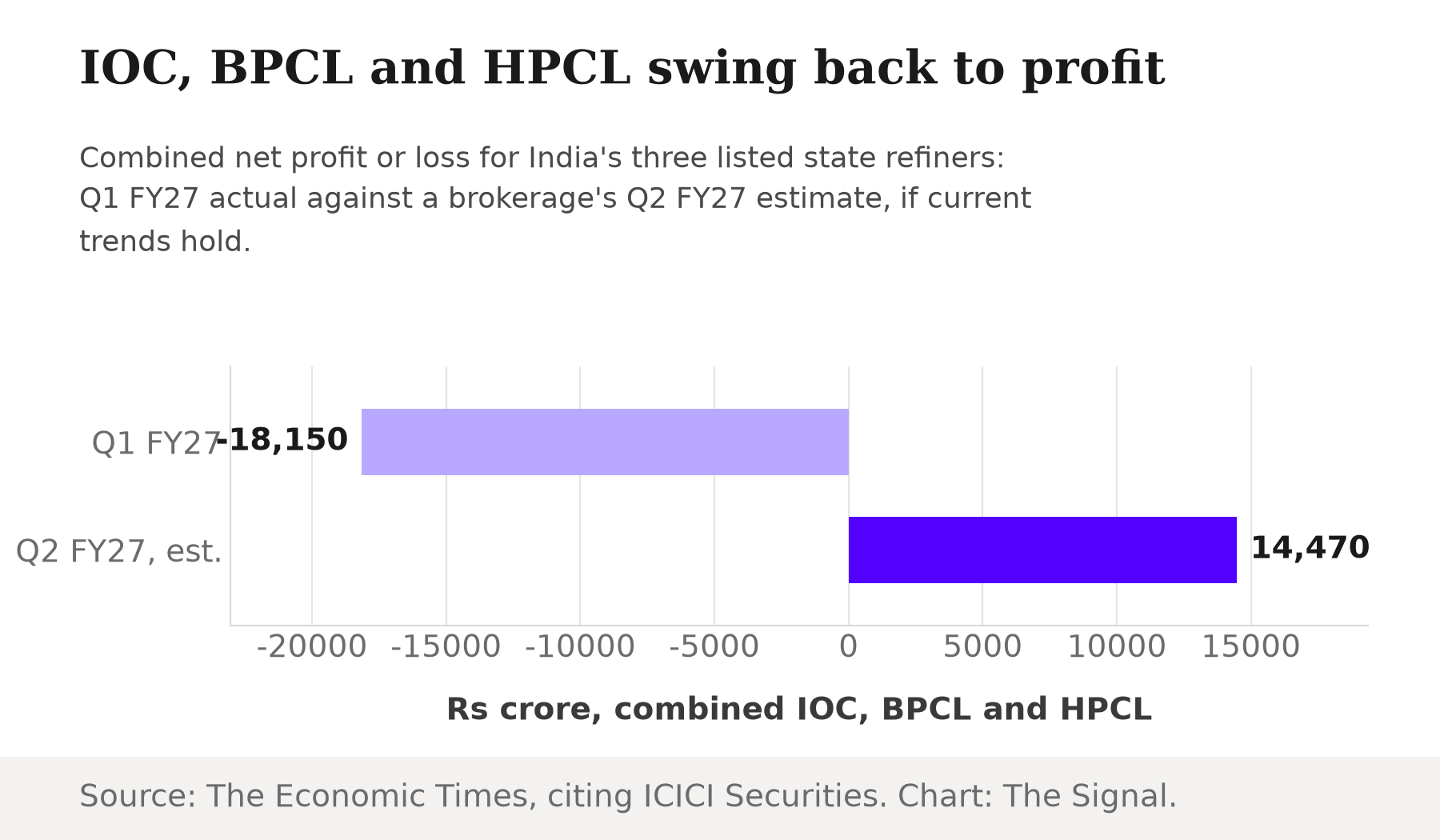
India's three listed state refiners, IndianOil, BPCL and HPCL, are projected to swing to a combined profit of Rs 14,470 crore in the July-September 2026 quarter, against a combined Rs 18,150 crore loss in April-June, according to an ICICI Securities brokerage note reported by The Economic Times. Read as a headline, it is a clean recovery story: the oil marketing companies (OMCs) that bled cash three months ago are back in the black. Emkay Research separately estimates the OMCs' integrated refining-and-marketing margins improving to Rs 9-14 a litre in the July-September quarter from Rs 1-3 a litre in April-June, with HPCL seeing the sharpest turnaround, per ANI.
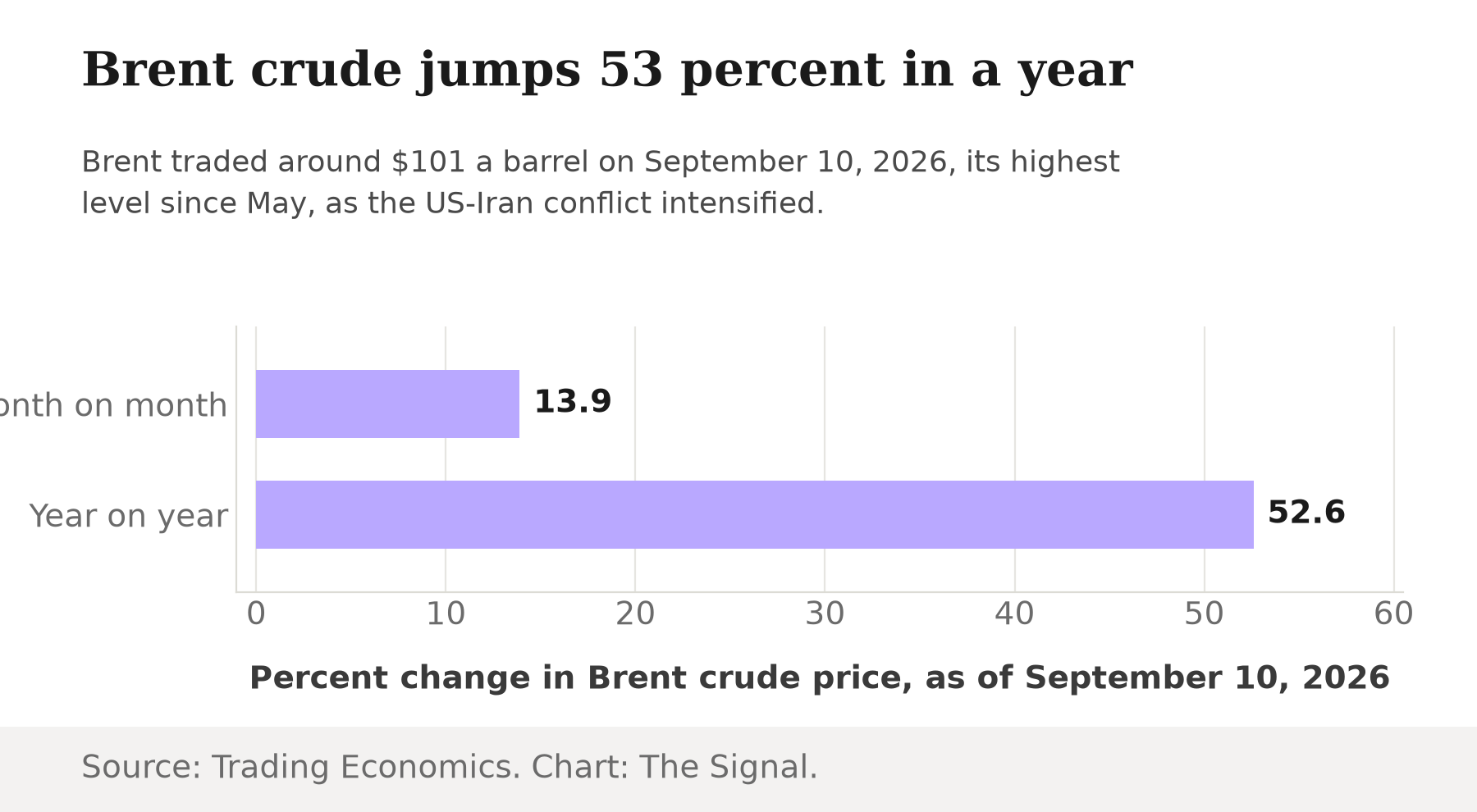
It is worth slowing down on that. Both estimates were published on September 9, 2026, days after the international crude benchmark crossed a threshold it had not touched in weeks. Brent crude traded around $101 a barrel on September 10, its highest level since May 2026, up 13.9 percent on the month and 52.6 percent on the year, according to Trading Economics. India's own crude basket, the actual blend its refiners pay for and the more precise input to the under-recovery math than Brent, climbed to a four-month high of $108.9 a barrel on September 9, according to Business Today. The brokerage math behind the Rs 14,470 crore line was built on trends running through most of the quarter, not on the price regime that had just arrived.
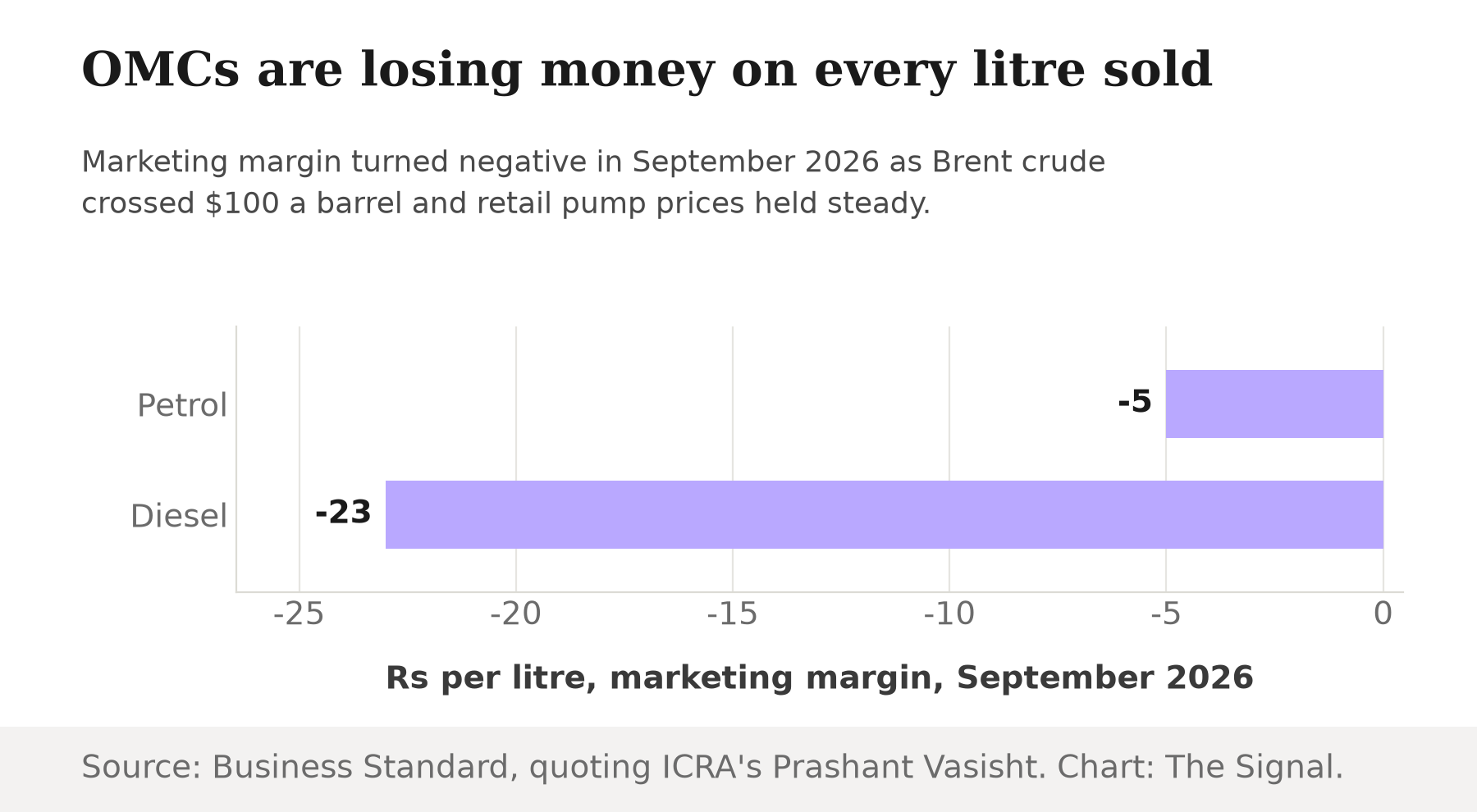
Today's economics are smaller and worse. OMCs are currently losing about Rs 5 a litre on petrol and Rs 23 a litre on diesel, with LPG under-recovery at Rs 200 a cylinder, after Brent crossed $100 a barrel, according to ICRA's Prashant Vasisht, quoted by Business Standard.
The margin math that flipped once already
This is not the first time the ledger has flipped inside a single year. HPCL alone reported a standalone net loss of Rs 11,526.41 crore in the April-June 2026 quarter, against a net profit of Rs 4,370.87 crore in the same quarter a year earlier, even as its gross refining margin surged to $23.80 a barrel from $3.08 a barrel, according to its results reported by Business Standard. A refining margin that strong should have meant a good quarter. It did not, because the marketing side of the business, selling fuel at a fixed pump price against a moving crude cost, can lose money fast enough to erase a healthy refining number entirely.
The brokerage upgrade rests on a margin line that was barely positive three months ago.
| Quarter | Integrated margin (refining plus marketing) |
|---|---|
| Q1 FY27 (April-June 2026) | Rs 1 to 3 per litre |
| Q2 FY27 (July-September 2026, estimate) | Rs 9 to 14 per litre |
Source: ANI, citing Emkay Research.
Pump prices have not moved since May
The other half of the mismatch is that retail prices are frozen. Petrol and diesel prices held unchanged on September 9, 2026: Delhi at Rs 102.12 and Rs 95.20 a litre, Mumbai at Rs 111.21 and Rs 97.83, Bengaluru at Rs 111.68 and Rs 99.56, even as Brent traded near $100 a barrel, according to Business Today.
Three Indian metros, unchanged pump prices, a $100 crude oil market.
| City | Petrol (Rs/litre) | Diesel (Rs/litre) |
|---|---|---|
| Delhi | 102.12 | 95.20 |
| Mumbai | 111.21 | 97.83 |
| Bengaluru | 111.68 | 99.56 |
Source: Business Today, September 9, 2026.
India last moved retail fuel prices in May 2026, raising petrol by Rs 7.35 a litre and diesel by Rs 7.53 a litre across four installments, when Brent had eased back to around $70-75 a barrel after the West Asia conflict began in late February 2026, according to Business Today. Four months later, that is still the price a driver in Delhi, Mumbai or Bengaluru pays, on top of a crude oil market that has moved sharply against it.
The lever nobody has pulled yet
India has a template for exactly this situation: cut excise duty rather than raise the pump price. On March 27, 2026, the government cut excise duty by Rs 10 a litre on both petrol and diesel without changing retail prices, after Brent surged from about $70 to about $122 a barrel in under four weeks; under-recoveries then stood at roughly Rs 26 a litre on petrol and Rs 81.90 a litre on diesel, a combined Rs 2,400 crore a day, according to a Press Information Bureau release from the Ministry of Petroleum and Natural Gas. That followed an earlier precedent: the Centre cut excise duty by a combined Rs 13 a litre on petrol and Rs 16 a litre on diesel in two tranches, in November 2021 and May 2022, which it says it passed fully to consumers, according to another PIB release.
Every time the OMC bill has gotten this large, the government has reached for excise duty, not the pump price.
| Precedent | Petrol cut | Diesel cut | Passed to pump price |
|---|---|---|---|
| November 2021 and May 2022 (two tranches) | Rs 13/litre combined | Rs 16/litre combined | Yes, government says |
| March 27, 2026 | Rs 10/litre | Rs 10/litre | No, pump prices held |
Source: Press Information Bureau, Ministry of Petroleum and Natural Gas (2026 release, 2021-22 release).
The honest objection
The strongest case against reading this as a looming squeeze is that OMCs have absorbed sharper spikes before, and refining economics are currently unusually strong. A blended integrated margin of Rs 9 to 14 a litre gives the companies real cushion even if the marketing line turns negative for a few weeks. On that view, September's under-recovery is noise inside a quarter that will still print well, and the March 2026 excise cut shows the government already has a tool it can deploy again quickly if it needs to. The stock market appears to agree: on September 10, with Brent near $101, IOC and BPCL shares fell less than half a percent and HPCL rose about 1 percent, a far smaller reaction than the 17-22 percent correction the same three stocks took over ten days the first time crude crossed $90 a barrel in March 2026, according to Business Standard.
That case weakens on the point HPCL's own numbers make. A gross refining margin of $23.80 a barrel still produced HPCL a Rs 11,526.41 crore net loss in the April-June 2026 quarter, because marketing losses can outrun even an excellent refining margin when the gap between crude cost and a frozen pump price is wide enough. And the current spike is not a blip so far: Brent is up 52.6 percent from a year earlier, and pump prices have not moved since May 2026, four months of retail prices set for a crude market that has since moved by roughly half. A cushion sized for a few weeks of negative marketing economics has less room against a full quarter of it.
The Signal
The Rs 14,470 crore figure due when IOC, BPCL and HPCL report is mostly a measurement of the market that ran through most of this quarter, not the one that showed up in its final weeks. Two things are worth watching once results land. First, whether October-December's numbers, the quarter that has not started yet, repeat this quarter's profit with Brent still above $100 a barrel. Second, whether the government reaches again for the excise lever it used in March 2026, rather than for the pump price it has not touched since May. The last two times it cut duty instead of raising prices, it says it passed the saving fully to consumers, which also means the exchequer, not the oil companies or the driver, absorbs a $100 crude oil market. A profit this good, arriving just as the crude that produced it stops being the crude that is priced, is not proof the squeeze is over. It is proof the squeeze has not been billed yet.
Reporting basis: the Q2 FY27 profit estimate is from an ICICI Securities brokerage note, as reported by The Economic Times; the integrated-margin estimate is from a separate Emkay Research note, as reported by ANI. HPCL's April-June 2026 results, including its net loss and refining margin, are per Business Standard's Capital Market News, citing the company's own reported results. The current per-litre under-recovery and LPG shortfall are as reported by Business Standard, quoting ICRA's Prashant Vasisht. Brent crude's price level and its month-on-month and year-on-year changes are from Trading Economics. Retail petrol and diesel prices in Delhi, Mumbai and Bengaluru, and the timing of the last price revision, are per Business Today. The March 2026 excise duty cut and its stated under-recovery figures, and the 2021-22 excise duty cuts, are both from separate Press Information Bureau releases by the Ministry of Petroleum and Natural Gas. The Indian crude basket figure is per Business Today, and the September 10 stock price reaction and its comparison to the March 2026 correction are per Business Standard, citing ACE Equity and NSE data. No figure in this piece beyond the plain arithmetic stated in the text is The Signal's own calculation.