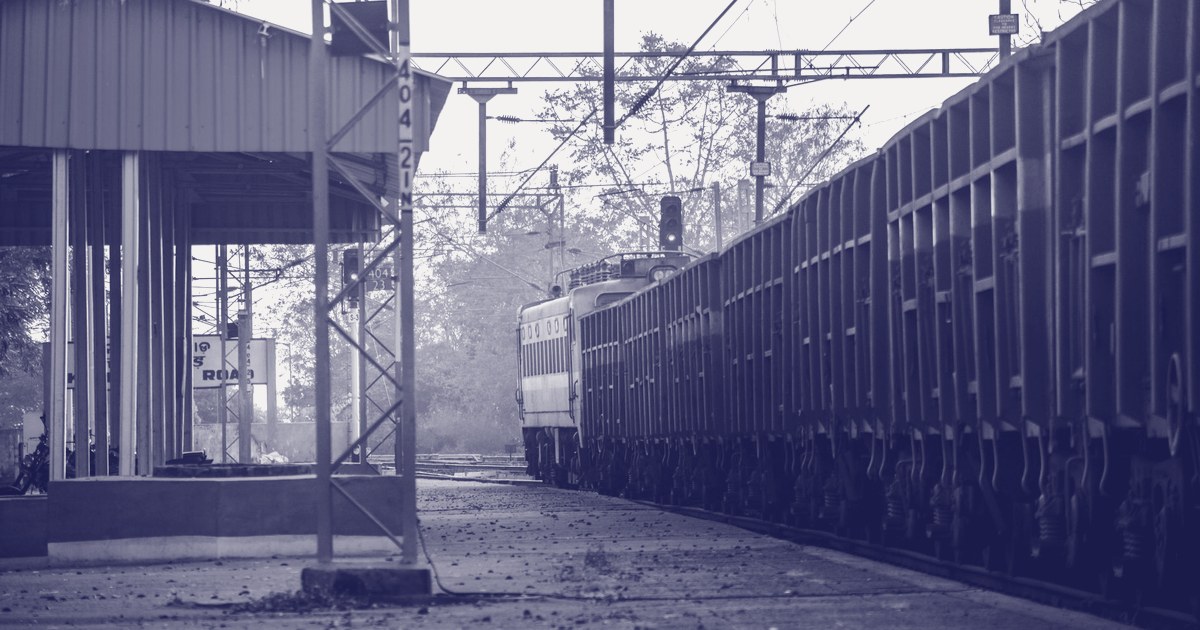
On September 8, 2026, Prime Minister Narendra Modi dedicated the final 326 kilometres of the Western Dedicated Freight Corridor to the nation, the last stretch of a rail line built to carry cargo from Jawaharlal Nehru Port near Mumbai to Dadri outside Delhi without sharing track with passenger trains. Combined with its eastern counterpart, the network now spans 2,843 kilometres, of which 2,741 kilometres, or 96.4 percent, had already been commissioned and operational as of March 2025. The pitch for what a finished corridor buys is concrete: a freight run that takes a truck 30 hours can cover the same route by rail in 10 to 12 hours, a cut of about 60 percent. One recent run made the scale tangible: a single train from JNPT to Vadodara carried cargo equivalent to the load of more than 250 trucks. Read the announcement on its own terms and the conclusion writes itself: India has finally built the rail spine to pull freight off its roads.
Eastern and Western DFC together commissioned 2,741 of a planned 2,843 kilometres.
| Corridor | Route | Length |
|---|---|---|
| Eastern DFC | Ludhiana to Sonnagar | 1,337 km |
| Western DFC | JNPT to Dadri | 1,506 km |
| Combined network | Both corridors | 2,843 km, 2,741 km (96.4%) commissioned |
Source: Ministry of Railways, via PIB, March 2025.
It is worth slowing down on the announcement, because a finished corridor and a used corridor are not the same claim, and the gap between the two shows up in the corridor's own numbers. Container train operators say the corridor's optimum cost-saving potential is about 25 percent, but the benefit they are actually capturing today is only 6 to 7 percent. That is barely a quarter of what the track was built to deliver.
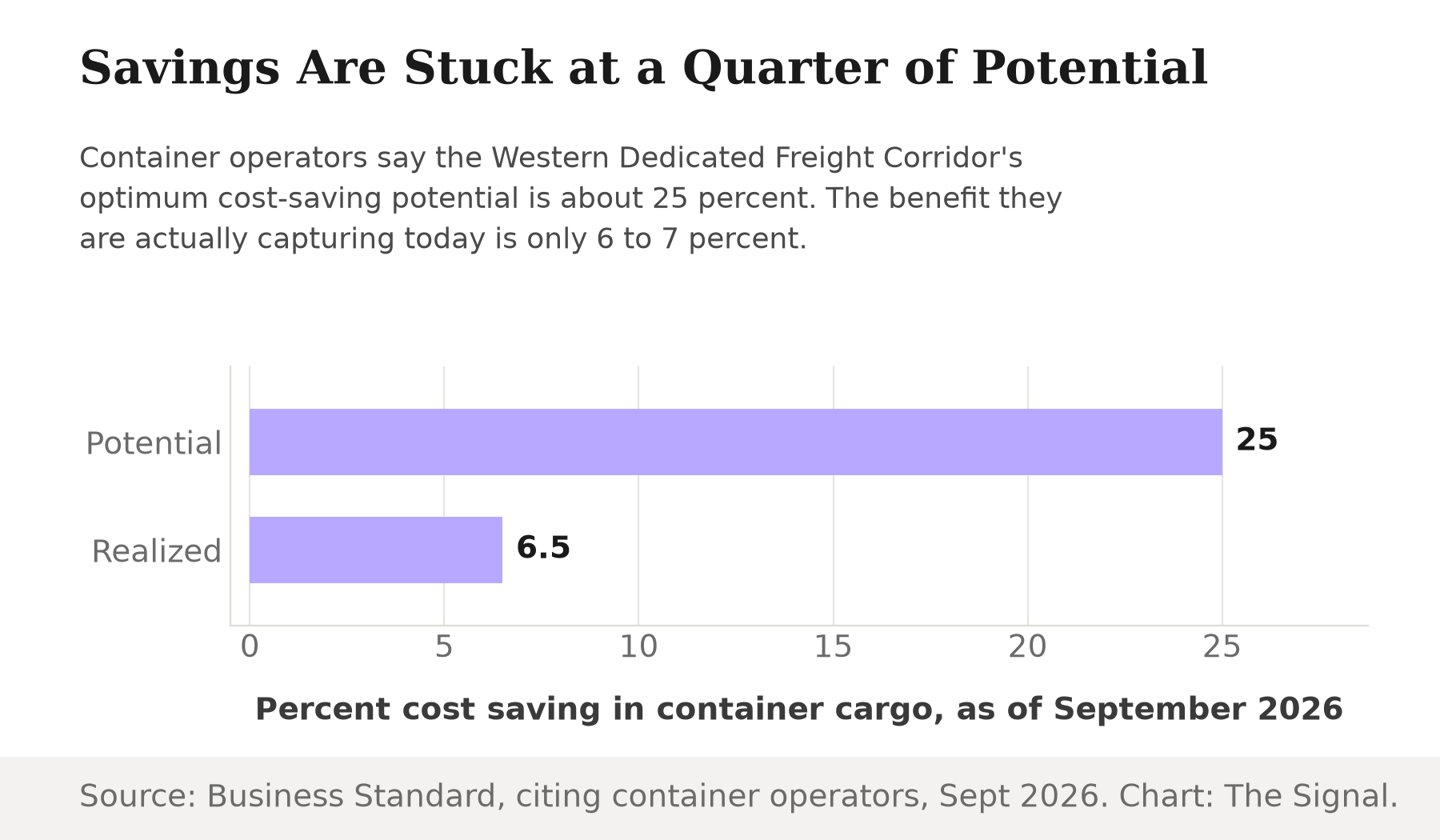
Source: Business Standard. Chart: The Signal.
The corridor is finished. The freight isn't.
The economic case for the corridor rests on a real cost gap. Moving one tonne of cargo one kilometre by rail costs about Rs 1.96, against Rs 3.78 by road, roughly half, according to India's first government study benchmarking freight costs by mode; waterways come in at Rs 2.3 per tonne-km and air freight at Rs 72. On paper, every tonne that shifts from truck to train saves the shipper money, and in aggregate chips away at India's logistics costs, estimated at about 7.97 percent of GDP for FY2023-24 in the government's own DPIIT-NCAER assessment. That number is worth trusting precisely because of what it replaces: for years India's logistics cost was commonly cited at 13 to 14 percent of GDP, a figure drawn from external studies and partial datasets rather than a real calculation, and the 7.97 percent estimate is the government's first comprehensive, scientifically derived one.
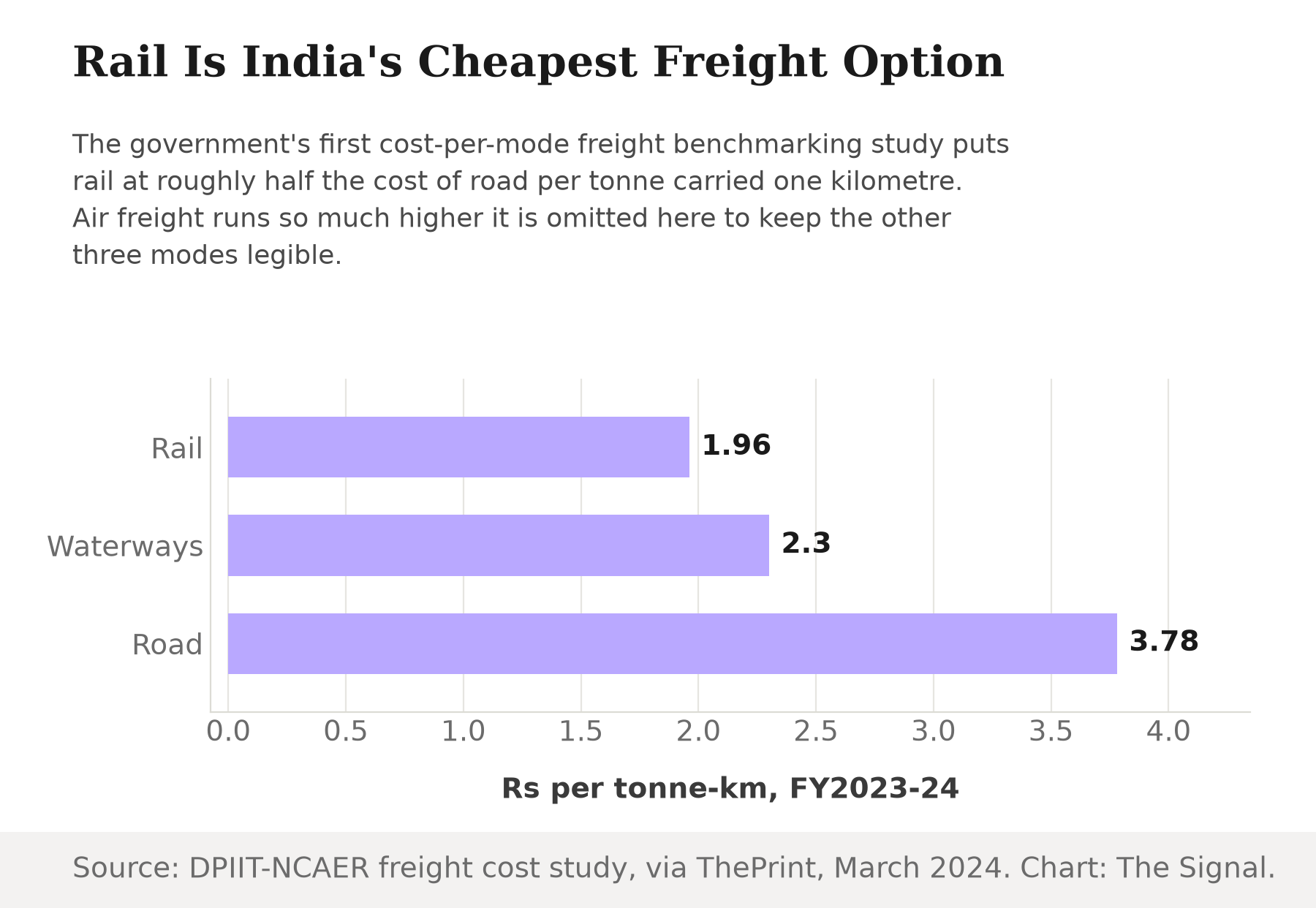
Source: ThePrint, citing the DPIIT-NCAER freight-cost study. Chart: The Signal.
But a cost advantage does not automatically become market share. Rail carried only 27 percent of India's freight traffic as of December 2022, and the National Rail Plan wants that share at 45 percent by 2030, a jump the network has not visibly started closing even as its flagship corridor nears completion. Indian Railways is separately targeting freight traffic of 3.3 billion tonnes by 2030, nearly triple the 1.2 billion tonnes it carried in 2019. Hitting that target assumes the corridor pulls real weight instead of sitting mostly idle.
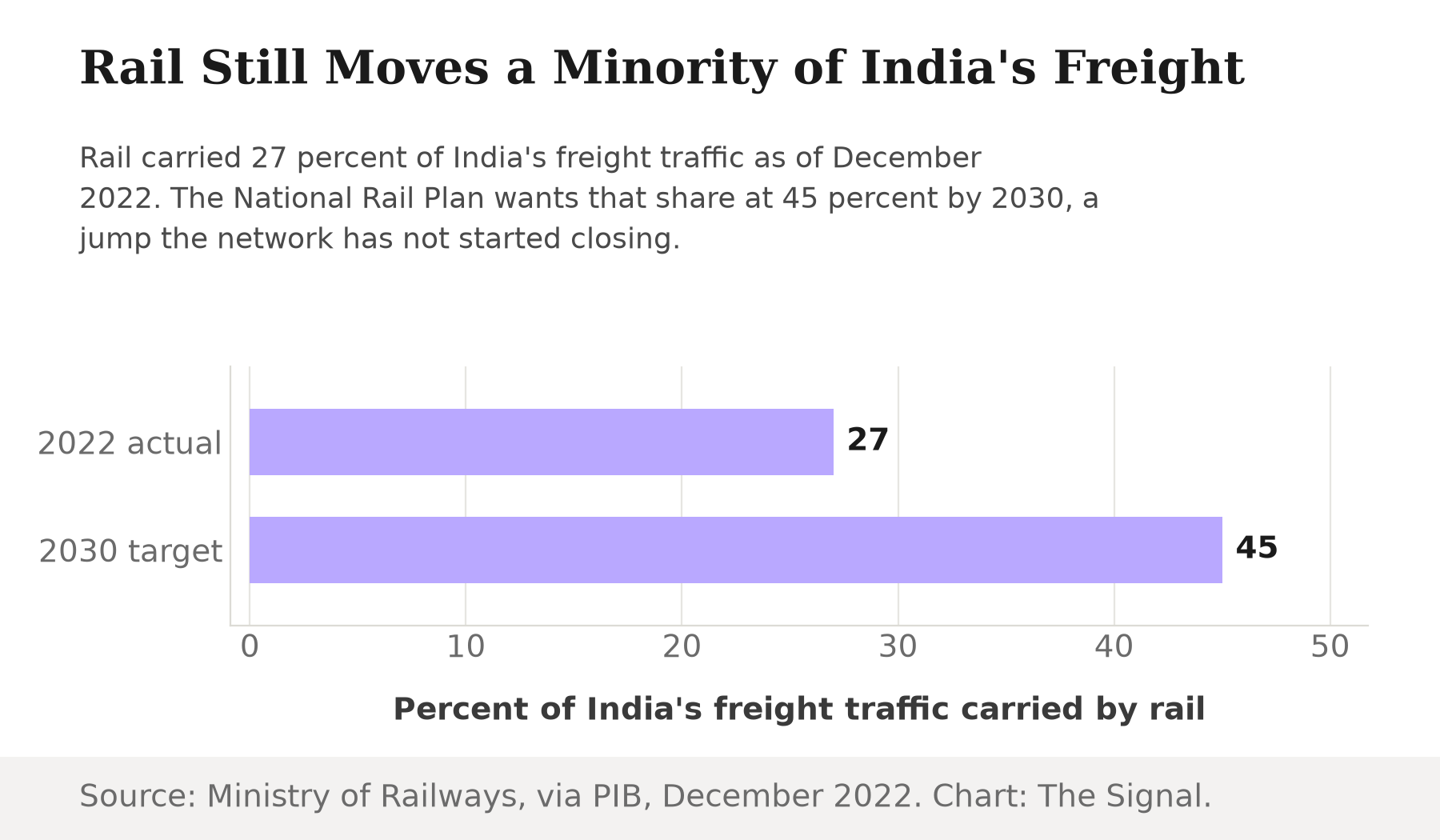
Source: Ministry of Railways, via PIB. Chart: The Signal.
Trucking isn't waiting
The corridor's premise only works if trucking gives up ground as rail's cost edge pulls freight away from the road. So far, the trucking industry shows no sign of bracing for that. India's commercial vehicle industry is projected to hit a record volume of about 12.4 lakh units in fiscal 2027, surpassing the previous peak set in fiscal 2019, after a 13 percent rebound in fiscal 2026. That rebound has an explanation that has nothing to do with rail economics: domestic commercial-vehicle wholesale volumes grew 12.6 percent in fiscal 2026, and ICRA attributes the growth primarily to a GST rate cut that lowered the tax on trucks from 28 percent to 18 percent starting September 2025. A fleet expanding into a record year does not look like an industry losing cargo to a finished rail corridor. It looks like an industry that has not yet felt the corridor at all, and this fiscal's growth traces to a tax cut, not a rail shortfall.
The honest objection
The strongest case for patience is that freight networks fill over years, not months. The corridor itself only reached 96.4 percent commissioning as of March 2025, and its final stretch was dedicated only in September 2026. Shippers sign multi-year rail contracts, build sidings, and requalify supply chains slowly, so judging modal share against a corridor whose last piece is barely weeks old risks mistaking a ramp-up for a failure.
That case is real, but it does not explain the size of the gap on the stretches that have been running for years already. Container operators, who have had access to the corridor's core sections for years, are still capturing only 6 to 7 percent of a 25 percent potential. A young network explains a slow start. It does not explain a start that has covered barely a quarter of the distance to its own stated ceiling.
The Signal
The corridor's defenders are counting kilometres: 2,843 of track, 96.4 percent commissioned, a documented 60 percent cut in transit time on the route Modi described. What will actually decide whether this project reshapes Indian logistics isn't on that list: the modal-share figure, 27 percent as of December 2022, against a 2030 target of 45 percent, and the utilization figure that container operators already report stuck at a quarter of potential. Finishing the last 326 kilometres does not, by itself, fix a mechanism that has spent years converting only a sixth of its cost advantage into traffic; it just gives that same mechanism more track to run under-used. Watch the modal-share number the next time the railways publish it, not the length of new track opened between now and then. A corridor is not judged by how far it runs. It is judged by how much of the country's freight decides to ride it.
Reporting basis: the September 2026 corridor-completion announcement, PM Modi's remarks on transit time, and the container-operator utilization figures are per Business Standard's reporting. The corridor's route lengths and commissioning percentage are from a Ministry of Railways press release via the Press Information Bureau. The JNPT-to-Vadodara train comparison is per Business Today. India's logistics-cost-to-GDP estimate is from the DPIIT-NCAER assessment, via a Press Information Bureau release, and the characterization of that estimate as the first scientific one, replacing a commonly cited but methodologically ungrounded 13-14 percent figure, is per Business Standard's report on the same DPIIT-NCAER assessment. The per-tonne-kilometre freight cost benchmarks across rail, road and waterways are from the same DPIIT-NCAER study, as reported by ThePrint. Rail's current and targeted freight modal share are from a Ministry of Railways statement via PIB. The 2030 freight-tonnage target is from a NITI Aayog report. The commercial-vehicle industry's fiscal 2027 volume projection is per CRISIL Ratings. The attribution of fiscal 2026's commercial-vehicle volume growth to the September 2025 GST rate cut is per ICRA Ratings. The roughly-half cost comparison between rail and road, and the nearly-triple freight-tonnage comparison, are The Signal's calculations from those figures.