On 7 September 2026, the CBI filed a second, supplementary chargesheet in the Reliance Commercial Finance Limited (RCFL) case before the Special CBI Court in Mumbai, naming 17 more accused: three Reliance ADA Group executives, eight private companies, and six bank officials associated with Bank of Baroda, Punjab National Bank and Indian Overseas Bank. That takes the case's cumulative chargesheeted tally, across both filings, to 24 individuals and companies. Read as a scoreboard, the story is simple: a large corporate-fraud investigation just got larger.
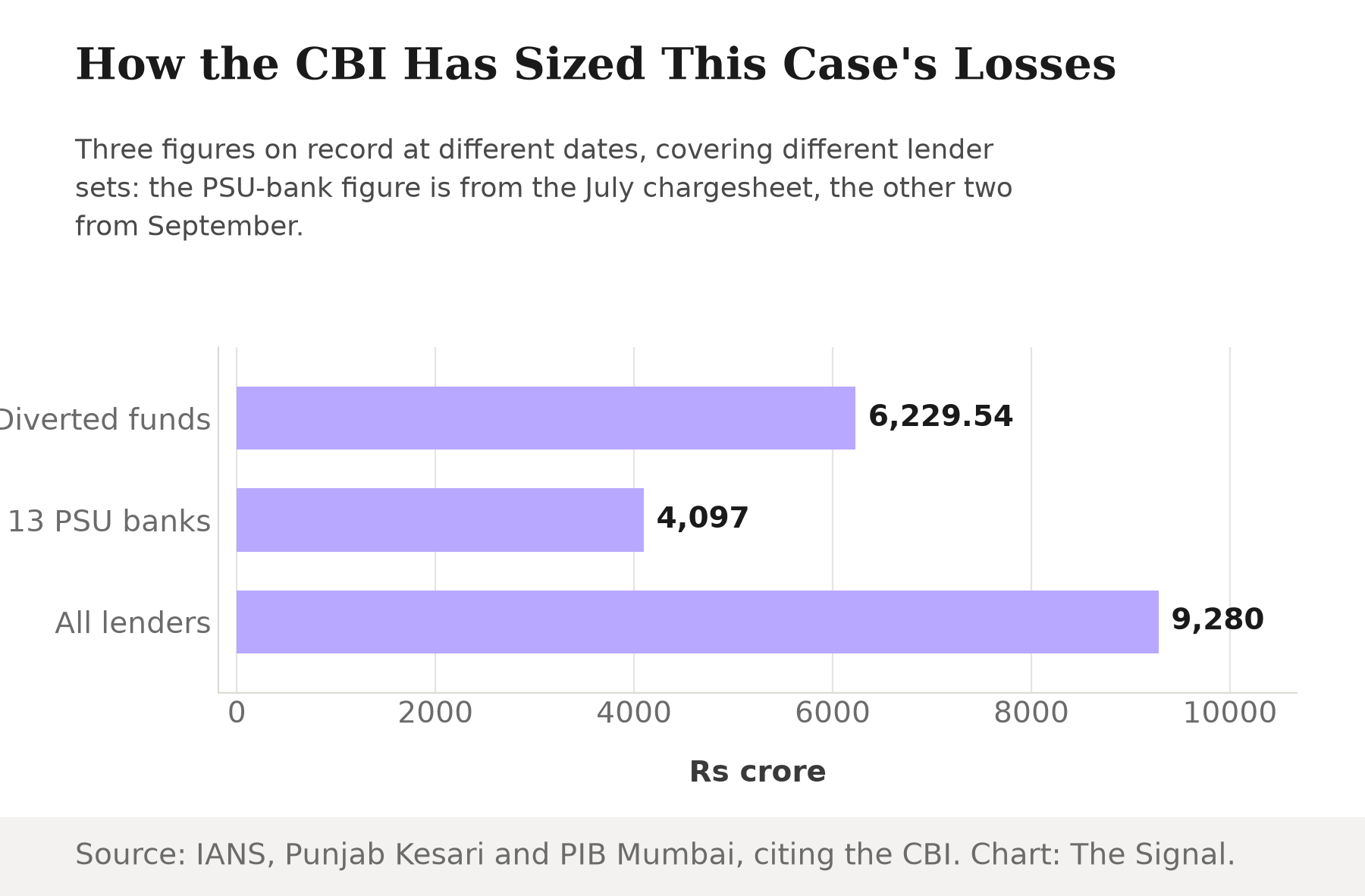
It is worth slowing down on that framing. The CBI's first chargesheet, filed 7 July 2026, accused two Reliance Group companies, Reliance Infrastructure Ltd and Reliance Home Finance Ltd, along with five former RCFL executives: all of them insiders to the borrower. Not one person from a lending bank was named. The second chargesheet is not simply more of the same category of accused. For the first time in this case, serving or former officials of the banks that lent RCFL money are chargesheeted alongside the borrower's own executives.
Six of the 17 new accused work, or worked, for the lenders, not the borrower.
That is the figure that carries this story. A case that opened as an allegation against a company and its own executives has, two months later, added people employed on the other side of the lending desk.
What the CBI alleges happened to the money
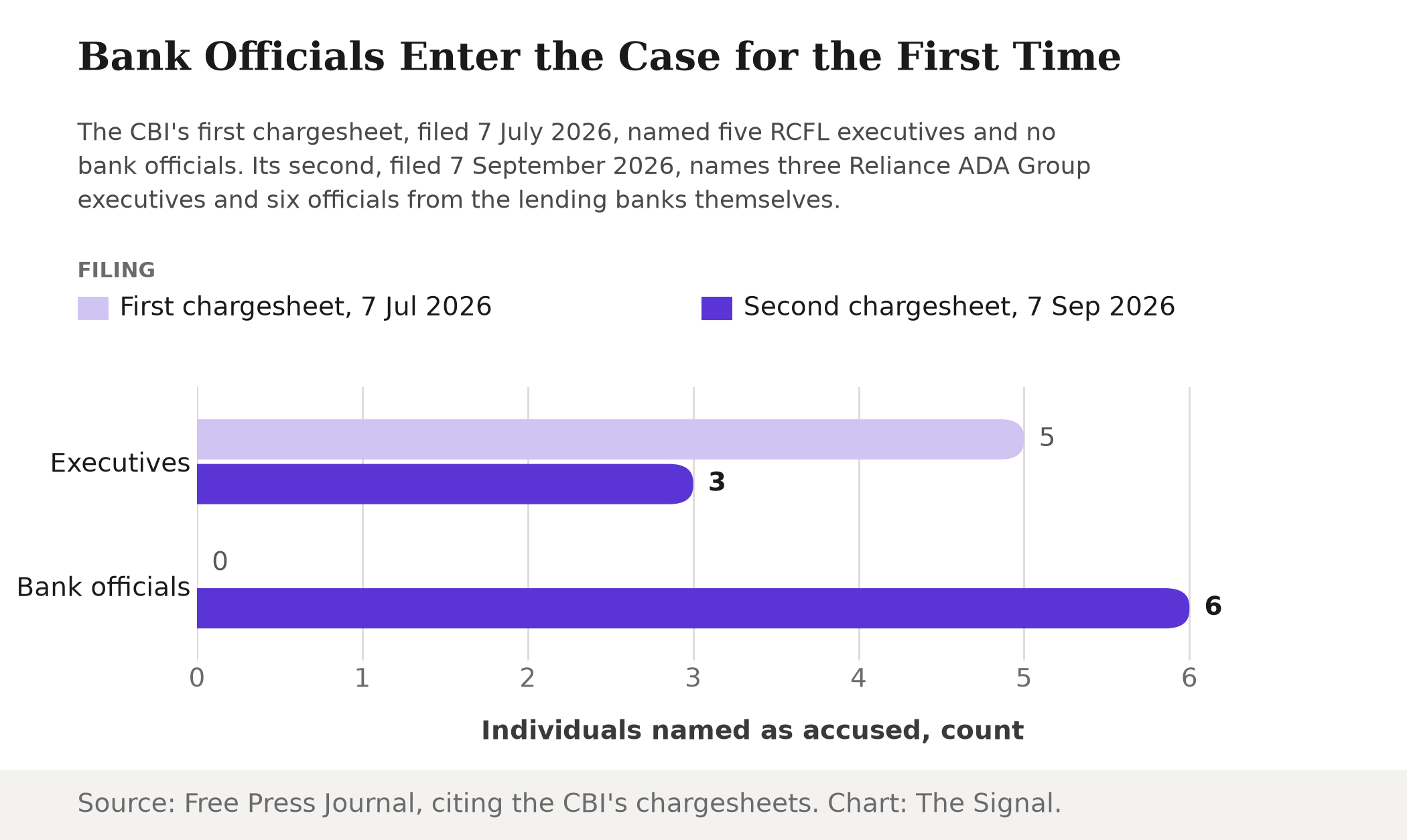
The second chargesheet's core allegation is a diversion. The CBI alleges that Rs 6,229.54 crore borrowed by RCFL was diverted through intermediary and conduit entities to various Reliance ADA Group companies, in violation of the terms governing the borrowings. The agency estimates the total loss caused to banks, financial institutions and other lenders across the case at around Rs 9,280 crore. A narrower, earlier figure sits inside that total: as of the first chargesheet, the alleged loss specifically to the 13 public sector banks in the lending consortium was estimated at Rs 4,097 crore.
Those three numbers do not all describe the same thing. They come from different filings, at different dates, and they cover different sets of lenders, so they should not be added or subtracted against each other. What they show together is a case whose size the CBI has now sketched from three separate angles: what was allegedly diverted, what public-sector banks alone were estimated to have lost, and what the total loss across every lender is now put at.
The case in two filings
| First chargesheet | Second chargesheet | |
|---|---|---|
| Filed | 7 July 2026 | 7 September 2026 |
| New accused named | 7 | 17 |
| Company entities named | 2 (Reliance Infrastructure Ltd, Reliance Home Finance Ltd) | 8 private companies |
| Individuals named | 5 former RCFL executives | 3 Reliance ADA Group executives |
| Bank officials named | 0 | 6, from Bank of Baroda, Punjab National Bank and Indian Overseas Bank |
| Cumulative accused, both filings | 7 | 24 |
Figures per the CBI's two chargesheets, as reported by Free Press Journal and Moneylife.
The individuals accused of running the alleged scheme have already been in custody for months. As of the first chargesheet, three people had been arrested: Amitabh Jhunjhunwala, former Vice Chairman of Reliance Capital Ltd, and Devang Pravin Mody, former CEO of RCFL, both in judicial custody, and Amit Bapna, former CFO of Reliance Capital Ltd, in CBI custody. The accused in the second chargesheet face charges of criminal conspiracy, criminal misappropriation and cheating under the Indian Penal Code, along with offences under the Prevention of Corruption Act, 1988: the same statute used to prosecute public servants and bankers for corrupt conduct in office, and the one that gives the bank-official names in this filing their legal weight.
Two of the three Reliance ADA Group executives the second chargesheet names are not new to this case. The three are Amitabh Jhunjhunwala, Group Managing Director of the Reliance ADA Group; Amit Bapna, CFO of Reliance Commercial Finance; and Ramesh Shenoy, Company Secretary of Reliance Infrastructure Ltd. Jhunjhunwala and Bapna are the same two men already arrested and in custody as of the first chargesheet; Mody, the arrested former RCFL CEO, is not among the three. Shenoy is the only individual the second filing adds who was not already a named figure in this case.
Where the case started
The RCFL case originated from a complaint filed by Bank of Maharashtra on 6 December 2025, alleging cheating of the bank to the tune of over Rs 57 crore. Nine months on, the CBI's own estimate of the case's total loss, around Rs 9,280 crore, is more than 160 times the size of the complaint that opened it (our calculation, from the Bank of Maharashtra figure and the CBI's current loss estimate). A single lender's complaint about a comparatively small default has grown into a multi-bank investigation that now names insiders at three more banks entirely.
The honest objection
The strongest case against reading much into the six bank names is that a chargesheet is an accusation, not a verdict. Naming a bank official in a loan-fraud chargesheet does not by itself prove the bank's internal controls failed, or that fraud was condoned rather than missed. Investigators routinely have to examine, and sometimes charge, the specific loan officers or credit committee members who signed off on a disputed sanction, without that implying their employer bank was complicit as an institution. Six named officials, drawn from three of the 13 public sector banks in the original lending consortium, are also a narrow slice: most of that consortium has, on the public record so far, no official named at all.
That case is real, and it is why the six names should be read as an allegation against specific individuals, not as a verdict on Bank of Baroda, Punjab National Bank or Indian Overseas Bank as institutions. But it does not erase the shift in kind. For nine months, every accused in this case was, by role, on the borrower's side of the transaction. The second chargesheet is the first point at which the CBI has put anyone from the lender's side into the same charge sheet, under the same Prevention of Corruption Act count, as the promoters and executives accused of diverting the money.
No on-record response to the second chargesheet, from Reliance ADA Group, the three named banks or defense counsel, appears in public reporting as of this writing. The one standing company position on the public record concerns two of the three executives now named. After the Enforcement Directorate arrested Jhunjhunwala and Bapna in April 2026 in a related money-laundering investigation, Reliance Group stated that both had already left the group, in December 2019 and September 2019 respectively, and were no longer associated with any group company. That statement predates the September chargesheet and was made about a different proceeding, so it is not a response to these specific charges, but it is the only on-record company position tied to any of the accused executives.
The Signal
The RCFL case began as a question of whether promoters and executives diverted borrowed money. The second chargesheet does not answer that question differently, but it adds a second one: whether anyone inside the lending banks helped the diversion along, or simply failed to catch it. Those are different allegations with different consequences. A promoter-fraud case ends with promoters in prison and lenders as victims. A case with bank officials chargesheeted under the Prevention of Corruption Act raises the harder possibility that the lending process itself had a weak link. What happens next in the Special CBI Court will decide which of those two cases the RCFL matter turns out to be. Watch whether more bank names get added as the probe continues. That will show whether 7 September was the exception or the start of a pattern.
Reporting basis: the second chargesheet's list of accused and their categories is per Free Press Journal's report on the CBI's filing, with the total accused count of 24 per Moneylife and the three executives' names and designations per Business Today. The alleged Rs 6,229.54 crore diversion figure is per IANS, and the Rs 9,280 crore total loss estimate is per Punjab Kesari's English edition, both citing the CBI's second chargesheet. The first chargesheet's list of accused is per Free Press Journal, and the three arrests recorded as of that filing are per IANS. The Rs 4,097 crore loss to 13 public sector banks is from the CBI's own press release, via the Press Information Bureau, Mumbai, the only primary-agency source among these. The charges under the Indian Penal Code and the Prevention of Corruption Act, 1988 are per Business Today's report of the second chargesheet. The case's origin in a Bank of Maharashtra complaint is per News On Air (Prasar Bharati), citing the CBI. Reliance Group's April 2026 statement on Jhunjhunwala and Bapna's departure from the group is per IANS, reported in connection with their arrest by the Enforcement Directorate, not the September chargesheet. Each of these facts rests on a single reporting origin; none has independent corroboration beyond that one outlet or agency source in this account. The comparison between the original complaint and the case's current estimated loss is The Signal's calculation from those two figures.