The UK government has added India's Carbon Credit Trading Scheme to its list of qualifying carbon pricing schemes under the UK's own carbon border tax, a change published on 27 August 2026 and picked up in Indian coverage on 8 September. In practical terms, UK importers of eligible Indian steel, aluminium, fertiliser and cement will be able to set the carbon price India already charges domestic producers against the carbon price the UK would otherwise charge at the border. Read only that far, and the story writes itself: India talked its way out of a carbon tariff before it ever bit.
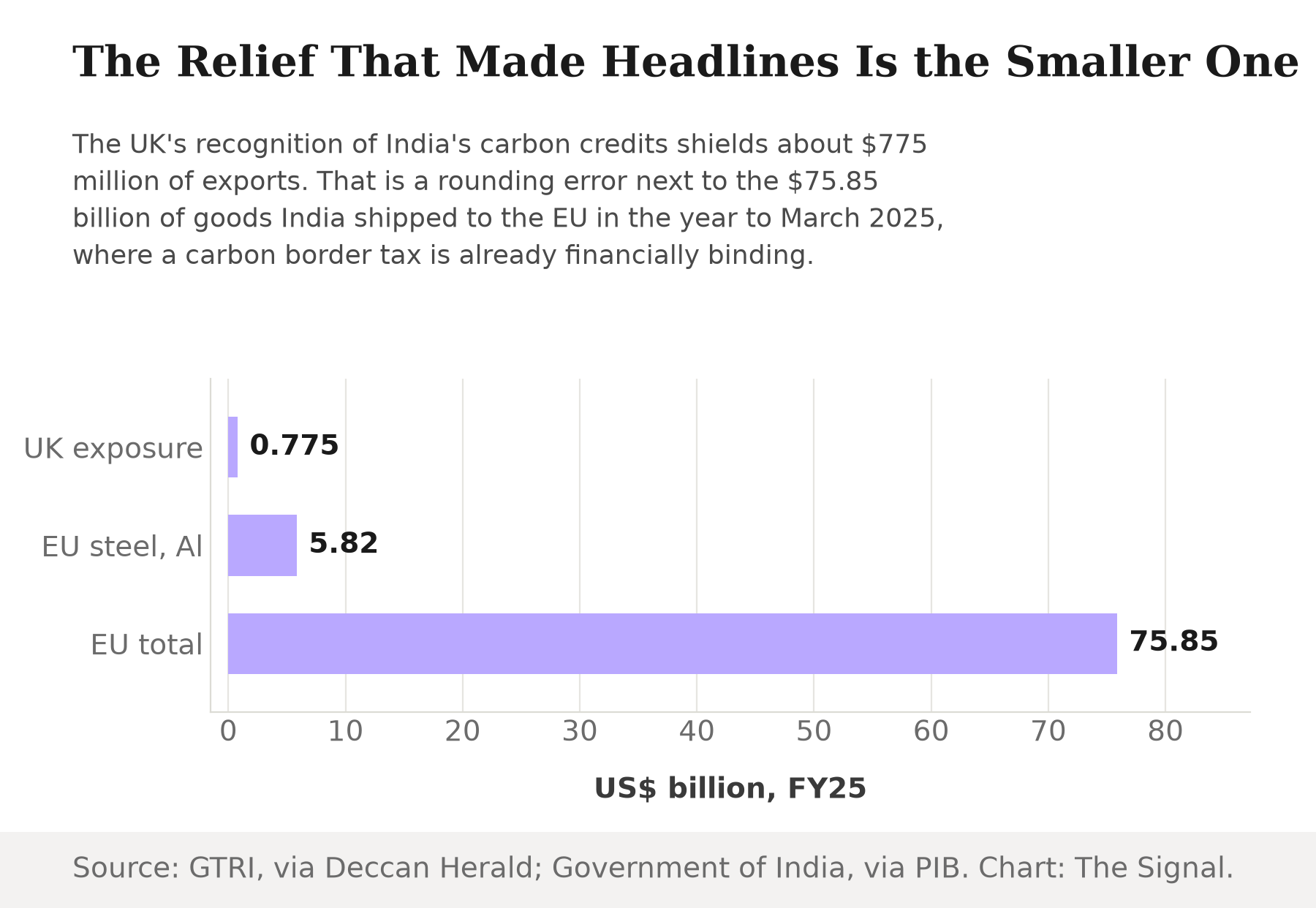
It is worth slowing down on that. The UK tax this recognition offsets is not yet a live cost and, list update or not, would not have been one for months regardless: the UK government's own CBAM guidance states it comes into effect on 1 January 2027, covering five sectors, aluminium, cement, fertiliser, hydrogen and iron and steel. And even once it exists, GTRI has estimated that only about $775 million of India's exports to the UK, spanning iron and steel, aluminium, fertiliser and cement, remain exposed to that carbon tax even after the two countries' trade agreement. That is the entire pool the 27 August recognition is fighting over.
The relief that made headlines is the smaller one.
A Government of India press release on the country's free-trade negotiations with the EU put India's total goods exports to the bloc at roughly INR 6.4 lakh crore, or about $75.85 billion, in the year to March 2025, dwarfing the UK's $775 million of exposure by nearly a hundredfold. That is where India's carbon-intensive trade actually sits, and it is the fight nobody just resolved.
Why the EU is the real border to watch
India built the CCTS for its own domestic reasons. A Ministry of Power press release states that the scheme has been notified with Greenhouse Gas Emission Intensity targets for seven energy-intensive sectors under its compliance mechanism, with credits tradable through the power exchanges. That domestic architecture is now what the UK is crediting against its own carbon tax, not what the EU is crediting against its version, because the EU has not offered India that credit at all.
The European Commission's Access2Markets portal confirms that the EU's Carbon Border Adjustment Mechanism entered its definitive period on 1 January 2026, replacing a reporting-only phase with the actual obligation for authorised importers to pay for the CO2 embedded in goods such as steel, cement and fertilisers. The European Commission's official CBAM page lists six carbon-intensive sectors under the mechanism: cement, iron and steel, aluminium, fertilisers, electricity and hydrogen. That tax is not scheduled. It is already financially binding, nearly eight months before the UK's 27 August update.
India tried, and failed, to get the same kind of exemption from Brussels that the UK has now granted. A Business Standard report quoting India's Commerce Secretary states that India secured a commitment that any flexibility the EU offers other trading partners on CBAM will also apply to Indian exporters, along with a technical dialogue on carbon verification, but no CBAM-specific exemption of its own. A promise to match whatever concession someone else eventually wins is not the same as winning one. It is a seat at the table for the next negotiation, not a result from this one.
The EU's border tax has been collecting since January. The UK's has not started.
| Carbon border tax | Financially binding from | Sectors covered |
|---|---|---|
| EU CBAM | 1 January 2026 | Cement, iron and steel, aluminium, fertilisers, electricity, hydrogen (6 sectors) |
| UK CBAM | 1 January 2027 | Aluminium, cement, fertiliser, hydrogen, iron and steel (5 sectors) |
Source: European Commission; UK government.
The pressure was already showing before the tax bit
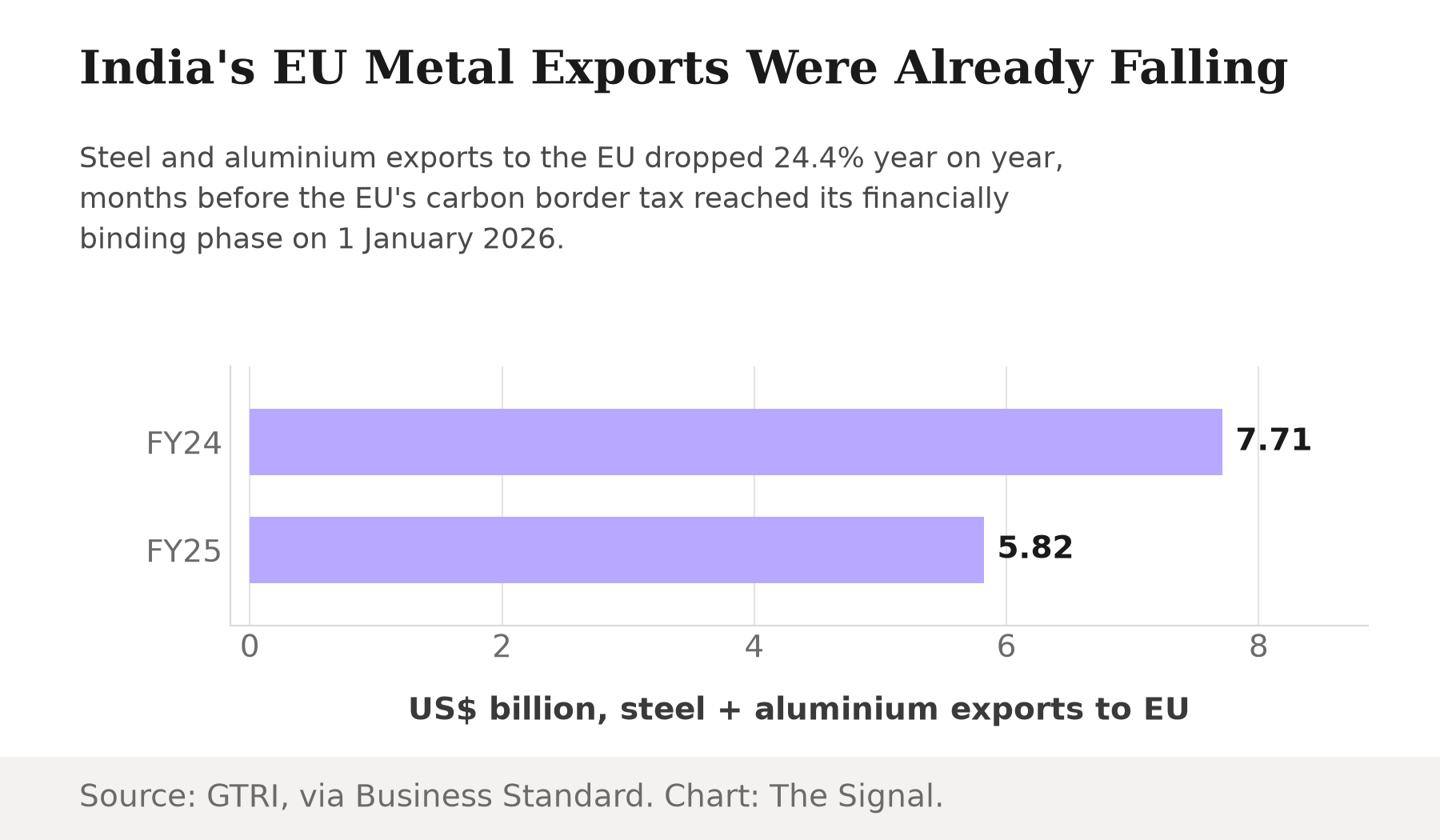
The EU exposure is not a future risk that starts on some announced date. It has already been reshaping trade. A GTRI analysis, reported by Press Trust of India, found that India's steel and aluminium exports to the EU fell 24.4 percent, from $7.71 billion in FY24 to $5.82 billion in FY25, a decline that happened before the EU's carbon tax reached its financially binding phase at all. Exporters, banks and buyers were already repricing the exposure on the expectation of the tax, not waiting for the invoice.
The honest objection
The strongest case for treating the UK's recognition as more than a footnote is that the $775 million GTRI estimate is real money for the specific steel, aluminium, fertiliser and cement exporters who carry it, and that removing a tariff, any tariff, is a genuine, immediate cost saving for the firms it covers. It is also a template: if the UK will credit India's domestic carbon price against its own border tax, that is a precedent India can point to in its still-unresolved argument with Brussels, where the stakes are roughly a hundred times larger.
That case is real, but it inverts the direction of leverage. The UK, a much smaller market for India's carbon-intensive exports, made the concession first and asked for nothing in return beyond aligning its own list. The EU is the market that actually matters at this scale, and it has offered India only a promise that it will not be treated worse than whoever gets the next concession, not a matching recognition of the CCTS itself. A precedent only helps if the other side is willing to follow it, and Brussels has given India no sign yet that it is.
The Signal
Two carbon border taxes are aimed at the same Indian sectors: steel, aluminium, cement and fertiliser. One of them, the UK's, just softened, does not start collecting for another four months, and was only ever going to reach a fraction of the shipments the domestic coverage now protects. The other, the EU's, has been financially binding since January, covers six sectors instead of five, and is attached to an export relationship worth close to a hundred times the UK's exposure, with no equivalent carbon-credit recognition on the table. The number to watch from here is not the UK's list. It is whether Brussels ever puts India's CCTS on its own.
Reporting basis: the UK's recognition of India's Carbon Credit Trading Scheme and the mechanics of the UK's carbon border tax are per the UK government's own published guidance and qualifying-scheme list. India's Carbon Credit Trading Scheme's domestic design is per a Ministry of Power press release via the Press Information Bureau. The EU's carbon border tax timeline and sector coverage are per the European Commission's own Access2Markets and CBAM pages. The $775 million UK exposure estimate and the 24.4 percent decline in steel and aluminium exports to the EU are GTRI figures, as reported by Press Trust of India via Business Standard and Deccan Herald respectively, and are a single-origin estimate in each case. The India-EU FTA's carbon-adjustment terms are per Business Standard, quoting India's Commerce Secretary. India's total goods exports to the EU are per a Government of India press release via the Press Information Bureau. The nearly-hundredfold comparison between the UK exposure and India's total EU exports is The Signal's calculation from those figures.