India's central bank delivered an update on household finances in June 2026 that read, at first glance, as reassuring. The Reserve Bank of India's Financial Stability Report, using data through September 2025, put household debt at 45.5 percent of GDP, continuing a run of increases the report has tracked since 2021. Set against that was a genuinely upbeat figure from the RBI's own annual report: net household financial savings rose to 7 percent of gross national disposable income (GNDI) in 2024-25, up from 5.8 percent the year before. Households are borrowing more and saving more. Read quickly, that looks like a growing economy doing what growing economies do.
It is worth slowing down on that pairing. The savings improvement did not come from households earning more and setting more of it aside. Gross household financial savings actually moderated to 11.8 percent of GNDI in 2024-25, down from 12.1 percent a year earlier. The net figure rose only because financial liabilities, the flow of new borrowing households took on in 2024-25, fell even faster: to 4.8 percent of GNDI from 6.4 percent. That is a single year in which households borrowed less than the year before. It is not evidence that the trend underneath has turned.
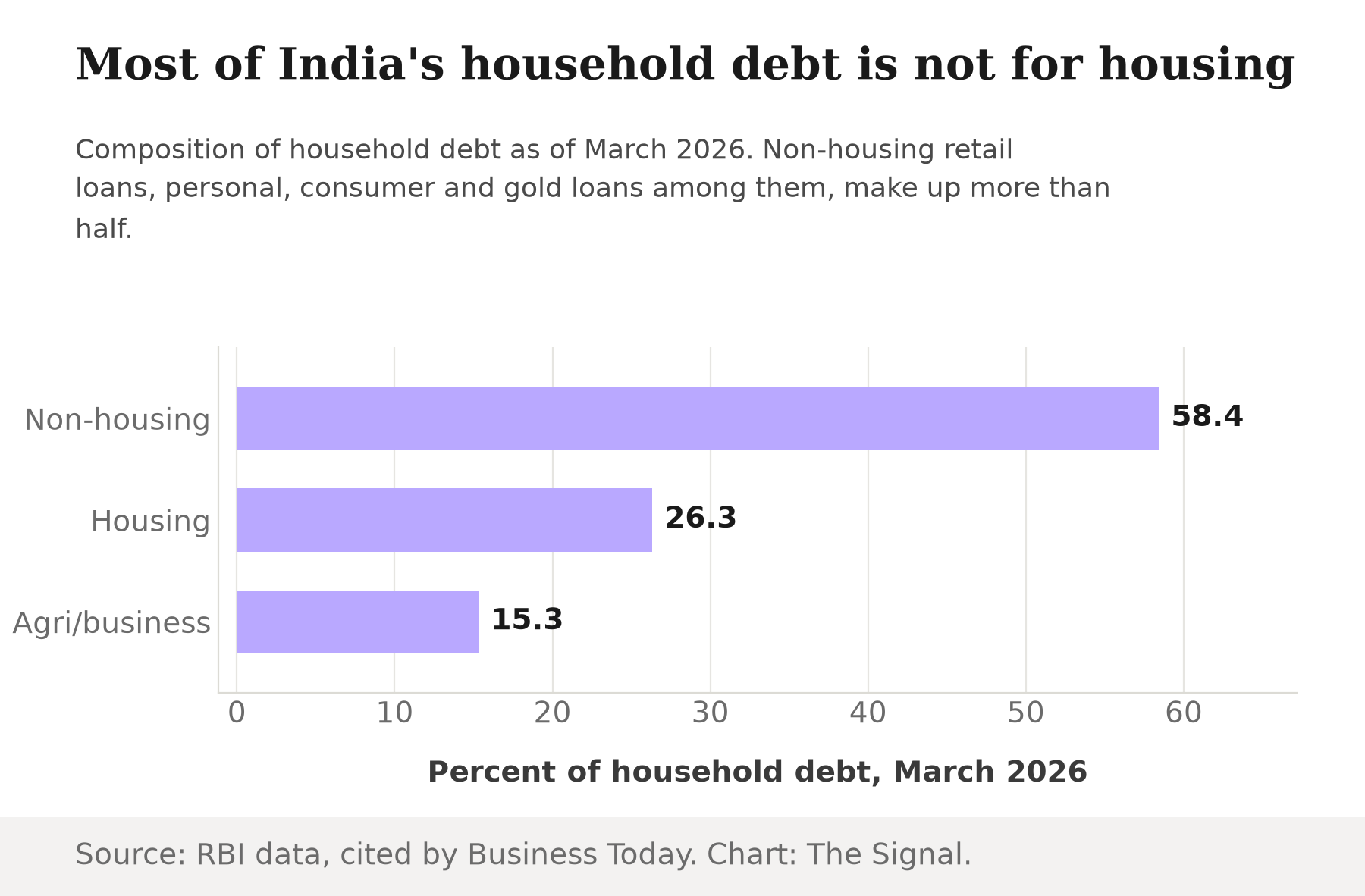
Strip out that one-year pause and the shape of India's household debt has not changed. As of March 2026, 58.4 percent of household debt sat in non-housing retail loans, personal loans, consumer loans, credit cards and gold loans among them, up from about 50 percent in 2019-20; housing loans made up just 26.3 percent, and agriculture and business loans the remaining 15.3 percent. Households are not borrowing more, on net, to buy homes. They are borrowing more to spend.
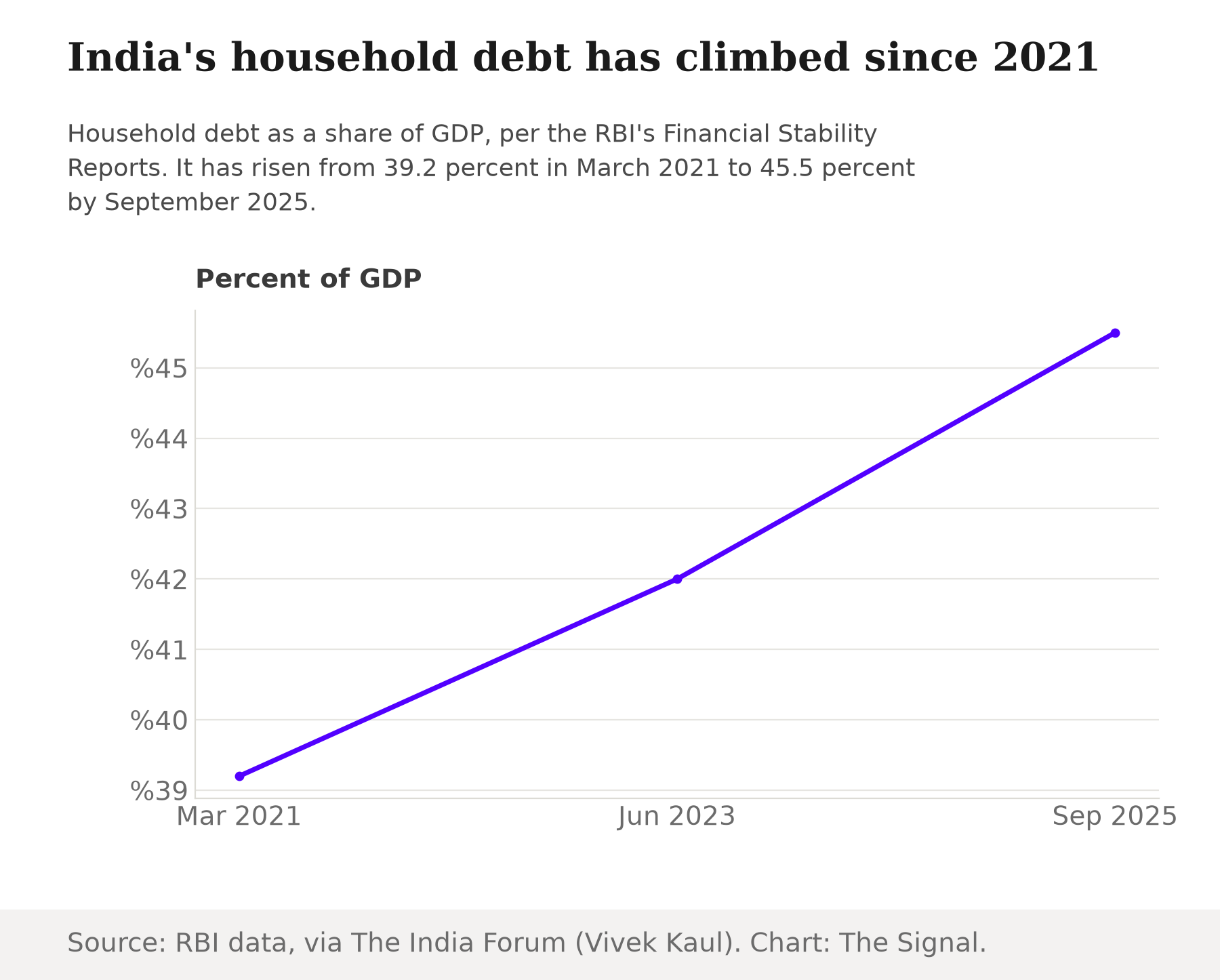
The debt-to-GDP ratio has risen at every reading available since 2021: 39.2 percent in March 2021, around 42 percent by June 2023, 45.5 percent by September 2025. One quiet year in the flow of new borrowing has not dented a five-year climb in the stock of it.
Where the new debt is going
Non-housing retail loans are now the single largest slice of household debt, and the composition shift shows up in the stress data too.
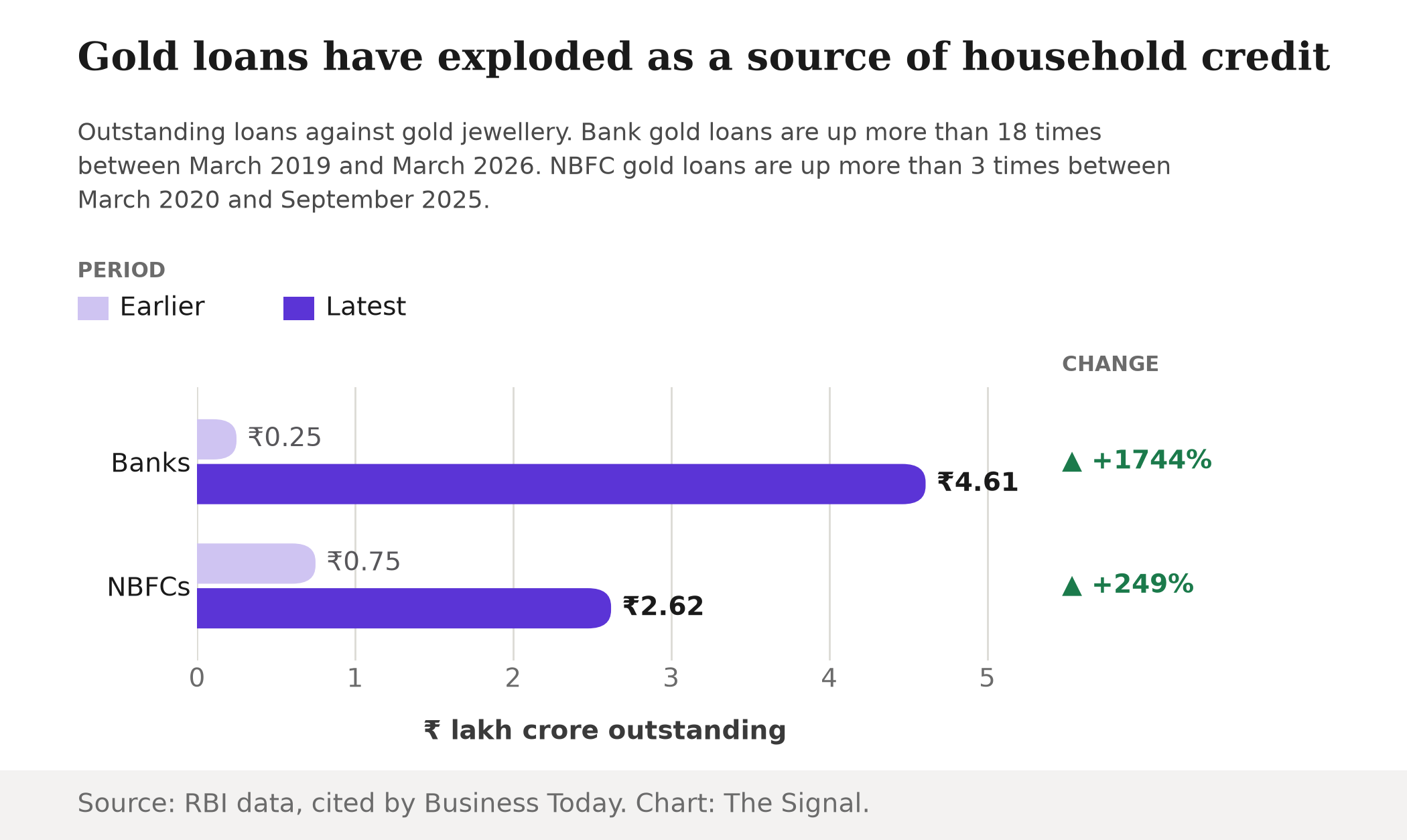
Delinquencies on small-ticket loans, the fastest-growing segment, rose to 6.4 percent in March 2026 from 4.5 percent two years earlier. The clearest sign of where stretched households turn is gold. Bank loans against gold jewellery rose from Rs 24,671 crore in March 2019 to Rs 4.61 lakh crore by March 2026, more than an eighteenfold increase, while loans from non-bank lenders (NBFCs) rose from Rs 75,451 crore in March 2020 to Rs 2.62 lakh crore by September 2025, more than a threefold increase. A gold loan is quick, collateralised by jewellery most families already own, and does not require the paperwork a home or vehicle loan does. Its growth rate is a decent proxy for cash-flow pressure, not asset-building.
Households are keeping a shrinking slice of the pie
The national savings picture, at the level regulators watch most closely, is genuinely strong. India's gross saving rate, households, companies and government combined, rose to 34.2 percent of GNDI in 2024-25, up from 32.3 percent in 2023-24 and 29.3 percent in 2022-23, the fastest two-year run of increases in the series.
But that headline hides which sector is actually banking the gain. Households' own share of India's total gross savings fell to 62.1 percent in 2024-25, down from 62.7 percent in 2023-24 and 67.2 percent in 2022-23, even as households' saving in rupee terms kept rising. The national saving rate is climbing mainly because companies and government are saving a growing share of it. Households are saving more rupees, but a shrinking slice of the national total, while carrying a growing share of GDP in debt.
The most recent month points the same way
If the FY2024-25 dip in new borrowing looked like a turn, the freshest data available undercuts that reading. Bank credit to the personal loans segment grew 16.2 percent year-on-year in the fortnight ended July 31, 2026, up from 11.9 percent growth a year earlier, even as growth in credit-card outstanding and loans against gold jewellery decelerated. Households are borrowing faster again; only the exact instrument mix is shifting, toward housing and vehicle loans within that broader personal category and away from gold and credit cards for now.
The honest objection
The strongest case against reading any of this as distress is that India's household debt, however fast it is rising, still starts from a lower base than most of its peers. As of end-March 2025, the RBI put household debt at 41.3 percent of GDP and explicitly noted that relative to most peer emerging market economies, India's household debt remains lower.
| Economy | Household debt (% of GDP, Sept 2025) |
|---|---|
| India | 45.5 |
| China | 59.0 |
| Malaysia | 69.9 |
| Thailand | 87.3 |
Source: Business Standard, citing the RBI's Financial Stability Report.
That case is real: a household sector 40 points of GDP behind Thailand's has real room to lever up before it resembles a crisis. But room to run and direction of travel are different questions, and on direction the numbers point one way. The household savings rate that would normally cushion this borrowing has structurally eroded, not just paused: the household savings rate stood at 7.2 percent of GDP in 2018-19 and had fallen to 4.9 percent of GDP by 2022-23, well before the FY2024-25 figures discussed above. Households' own share of the (admittedly higher) national saving pool is shrinking. Delinquencies are rising fastest exactly where borrowing is growing fastest, on small-ticket loans. And the classic recourse for a household under cash-flow strain, a loan against the gold it already owns, has grown roughly eighteenfold at banks alone since 2019. Being fourth among four large emerging markets describes the level, not which way the arrow is pointing.
The Signal
The RBI's own numbers tell two different stories that keep getting merged into one headline. One is about a flow: for a single year, households borrowed less than the year before, and net savings ticked up as a result. The other is about a stock: household debt has risen at every reading since 2021, an increasingly consumption-heavy stock, with rising delinquencies and an exploding reliance on gold as collateral. That flow lasted one good year; the debt story has been building for five. Watch what the next Financial Stability Report says about the debt ratio itself, and whether small-ticket delinquencies keep climbing past the 6.4 percent already recorded in March 2026, given that personal loan growth had already reaccelerated to 16.2 percent by the fortnight ended July 31, 2026. If both keep moving the way they have, the FY2024-25 pause will read as a rest stop on a longer climb, not the top of it. A household is not deleveraging because it borrowed slightly less than it did the year before; it is deleveraging when the debt it is carrying stops growing faster than its income.
Reporting basis: the September 2025 household debt-to-GDP figure and the emerging-market peer comparison are from the RBI's Financial Stability Report (June 2026 edition), as reported by Business Standard; the end-March 2025 debt figure and the RBI's own peer characterisation are from the FSR's December 2025 edition, also via Business Standard. The composition of household debt (non-housing, housing and agriculture/business shares), small-ticket delinquency rates and the gold-loan figures are RBI data as reported by Business Today. The 2021-2025 debt-to-GDP trajectory and the 2018-19 to 2022-23 household savings rate are drawn from RBI Financial Stability Report data compiled by Vivek Kaul for The India Forum. Net and gross household financial savings and financial liabilities for FY2024-25 are from the RBI's Annual Report 2025-26, via Business Standard. The gross national saving rate and households' declining share of total gross savings are from MoSPI's First Revised Estimates of National Income 2024-25, via the Press Information Bureau. The July 2026 bank credit growth figures are from the RBI's Sectoral Deployment of Bank Credit data, as reported by Business Standard. The eighteenfold and threefold gold-loan growth figures are The Signal's calculations from those RBI figures.