
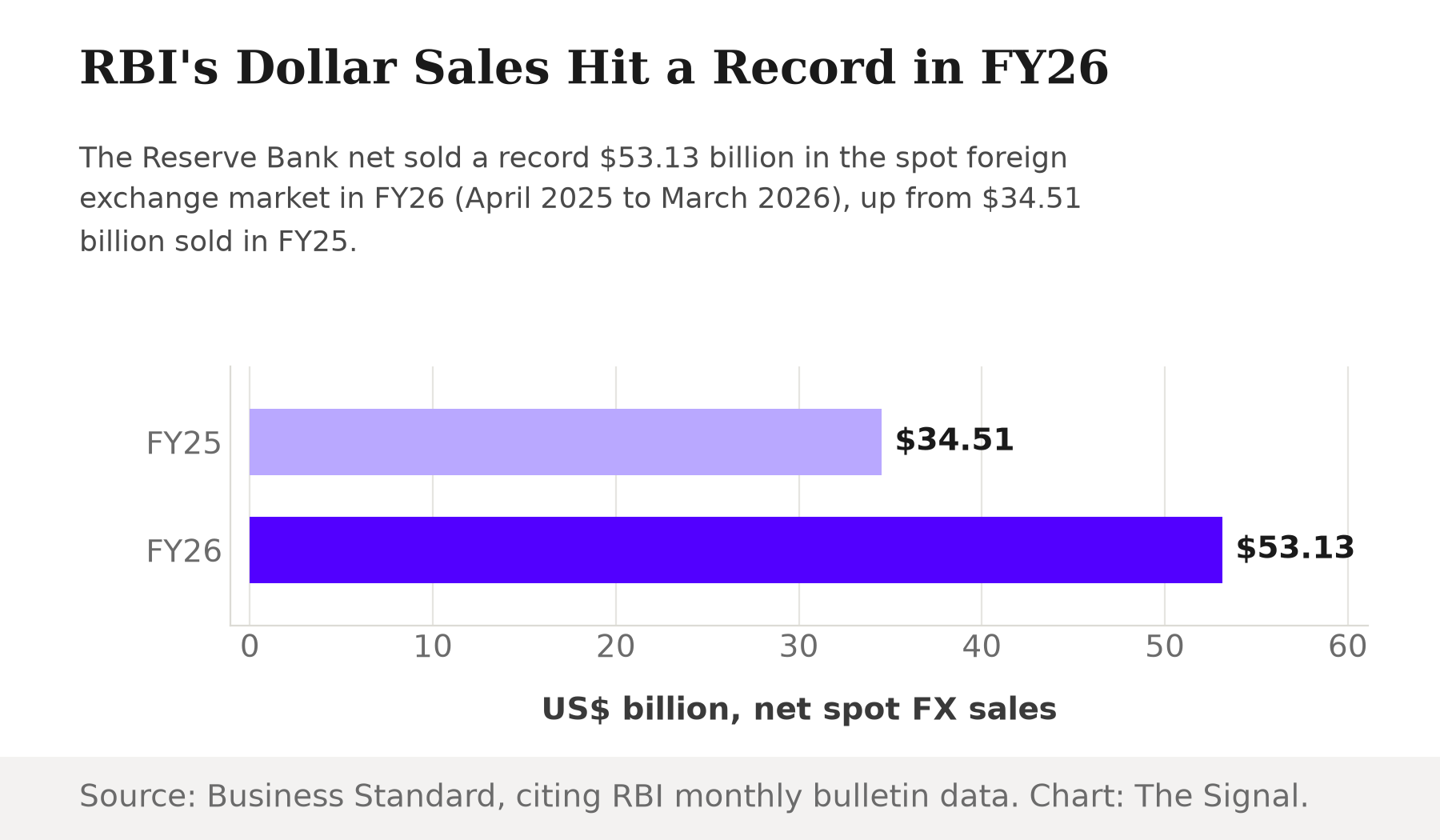
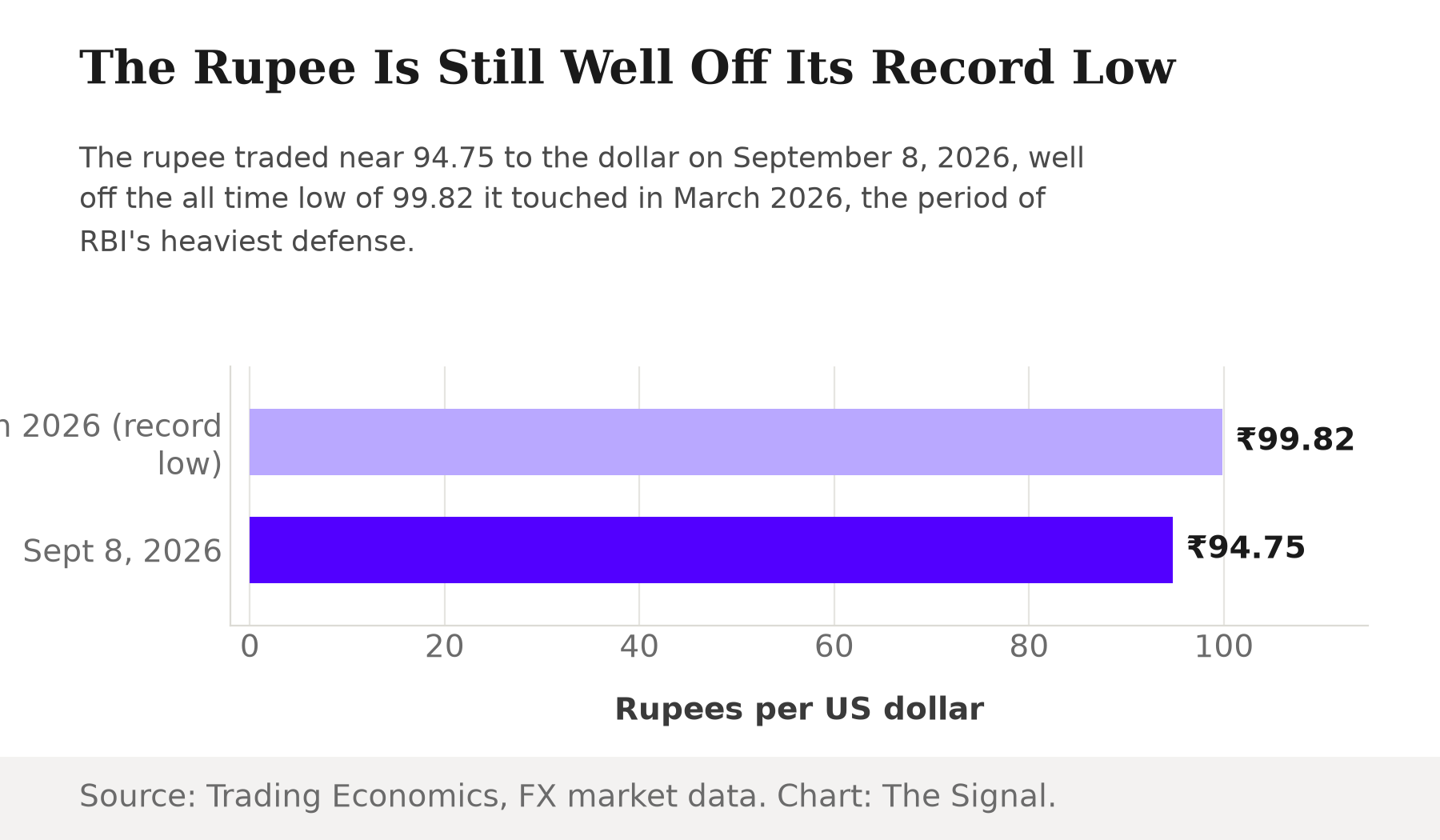
For most of the past two years, the story of the rupee has been the Reserve Bank of India standing between the currency and a fall. The central bank net sold a record $53.13 billion in the spot foreign exchange market in FY26, the year to March 2026, up from $34.51 billion sold in FY25. That defense worked in the sense that matters most to a headline: the rupee traded near ₹94.75 to the dollar on September 8, 2026, well off the all-time low of ₹99.82 it touched in March 2026. Read only that far, this is a central bank successfully holding the line.
RBI's defense of the rupee has come at the cost of rupee liquidity at home.
Selling dollars means buying rupees, and buying rupees at the scale RBI has run pulls rupees out of the banking system. In late July 2026, India's banking system liquidity surplus shrank to just ₹2,884 crore, its tightest reading since a ₹13,077 crore deficit at the end of June, with Business Standard citing RBI's likely forex-market intervention alongside credit growth outpacing deposits as the drivers. A defense built to keep the rupee stable was quietly making rupees scarcer.
It is worth slowing down on what companies did next. Rather than compete for that thinner pool of rupee funding at home, more of them went abroad and borrowed dollars instead, the very currency RBI had just spent a record sum selling.
The number that carries the thesis
Indian companies filed proposals to raise $7.70 billion through external commercial borrowings and foreign currency convertible bonds in July 2026, of which $6.92 billion came under the automatic route and $780 million under the approval route. That is up from $6.08 billion filed in June 2026, a jump of nearly 27 percent in a single month.
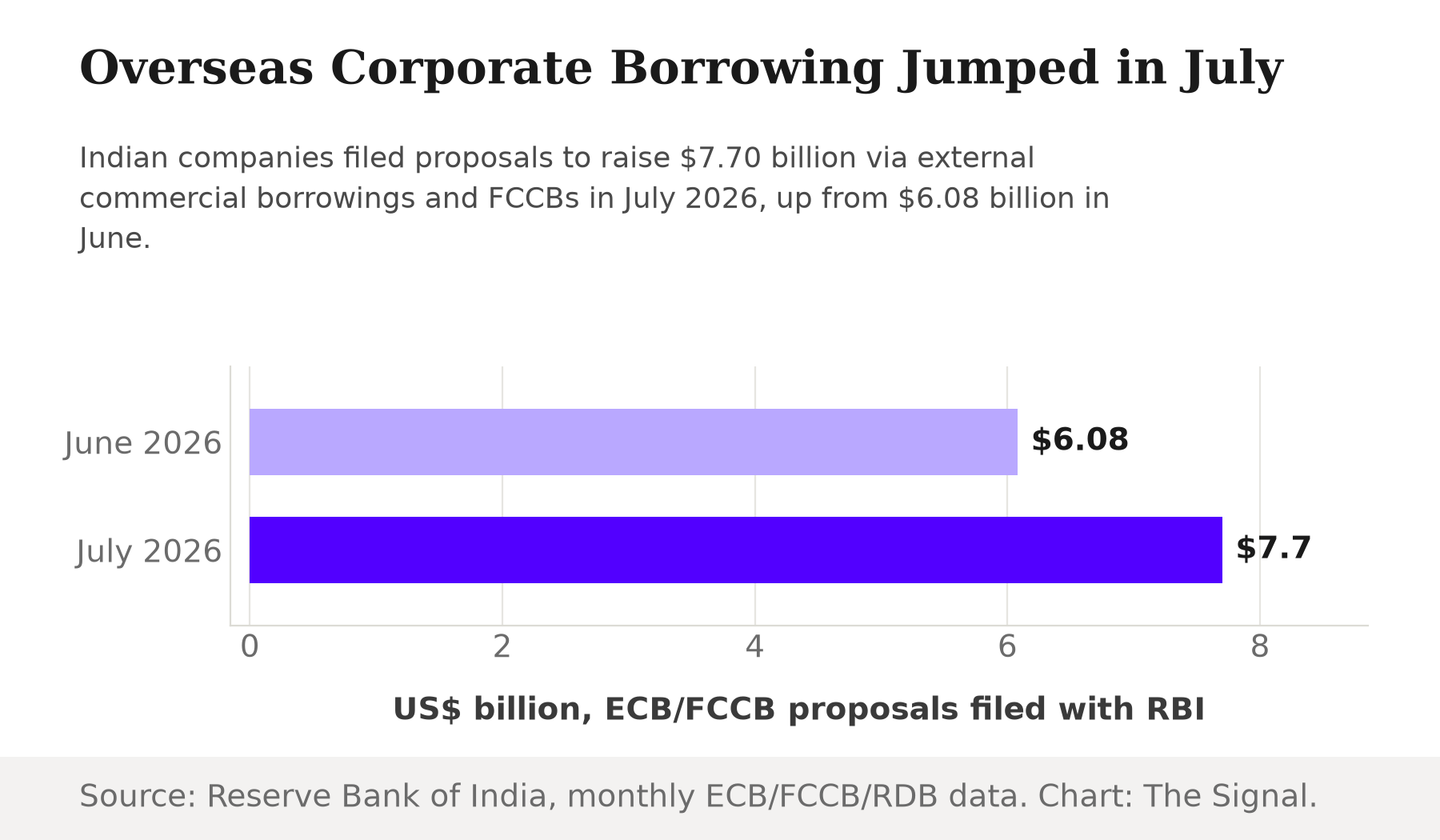
July was not just the biggest of two months, it was the biggest of the year. ECB and FCCB filings had already peaked, before this, at $5.43 billion in March 2026, and bottomed at $3.77 billion in April, with April's total confirmed independently at the same figure. Every one of the first five months of the year fell well short of July's $7.70 billion, making July a calendar-year high, not just a jump from June.
The timing is not incidental. July is exactly the month the liquidity surplus was cited as being at its tightest in weeks. When rupee funding gets scarce and expensive at home, a company with genuine dollar revenue, or a treasury willing to run the currency risk, can look past the domestic squeeze and borrow abroad instead. RBI itself widened that door before the squeeze bit.
Look at who actually filed in July and the picture sharpens further: non-banking financial companies dominated the list, and mostly not to fund dollar-linked capital spending. HUDCO sought $500 million for on-lending plus further tranches to refinance rupee loans, Tata Capital sought $500 million to refinance rupee loans, IIFL Finance sought $300 million for on-lending and sub-lending, Power Finance Corporation sought $300 million for general corporate purposes, Capri Global sought $300 million for on-lending or sub-lending, and Godrej Finance sought $200 million for similar on-lending activities. These are rupee lenders raising dollars to fund rupee loan books, not exporters with dollar revenue to match the liability. That is close to the purest form of the exposure this piece is about: borrowing in a currency you do not earn, to fund lending in the one you do.
RBI loosened the rules first
In February 2026, RBI amended the external commercial borrowing framework so that an eligible borrower can raise ECBs up to the higher of $1 billion outstanding, or 300 percent of net worth combining external and domestic borrowing, with the cost of borrowing required only to stay "in line with prevailing market conditions" rather than a fixed all-in-cost ceiling. That is a materially wider door than a hard-capped ceiling: a large, well-capitalised borrower now has real headroom to raise dollars abroad instead of competing for rupees at home.
The rule change and the liquidity squeeze were not planned as a pair, but they landed close together: the ECB ceiling was widened in February 2026, and the liquidity surplus hit its tightest reading in July. July's jump in ECB filings is what happens when a wider door meets a narrower one at home.
It was not a rate story
One obvious alternative explanation is that domestic borrowing simply got more expensive because RBI raised rates, pushing companies to hunt for cheaper money abroad. The data does not support that. RBI's Monetary Policy Committee voted unanimously to hold the policy repo rate unchanged at 5.25 percent at its August 2026 meeting, the meeting immediately following July's surge in ECB filings. Rates stayed flat. What moved instead was the quantity of rupees available to borrow at any rate, a liquidity story, not a rate story.
The honest objection
The strongest case against reading this as a squeeze-driven rush is that RBI is nowhere close to running out of ammunition, so "squeeze" may overstate what is really routine cyclical borrowing. India's foreign exchange reserves stood at $740.8 billion as of August 28, 2026, up from $729.33 billion a week earlier, comfortably above the roughly $53 billion RBI net sold across the whole of FY26. On that reading, one month of higher ECB filings is well within normal variation for a large, growing economy, not evidence of companies fleeing a liquidity crunch.
That case has real force on the reserves point. But it does not explain away the mechanism. Business Standard's own reporting attributes the July liquidity squeeze directly to RBI's forex intervention, alongside credit growth outrunning deposits, and the ECB filing jump landed in that same month, right after a rule change built for exactly this kind of use. Ample reserves mean RBI can keep defending the rupee. They do not mean the defense stops tightening rupee liquidity at home, and they do not explain why companies chose the same month to file for dollars abroad instead of waiting it out domestically.
The Signal
RBI's dollar sales were built to keep the rupee stable, and by the currency's own path back from its ₹99.82 low to near ₹94.75 today, they have done that. But defending a currency by selling dollars and buying rupees is not a free action. It tightens the very rupee liquidity companies need for ordinary domestic funding, and when RBI simultaneously widened the door for overseas borrowing, some of that funding gap went abroad instead, in dollars, from the same companies the defense was meant to insulate. The rupee looks steadier. The exposure it was supposed to reduce has partly just moved balance sheets. Watch the next two or three months of ECB filings against the weekly liquidity data: if July was a one-month blip, this fades. If the filings keep climbing every time liquidity tightens, RBI's rupee defense has found a second job, quietly re-importing the dollar exposure it exists to manage.
Reporting basis: the February 2026 ECB rule change is from RBI's own regulatory notification. The FY26 net dollar sales figure is per Business Standard, citing RBI's monthly bulletin data. The March, April, June and July 2026 ECB and FCCB filing totals are from RBI's monthly ECB/FCCB/RDB data releases. The August 2026 policy rate decision is from the Monetary Policy Committee's own statement. The July 2026 liquidity squeeze and its cited causes are as reported by Business Standard, citing chief economist Madan Sabnavis, and rest on that single source for the attribution of cause. The borrower-level detail on July's ECB filers is likewise from Business Standard, citing RBI data. The rupee's current level against its March 2026 low, and the foreign exchange reserves figures, are from Trading Economics market data, drawing on RBI series. The month-on-month percentage increase in ECB filings, and the characterization of July as a calendar-year high, are The Signal's calculation from the RBI figures.