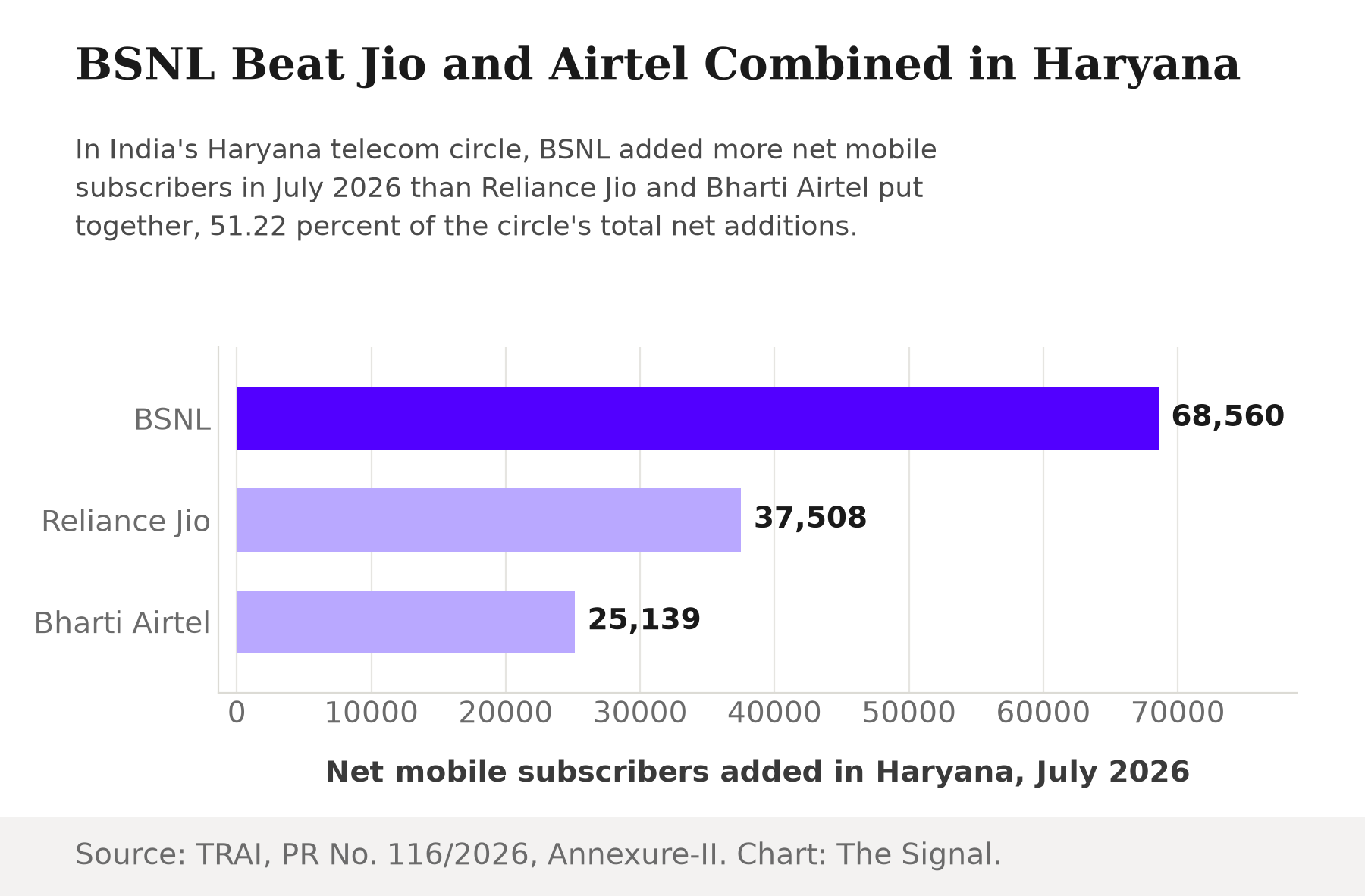
Every month, India's telecom regulator publishes a circle-by-circle count of who is winning and losing mobile subscribers, and the July 2026 numbers threw up a genuine surprise. In India's Haryana telecom circle, BSNL added a net 68,560 mobile subscribers in July 2026, 51.22 percent of the circle's total net additions that month, more than Reliance Jio's 37,508 and Bharti Airtel's 25,139 combined. Read that on its own and BSNL, the state-run carrier written off for years as a shrinking legacy operator, looks like it just outmuscled India's two largest private telecom groups in one of the country's more competitive markets.
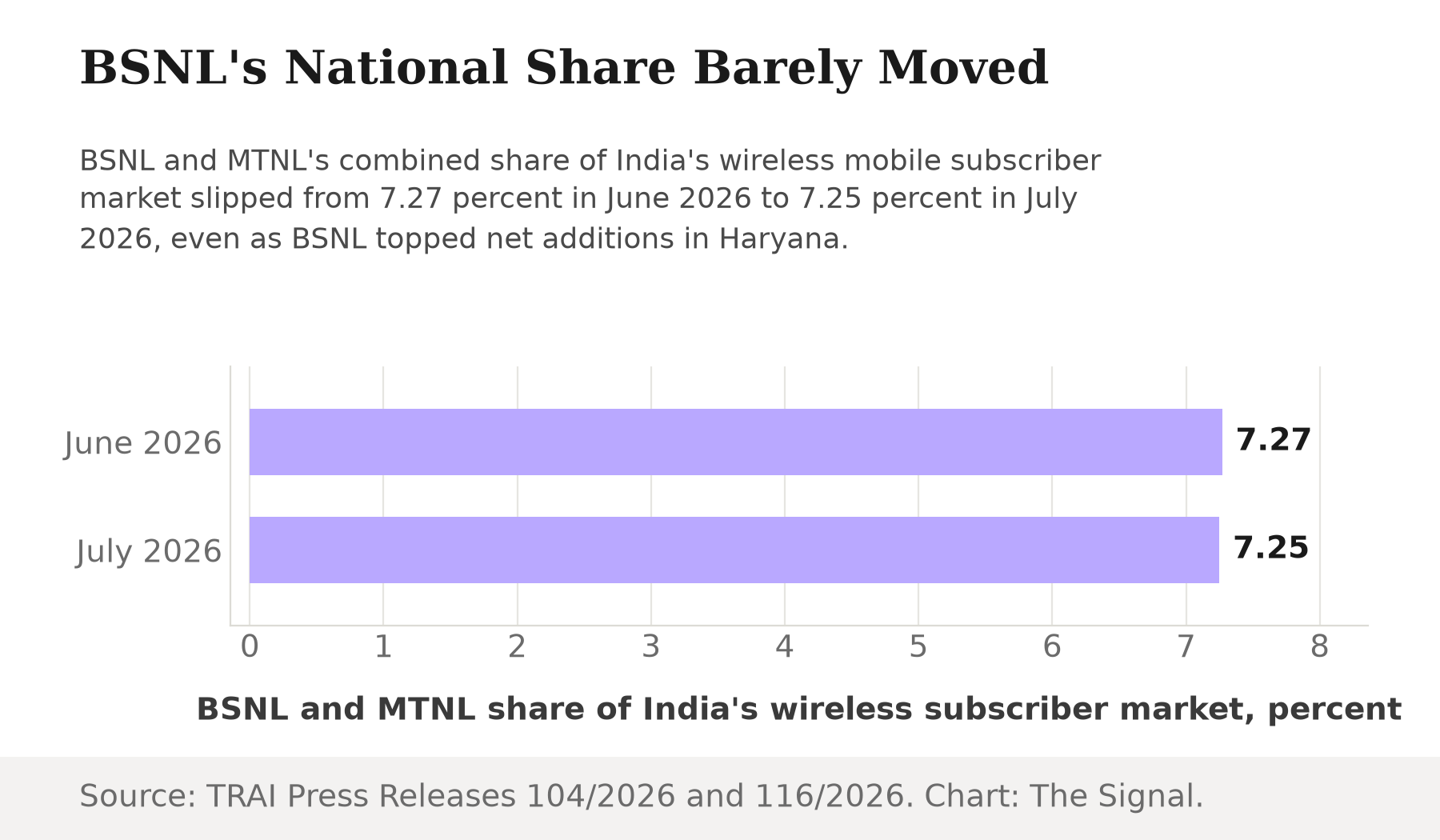
It is worth slowing down on that. At the end of July 2026, private operators held 92.75 percent of India's wireless mobile subscriber market, with BSNL and fellow public-sector operator MTNL together holding 7.25 percent, and one month earlier, at the end of June 2026, that combined public-sector share was 7.27 percent. A circle-topping month in Haryana did not move BSNL's national position. If anything, the public sector's national share slipped.
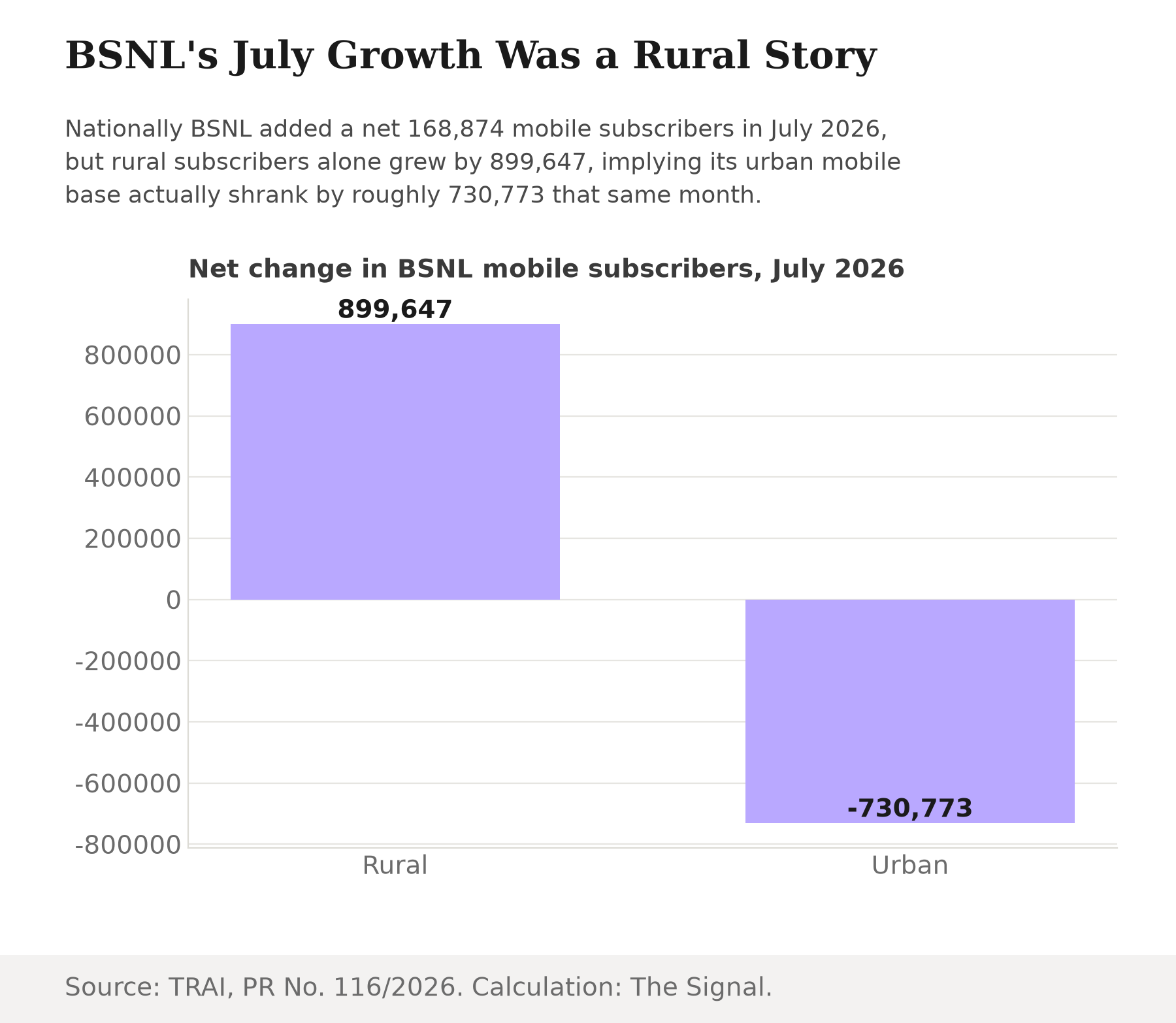
Strip out the geography, and here is the number that explains it: BSNL's national mobile subscriber base grew by a net 168,874 in July 2026, but its rural subscribers alone grew by 899,647, implying its urban mobile base actually shrank by roughly 730,773 that same month. BSNL's July gain was a rural surge, not a broad-based comeback, large enough to mask a shrinking city business.
The rural engine
BSNL's rural surge did not come from nowhere. The Department of Telecommunications told the Rajya Sabha that BSNL's customer base grew from 8.86 crore in March 2024 to 9.28 crore in December 2025, an increase of about 42 lakh subscribers, while the company had installed 97,672 indigenous 4G sites nationwide, with 95,511 of them already on air, as of 15 January 2026, under a government-backed push to build BSNL's own 4G network largely from scratch. A build-out like that lands first, and hardest, in the places where BSNL previously had the weakest signal: rural circles where Jio's and Airtel's towers do not reach every village, and where a working 4G connection at almost any price beats no signal at all.
A stale price gap, not a new shock
The other driver behind Haryana predates the headline by two years. Reliance Jio, Bharti Airtel and Vodafone Idea raised prepaid and postpaid tariffs by 13 to 27 percent, 10 to 21 percent and 10 to 23 percent respectively, effective the first week of July 2024. BSNL sat out that round, and its CMD said in October 2024 the company had no plans to raise tariffs; in July 2024 alone BSNL added 2.9 million subscribers even though its national market share was just 7.59 percent that month, against 40.68 percent for Jio, 33.12 percent for Airtel and 18.46 percent for Vi. That price gap opened in mid-2024, and none of the three private operators has closed it since. Haryana's July 2026 result reads less like a new shock and more like the same two-year-old arithmetic still working itself out, one circle at a time, now running on top of a 4G network that is actually built.
BSNL's gains are also not confined to one circle.
| Circle | BSNL net addition, May 2026 |
|---|---|
| Haryana | +18,060 |
| Rajasthan | +15,058 |
| Karnataka | +13,968 |
| Kerala | +9,535 |
Source: TelecomTalk, based on TRAI's May 2026 subscription data.
BSNL gained wireless mobile subscribers in 11 telecom circles in May 2026, led by Haryana, Rajasthan, Karnataka and Kerala, even though its national wireless mobile subscriber base fell by 104,660 that same month. The pattern that showed up in Haryana two months later, in July 2026, has become routine for BSNL: real, circle-level wins that do not add up to a national trend.
The honest objection
The strongest case against reading this as noise is that BSNL's underlying investment is real and compounding, not a one-time price effect. Its customer base and its 4G footprint have both grown steadily from March 2024 to January 2026, and as more towers come on air, the argument goes, growth should eventually broaden out of rural circles and into cities too, with Haryana as the first circle rather than the exception.
That case is real, but the same months of data undercut its timeline. BSNL's national market share held flat at roughly 7.25 to 7.27 percent across June and July 2026 even as circle after circle produced a Haryana-style headline, and its implied urban base kept shrinking rather than turning the corner. A network build that is more than two years into a rollout and still losing net urban customers has not yet reached the point where more towers reliably mean more subscribers nationally. What it currently means is that the state carrier is winning the customers private operators are not fighting hard to keep: price-sensitive, often rural, subscribers the 2024 tariff hikes priced out of Jio, Airtel and Vi.
The Signal
BSNL's Haryana win is real, and TRAI's own data confirm it. But a circle is not a country, and the same data show the public sector's national share has not climbed off roughly 7.25 percent in two straight months, while a rural surge is currently masking real losses in the cities that will eventually decide whether this becomes an actual revival or stays a rural sideshow. Watch two things next: whether BSNL's national share, not just its circle-level wins, starts climbing rather than holding flat, and whether the 4G build-out driving rural growth ever shows up as growth in Delhi, Mumbai or Bengaluru instead of just smaller towns in Haryana and Rajasthan. Until then, BSNL is not staging a comeback. It is winning back the villages the private telecoms priced out two years ago, while losing ground in the cities that still decide who leads India's telecom market.
Reporting basis: the July 2026 circle-wise and national subscriber figures, including the Haryana operator breakdown, the national market-share split and the rural-urban breakout, are from the Telecom Regulatory Authority of India's Highlights of Telecom Subscription Data, Press Release No. 116/2026. The preceding June 2026 national market-share figure is from TRAI's Press Release No. 104/2026. BSNL's customer-base growth and its 4G site count are as the Department of Telecommunications told the Rajya Sabha, via a Press Information Bureau release. The July 2024 tariff hikes by Reliance Jio, Bharti Airtel and Vodafone Idea are as reported by Gulf News, citing the operators' own announcements. BSNL's decision to hold its tariffs, and its July 2024 subscriber and market-share figures, are as reported by Business Standard, citing BSNL CMD Robert J Ravi on the record. The May 2026 circle-wise gains are as reported by TelecomTalk, based on TRAI's underlying data for that month. BSNL's 51.22 percent share of Haryana's net additions, its roughly 42 lakh subscriber increase from March 2024 to December 2025, the implied roughly 730,773 decline in its urban base, and all other totals and comparisons are The Signal's calculations from those figures.