On Monday, 7 September 2026, PVR Inox shares fell 8.24 percent to hit a low of Rs 1,126, as media reports resurfaced an internal probe into kickbacks that developers building the company's cinema properties allegedly paid to insiders over several years. The alleged kickbacks could total as much as Rs 200 crore. PVR Inox's own exchange filing pushed back hard. Pramod Arora, the company's former CEO for Growth and Investment, resigned on 4 May 2026 for personal reasons and was not asked to leave, and a preliminary examination by external third-party experts did not indicate any evidence of kickbacks. Read at face value, this is a governance scare the company has already rebutted: an old resignation, an unproven allegation, a stock that overreacted to a headline.
It is worth slowing down on that. Three days before the story broke wide, on 4 September 2026, PVR Inox's board had set the record date for a Rs 300 crore buyback of 20.6 lakh shares at Rs 1,450 apiece, a program the board alone could approve. And the allegation itself is not small change next to what the company actually earns.
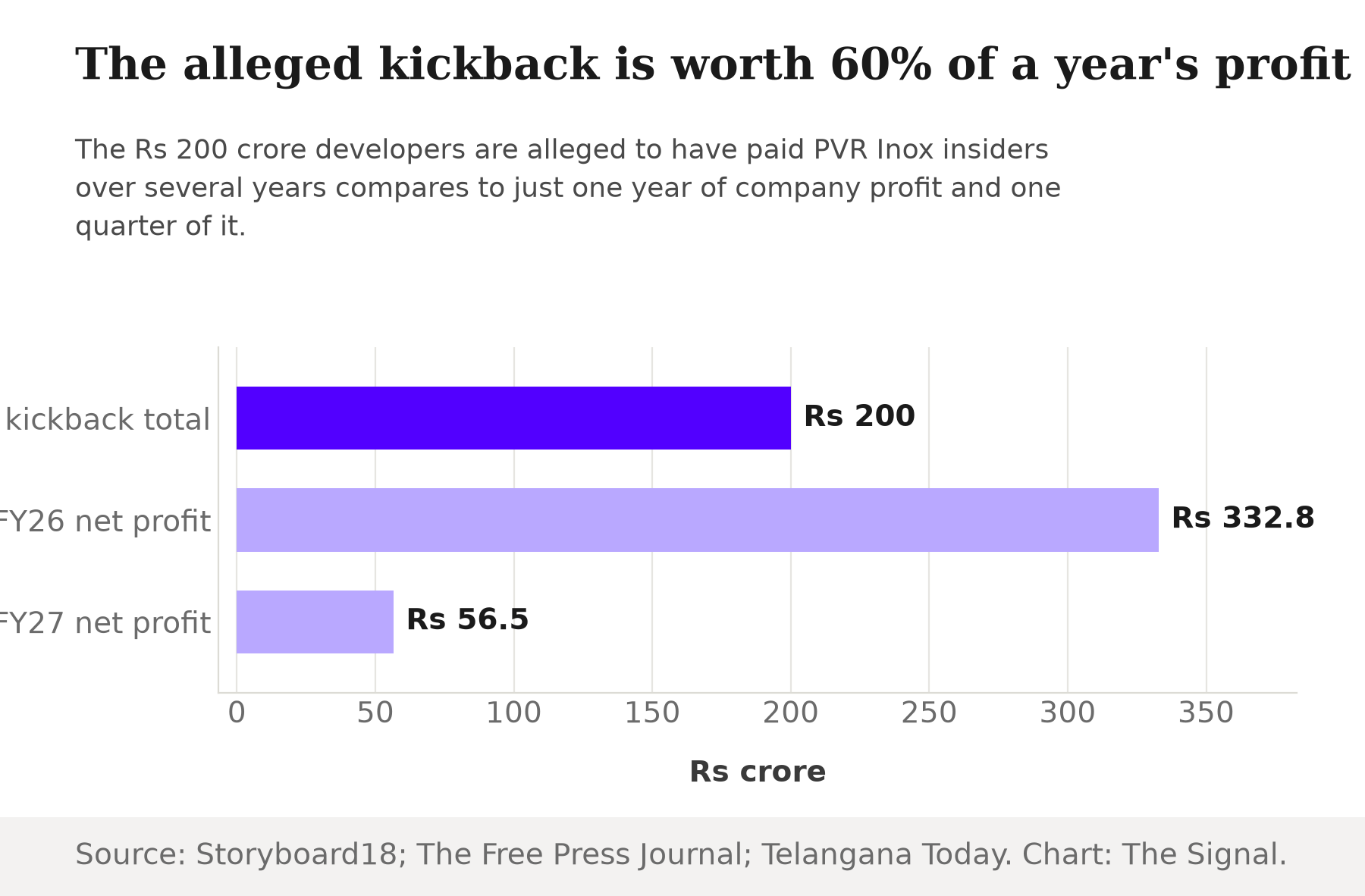
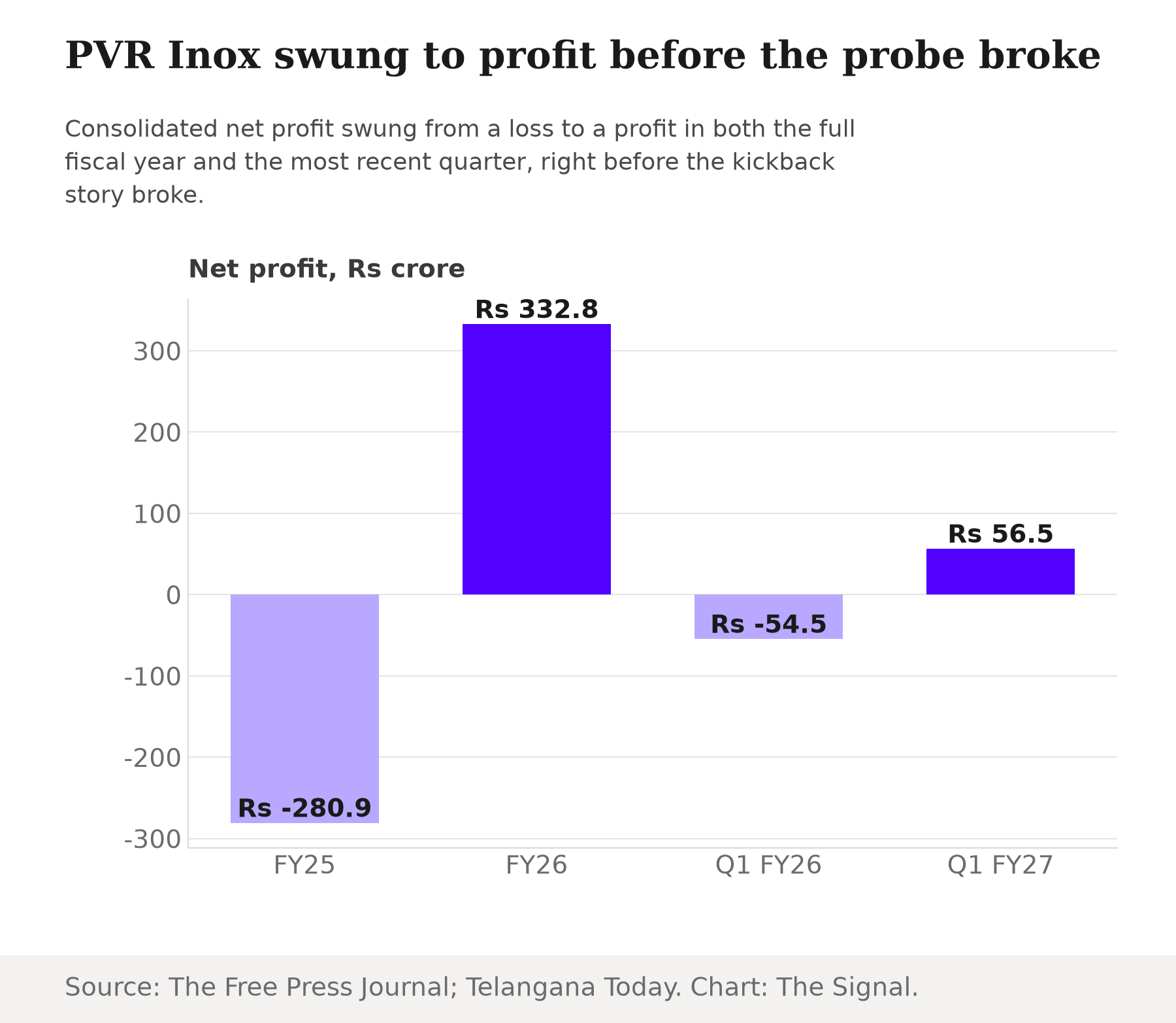
PVR Inox's consolidated net profit for FY26, the year ended 31 March 2026, was Rs 332.8 crore, the company's first full-year profit after a loss of Rs 280.9 crore in FY25. Set the alleged Rs 200 crore in kickbacks against that single year of profit, and it comes to roughly 60 percent, more than three and a half times the Rs 56.5 crore PVR Inox earned in the quarter ended June 2026, Q1 FY27. Whatever the box office did in any given quarter, a sum that size, moving out of the company over years, is the kind of number that can turn a marginal year profitable or not.
Profit is the sharper yardstick, but market value gives a second one. PVR Inox's market capitalisation was Rs 11,819 crore on 1 September 2026, three days before the buyback's record date and days before the kickback reports resurfaced. Against that base, the alleged Rs 200 crore kickback is worth about 1.7 percent of the whole company, and the Rs 300 crore buyback about 2.5 percent, both figures calculated from that market cap. Neither number looks large next to the total value of a company this size; both look large next to the profit it actually earns in a year.
The buyback that needed no permission
Under SEBI's Buy-back of Securities Regulations, a company's board of directors alone can authorise a buyback of 10 percent or less of the company's total paid-up equity capital and free reserves, without putting the matter to a shareholder vote. Anything larger needs a special resolution passed by shareholders. PVR Inox's Rs 300 crore buyback used approximately 4.09 percent of the company's paid-up equity capital and 4.07 percent of its free reserves, comfortably inside the board-only ceiling, with 4 September 2026 set as the record date.
Nothing about that is unusual on its own. Many Indian companies size buybacks under that board-only threshold precisely because it is faster than convening shareholders. What makes the timing worth noting here is that the board did not need to explain or put to a vote a capital return that landed the same week a kickback allegation started moving the stock, while a related-party transaction of comparable consequence would have faced exactly that scrutiny.
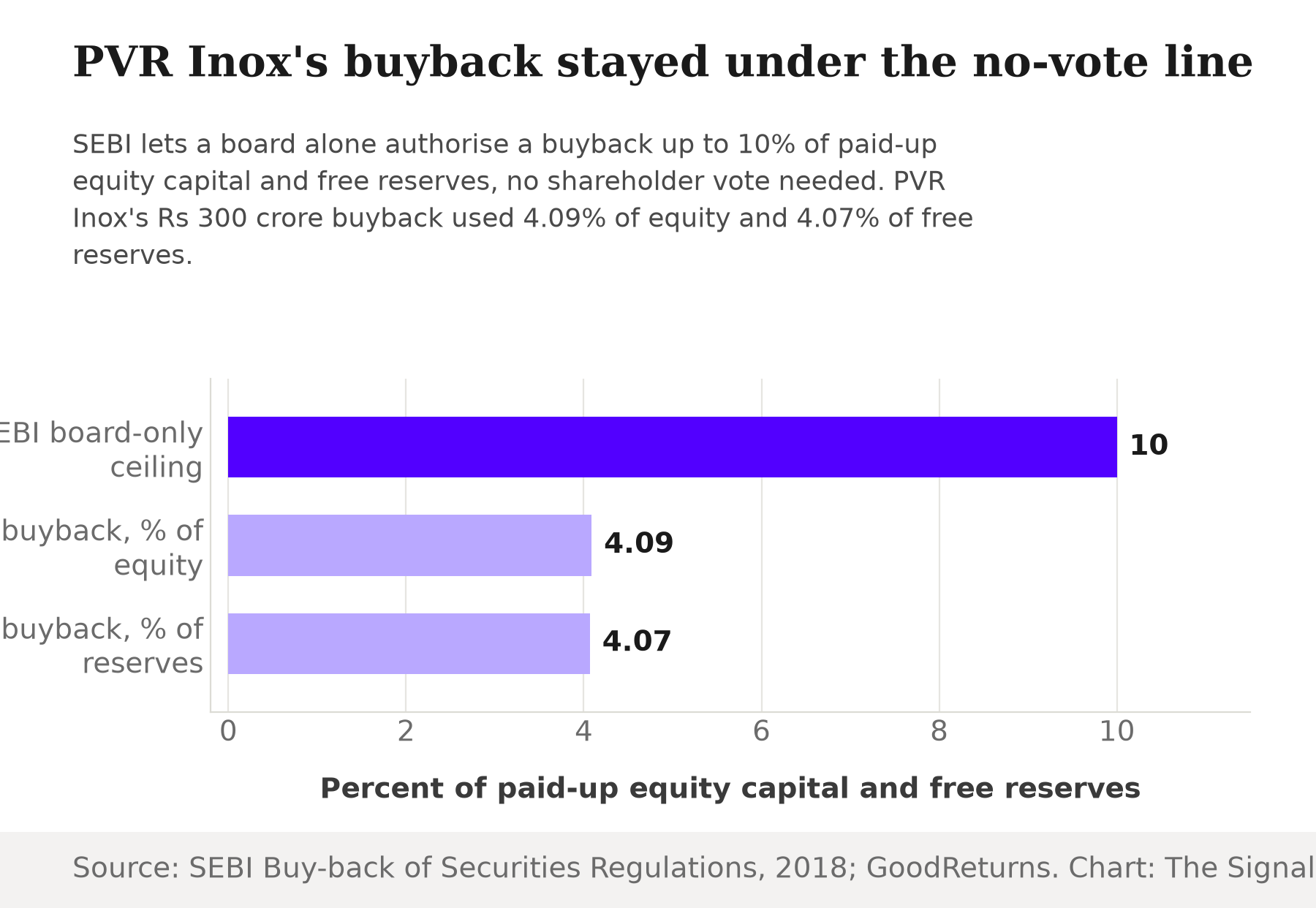
Source: SEBI Buy-back of Securities Regulations, 2018; GoodReturns. Chart: The Signal.
Why a shareholder vote would matter here
SEBI's LODR Regulation 23(4) requires that material related-party transactions get prior shareholder approval, and bars the related party from voting on that resolution. That rule exists for exactly this kind of situation: a company transferring value to people connected to its own insiders, where an ordinary board sign-off is not considered enough oversight. The alleged kickback scheme, payments moving from developers to PVR Inox insiders over several years, is the type of relationship the RPT regime is built to catch through disclosure and an outside shareholder check. A capital-market transaction like a buyback goes through that check only once it crosses the 10 percent threshold; alleged internal graft, if it happened, went through no such check at all. That contrast, not the share price move by itself, is the governance story here.
A turnaround now under a cloud
The allegations land at an inconvenient moment for the company's own numbers. PVR Inox's FY26 revenue rose 17 percent to Rs 6,646 crore from Rs 5,700 crore in FY25, alongside the swing from loss to profit already noted. Q1 FY27 revenue was up 11.9 percent year-on-year to Rs 1,622 crore from Rs 1,450 crore, with the company returning to quarterly profitability against a year-ago loss. This is the operator that dominates India's multiplex business: PVR Inox runs 1,798 screens across 359 cinemas in 113 cities in India and Sri Lanka, the scale that resulted from the 2023 PVR-Inox merger.
Both the full year and the latest quarter swung from a loss to a profit.
| Period | Revenue from operations | Net profit / (loss) |
|---|---|---|
| FY25 (year to March 2025) | Rs 5,700 crore | (Rs 280.9 crore) |
| FY26 (year to March 2026) | Rs 6,646 crore | Rs 332.8 crore |
| Q1 FY26 (quarter to June 2025) | Rs 1,450 crore | (Rs 54.5 crore) |
| Q1 FY27 (quarter to June 2026) | Rs 1,622 crore | Rs 56.5 crore |
Source: The Free Press Journal; Telangana Today.
This is the profile investors had just started to trust again, after two straight loss-making comparison periods gave way to two straight profitable ones.
The honest objection
The strongest case against reading much into this is the company's own rebuttal. PVR Inox's stock exchange filing states that a preliminary examination by external third-party experts did not indicate any evidence of kickbacks, and that Arora's exit in May was voluntary, not a firing tied to the allegations. On that reading, a four-month-old resignation got re-attached to an unverified number, the market overreacted to a headline, and the board's buyback was simply a routine capital decision that happened to land in an unlucky week.
That case has real weight, and a preliminary finding of no evidence is not nothing. But "preliminary" is doing real work in that sentence: the company has not said the matter is closed, only that the first pass found nothing. And the market's reaction argues against pure noise. The stock fell as much as 8.24 percent intraday on the day the story resurfaced, a move large enough to suggest investors were pricing something more than a stale headline, even against a company that had just posted back-to-back profitable periods.
The Signal
None of the individual facts here proves wrongdoing. What they show is a mismatch in scrutiny. The kickback allegation is large enough to swing a marginal year's results at a company that only just turned the corner, yet it moved through the same channel as any office memo: an internal probe, an exchange filing, a company statement. The buyback moved through the one legal channel that asks the board to answer to no one but itself, because it was sized to stay under the line that would have required a shareholder vote. SEBI built its related-party rule precisely so that value moving toward insiders gets an outside check; nothing in the buyback rules asks a board to explain why it stayed under that separate line. Watch what the fuller kickback investigation concludes, and whether PVR Inox's next capital-return decision, if there is one, stays under that same threshold. A board that keeps choosing the number that avoids a vote is telling shareholders something, whether or not it says so out loud.
Reporting basis: the 8.24 percent share fall and intraday low are per Business Today's market report of 7 September 2026. The alleged Rs 200 crore kickback figure and the developers-over-several-years detail are per Storyboard18. Pramod Arora's resignation date and the company's preliminary-probe statement are per Business Today, citing PVR Inox's stock exchange filing. The Rs 300 crore buyback's size, price, share count and percentage of equity and reserves are per GoodReturns, citing the company's buyback announcement. FY26 and FY25 revenue and profit figures are per The Free Press Journal. Q1 FY27 and Q1 FY26 figures are per Telangana Today. The screen, cinema and city count is per Digital Cinema Report, citing PVR Inox's own operational disclosures. The board-only buyback threshold is from SEBI's Buy-back of Securities Regulations, 2018; the related-party-transaction shareholder-approval rule is from SEBI's FAQs on the LODR Regulations. The Rs 11,819 crore market capitalisation is per Business Today's report of 1 September 2026. The alleged kickback's and buyback's share of FY26 profit, Q1 FY27 profit and market capitalisation are The Signal's calculations from those figures.