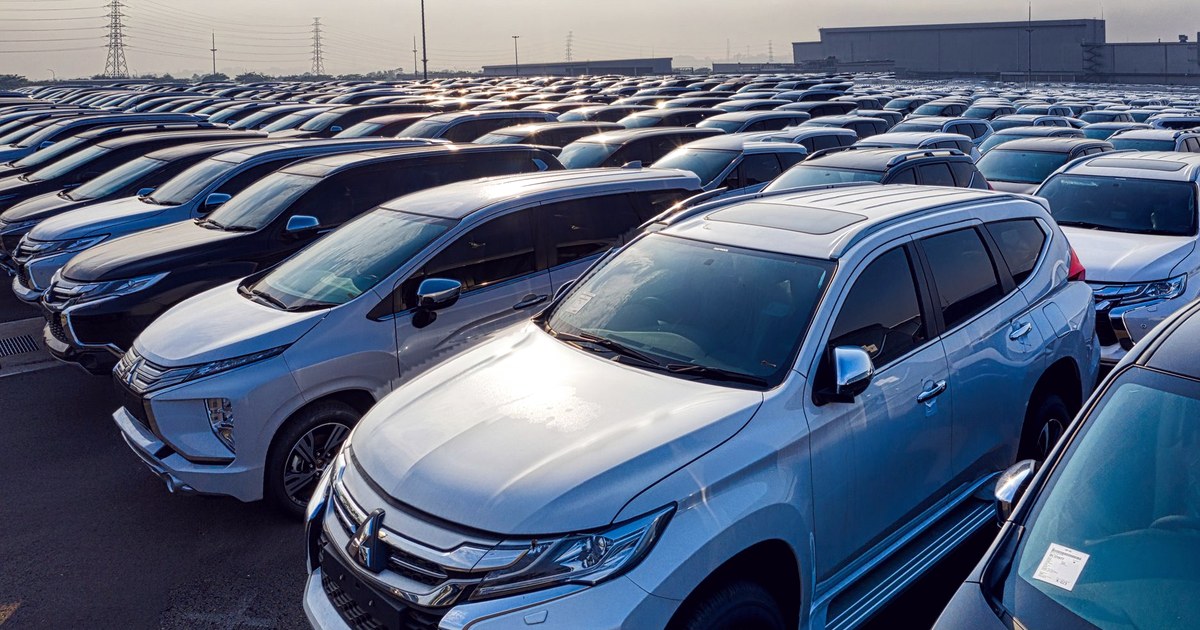
Jaguar Land Rover said Monday it will cut 4,000 jobs across its global workforce over the next two years, citing tariffs and competition from Chinese rivals as it works to control costs, The Associated Press reports. JLR is targeting roughly £1.7 billion of savings over that period and wants to cut its break-even point to 300,000 vehicles a year, the company said in an official statement. Read as a British story, it is a hard-nosed but familiar one: a storied carmaker trims its workforce to defend its margins against tariffs and tougher competition abroad.
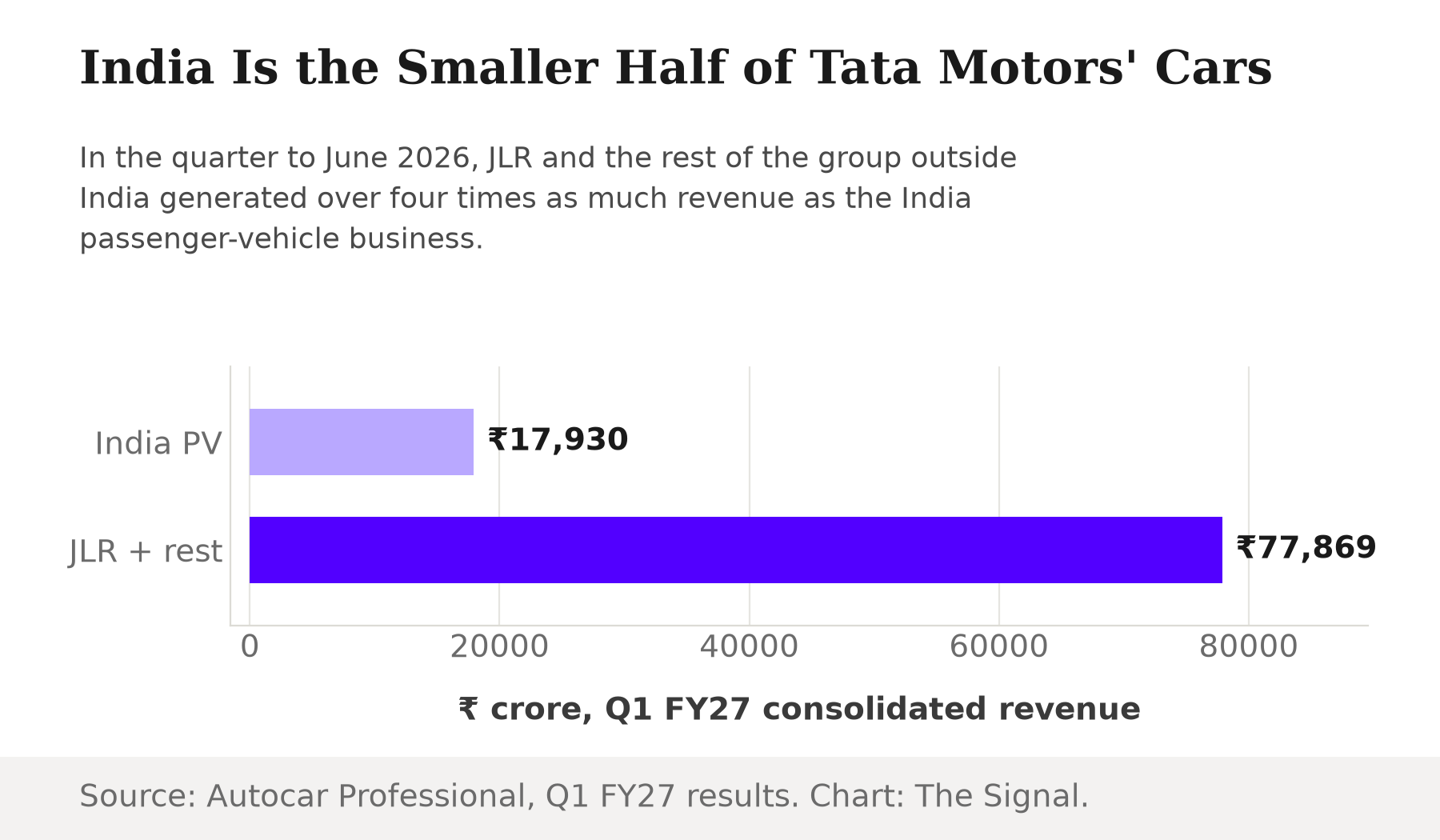
It is worth slowing down on who actually owns Jaguar Land Rover. JLR is a wholly owned subsidiary of Tata Motors, and it is not a small piece of that group. In the quarter to June 2026, JLR and the rest of the group outside India accounted for roughly 81% of Tata Motors Passenger Vehicles' ₹95,799 crore consolidated revenue, with India's own domestic car business contributing only ₹17,930 crore, about 19%, Autocar Professional's results coverage and The Signal's own calculation from those figures show. A round of British layoffs driven by American tariffs is not, structurally, a British problem alone. It is an Indian balance-sheet event.
India is the smaller half of Tata Motors' car business.
The profit that vanished before the cuts were even announced
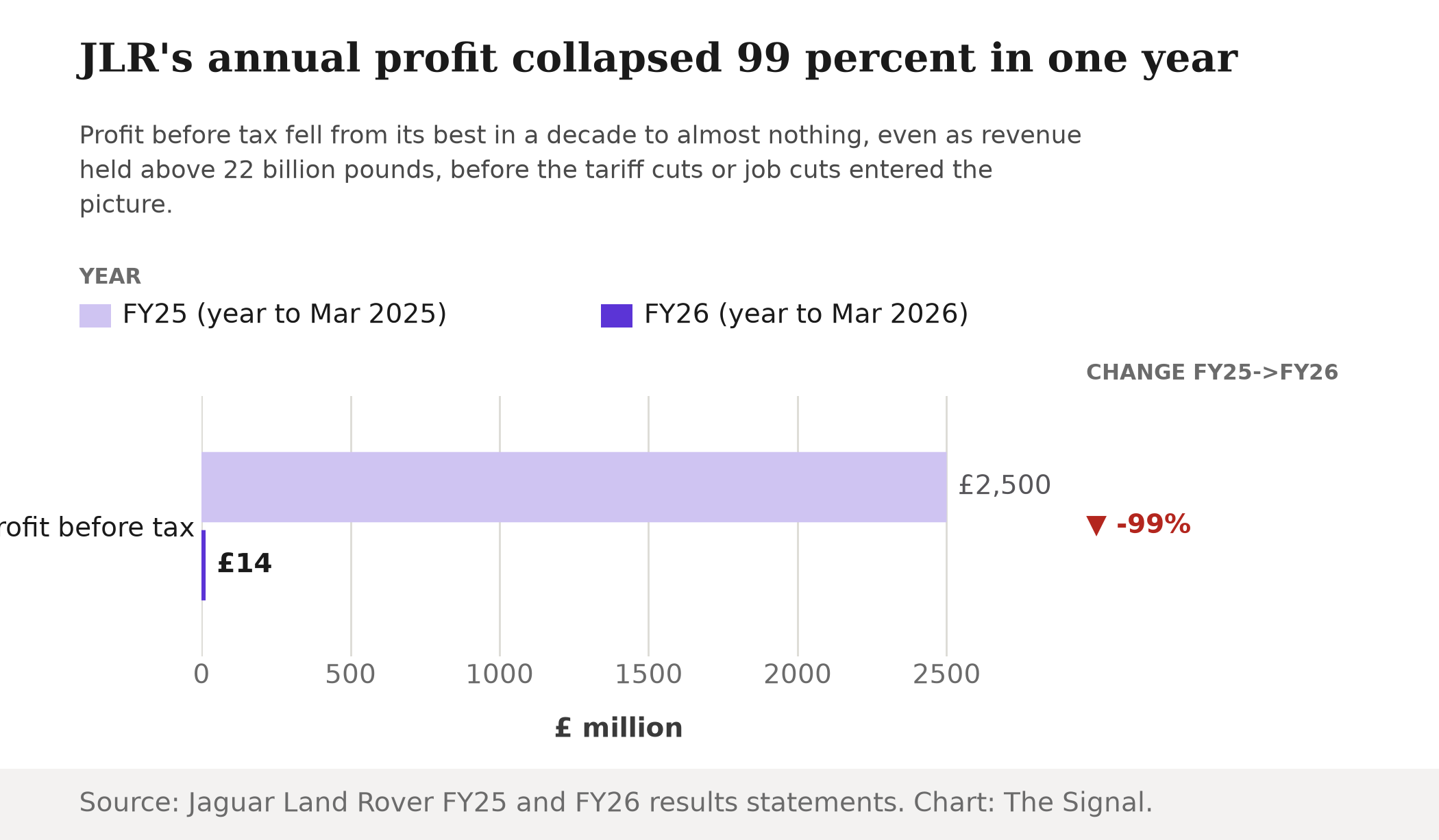
The job cuts did not come out of nowhere. JLR's full-year revenue for the year to 31 March 2026 fell 20.9% year on year to £22.9 billion, and profit before tax collapsed to just £14 million, the company's own FY26 results statement reports. A year earlier, JLR's full-year profit before tax was £2.5 billion, its best in a decade, on flat revenue of £29.0 billion, per its FY25 results statement. Set the two years side by side and the swing is stark: a profit near £2.5 billion effectively wiped out in a single year, well before this week's job cuts were on the table.
The next quarter offered a partial reprieve, and it still was not enough. In the quarter to 30 June 2026, JLR revenue fell 9.6% year on year to £6.0 billion, profit before tax fell 68.9% to £109 million, and adjusted EBIT margin narrowed to 2.8% from 4.0%, the company's Q1 FY27 results statement reports. That quarter is also when the US-UK tariff rate on JLR's cars fell from 27.5% to 10% under the two countries' trade agreement, a saving JLR itself booked in the same results. The relief helped. It did not stop the margin from shrinking.
US car tariffs remain a moving target even after the UK trade deal.
| Tariff | Rate | Applies to |
|---|---|---|
| Section 232 baseline | 25% | Imported cars generally, including most other countries' carmakers |
| US-UK trade agreement rate | 10% | UK-made cars, within a 100,000-vehicle-a-year quota |
Source: The White House; US Customs and Border Protection; Jaguar Land Rover.
The Trump administration's Section 232 tariff imposes a 25% baseline on imported automobiles generally, the rate most foreign carmakers pay. The UK's lower 10% rate is not unlimited: it applies only within a tariff-rate quota that caps access to that rate at 100,000 UK-made vehicles a year, per US Customs and Border Protection. JLR sells well within that ceiling today, so the quota is not yet the binding constraint. But it means the 10% rate is a negotiated allowance, not a floor JLR can count on if its US volumes ever grow into the cap.
Whose balance sheet actually absorbs this
JLR has been the dominant piece of Tata Motors for years, not just this quarter. As of fiscal 2024, JLR generated around 70% of Tata Motors' consolidated revenue from operations, Autocar Professional's analysis of the fiscal 2024 results found, making the British marque the group's main revenue engine even before this tariff shock. The Q1 FY27 split cited above, JLR and the rest of the group at 81% against India's 19%, shows that concentration has not eased. If anything, it means JLR's own bad quarter now shows up almost directly in the parent's numbers.
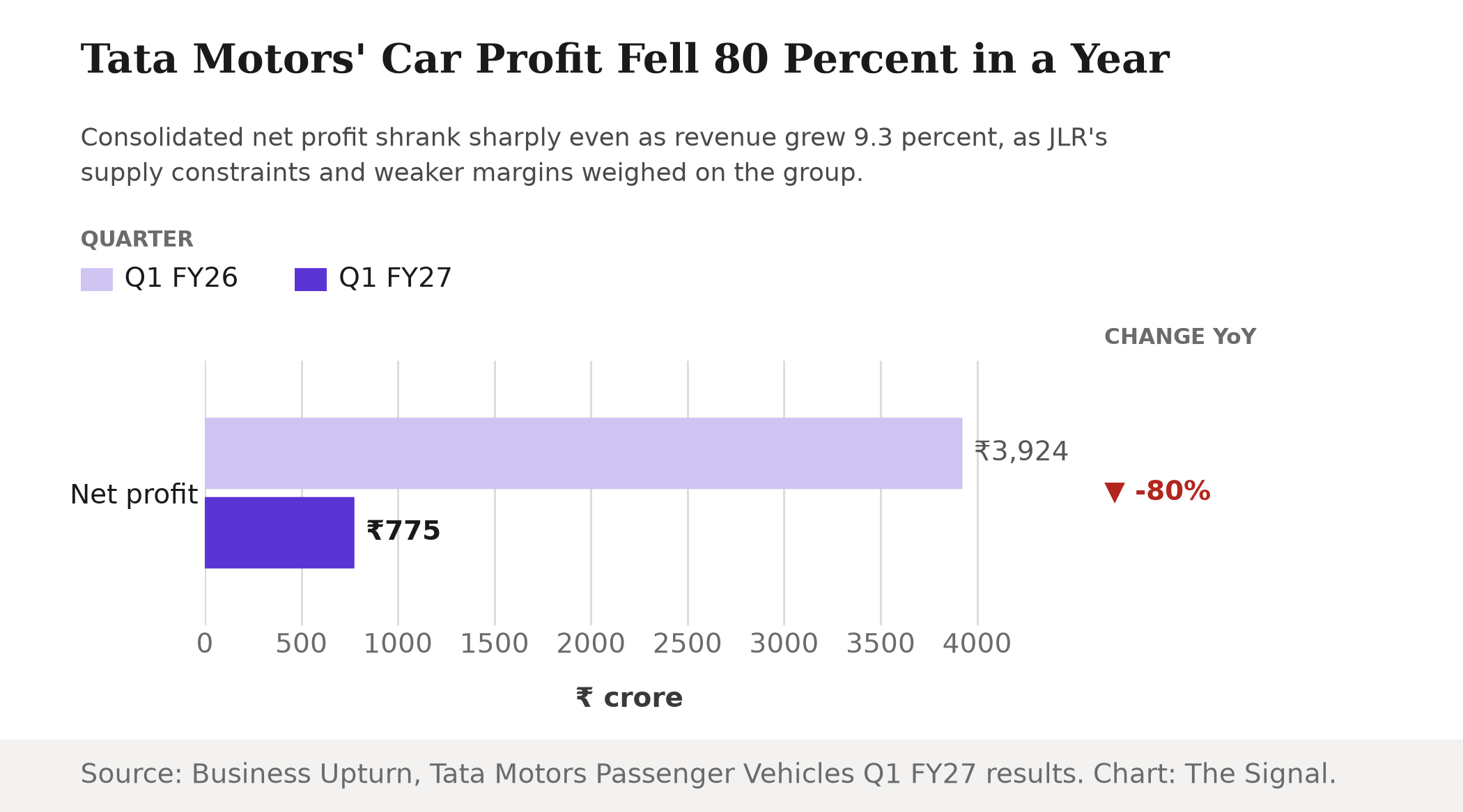
It already has. Tata Motors Passenger Vehicles' consolidated net profit fell 80.3% year on year to ₹775 crore in Q1 FY27, down from ₹3,924 crore a year earlier, Business Upturn's coverage of the results reports, with JLR's supply constraints and thinner margins named as the drag. Cash tells the same story from a different angle: JLR's free cash flow was negative by just under £1 billion in Q1 FY27, the main drag on the whole group's consolidated cash generation that quarter, according to a GuruFocus summary of the company's earnings call. India's domestic car business grew handsomely in the same quarter. It was not big enough to matter against that.
Tata Motors Passenger Vehicles' profit fell 80 percent even as revenue grew.
The honest objection
The strongest case against reading this as an Indian crisis is that the job cuts are exactly the kind of self-correction a healthy parent company should welcome. JLR is not being propped up: it is cutting its own costs, targeting £1.7 billion in savings and a lower break-even point, while the US-UK trade deal has already cut its tariff rate on JLR's cars from 27.5% to 10%, more than half of the earlier rate. On this view, Tata Motors owning a subsidiary willing to make hard cuts, rather than one that waits to be rescued, is a sign of a well-run group, not a fragile one.
That case has real force, but it does not explain the direction of travel. The tariff relief landed in the same quarter that JLR's margin still narrowed and its free cash flow still went nearly a billion pounds negative. Cost cuts announced this week will take two years to fully land, and they address JLR's own expenses, not the competitive pressure from Chinese rivals that JLR itself named alongside tariffs as a reason for the cuts. A subsidiary correcting itself is reassuring only if the correction outruns the pressure that made it necessary. On the numbers available so far, it has not yet.
The Signal
None of this makes Tata Motors a fragile company. It makes it a company whose fortunes now run largely through Solihull and the Midlands rather than through Mumbai or Pune. That was true before the tariffs, when JLR was already generating around 70% of the group's revenue, back in fiscal 2024. The tariffs and the job cuts just made the arithmetic impossible to ignore. Watch JLR's next quarterly margin, not its India sales figures, if you want to know where Tata Motors is actually headed. A car company's Indian identity, on the current numbers, is now mostly a matter of where its headquarters happens to sit.
Reporting basis: the job-cuts announcement and its stated rationale are per the Associated Press, as carried by WRAL, and JLR's own statement on the savings target and break-even goal is as reported by Motor Trader. JLR's FY25, FY26 and Q1 FY27 revenue, profit and margin figures are all from JLR's own results statements, published on its corporate media site. US tariff rates and the UK quota are from the White House's official fact sheet and a US Customs and Border Protection bulletin, both primary government sources. Tata Motors' FY24 revenue share is per Autocar Professional's analysis of the fiscal 2024 results, and the Q1 FY27 revenue split, net profit and their comparison to India's domestic segment are per Autocar Professional's and Business Upturn's separate coverage of the same results. JLR's free cash flow figure is per a GuruFocus summary of the company's own earnings call. The 81 percent and 19 percent revenue shares, and the four-times comparison between JLR-plus-rest and India's domestic business, are The Signal's calculations from those reported figures.