On September 4, 2026, ICICI Bank told the stock exchanges that the Reserve Bank of India had approved Life Insurance Corporation of India to acquire up to 9.99 percent of the bank's paid-up share capital or voting rights, a clearance valid for one year from the date of the RBI's letter. LIC already held 4.35 percent of ICICI Bank as of June 30, 2026, so using the full new headroom would take its stake to 14.34 percent, comfortably inside the 15 percent ceiling the Insurance Regulatory and Development Authority of India allows an insurer to hold in a single company, depending on the insurer's asset size. Read on its own, that is a single institutional investor topping up a bank holding, cleared by two regulators doing routine work.
It is worth slowing down on the one number in that filing: 9.99 percent. It is not the first time it has shown up on an LIC bank filing.
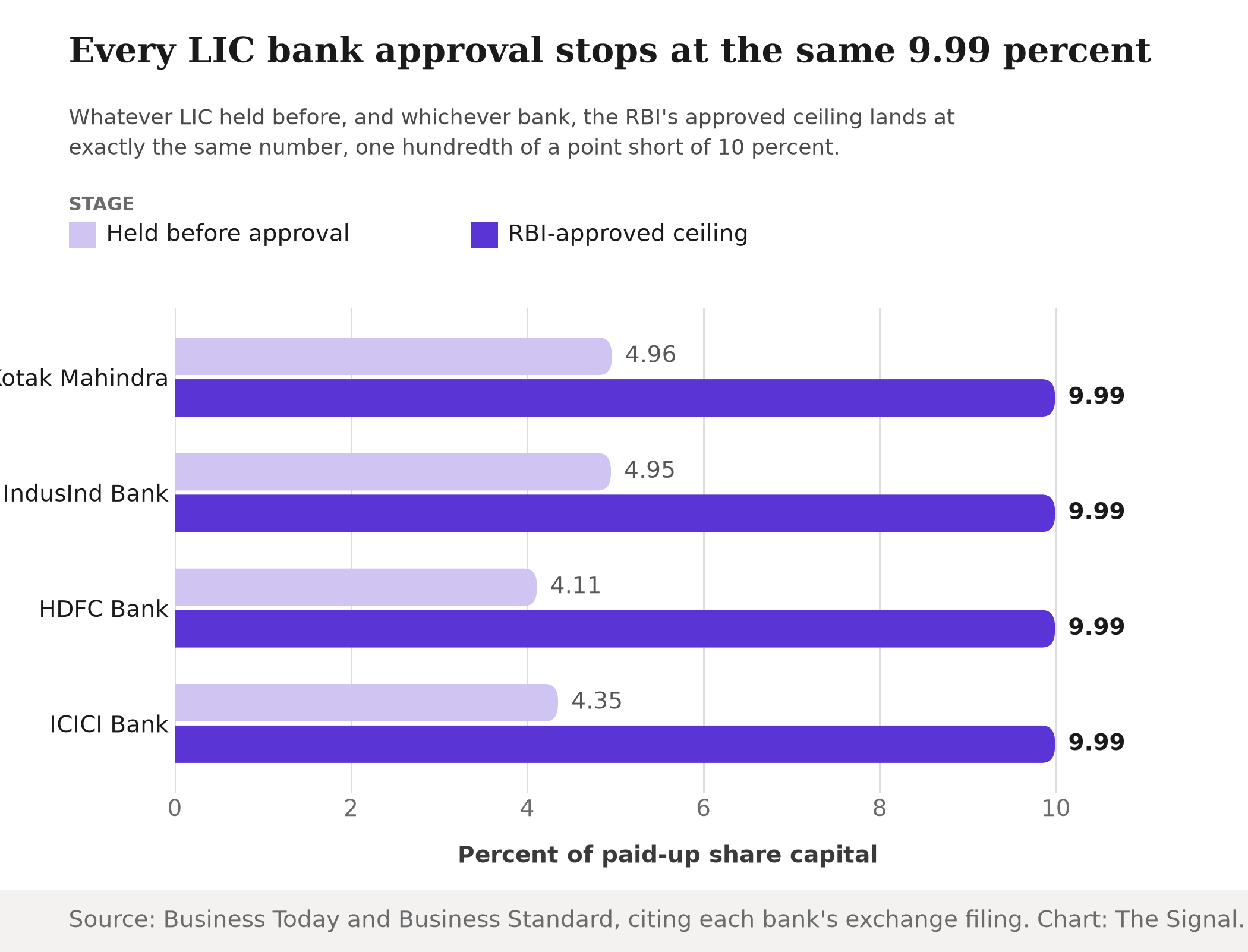
The same ceiling has now appeared on four separate approvals in under five years.
In November 2021, the RBI approved LIC to raise its Kotak Mahindra Bank stake to up to 9.99 percent, from 4.96 percent as of September 2021. In December 2021, the RBI cleared LIC to raise its IndusInd Bank stake to up to 9.99 percent, from 4.95 percent. In August 2026, the RBI approved the same 9.99 percent ceiling for LIC's stake in HDFC Bank, up from 4.11 percent as of August 14, 2026. And now ICICI Bank makes four. Whatever LIC held going in, and whichever bank it was buying into, the number the RBI signs off on never moves.
Why 9.99 and not 10
The number is not a coincidence, and it is not really about LIC's appetite. Under the RBI's Master Direction on acquisition and holding of shares in banking companies, effective January 16, 2023, any acquisition that results in "major shareholding", defined as an aggregate of 5 percent or more of a bank's paid-up share capital or voting rights, requires the RBI's prior approval, with materially stricter fit-and-proper scrutiny once holdings reach 10 percent or more. Ten percent is where the regulatory question shifts from a basic check to something closer to a control test. Staying one hundredth of a point under it keeps an acquisition inside the lighter of the two regimes.
That this is a structural feature of the approval process, not an LIC habit, shows up in who else has hit the exact same number. In March 2022, the RBI separately approved SBI Mutual Fund and other SBI group companies, which together held 5.72 percent of ICICI Bank at the end of December 2021, to acquire up to 9.99 percent of the bank. That approval came from the same post-2021 framework that lets widely-held financial institutions hold up to 15 percent of a private bank, so long as anything above 5 percent clears the RBI first. Two different owners, one bank in common, one ceiling in common. The number is the shape of the rule, and LIC is simply the shareholder that has now hit it four times.
The bank ICICI is catching
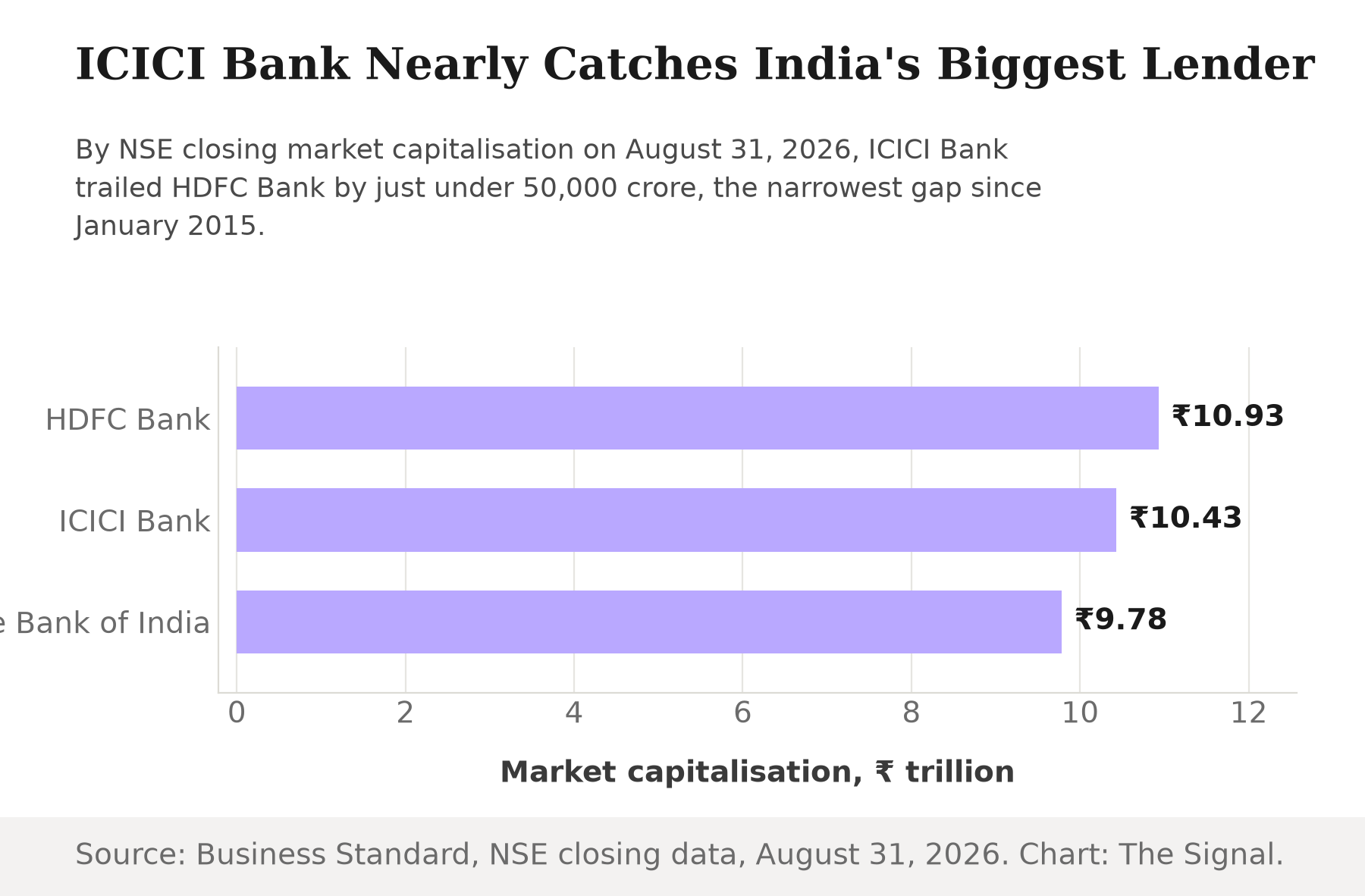
The stake LIC just added headroom for sits atop a gap that has been narrowing on its own. By NSE closing data on August 31, 2026, ICICI Bank's market capitalisation stood at 10.43 trillion rupees, just 49,167 crore behind HDFC Bank's 10.93 trillion rupees, the tightest gap between the two since January 2015. State Bank of India ranked third by that same measure, at 9.78 trillion rupees. ICICI Bank is India's second-largest bank by market value, not its largest, but the gap has rarely been narrower.
The buyer approaching that stake is not a small one either. LIC's assets under management reached 59,39,384 crore rupees, about 59.4 trillion rupees, as of June 30, 2026, up 4.10 percent year on year, while standalone net profit grew 23 percent year on year to 13,492 crore rupees in the same quarter. That scale is not just an absolute number against LIC's own history. In FY26, LIC's new business premium of 2.60 trillion rupees, up 14.9 percent year on year, was larger than the combined 1.99 trillion rupees collected by every private life insurer in the country put together, out of industry-wide new business premium of 4.59 trillion rupees reported by the Life Insurance Council, making LIC alone about 56.6 percent of the entire life insurance new-business market in FY26. An insurer that size buying into large bank stocks is unremarkable on its own. What is less ordinary is that it keeps happening to the same handful of names, at the same ceiling.
The other LIC playbook
LIC has a second, older relationship with a bank, and it looks nothing like the 9.99 percent pattern. On August 1, 2018, the Union Cabinet approved LIC's acquisition of a controlling stake, up to 51 percent, in IDBI Bank as promoter, alongside the government's own shareholding falling below 50 percent and its relinquishment of management control. That was a takeover, approved once, at cabinet level, not a capped minority position cleared bank by bank.
Eight years on, that stake is being unwound rather than repeated elsewhere. SEBI has approved reclassifying LIC's 49.24 percent stake in IDBI Bank from promoter to public shareholder once the bank's strategic disinvestment concludes, on the condition that LIC's voting rights are capped at 10 percent, that it takes no board representation or control, and that it cuts its residual stake to 15 percent or below within two years of the sale closing. As of July 14, 2026, the government and LIC were jointly selling their combined 60.7 percent stake in IDBI Bank, with revised bids from Canada's Fairfax Financial Holdings and Dubai's Emirates NBD under evaluation in a deal estimated at about 5.7 billion dollars.
LIC's IDBI Bank position is being sold down to the same kind of stake it is building everywhere else.
| Holder | Stake in IDBI Bank | Status as of the deal |
|---|---|---|
| Government of India | 45.48% | Selling, part of combined stake |
| Life Insurance Corporation | 49.24% | Selling, capped at 10% voting rights and no board seat post-sale |
| Combined stake on offer | 60.7% | Under evaluation by Fairfax Financial Holdings and Emirates NBD |
Source: ANI, July 14, 2026 and Business Today, citing IDBI Bank's exchange disclosure.
LIC's two modes converge on the same shape of stake: a controlling, board-level position dismantled down toward a capped, non-controlling one at IDBI Bank, and fresh approvals building capped, non-controlling positions from scratch everywhere else. Large, present, but kept just under the line that would require it to run anything.
The honest objection
The case for treating this as nothing more than prudent asset allocation is straightforward. Each approval is public, bank by bank, cleared by a named regulator against a documented rule. IRDAI's own ceiling limits how much of any single company an insurer can hold, scaled to the insurer's asset size, so no individual position can run away unchecked. For an insurer with liabilities to match, a spread of large, liquid bank holdings is closer to prudent than aggressive. Nothing here is hidden: every filing lands with the exchanges the same day or the next.
That defense holds for any one bank taken alone. It says less about the four taken together. The RBI's approval regime works bank by bank, clearing each acquisition against that bank's own ownership limits, and IRDAI's cap works company by company, not against LIC's combined exposure across the banking system. No single filing, and no single regulator, is required to add up what a 9.99 percent position in four of India's largest private lenders amounts to held at once. The rule that caps each stake was never built to cap their sum.
The Signal
Nothing in these four filings breaks a rule; every one of them followed it. That is exactly the point. A ceiling designed to keep any one acquisition from tipping into control does nothing to stop the same institution from approaching that ceiling in bank after bank, because each approval is judged only against the bank in front of it. The two 2021 approvals are the closest thing to a precedent for what happens after the clearance lands: as of the December 2024 quarter, LIC held just over 5 percent of IndusInd Bank, according to ACE Equity data, well short of the 9.99 percent the RBI had cleared it to reach three years earlier. Approval to buy is not the same as buying. Watch what LIC does next with the fresh headroom in ICICI Bank and HDFC Bank: if it stops well short of 9.99 percent, that would match the IndusInd pattern of holding the option rather than exercising it. If it fills the room all the way to the ceiling in both, four approvals will have quietly built LIC into one of the largest shareholders across most of India's biggest private banks, and the country's bank-ownership rules will have allowed it one filing at a time.
Reporting basis: the ICICI Bank and HDFC Bank RBI approvals, and the SBI group's ICICI Bank approval, are attributed to Business Standard, citing each bank's exchange filings and the RBI's approval letters. The Kotak Mahindra Bank and IndusInd Bank approvals are attributed to Business Today, citing those banks' exchange filings. LIC's assets under management and quarterly results are per Business Standard's write-up of LIC's own disclosure. The IDBI Bank SEBI reclassification is per Business Today's write-up of IDBI Bank's exchange disclosure, and the stake sale to Fairfax Financial Holdings and Emirates NBD is per ANI, citing government sources. The 2018 Cabinet approval is a Press Information Bureau record of that decision, and the ownership thresholds are from the Reserve Bank of India's own Master Direction. The 14.34 percent combined stake and the 49,167 crore gap are as stated in that Business Standard reporting, not derived. LIC's FY26 new business premium and its share of the industry total are per Business Standard's reporting of Life Insurance Council data; the 56.6 percent figure is derived by dividing LIC's reported premium by the reported industry total. LIC's December 2024 IndusInd Bank stake is per Business Standard's reporting of ACE Equity data.