On 20 August 2026, India's Directorate General of Foreign Trade opened a tariff-rate quota letting traders bring in one million tonnes of raw sugar duty free, to be refined and sold domestically by 31 October. The Week reported the notice as a straightforward supply fix: retail sugar in India was running well above last year's level, and importing more of it, without the usual duty, should bring the shelf price down before the festival season. It reads like ordinary demand management, the kind of order a trade ministry issues every year.
It is worth slowing down on that reading. Two weeks later, the UN's Food and Agriculture Organization published its August Food Price Index, and named the reasons its sugar sub-index had jumped. India's own announcement was one of them.
The index that named India
The FAO's Food Price Index averaged 133.3 points in August 2026, up 1.9 percent from July's revised level. Buried in the same release is a sharper number: the sugar component alone rose 11.9 percent that month, more than six times the pace of the broader basket.
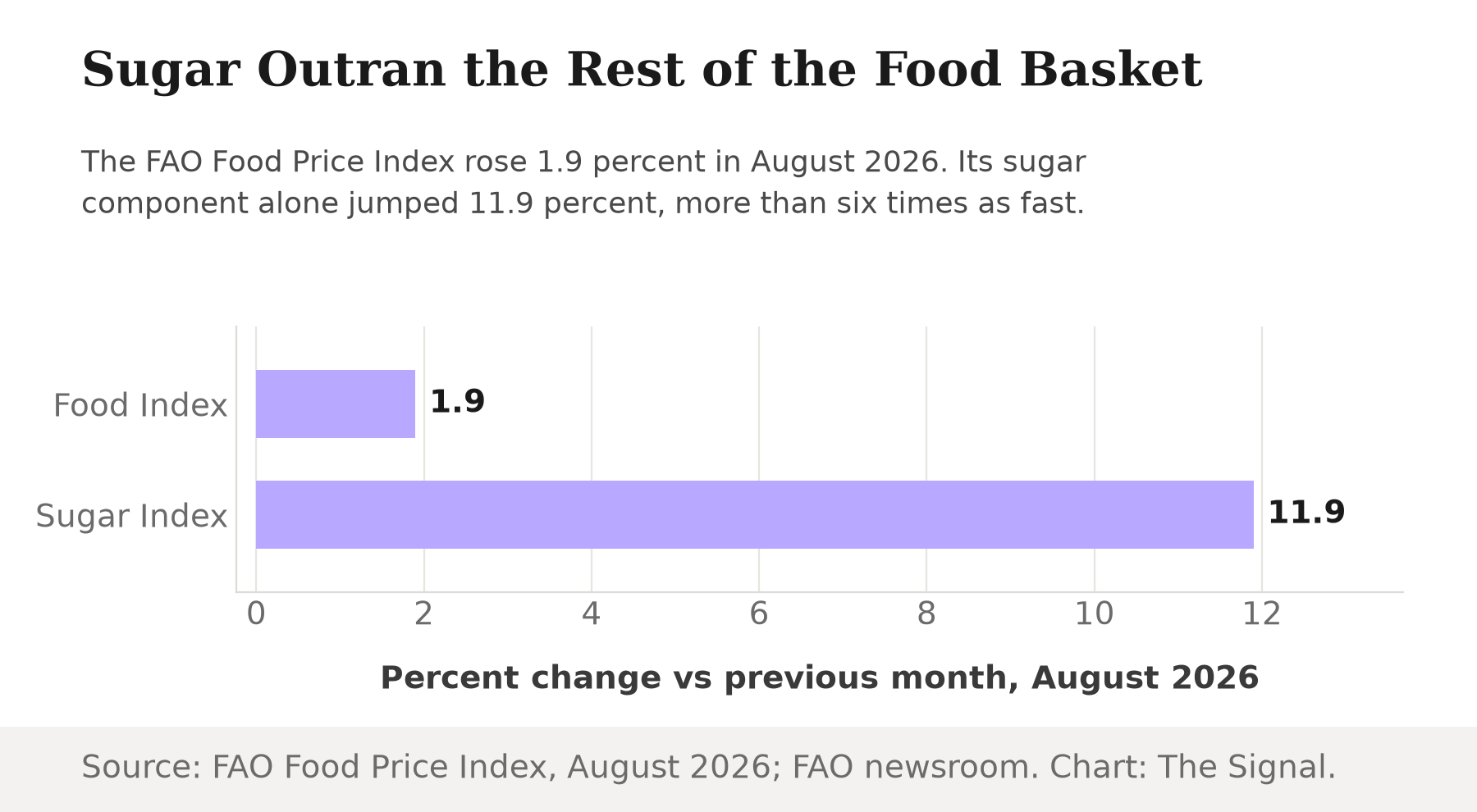
The FAO's own newsroom release explained the surge as a combination of four things: weaker sugar beet yields in the European Union, El Nino's hit to production prospects in key Asian producers, lower output from Brazil's Center-South cane belt, and, the FAO said, "India's announcement of duty-free raw sugar imports." A policy written to bring a domestic price down had registered, within days, as a demand signal large enough for the world's food-price agency to name it alongside a continent's harvest and a hemisphere's weather.
That August reading was not a one-off spike in an otherwise calm year. Reuters reported, as carried by RTE, that August's Food Price Index score was the highest since November 2022, though still nearly 17 percent below the record set in March 2022. Global food prices, in other words, were already climbing before India's sugar order landed. What that order did was add its own weight to a rise already in motion.
The price India will actually pay
India is not just an announcer in this market. It is about to be a buyer, and the price it buys at is set on the same global market its announcement helped move.
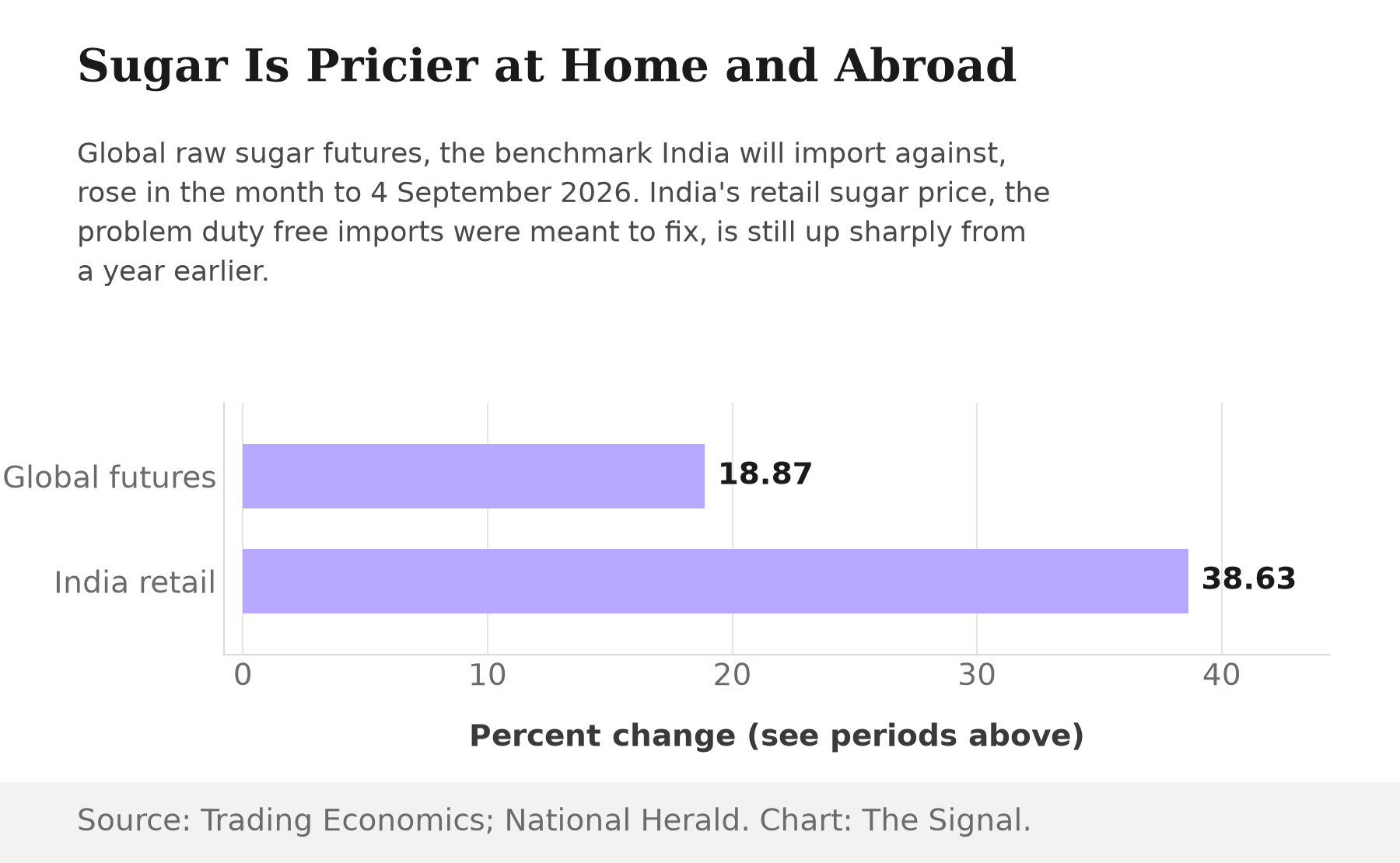
Trading Economics data show that global raw sugar futures, the benchmark contract against which India's traders will price their imports, rose 18.87 percent in the month to 4 September 2026, trading at 18.01 US cents a pound. That window runs from 21 August, the day after India's duty-free notice, to 4 September 2026. The one million tonnes due to land and get refined by 31 October will be bought against a benchmark that moved sharply higher in exactly the weeks since the policy was announced.
Meanwhile the problem the policy was meant to solve has not gone away. National Herald reported, citing Consumer Affairs Ministry price-monitoring data, that India's all-India average retail sugar price was 38.63 percent higher in late August 2026 than the same period a year earlier. Indian shoppers are paying more, and the import benchmark is higher too. Both lines point the same way.
Cause and buyer are not the same seat
The honest objection here is that the FAO listed four factors, not one, and India's announcement is a single line in a list that also includes a weak European harvest, El Nino's drag on Asian cane, and a smaller Brazilian crop. Brazil's Center-South region supplies a large share of the sugar that moves in world trade, and a genuine shortfall there can move the benchmark on its own, with or without any single importer's policy news. On that reading, India's notice was a footnote to a supply story, not the engine of it, and the coincidence of timing between the DGFT order and the futures rise says less about India's weight in the market than it does about a market that was already tight.
That case has real force, and the FAO's own wording treats the four factors as co-equal, not ranked. But it does not undo the second half of the story, which has nothing to do with how much of the sugar sub-index's 11.9 percent rise India's announcement actually caused. Whatever the split among those four causes, India still has to import a million tonnes against whatever the benchmark says on the day its traders buy, and that benchmark is now 18.87 percent higher than it was a month before. A policy can be a minor contributor to a price rise and still be a major victim of it. Those are different claims, and India's sugar order is exposed on the second one regardless of how the first one is argued.
The Signal
For years, India has mostly been written about as a price taker in global commodity markets: a large enough buyer to matter, rarely large enough to be named as a mover. This is a rare case where an Indian policy shows up by name in the FAO's own explanation for a global price swing, before a single tonne under that policy has even reached a port. The irony is that the timing works against the policy's own goal. A tariff-rate quota meant to arrive by 31 October cheap enough to cool a 38.63 percent retail rise will instead be filled against a benchmark that had already climbed almost 19 percent by early September. Watch what the landed cost of that million tonnes turns out to be, and whether India's retail sugar price is actually lower by the time the quota closes. If it is not, the fix will have spent its effect on the world price before it ever reached the shelf.
Reporting basis: the FAO's food price benchmark and its month-on-month change, and the sugar component's rise with its stated causes including India's duty-free import announcement, are both from FAO releases, the benchmark itself and a separate FAO newsroom detail page. The historical comparison is per Reuters, as carried by RTE. The DGFT's tariff-rate quota notice and its terms are per The Week's reporting of the public notice. India's retail sugar price change is per National Herald, citing Consumer Affairs Ministry price-monitoring data. The global raw sugar futures level and its one-month change are from Trading Economics market data. No figure in this piece is The Signal's own calculation; all are as reported by the sources above.