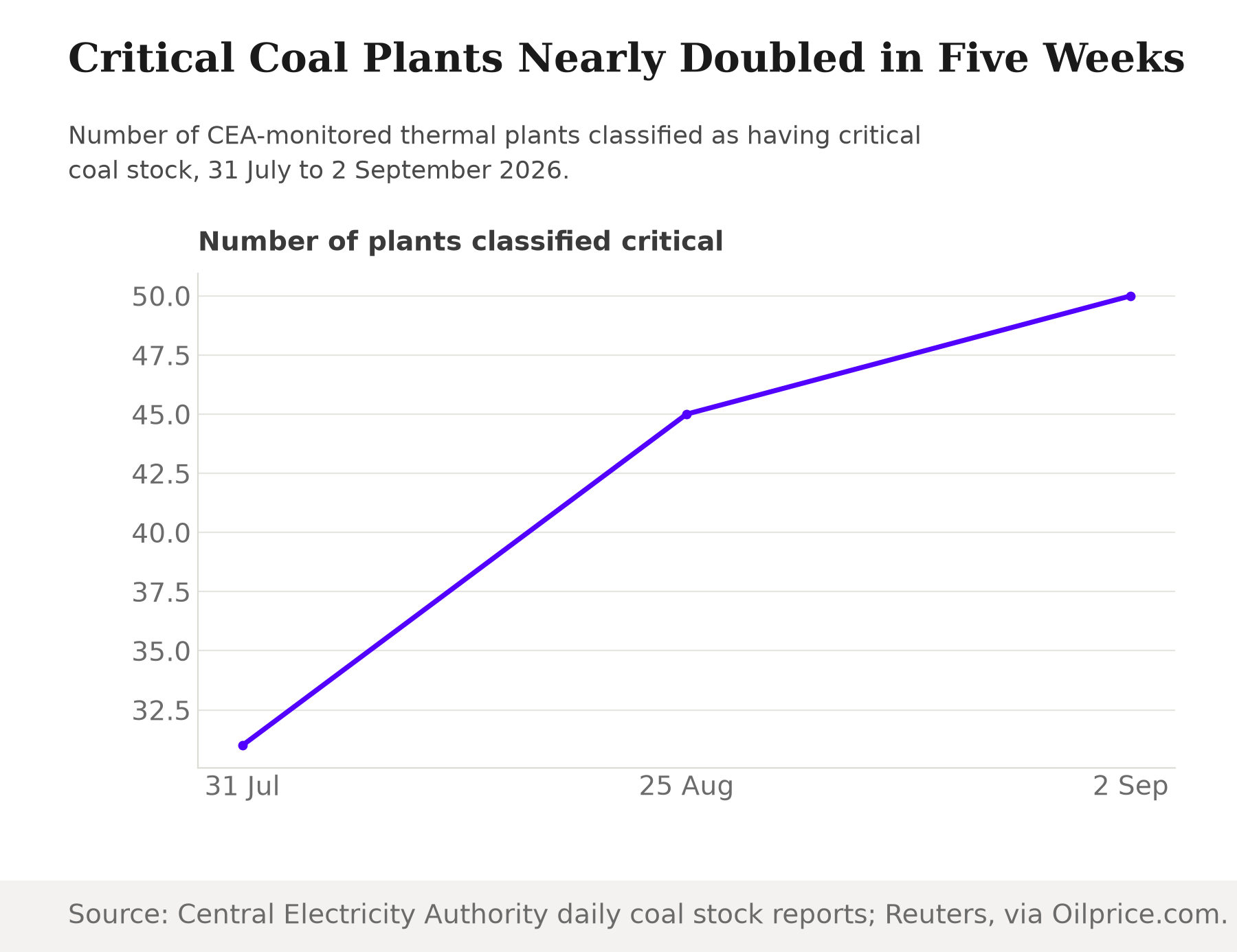
Fifty of India's 190 coal-fired thermal power plants monitored by the Central Electricity Authority held critical coal stock on 2 September 2026: 45 running on domestic coal, four built for imported coal, and one on washery rejects. Across all 190 plants, national coal inventory stood at 28.17 million tonnes against a prescribed requirement of 57.68 million tonnes, or 48 percent of norm, on the same CEA report. That fleet represents 223,868 megawatts of capacity, running on just under half the fuel cushion it is designed to hold.
That alone would read as a seasonal blip. It is worth slowing down on the timeline, because a month earlier the same CEA tracker counted only 31 critical plants, with national stock at 59 percent of norm. By 25 August the count had already reached 45, 40 of them domestic-coal plants, according to Reuters's review of the data. In five weeks, the critical-plant count climbed from 31 to 50 and the stock cushion fell 11 points further behind its own design target.
A plant only earns the critical label below 25 percent of its required inventory, or with fuel for fewer than three days of generation: a deliberately conservative early-warning line, not the point at which a plant actually goes dark. That framing has held in past years, when the count ticked up in the monsoon and back down once rail traffic recovered. It does not explain why the number kept climbing through the exact window India's own weather office had already told the country to expect trouble in.
The forecast came a month early
On 31 July 2026, the India Meteorological Department forecast below-normal rainfall, under 94 percent of the Long Period Average, for August and September, and said moderate El Nino conditions in the equatorial Pacific were expected to strengthen through the rest of the monsoon season. That combination is precisely the stress case a coal-fired power system is stockpiled against: less rain should mean fewer flooded pits and rail lines moving coal out of the eastern coalfields, but it also means more heat and heavier air-conditioning load pulling on plants that were supposed to be sitting on a comfortable buffer.
An NTPC official captured the mismatch to Reuters on 25 August: the uneven monsoon has driven power demand, primarily for air-conditioning, while coal supplies are running hand-to-mouth, adding that some plants needed five to six coal rakes a day and were getting only about half that number. India's stockpile mechanism exists to absorb exactly this kind of forecastable seasonal stress. Five weeks after IMD's own warning, the CEA numbers show it had not.
The market has already priced it
If this were only a monitoring quirk, coal itself would not be getting more expensive. It has. Coal India's average e-auction premium over the notified price rose to 59 percent in August 2026, compared with a 46 percent average over the wider April-August period. Buyers without a fuel-supply agreement pay this premium for spot coal, and a premium that jumps 13 points in a single month is what real scarcity pricing looks like, not an artifact of a classification threshold.
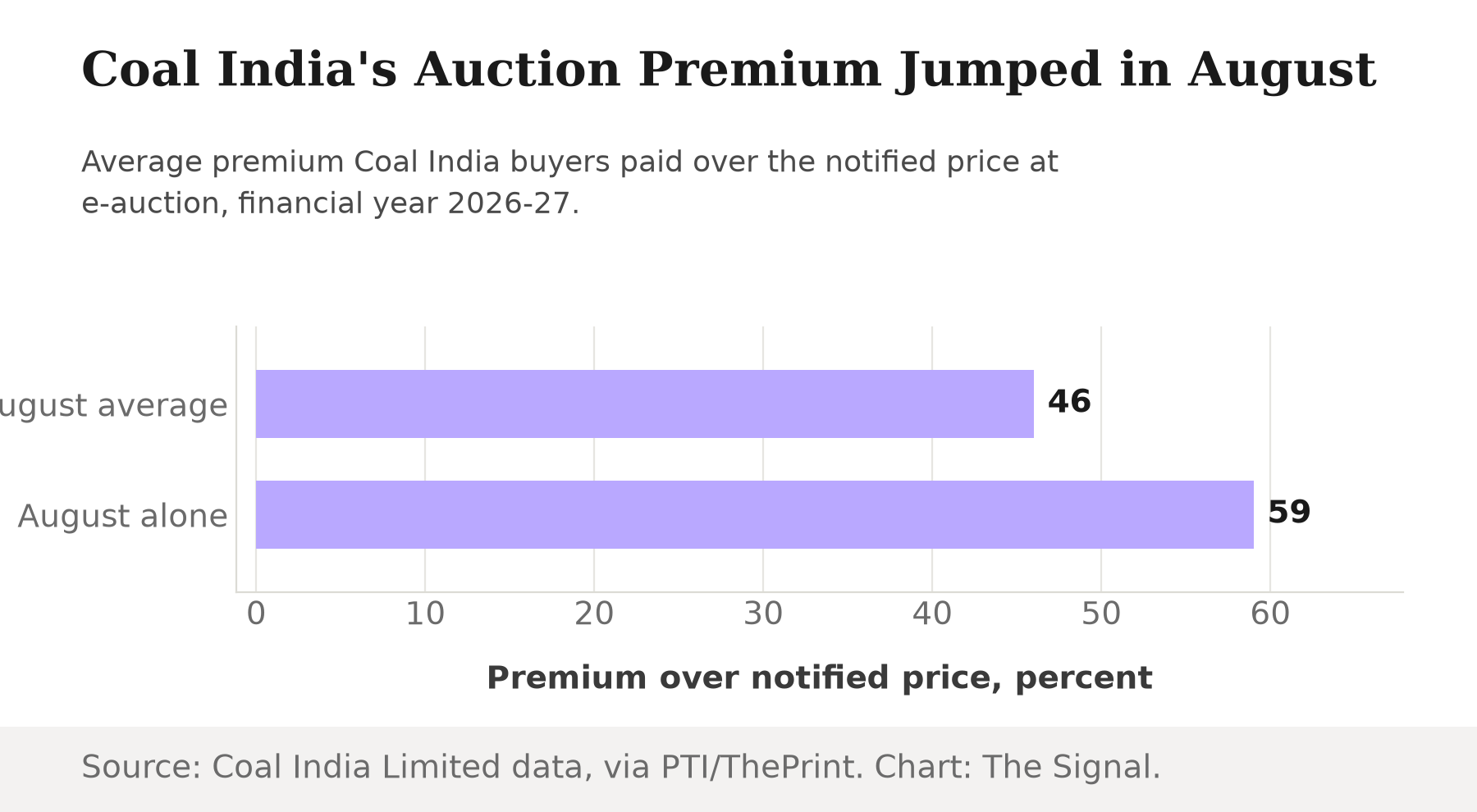
Coal India's own buyers are paying up for scarcity, not just watching a data flag.
The miners are scrambling too
The response inside the coal sector matches the price signal. Singareni Collieries, the Telangana state coal company, directed all its mining areas to raise daily coal production and dispatch to 1.9 lakh tonnes to meet rising power demand, in a directive reported on 4 September, a day before CEA's critical-plant count reached 50. A state coal producer telling every one of its mining areas to hit a specific daily tonnage target is not the posture of a company treating this as a routine data flag.
The honest objection
The strongest case for calm is definitional. Forty-five of the 50 critical plants on 2 September ran on domestic coal, so the pressure sits in the ordinary mining-and-rail supply chain the stockpile system is built to smooth over, not in a chain that broke unexpectedly. And the same 25 August review that reported the count at 45 also described the situation as localised logistical pressure rather than a nationwide coal shortage. On this reading, a conservative early-warning line is doing exactly its job, flagging stress before it becomes a blackout risk, and nothing more should be read into the count itself.
That case would be stronger if the trend had leveled off once IMD's forecast window opened on 1 August. It has not. The critical count rose at each of the three CEA and Reuters data points between 31 July and 2 September, and the national cushion fell from 59 to 48 percent of norm over the same five weeks, while Coal India's buyers paid a steadily rising premium to secure spot fuel. A warning line that keeps tripping in the same direction, for five straight weeks, during the exact period the country's own forecasters flagged in advance, has moved past routine monitoring. It is the response, not the alarm, that has lagged.
The Signal
India's coal buffer exists to convert a forecastable monsoon and demand risk into a manageable one. IMD gave the country a month's notice on both halves of that risk, below-normal rain and a strengthening El Nino, on 31 July. By 2 September, the critical-plant count had climbed from 31 to 50 and the national cushion had fallen 11 points further behind its own norm, while Coal India's own buyers were paying 59 percent premiums to secure spot fuel. None of that required a surprise. It required stock built ahead of a well-flagged window, and by the CEA's own numbers, that build did not keep pace. The number to watch next is whether the critical count keeps climbing past 50 as IMD's forecast window runs through September, or whether Singareni's 1.9-lakh-tonne target and Coal India's premium-priced e-auctions close the gap first.
Reporting basis: the 2 September and 31 July 2026 coal stock figures, the critical-plant counts, and the capacity and normative-stock totals are per the Central Electricity Authority's own daily coal stock reports. The 25 August critical-plant count, the fuel-mix breakdown at that date, the definition of the critical threshold, and the NTPC official's quote are as reported by Reuters, via Oilprice.com. The India Meteorological Department's rainfall and El Nino forecast is from its own 31 July 2026 press release. Coal India's e-auction premium figures are per Coal India Limited data, as reported by PTI via ThePrint. The Singareni Collieries production directive is as reported by Deccan Chronicle. No figure in this piece is The Signal's own calculation.