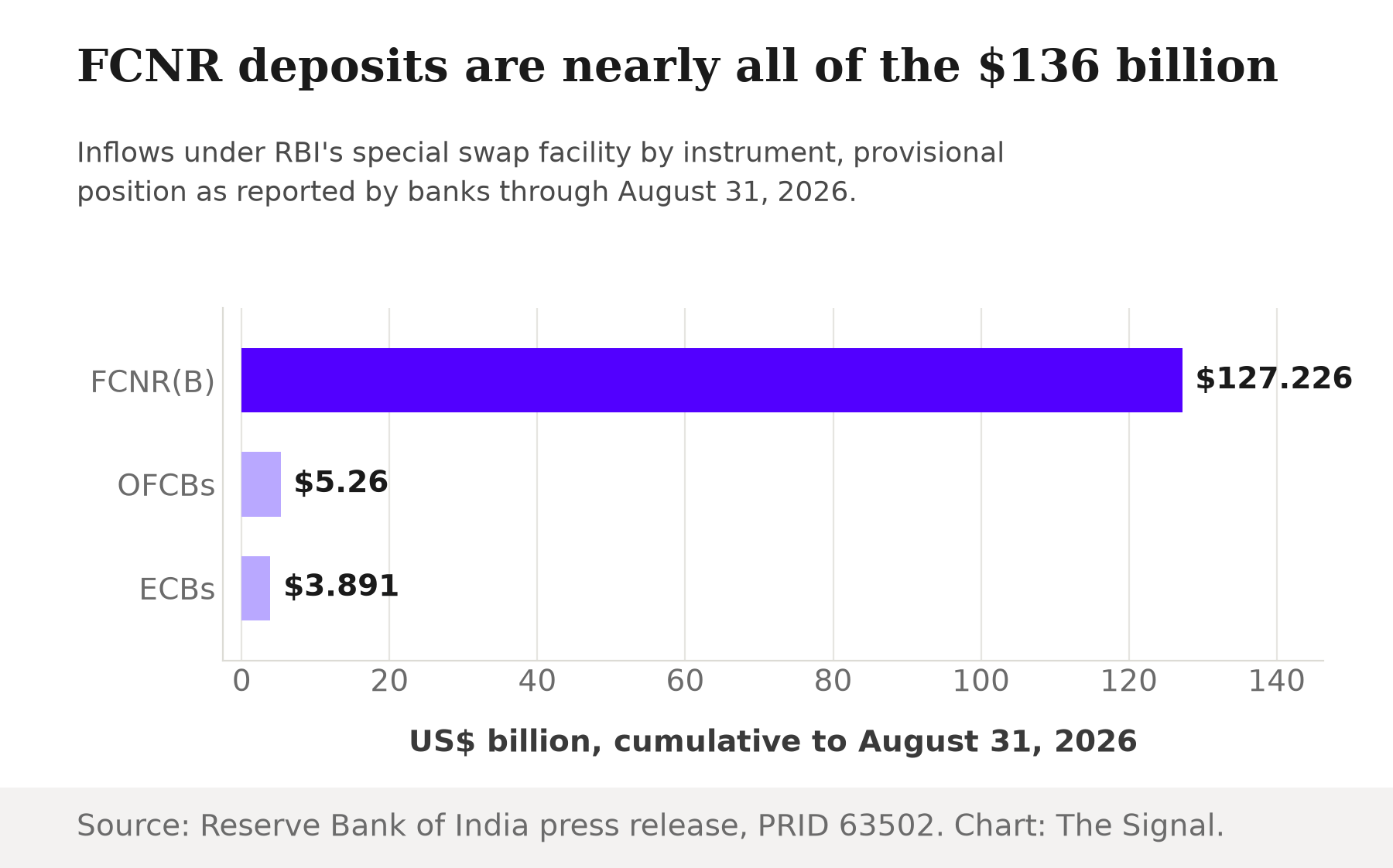
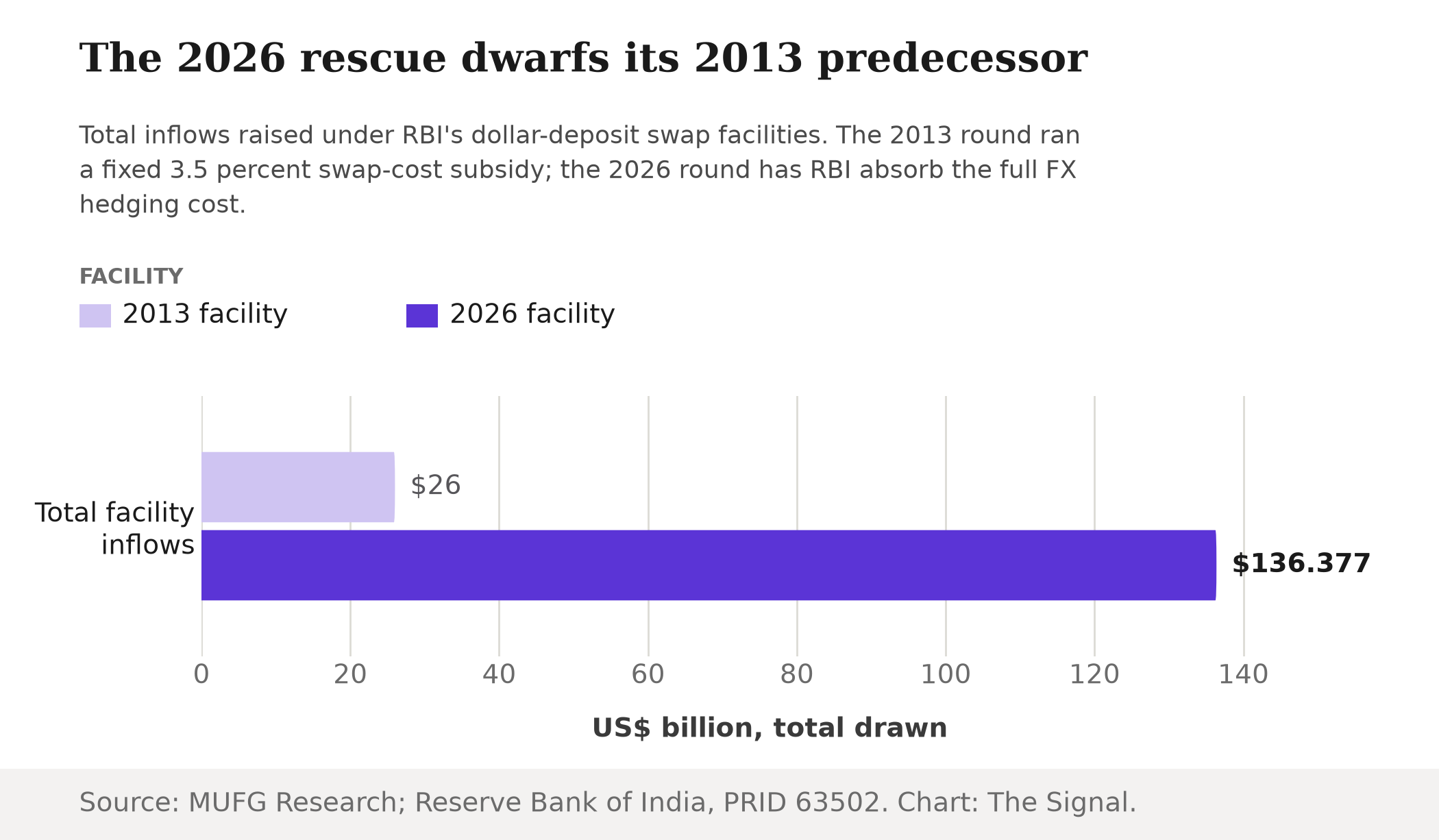
By the time the counting stopped, RBI's special swap facility had pulled in $136.377 billion, with FCNR(B) deposits alone accounting for $127.226 billion of that, per provisional figures banks reported through August 31, 2026. The response was strong enough that RBI moved the window's closing date forward a full month, from September 30 to August 31, 2026, having already met its objective ahead of schedule. Along the way, FCNR(B) inflows helped push India's foreign exchange reserves to a record $729.33 billion in the week ended August 21, 2026, adding $65.397 billion since the facility opened on June 8. Read only the totals and this looks like a clean win: the rupee needed defending, banks and depositors answered, and RBI closed the book early.
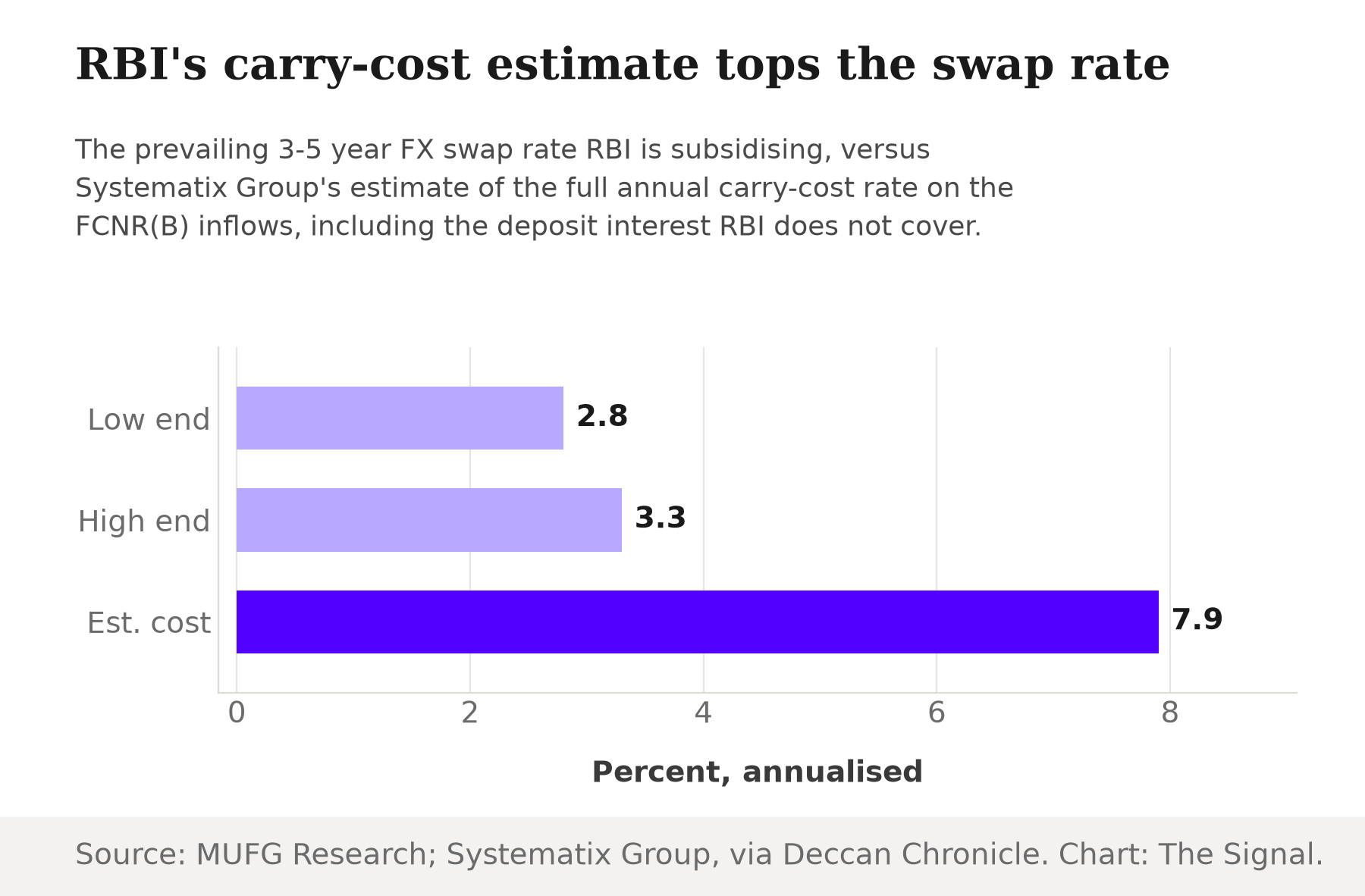
It is worth slowing down on that framing. The facility worked by asking banks to bring in dollar deposits and letting RBI take the currency risk off their hands. RBI's swap covers only the principal of the deposits, not the interest, on fresh FCNR(B) deposits carrying a minimum three-year tenor, with the swap itself running for up to five years. That structure did not eliminate the cost of the rescue. It moved the cost onto RBI's own books. A Systematix Group analysis estimates that price directly: the FCNR(B) inflows could carry an annual carry cost of around $5.7 billion for the country, a carry-cost rate of roughly 7.9 percent. That is the number the success story leaves out.
How the rescue is structured
RBI has run this play before. In 2013, a fixed 3.5 percent swap-cost subsidy on similar deposits drew about $26 billion, and this year's facility, with total inflows of $136.377 billion, outdrew it more than five times over. The mechanics changed along with the scale. Banks and depositors could plan around the 2013 subsidy's fixed rate. The 2026 facility instead has RBI absorb the full FX hedging cost, a discount of around 3 percentage points against the prevailing FX swap rate of 2.8 to 3.3 percent for the three-to-five-year tenor. RBI did not just make the deal more attractive this time. It took on the whole hedge itself.
The bill nobody advertised
The 2.8 to 3.3 percent range is only the swap-market price of the hedge RBI is subsidising. It is not the full cost of the deposits themselves, which also carry the interest RBI does not cover under its principal-only swap. That gap is exactly where Systematix Group's estimate lands: a 7.9 percent all-in carry-cost rate, more than double the top of the swap-rate range, and the rate behind that $5.7 billion annual figure.
Held constant across the deposits' minimum three-year and maximum five-year tenor, that $5.7 billion annual estimate would compound to a cumulative cost of roughly $17 billion to $29 billion by the time the last of these swaps mature, our calculation from Systematix's annual figure and RBI's own stated tenor range. Whether the true figure lands nearer the low or high end depends on how long individual banks hold their deposits and where swap rates move from here, both of which RBI does not disclose deposit-by-deposit.
Where the cost lands
RBI's own accounts show it is in no immediate danger from a bill this size. RBI's Central Board approved a record ₹2.86 lakh crore surplus transfer to the central government for the fiscal year 2025-26, which closed in March 2026, with net income before risk provisions rising to ₹3.95 lakh crore from ₹3.13 lakh crore the year before.
RBI's income base dwarfs the estimated carry cost, for now.
| RBI net income before risk provisions (₹ lakh crore) | FY 2024-25 | FY 2025-26 |
|---|---|---|
| Amount | 3.13 | 3.95 |
Figures are for RBI's fiscal year ending March. FY 2025-26's income underpinned a record ₹2.86 lakh crore surplus transfer to the government, as reported via Akashvani News, citing the RBI.
That FY26 surplus was set before the FCNR(B) facility existed, covering RBI's income through March 2026, three months before the swap window opened in June 2026. The $5.7 billion a year Systematix estimates has not yet shown up in a surplus transfer, because the transfer that would carry it has not happened yet. RBI does not book a rescue like this as a separate government-facing line item. The hedging cost is absorbed into RBI's own income and reserves, and whatever it subtracts, subtracts quietly from what is left to hand to New Delhi each year.
The honest objection
The strongest case against treating this as a real cost is that RBI can plainly afford it. Net income before risk provisions running at ₹3.95 lakh crore a year, several times any plausible reading of a $5.7 billion charge, means the facility is not a solvency risk, and a central bank absorbing a defensive hedge is closer to an insurance premium against a currency crisis than a loss. On that view, the $136 billion of inflows and the reserves they built are worth far more to India than whatever RBI pays in carry cost to have raised them.
That case holds on solvency, but not on where the money comes from. RBI's income is not a private balance sheet; it is the source of the surplus transfer that funds part of the union budget, a transfer that hit a record ₹2.86 lakh crore for FY 2025-26 alone. An insurance premium is still a premium. Someone pays it, even if RBI can absorb the payment without strain. In this case, the someone is whichever future surplus transfer would otherwise have been larger.
The Signal
RBI's rupee defense worked exactly as designed: it drew more than five times its 2013 predecessor, filled its own target early, and left reserves at a record. None of that required banks or depositors to price in currency risk, because RBI chose to carry the risk itself, and Systematix Group's estimate puts what that choice costs at roughly $5.7 billion a year. RBI has not published its own figure for the bill, and the honest accounting of a rescue this size will not be visible in any single week's data. It will show up, if it shows up at all, in whether next year's surplus transfer to the government grows as fast as this year's did. A currency defended is not the same as a currency defended for free. Watch the transfer, not the headline inflow number.
Reporting basis: the swap facility's inflow totals and instrument breakdown are from the Reserve Bank of India's own press release, and the swap terms from its FAQ on the facility. The window's advanced closure and the record forex-reserves figure are as reported by BusinessToday, citing RBI data. The 2013 comparison and the prevailing FX swap-rate range are from MUFG Research. The $5.7 billion annual carry-cost estimate and its 7.9 percent rate are a Systematix Group analysis, as reported by Deccan Chronicle, and rest on that single analysis. RBI's FY 2025-26 surplus transfer and net income figures are per the RBI, as reported by Akashvani News (Prasar Bharati). The cumulative three-to-five-year cost range and the description of the swap-rate-to-carry-cost gap are The Signal's calculations from those figures.