India's economy grew faster than almost anyone forecast this quarter. Real GDP grew 7.8% year on year in the April-June 2026 quarter, beating expectations, while nominal GDP grew 10.3% to Rs 88.27 lakh crore, MoSPI's National Statistics Office reported. That is the number that made headlines, and on its own terms it is a strong print: growth accelerating, not slowing.
It is worth slowing down on that. A critique that has circulated widely since the print landed does not dispute the Rs 88.27 lakh crore figure itself. It disputes what that figure should be measured against. Former Finance Secretary Subhash Chandra Garg put it plainly: if last year's GDP had not been revised, growth in current prices would have been only 2.6%, not 7.8%, and on that arithmetic, growth was not 7.8%, it was 2.6%.
Both numbers come from the exact same Rs 88.27 lakh crore. The critique compares it to Rs 86.05 lakh crore, the nominal GDP MoSPI itself had reported for the year-ago quarter under the old series. MoSPI's original Q1 FY26 press note, published 29 August 2025, put nominal GDP for that quarter at Rs 86.05 lakh crore, an 8.8% rise on the year before. Line the two numbers up and the gap looks tiny: about 2.6%, not 10.3%, let alone 7.8% real growth.
Two ways to divide the same number
The reason the two calculations diverge has nothing to do with data collection and everything to do with the yardstick. MoSPI says the Rs 86.05 lakh crore figure was calculated under the old 2011-12 base-year series. That series has since been superseded, so it cannot be compared directly with the new Q1 FY27 estimate under the revised 2022-23 series. The correct comparison, MoSPI says, is against Rs 80.32 lakh crore, the Q1 FY26 figure restated under the same new series. Measured against that number, nominal growth comes to 10.3%, the figure MoSPI actually published alongside the 7.8% real-growth number.
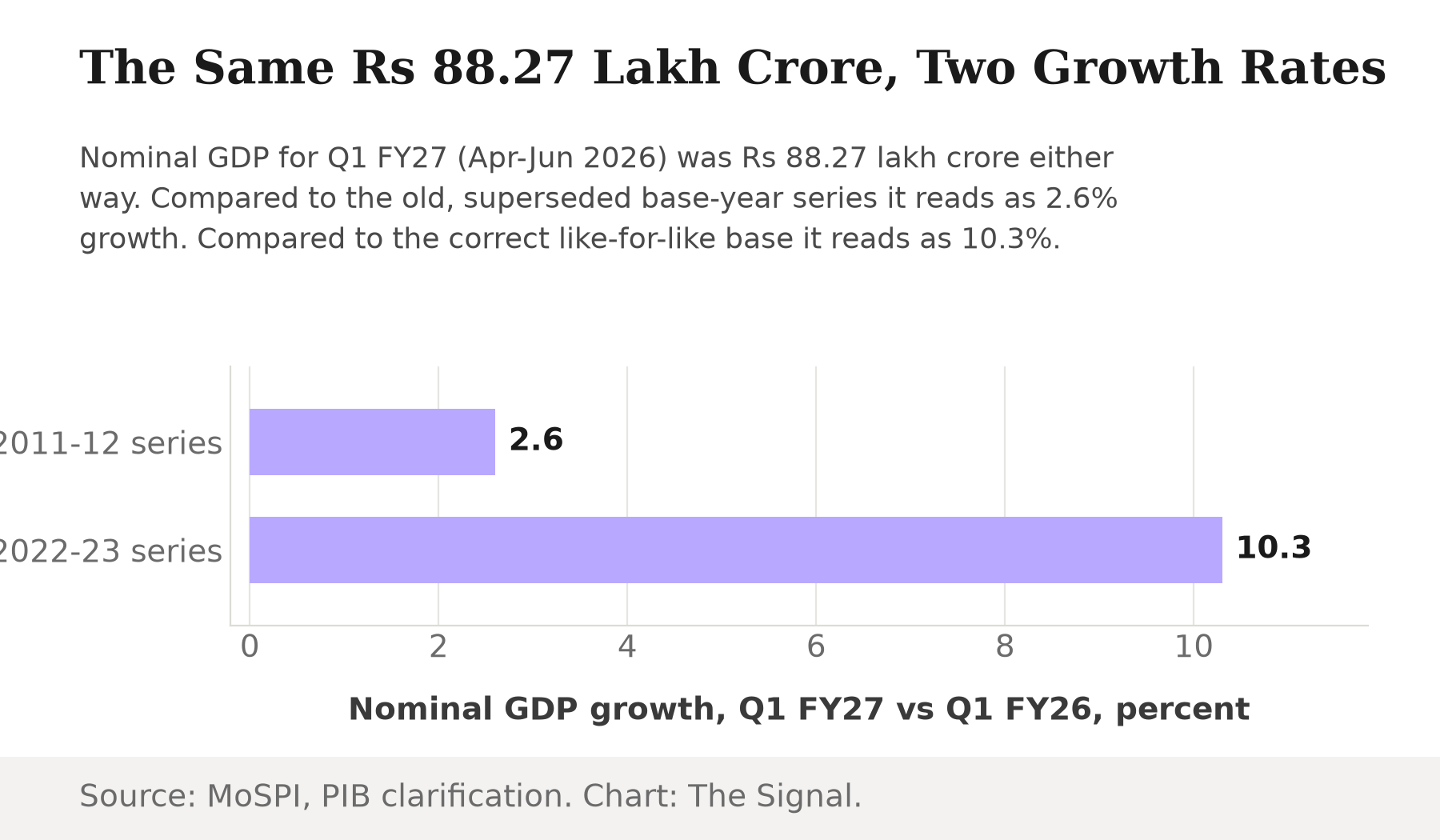
Source: MoSPI's Q1 2026-27 GDP press note; PIB clarification release. Chart: The Signal.
Neither side disputes what India produced in April-June 2026. The fight is entirely about which year's estimate belongs in the denominator, old-series or new-series, and mixing the two produces a growth rate that is not wrong so much as meaningless: an apples-to-oranges comparison dressed up as arithmetic.
This is not just MoSPI defending its own number. SBI Research's Ecowrap note called the 2.6% calculation "completely unsolicited" and "a sure sign of intellectual dishonesty," for the same reason: it compares GDP across two different base-year series. Neelkanth Mishra, an Executive Director at the World Bank, separately called the claim "ill-educated and egregiously wrong". Two independent economists, not just the statistics office being graded on its own homework, landed on the same base-year explanation.
A base built for a different economy
That mismatch exists because MoSPI rebuilt its GDP series mid-year. The base year for GDP estimates was revised from 2011-12 to 2022-23 on 27 February 2026, a change MoSPI says better reflects how India's economy has evolved since the last update. Under the revised series, full-year real GDP growth for FY 2025-26 is estimated at 7.6%, up from 7.1% in FY 2024-25. On the government's own revised numbers, growth was already accelerating before the disputed quarter even arrived.
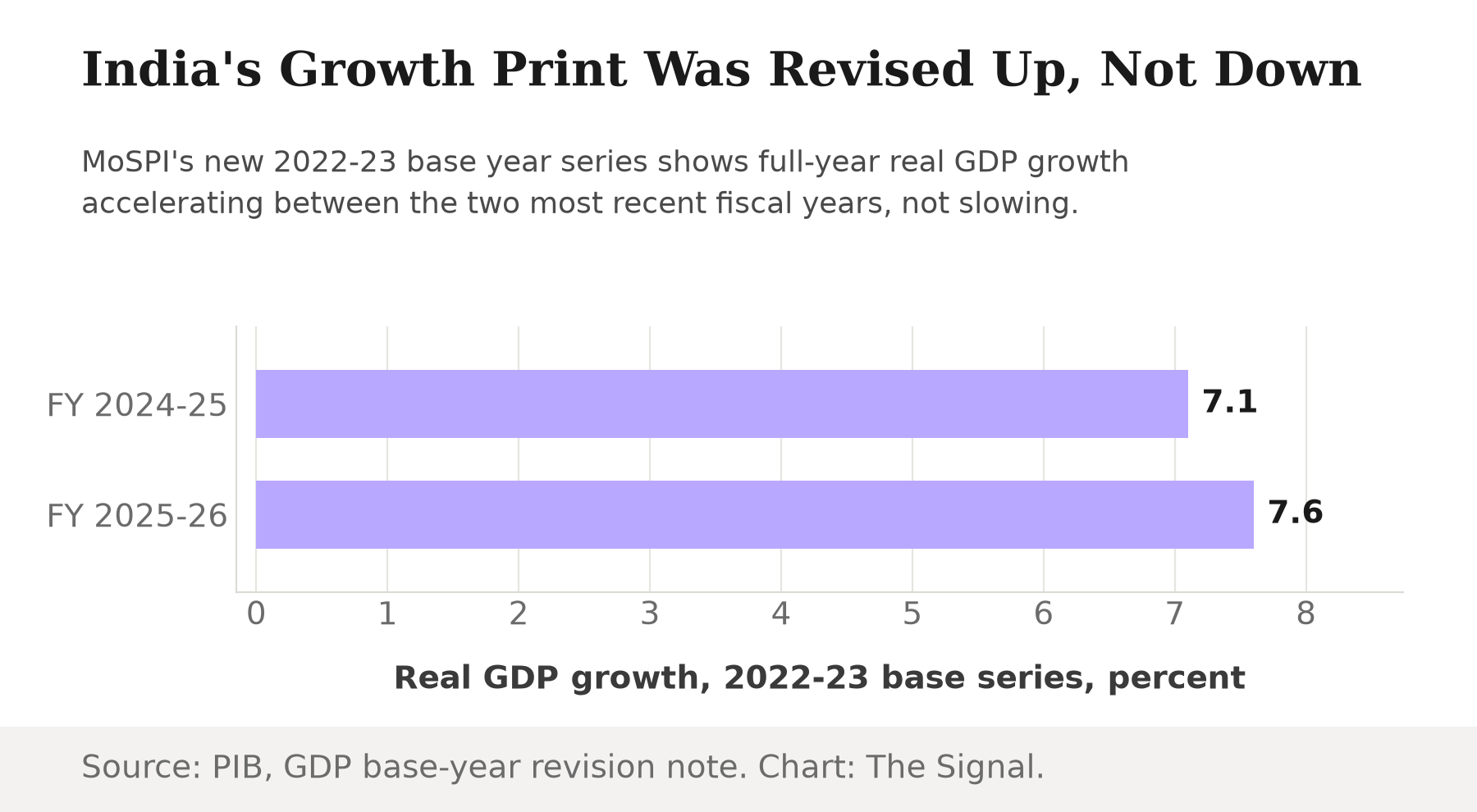
Source: PIB backgrounder on the GDP base-year revision. Chart: The Signal.
A base-year revision is routine statistical housekeeping; every major economy periodically re-weights its GDP basket. MoSPI itself frames the 2026 switch to the 2022-23 base as reflecting India's evolving economic structure, not a break in the data. But it also means that any comparison spanning the changeover date has to specify, explicitly, which series both ends are drawn from. The 2.6% figure does not do that.
The ratios measured against the same base
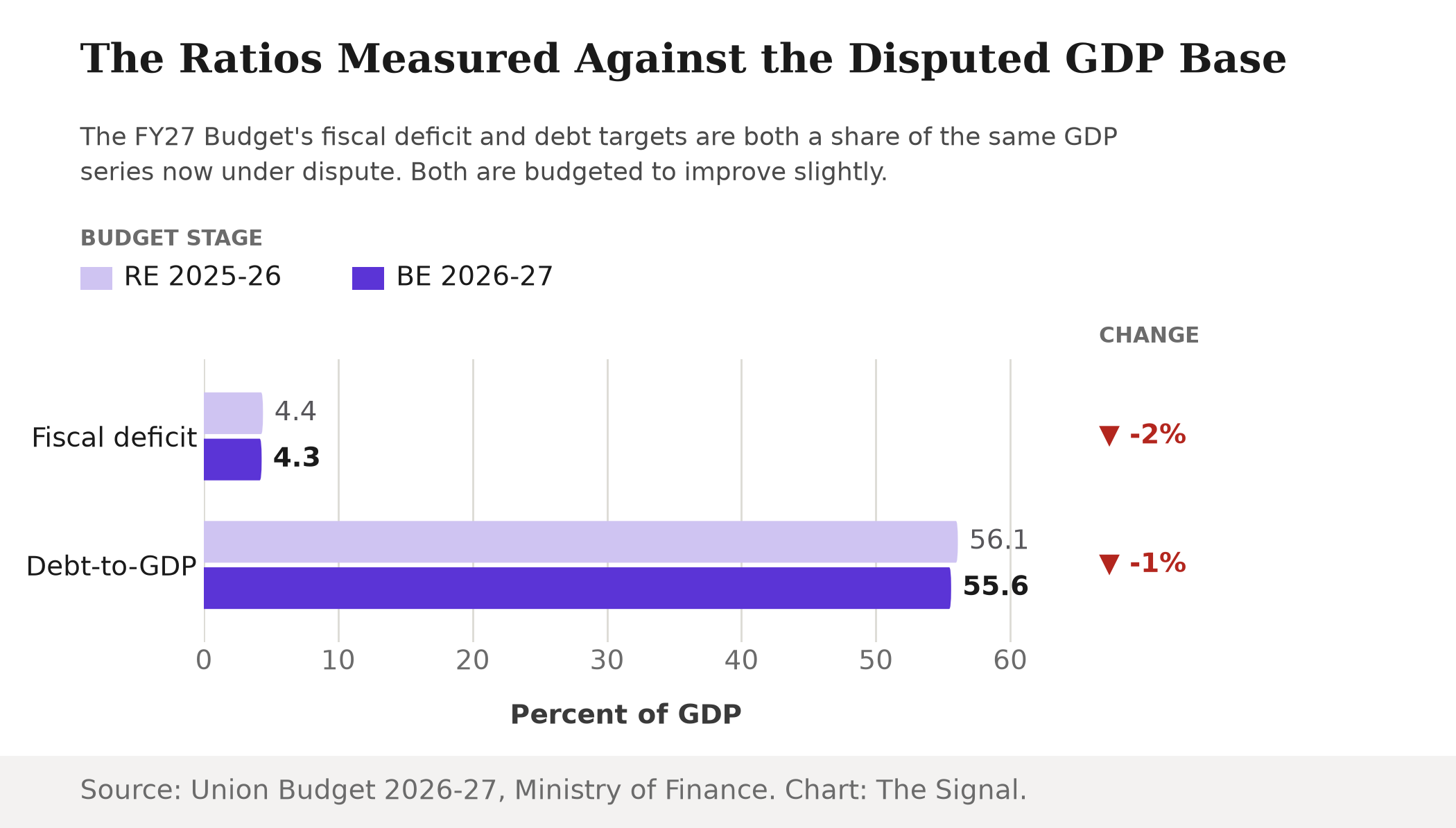
The reason this argument is not just a statistician's quibble is that the same GDP series is the denominator for numbers well beyond the quarterly growth headline. The Union Budget set the fiscal deficit target for FY27 at 4.3% of GDP, down from 4.4% of GDP in the FY26 revised estimate, and the central government's debt-to-GDP ratio is budgeted at 55.6% in FY27, against 56.1% in the FY26 revised estimate, with a target of 50(+/-1)% by 2030. Both figures are shares of the very GDP series now under dispute.
Source: Union Budget 2026-27 highlights, PIB; Union Budget 'Budget at a Glance'. Chart: The Signal.
That is the stakes the growth-rate dispute quietly carries. A fiscal deficit ratio or a debt ratio is only as trustworthy as the GDP figure sitting in its denominator, and both the 4.3% deficit target and the 55.6% debt ratio are Budget-stage figures set against that same series. If a reader comes away from the 2.6%-versus-7.8% fight doubting the new series generally, that doubt spreads past the growth headline and into whether those Budget ratios mean what the government says they mean.
The honest objection
The strongest case for taking the skeptics seriously is not the base-year arithmetic, which MoSPI and independent economists have directly rebutted. The real weight falls on a separate data point: the Reserve Bank of India's own forecasters, using their full toolkit of independent models, are not nearly as bullish as the Q1 print. The RBI's own FY27 growth forecast, raised in its August 2026 policy review, still stood at only 6.7%, well below the actual 7.8% Q1 print, RBI Governor Sanjay Malhotra said, as reported by All India Radio's News on AIR. If the country's own central bank, forecasting after the Q1 data was already public, still expects the full year to land well below the opening quarter's pace, that is a real reason to treat 7.8% as an early, possibly unrepresentative reading rather than the new normal.
That case is real, but it answers a different question than the 2.6% critique does. A full-year forecast running below a strong opening quarter is unremarkable: the RBI's own 6.7% forecast implies growth cooling over the next three quarters, not that the Q1 number itself is wrong. The 2.6% figure, by contrast, claims the Q1 number is arithmetically mistaken, a claim MoSPI's own base-year math directly contradicts. Skepticism about whether 7.8% will hold for the year is reasonable. Recomputing it down to 2.6% by comparing across two different GDP series is not the same kind of skepticism, and conflating the two overstates the case against the print.
The Signal
The 2.6% number will keep circulating regardless of MoSPI's clarification, because a smaller growth number is a more attention-grabbing accusation than a technical note about base-year vintages. But the actual dispute here is narrower and more useful than "is India's growth real": it is about whether commentators comparing GDP figures across India's base-year revision are doing the like-for-like arithmetic MoSPI itself has now published. Watch two things from here. First, whether the RBI's more cautious 6.7% full-year forecast proves right as Q2 and Q3 data arrive, which would be the honest test of whether 7.8% was representative or a peak. Second, whether the 55.6% debt ratio and 4.3% deficit target hold up as the year's GDP numbers come in, since both were budgeted against the same series now being fought over in public. A growth rate is a headline. A debt ratio computed against the wrong one is a balance sheet.
Reporting basis: the Q1 FY27 GDP print, including the 7.8% real growth and 10.3% nominal growth figures, is from MoSPI's National Statistics Office press note. The mechanics of the 2.6% comparison and MoSPI's rebuttal are from a PIB clarification release. The original Q1 FY26 estimate under the old 2011-12 series is from MoSPI's press note of 29 August 2025, via Press Information Bureau. The base-year revision details and the FY 2024-25 and FY 2025-26 full-year growth figures are from a PIB backgrounder on the revision. The fiscal deficit target is from Union Budget 2026-27 highlights released by PIB, and the debt-to-GDP figures are from the Union Budget's "Budget at a Glance" document, both Ministry of Finance publications. The RBI's 6.7% FY27 growth forecast is as reported by All India Radio's News on AIR, quoting RBI Governor Sanjay Malhotra. Subhash Chandra Garg's critique is as reported by Newslaundry; the SBI Research and World Bank rebuttals are as reported by Business Today. All figures in this piece are as officially reported by these sources; none are The Signal's calculations.